

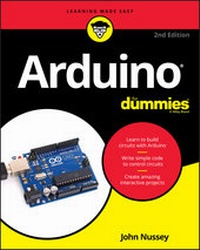
Arduino For Dummies
Beschreibung

Arduino is an affordable and readily available hardware development platform based around an open source, programmable circuit board. You can combine this programmable chip with a variety of sensors and actuators to sense your environment around you and control lights, motors, and sound. This flexible and easy-to-use combination of hardware and software can be used to create interactive robots, product prototypes and electronic artwork, whether you're an artist, designer or tinkerer.
Arduino For Dummies is a great place to start if you want to find out about Arduino and make the most of its incredible capabilities. It helps you become familiar with Arduino and what it involves, and offers inspiration for completing new and exciting projects.
* Covers the latest software and hardware currently on the market
* Includes updated examples and circuit board diagrams in addition to new resource chapters
* Offers simple examples to teach fundamentals needed to move onto more advanced topics
* Helps you grasp what's possible with this fantastic little board
Whether you're a teacher, student, programmer, hobbyist, hacker, engineer, designer, or scientist, get ready to learn the latest this new technology has to offer!
Weitere Details
Weitere Ausgaben
Andere Ausgaben
Inhalt
Introduction 1
Part 1: Getting to Know Arduino 5
Chapter 1: Discovering Arduino 7
Chapter 2: Finding Your Board and Your Way Around It 17
Chapter 3: Blinking an LED 37
Part 2: Getting Physical with Arduino 55
Chapter 4: Tools of the Trade 57
Chapter 5: A Primer on Electricity and Circuitry 69
Chapter 6: Basic Sketches: Inputs, Outputs, and Communication 85
Chapter 7: More Basic Sketches: Motion and Sound 119
Part 3: Building on the Basics 159
Chapter 8: Learning by Example 161
Chapter 9: Soldering On 177
Chapter 10: Getting Clever with Code 205
Chapter 11: Common Sense with Common Sensors 237
Chapter 12: Becoming a Specialist with Shields and Libraries 285
Part 4: Sussing Out Software 303
Chapter 13: Getting to Know Processing 305
Chapter 14: Processing the Physical World 323
Part 5: The Part of Tens 357
Chapter 15: Ten Places to Learn More about Arduino 359
Chapter 16: Ten Great Shops to Know 363
Index 367
Chapter 1
Discovering Arduino
IN THIS CHAPTER
Discovering what Arduino is
Learning where Arduino came from
Introducing the basic principles
Arduino is made up of both hardware and software.
The Arduino board is a printed circuit board (PCB) designed to use a microcontroller chip as well as other input and outputs. The board has many other electronic components that are needed for the microcontroller to function or to extend its capabilities.
A microcontroller is a small computer contained in a single, integrated circuit or computer chip. Microcontrollers are an excellent way to program and control electronics. Microcontroller boards have a microcontroller chip and other useful connectors and components that allow a user to attach inputs and outputs. Some examples of devices with microcontroller boards are the Wiring board, the PIC, and the Basic Stamp.
You write code in the Arduino software to tell the microcontroller what to to-do. For example, by writing a line of code, you can tell an light-emitting diode (LED) to blink on and off. If you connect a pushbutton and add another line of code, you can tell the LED to turn on only when the button is pressed. Next, you may want to tell the LED to blink only when the pushbutton is held down. In this way, you can quickly build a behavior for a system that would be difficult to achieve without a microcontroller.
Similar to a conventional computer, an Arduino can perform a multitude of functions, but it's not much use on its own. It requires inputs or outputs to make it useful. These inputs and outputs allow a computer - and an Arduino - to sense objects in the world and to affect the world.
Before you move forward, it might help you to understand a bit of the history of Arduino.
Where Did Arduino Come From?
Arduino started its life in Italy, at Interaction Design Institute Ivrea (IDII), a graduate school for interaction design that focuses on how people interact with digital products, systems, and environments and how they in turn influence us.
The term interaction design was coined by Bill Verplank and Bill Moggridge in the mid-1980s. The sketch in Figure 1-1 by Verplank illustrates the basic premise of interaction design: If you do something, you feel a change, and from that you can know something about the world.
Courtesy of Bill Verplank
FIGURE 1-1: The principle of interaction design, illustrated by Bill Verplank.
Although interaction design is a general principle, it more commonly refers specifically to how we interact with conventional computers by using peripherals (such as mice, keyboards, and touchscreens) to navigate a digital environment that is graphically displayed on a screen.
Another avenue, referred to as physical computing, is about extending the range of these computer programs, software, or systems through electronics. By using electronics, computers can sense more about the world and have a physical effect on the world themselves.
Both areas - interaction design and physical computing - require prototypes to fully understand and explore the interactions, which presented a hurdle for non-technical design students.
In 2001, a project called Processing, started by Casey Reas and Benjamin Fry, aimed to get non-programmers into programming by making it quick and easy to produce onscreen visualizations and graphics. The project gave the user a digital sketchbook on which to try ideas and experiment with a small investment of time. This project in turn inspired a similar project for experimenting in the physical world.
In 2003, building on the same principles as Processing, Hernando Barragán started developing a microcontroller board called Wiring. This board was the predecessor to Arduino.
In common with the Processing project, the Wiring project also aimed to involve artists, designers, and other non-technical people. However, Wiring was designed to get people into electronics as well as programming. The Wiring board (shown in Figure 1-2) was less expensive than some other microcontrollers, such as the PIC and the Basic Stamp, but it was still a sizable investment for students.
FIGURE 1-2: An early Wiring board.
In 2005, the Arduino project began in response to the need for affordable and easy-to-use devices for interaction design students to use in their projects. It is said that Massimo Banzi and David Cuartielles named the project after Arduin of Ivrea, an Italian king, but I've heard from reliable sources that it also happens to be the name of the local pub near the university, which may have been of more significance to the project.
The Arduino project drew from many of the experiences of both Wiring and Processing. For example, an obvious influence from Processing is the graphic user interface (GUI) in the Arduino software. This GUI was initially "borrowed" from Processing, and even though it still looks similar, it has since been refined to be more specific to Arduino. I cover the Arduino interface in more depth in Chapter 3.
Arduino also kept the naming convention from Processing, calling its programs sketches. In the same way that Processing gives people a digital sketchbook to create and test programs quickly, Arduino gives people a way to sketch their hardware ideas as well. Throughout this book, I show many sketches that allow your Arduino to perform a huge variety of tasks. By using and editing the example sketches in this book, you can quickly build up your understanding of how they work. You'll be writing your own in no time. Each sketch is followed with a line-by-line explanation of how it works to ensure that no stone is left unturned.
The Arduino board, shown in Figure 1-3, was made to be more robust and forgiving than Wiring and other earlier microcontrollers. It was not uncommon for students, especially those from a design or arts background, to break their microcontroller within minutes of using it, simply by getting the wires the wrong way around. This fragility was a huge problem, not only financially but also for the success of the boards outside technical circles. You can also change the microcontroller chip on an Arduino; if the chip becomes damaged, you can replace just it rather than the entire board.
FIGURE 1-3: The original Arduino Serial board.
Another important difference between Arduino and other microcontroller boards is the cost. Back in 2006, another popular microcontroller, the Basic Stamp, cost nearly four times as much ($119) as an Arduino ($32). Today, an Arduino Uno costs just $22.
In one of my first Arduino workshops, I was told that the price was intended to be affordable for students. The price of a nice meal and a glass of wine at that time was about $42, so if you had a project deadline, you could choose to skip a nice meal that week and make your project instead.
The range of Arduino boards on the market is a lot bigger than it was back in 2006. In Chapter 2, you learn about just a few of the most useful Arduino and Arduino-compatible boards and how they differ to provide you with a variety of solutions for your own projects. Also, in Chapter 12, you learn all about a special type of circuit board called a shield, which can add useful, and in some cases phenomenal, features to your Arduino, turning it into a GPS (Global Positioning System) receiver, a mobile phone, or even a Geiger counter, to name just a few.
Learning by Doing
People have used technology in many ways to achieve their own goals without needing to delve into the details of electronics. Following are just a few related schools of thought that have allowed people to play with electronics.
Patching
Patching is a technique for experimenting with systems using wires. The earliest popular example of patching is in phone switchboards. For an operator to put you through to another line, he or she had to physically attach a cable.
This technique was also popular for synthesizing music, such as with the Moog synthesizer. When an electronic instrument generates a sound, it's really generating a voltage. Different collections of components in the instrument manipulate that voltage before it is outputted as an audible sound. The Moog synthesizer works by changing the path that that voltage takes, sending it through a number of different components to apply different effects.
Because so many combinations are possible, the musician proceeds largely through trial and error. But the simple interface means that this process is extremely quick and requires little preparation to get going.
Hacking
Hacking is a term that typically refers to the subversive use of technology. More generally, though, it refers to exploring systems and making full use of them or repurposing them to suit your needs.
Hacking in this sense is possible in hardware as well as software. A great example of hardware hacking is a keyboard hack. Say that you want to use a big red button to move through a slideshow. Most software programs contain keyboard shortcuts, and most PDF viewers move to the next page in a slideshow when the user presses the spacebar. If you know this, you ideally want a keyboard with only a spacebar.
Today's keyboards have a small circuit board, a bit smaller than a credit card (see Figure...
