

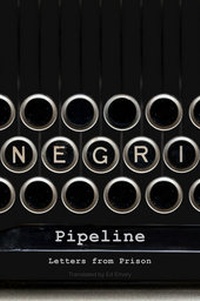
Pipeline
Beschreibung

Published here for the first time, these letters offer a unique and invaluable insight into the factors that shaped the thinking of one of the most influential political theorists of our time and they document Negri's role in the development of political movements like Autonomia. They are a vivid testimony to one man's journey through the political upheavals and intellectual traditions of the late 20th century, in the course of which he produced a body of work that has had, and continues to have, a profound impact on radical thought and politics around the world.
Weitere Details
Weitere Ausgaben


Personen
Translated by Ed Emery
Inhalt
Letter Two: Working-class movement
Letter Three: Souzy
Letter Four: Admiratio
Letter Five: Jürgen
Letter Six: Torino
Letter Seven: July '
Letter Eight: Piazza Statuto
Letter Nine: Autonomy
Letter Ten: New Year '
Letter Eleven: Golem '
Letter Twelve: Civil Warre
Letter Thirteen: Separation
Letter Fourteen: A jump for joy
Letter Fifteen: Carnival
Letter Sixteen: Deadline '
Letter Seventeen: Manhattan
Letter Eighteen: Moro
Letter Nineteen: Ferocious Alphabets
Letter Twenty: Renaissance
Letter One
The Dry Veneto
Rebibbia, 10 October 1981
Cher David,
So you have been in Padua. At last you have seen it - that city, which is a fount of every kind of extremist conspiracy and intrigue. Yet for me it has always seemed worthier of the pen of a Stendhal than of a Dostoevsky. Never mind . . . not only the cities, but above all the ways of the world have changed. So much so that dyspeptic small-time public prosecutors can go round inventing chilling tales to hit the headlines. For some reason it fell to me to be the pivotal point in this game, which was being played (and still is) around falsehood and provocation, because the truth was immediately clear and immediately recognised as unacceptable to the raison d'état. The story here is a heavy story and it's already brought me a great many years of prison; besides, at this point I do not want to pull out of the game. So I understand your question, my young friend: tell me your name. A name that has been sullied by the brutality of the political courts and by the violence of the media. Tell me your name, claim what you are. Sure, David, I want to try. Because I like you. But also because this story has not been painless and, in living it - whether with irony or in despair - I've had more than one moment of doubt. Maybe, in explaining things to you, I'll manage to deal with a few uncertainties about my identity. But where shall I begin? Should I call on memory for assistance? I fear memory. Too often it is empty vanity and replaces the real instead of getting immersed in it. It is ideology; it is self-complacency; and, in this prison I inhabit, it is also the torment of a past that is fixed, downcast, turned against life; it is the act of blackmail of solitude against collective desire. There must be something truer, which enabled me both to become a man and to offer you now this bodily thing that I am, declaring myself a collective being, beyond the sour taste of individuality. In the old days I used to attend Jean Bollack's lectures: animus - not anima - is what Lucretius called that nucleus of very thin material in quo consilium vitae regimenque locatum est.1 Here we are: neither the pure, vital sensibility nor the memory of its illusions - rather it is the animus that should speak, against and beyond the triviality of memory. As for our names, we find them assigned to us - they come out slowly from a kind of great indifference in which we recognise ourselves to be immersed. Imagination, then and now, breaks this indifference - and it is a hard nucleus of rationality and passion. It constitutes us as what we are: signs of a relationship between past, future, and the many senses of time; and signs of a collective relationship. I find my name only in relation to a history that has been co-lived with me and in which my being has been formed. A good hermeneutics points to what is most internal with the help of what is most external. So it will be this cupiditas that will allow me to tell the story and to set in motion the machine of liberation.
You, David, like many comrades born in this last decade of struggles (and out of its passionate and ruthless critique), are nevertheless deeply puzzled about the ontological compactness to which I refer, and you wonder whether taking it as a starting assumption does not flatten history. That may even be so; for the moment I cannot offer much to counter this puzzlement. I entrust the thesis to history. The canvas is materialist: life is a sacrament, a blend of divinity and reality, and, on this surface, love and violence form social essences and collective identities. A real flow. Pipeline. It is in here that we carve ourselves out. Imagination shows us childhood as a transcendental structure without a subject; the untidiness of memory and the misery of individuality are tempered against this background. We generously seek ourselves within this controverted reality into which we are immersed; it is an astute generosity, à la Lévi-Strauss, that sets us on the hunt, and the ego is the savage. I do not know how to explain this better; it is in the fact of recognising ourselves in a community that we grasp ourselves. It's a tough act. Did you not learn this in your native Brittany?
The people's Veneto, where I grew up, is not a soft land - everything was dry. Dry, the frost that clung to the workers' jackets in the morning, when long queues of bicycles - a huge procession of ants whitened by frost - arrived to assist in the dispersed and primitive accumulation of capital. Dry from the dust that collected on plane trees in the countryside, in the summer heat. That dust was full of pollen in both spring and autumn; it, too, was dry, and always gave me asthma. Dry, the sweet evening air of May - when, after the evening service, we caught fireflies and put them in glasses. Dry, the magnolia leaves - almost wooden by autumn; and when you walked on them they broke with a crack. Recently certain intellectuals have accredited an image of this strong landscape as moist and flaccid. They are bad witnesses. My mother tongue and that of the people were similarly dry and hard. You found Ruzante2 in the priest's Sunday sermon, and his sing-song dialect did not diminish the power of the words. My Veneto, the popular and peasant Veneto that I knew in the 1940s and 1950s, had not seen the eighteenth-century bourgeois corruption of morals. It was not Venice, it was the mainland. No religious mysticism. The church was everything in this region, which had no metropolis and had not yet experienced the dispersals of the individual and the exaggerated violence of industrial concentration. The church was a mass organisation. Articulated, loving, omnipresent and powerful. A medieval knight. My relationship with it was physical - a relationship in which the exercise of Christian virtues was dry and natural. I didn't know what torbid meant - neither the melancholy of Rilke's Malte Laurids Brigge nor the emotional upheavals of Musil's young Törless; in the Veneto of my adolescence there was more of Bavaria than of Mitteleuropa. So that's where I grew up - and there, at about the age of eighteen, I learned the magic words that were to enable me to articulate the indistinctness into which I was immersed and to swim freely in that dry sea.
The first magic word that I learned at that time was 'witnessing'. The Catholic movement in the late 1940s and early 1950s was experiencing its first crisis of orientation. Only later did I realise the seriousness of this crisis. My friends and I felt its effects: it was, against the pure and simple political restoration that had happened in Rome, an appeal to the notions of militancy and Christian witnessing in the world. I lived this appeal to witnessing not at the political level but at a human and religious level - this was the concluding phase of my adolescence. Rather than being grounded in history, my experience was psychologically and ethically defined. I lived an enveloping and indistinct horizon and that was where I built the beginnings of my desire to know - witnessing was, first and foremost, an act of vitality effected from within the conditions that you experienced, a break, a choice between what oppresses you and what liberates you. (Do you recall, cher David, the Saxon witnessing of Hans Jürgen Krahl? When I read it in the middle of the events of 1968 I recognised in that confession the genesis of my own desire for a breaking.) A witnessing - but of what? The community, its needs, its reality, the tension that we recognised in it, between poverty and the desire for happiness. Of course, it was a vicious circle ('there is again a generation that wants to be at the crossroads' - so says Benjamin in the Metaphysics of Youth - 'but the crossroads is nowhere to be found').3 And yet it was not a vicious circle when the circle was infused with charity - with a stripping bare of oneself in the love of others, which broke indifference and produced the first projects of solidarity. We filled this word with content and with hope, as an alternative to another word, which was also magic but in some ways frightening: 'the priesthood'. It was nevertheless an alternative that we understood well - as a single act of free choice - since it was left to us to take one option or the other, in a world where the abundance of ecclesiastical vocations was accompanied by the urgent need for civil agents of clerical politics. But there was a contradiction - namely this: we were not interested in politics, or at least not in the Christian democrat politics that we saw before us - and we knew no other kind; and yet we wanted to make a stand in the world through radical choices of poverty and of charity. It was clear to us that these choices would not be possible for us as priests, in the world where we lived. In those years, five or six of my friends chose the priesthood, despite everything; but they are all far away now, very far away, as missionaries. We did not understand that the choice of poverty was also an immediately anticapitalist one - only in a distant future could that be argued, not here among us. Here we lived secularism like saints, leaving politics to the priests. What a crazy mix-up. In fact, the decision to opt for poverty...
