

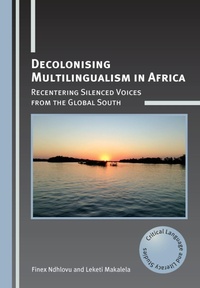
Decolonising Multilingualism in Africa
Recentering Silenced Voices from the Global South
Erschienen am 16. Juli 2021
208 Seiten
978-1-78892-337-8 (ISBN)
Beschreibung
This book interrogates and problematises African multilingualism as it is currently understood in language education and research. It challenges the enduring colonial matrices of power hidden within mainstream conceptions of multilingualism that have been propagated in the Global North and then exported to the Global South under the aegis of colonial modernity and pretensions of universal epistemic relevance. The book contributes new points of method, theory and interpretation that will advance scholarly conversations on decolonial epistemology by introducing the notion of coloniality of language - a summary term that describes the ways in which notions of language and multilingualism in post-colonial societies remain colonial. The authors begin the process of mapping out what a socially realistic notion of multilingualism would look like if we took into account the voices of marginalised and ignored African communities of practice - both on the African continent and in the diasporas.
Rezensionen / Stimmen
This book contributes to the growing interest in southern decolonial linguistics. It reanimates important earlier discussions of the plurality of southern multilingualisms and the linguistic citizenship of individuals and communities with narratives that encourage rethinking the coloniality of language. In reminding us of the many forgotten 20th century contributors to southern decolonial scholarship, the authors accentuate the persistent circulation of colonial hegemonies. * Kathleen Heugh, University of South Australia * Centering the African experience, two world-renowned African sociolinguists push back on the language coloniality that continues to permeate the study of multilingualism, multilingual education, language policy, and language education research in the Global South. Inverting the power relationship between the Global South and the North, Ndhlovu and Makalela decolonize understandings of multilingualism everywhere. * Ofelia Garcia, The Graduate Center, City University of New York, USA * I find Decolonising Multilingualism in Africa to be cohesive, resourceful and well written. It is a welcome addition to the literature on sociolinguistics in Africa and the Global South in general - and I consider it to be required reading for graduate seminars in colonial and post-colonial language ideologies and practices. -- Nkonko Kamwangamalu, Howard University, USA * Journal of Multilingual and Multicultural Development, 2022 * [This book] advances the field of multilingualism studies both in Africa and globally. Indeed its international relevance is enhanced by the approach of presenting fine-grained research conducted in Africa as illustrations ofdecoloniality within language theorising. Future multilingualism research will certainly benefit from both the critiques of the coloniality of language and the propositions of decolonial linguistic concepts contained within the pages of this book. -- Robyn Tyler, University of the Western Cape, South Africa * Multilingual Margins 2021, 8(1) *
Weitere Details
Reihe
Sprache
Englisch
Verlagsort
Bristol
Großbritannien
Zielgruppe
Für höhere Schule und Studium
Produkt-Hinweis
Reflowable
ISBN-13
978-1-78892-337-8 (9781788923378)
Copyright in bibliographic data and cover images is held by Nielsen Book Services Limited or by the publishers or by their respective licensors: all rights reserved.
Schweitzer Klassifikation
Weitere Ausgaben
Personen
Finex Ndhlovu is Associate Professor of Language in Society at the University of New England, Australia. He is the author of Language, Vernacular Discourse and Nationalisms: Uncovering the Myths of Transnational Worlds (2018, Palgrave Macmillan).
Leketi Makalela works in the Wits School of Education, University of the Witwatersrand, South Africa. His research interests include translanguaging, African multilingualism and African languages and literacies.
Leketi Makalela works in the Wits School of Education, University of the Witwatersrand, South Africa. His research interests include translanguaging, African multilingualism and African languages and literacies.
Inhalt
Preface
Chapter 1. Myths We Live By: Multilingualism, Colonial Inventions
Chapter 2. Unsettling Colonial Roots of Multilingualism
Chapter 3. Unsettling Multilingualism in Language and Literacy Education
Chapter 4. Decolonising Multilingualism in Higher Education
Chapter 5. Decolonising Multilingualism in National Language Policies
Chapter 6. African Vehicular Cross Border Languages, Multilingualism Discourse
Chapter 7. African Multilingualism, Immigrants, Diasporas
Chapter 8. Multilingualism from Below: Languaging with a Seven Year Old
Chapter 9. Recentering Silenced Lingualisms and Voices
Chapter 1. Myths We Live By: Multilingualism, Colonial Inventions
Chapter 2. Unsettling Colonial Roots of Multilingualism
Chapter 3. Unsettling Multilingualism in Language and Literacy Education
Chapter 4. Decolonising Multilingualism in Higher Education
Chapter 5. Decolonising Multilingualism in National Language Policies
Chapter 6. African Vehicular Cross Border Languages, Multilingualism Discourse
Chapter 7. African Multilingualism, Immigrants, Diasporas
Chapter 8. Multilingualism from Below: Languaging with a Seven Year Old
Chapter 9. Recentering Silenced Lingualisms and Voices
