

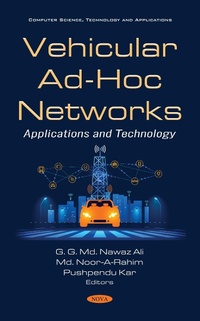
Vehicular Ad-Hoc Networks: Applications and Technology
Erschienen am 17. Juli 2020
276 Seiten
978-1-5361-8039-8 (ISBN)
Beschreibung
From the past decade vehicular ad hoc networks got tremendous attention from the industry, academia and research community. According to US National Highway Traffic Safety Administration (NHTSA), there are more than 30 thousands fatalities caused by the vehicle accidents in the U.S. each year, which worth around 250 billion dollars economic cost annually. Research shows that 82% of these accidents can be reduced by the successful deployment of vehicular networks, because nearly 75% percent of vehicular crashes are caused by inattentive drivers. Literally, vehicular ad hoc networks means a network forms by the vehicles. But it has been evolved to network with the infrastructure as well due to the inherent intermittent nature of vehicle-to-vehicle (V2V) connection. The high mobility of vehicles, wireless communication loss and range constraints are the main reason for this intermittent V2V connection. So, now vehicular networks means communication between vehicle-to-vehicle (V2V) and vehicle-to-infrastructure (V2I). There are billions of dollars invested to research, deployment and testing of vehicular networks. For the emerging connected and autonomous vehicle (CAV), a stable vehicular networks is the foremost requirement. It is now very much visible that CAV will be the future of Intelligent Transportation System (ITS). The book is dedicated to discuss for the techniques, applications and relevant technologies of vehicular ad hoc networks and its challenges. The first chapter discuss about the routing protocols of vehicular networks. It focuses on different position-based routing protocols and their mechanisms for the successful use of vehicular networks for different applications. The second chapter discusses on the security and privacy issues on vehicular networks. A well-known security technique called Elliptic Curve Cryptography (ECC) is discussed to secure vehicular data from various tampering attacks. The third chapter discusses on the on-demand wireless broadcasting mechanism for improving data dissemination performance in terms of data delivery ratio and response time. A network-coding based approach has been investigated for improving the overall performance of existing classical data broadcast algorithms. The fourth chapter describes how to get a dependable system in the lossy communication medium. This chapter discusses on a number of fault diagnosis techniques, their strengths and weaknesses, and it reviews their implementations in mobile wireless networks. The fifth chapter discusses the basics of Blockchain technology, applications, research challenges and opportunities in the field. Finally, chapter six discuss about the identification and mitigation of the faulty nodes in the wireless network.
Weitere Details
Weitere Ausgaben
Inhalt
- Intro
- Contents
- Preface
- Chapter 1
- Role of Position-Based Routing Protocols for Different Applications of VANET
- Abstract
- 1. Introduction
- 2. Communication Model for Vanet
- 3. Routing Protocol for Vanet
- 3.1. Topology Based Routing Protocol
- 3.1.1. Proactive Routing Protocols
- 3.1.2. Reactive Routing Protocols
- 3.1.3. Hybrid Routing Protocols
- 3.2. Position-Based Routing Protocols
- 3.3. Cluster-Based Routing Protocols
- 3.4. Geo Cast Based Routing Protocols
- 3.5. Broadcast Based Routing Protocols
- 4. Position-Based VANET Routing Protocol
- 4.1. Non-Delay Tolerant Network
- 4.1.1. Beacon Based Position-Based Routing Protocol
- 4.1.1.1. Greedy Perimeter Stateless Routing (GPSR)
- 4.1.1.2. Geographic Source Routing (GSR)
- 4.1.1.3. Anchor Based Street and Traffic-Aware Routing (A-STAR)
- 4.1.1.4. Greedy Perimeter Coordinator Routing (GPCR)
- 4.1.1.5. Connectivity Aware Routing protocol (CAR)
- 4.1.2. Non-Beacon Based Position-Based Routing Protocol
- 4.1.2.1. Contention Based Forwarding (CBF)
- 4.1.3. Hybrid Routing Protocol
- 4.1.3.1. Topology Assist Geo Opportunistic Routing (TO-GO)
- 4.2. Delay Tolerant Network
- 4.2.1. Vehicle Assisted Data Delivery (VADD)
- 4.2.2. Reactive Pseudo-Suboptimal-Path Selection Routing (RPS)
- 4.3. Hybrid Network
- 4.3.1. GeoDTN + NAV
- 4.3.2. Connectivity Aware Minimum Delay Geographic Routing Protocol (CMGR)
- Conclusion and Future Scope
- References
- Chapter 2
- Elliptic Curve Cryptography in Intelligent Transport Systems
- Abstract
- Introduction
- ITS Applications and Security
- Security in ITS
- Elliptic Curve Cryptography
- Elliptic Curve
- Domain Parameters of the Elliptic Curve
- Point Addition and Point Multiplication
- Different Multiplication Techniques
- Proposed Architecture
- Endomorphism
- Efficient Usage of Endomorphism in ECDSA
- Calculations Using Endomorphism
- Point Adder
- Point Multiplier
- LUT Main
- Proposed Architecture for =
- Total Delay
- Architecture for =
- U1-k Module
- Results
- Validation Results
- Computational Time Analysis
- Memory Utilization
- Comparison with Other Implementations
- Discussion
- Conclusion and Future Work
- References
- Chapter 3
- Exploitation of Network Coding in On-Demand Wireless Data Broadcast
- Chapter 4
- Fault Diagnosis Techniques for Mobile Wireless Networks
- Abstract
- Introduction
- Unreliable Wireless Connections
- Dynamic and Arbitrary Network Topology
- Resource Limitations
- Minimum Bandwidth Usage
- Distributed Diagnosis
- Adaptable
- Scalability
- Heterogeneous
- Self-Diagnosis
- Dependability: Attributes, Threats, and Means
- Availability
- Reliability
- Safety
- Integrity
- Maintainability
- Fault Prevention Techniques
- Fault Tolerance Techniques
- Fault Removal Techniques
- Fault Forecasting Techniques
- Fault Diagnosis
- Fault Diagnosis Techniques
- Test-Based Techniques
- Invalidation-Based Models
- Comparison-Based Models
- Watchdog Techniques
- Self-Checking Techniques
- Heartbeat-Based Techniques
- Replication with Voting Techniques
- Model-Based Techniques
- Concluding Remarks
- System-Level Fault Diagnosis
- Faults Classification under System-Level Diagnosis
- System-Level Diagnosis Terminologies and Concepts
- Comparison-Based Fault Diagnosis for Wireless Networks
- Chessa and Santi Diagnostic Model
- Flooding-Based Protocols
- Static-DSDP
- Mobile-DSDP
- Spanning -Tree -Based Protocols
- Dynamic-DSDP
- Adaptive-DSDP
- Hierarchy-DSDP
- Fixed-DSDP
- Vehicle-DSDP
- Flexible-DSDP
- Clustering-Based Protocols
- CBCD
- Hi-DSDP
- NOL-CBDP
- Discussion
- Time-Free Diagnostic Model
- Time-Free-DSDP
- RLNC-DSDP
- Discussion
- Conclusion
- References
- Chapter 5
- Blockchain: Basics, Applications, Challenges and Opportunities
- Abstract
- 1. Introduction
- 2. Blockchain Architecture
- A. Block
- B. Hash of the Block
- C. Time Stamp
- D. Difficulty
- E. Nonce
- F. Block Header
- G. Blockchain Data Structure
- H. Digital Signature
- 3. Consensus Algorithms
- A. Proof of Work (PoW)
- B. Proof of Stake (PoS)
- C. Practical Byzantine Fault Tolerance (PBFT)
- D. Delegated Proof-of-Stake (DPoS)
- E. Proof of Space (PoS)
- F. Proof of Authority
- G. Ripple
- H. Tendermint
- 4. Blockchain Variants
- A. Public Blockchain
- B. Private Blockchain
- 5. Blockchain Versions
- A. Blockchain 1.0
- B. Blockchain 2.0
- C. Blockchain 3.0
- 6. Cryptocurrency
- A. Bitcoin
- B. Bitcoin Cash
- C. Zilliqa
- D. ZCash
- E. USDT
- F. Litecoin
- G. Peercoin
- H. Permacoin
- I. Ethereum
- 7. Blockchain Applications
- A. Internet of Things (IoT)
- B. Blockchain in Big Data
- C. Blockchain in Cloud Computing and Edge Computing
- D. Blockchain in Supply Chain and Logistics
- E. Industry Perspective
- 8. Challenges of Blockchain Technology
- A. Scalability
- B. Security and Privacy Issues
- C. Storage Management
- D. Consensus Performance
- E. Resource Management
- F. Conditions Inflexibility
- G. Lack of Governance, Standards, and Regulations
- Conclusion
- References
- Chapter 6
- Optimal Hole Coverage in the Presence of Dumb Node in Wireless Sensor Networks
- Abstract
- Introduction
- Related Work
- Objective
- Methodology
- Hole Area Calculation
- Finding Sector of a Circle
- Hole Coverage
- State Transition Diagram
- Conclusion
- References
- About the Editors
- Index
- Blank Page
