

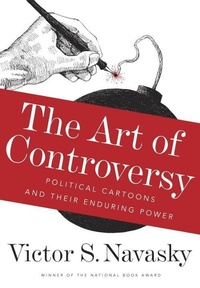
The Art of Controversy
Beschreibung
A lavishly illustrated, witty, and original look at the awesome power of the political cartoon throughout history to enrage, provoke, and amuse. As a former editor of The New York Times Magazine and the longtime editor of The Nation, Victor S. Navasky knows just how transformative-and incendiary-cartoons can be. Here Navasky guides readers through some of the greatest cartoons ever created, including those by George Grosz, David Levine, Herblock, Honoré Daumier, and Ralph Steadman. He recounts how cartoonists and caricaturists have been censored, threatened, incarcerated, and even murdered for their art, and asks what makes this art form, too often dismissed as trivial, so uniquely poised to affect our minds and our hearts. Drawing on his own encounters with would-be censors, interviews with cartoonists, and historical archives from cartoon museums across the globe, Navasky examines the political cartoon as both art and polemic over the centuries. We see afresh images most celebrated for their artistic merit (Picasso's Guernica, Goya's "Duendecitos"), images that provoked outrage (the 2008 Barry Blitt New Yorker cover, which depicted the Obamas as a Muslim and a Black Power militant fist-bumping in the Oval Office), and those that have dictated public discourse (Herblock's defining portraits of McCarthyism, the Nazi periodical Der Stürmer's anti-Semitic caricatures). Navasky ties together these and other superlative genre examples to reveal how political cartoons have been not only capturing the zeitgeist throughout history but shaping it as well-and how the most powerful cartoons retain the ability to shock, gall, and inspire long after their creation. Here Victor S. Navasky brilliantly illuminates the true power of one of our most enduringly vital forms of artistic expression.
Weitere Details
Weitere Ausgaben
Person
Victor S. Navasky is the former editor and publisher of The Nation, and a former editor at The New York Times Magazine, who once founded his own quarterly of political satire, Monocle, "a radical sporadical." He is the author of, among other books, Naming Names, which won a 1982 National Book Award, and A Matter of Opinion, which won the George Polk Book Award. He teaches at the Columbia University Graduate School of Journalism, where he is the director of the Delacorte Center for Magazine Journalism and chair of the Columbia Journalism Review. He lives in New York.
Inhalt
- Intro
- Title Page
- Copyright
- Dedication
- Epigraph
- Contents
- Introduction
- The Cartoon as Content
- The Cartoon as Image
- The Cartoon as Stimulus
- Caricature
- The Gallery
- William Hogarth
- James Gillray
- Francisco Goya
- Charles Philipon
- Honoré Daumier
- Thomas Nast
- Pablo Picasso
- The Masses: Art Young and Robert Minor
- Käthe Kollwitz
- George Grosz
- John Heartfield
- Der Stürmer
- David Low
- Philip Zec
- Victor Weisz (Vicky)
- Bill Mauldin
- Herbert Block (Herblock)
- Al Hirschfeld
- Raymond Jackson (Jak)
- Ralph Steadman
- Robert Edwards
- Naji al-Ali
- Edward Sorel
- Robert Grossman
- Steve Platt and the New Statesman
- The New Yorker Images
- Doug Marlette
- Plantu and the Danish Muhammads
- Qaddafi and the Bulgarians
- Jonathan Shapiro (Zapiro)
- David Levine
- Timeline
- Acknowledgments
- Selected Bibliography
- Index
- Color Illustrations
- Illustration Credits
- A Note About the Author
- Other Books by This Author
