

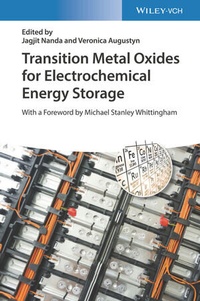
Transition Metal Oxides for Electrochemical Energy Storage
1. Auflage
Erschienen am 23. März 2022
XII, 420 Seiten
978-3-527-81722-1 (ISBN)
Beschreibung

This authoritative handbook focuses on the science and applications of metal oxides for energy storage. It provides in-depth, application-oriented information by covering electrochemistry, morphology and both in situ and in operando characterization.
Weitere Details
Weitere Ausgaben
Andere Ausgaben
Jagjit Nanda | Veronica Augustyn
Transition Metal Oxides for Electrochemical Energy Storage
Buch
04/2022
1. Auflage
Wiley-VCH
182,00 €
Versand in 5-7 Tagen
Personen
Jagjit Nanda is team leader and senior staff scientist at Oak Ridge National Laboratory, USA, working in the area of high capacity energy storage materials, interfaces and energy systems. He also holds a joint faculty appointment as a professor in the Chemical and Bio-Molecular Engineering Department, University of Tennessee, Knoxville and as a Bredesen Center Faculty between ORNL and University of Tennessee. Prior to joining Oak Ridge in 2009, Jagjit Nanda worked as a Technical Expert at the Research and Advanced Engineering Center, Ford Motor Company, MI leading R&D projects in the area of lithium-ion battery materials and nanomaterials for energy applications. He has more than 150 technical and journal publications, 40 invited talks, and a number of patents in the area of energy storage and conversion. Dr. Nanda is also an active member of a number of professional scientific societies.
Veronica Augustyn is Assistant Professor of Materials Science & Engineering at North Carolina State University, USA. From 2013-2015 she was a Postdoctoral Fellow at the Texas Materials Institute at the University of Texas at Austin. She received her PhD in 2013 from the University of California, Los Angeles and her BSc in 2007 at the University of Arizona, both in Materials Science & Engineering. Her research is focused on the development and characterization of materials for electrochemical energy technologies including batteries, electrochemical capacitors, electrolyzers, and fuel cells. In particular, she is interested in the relationships between material structure and morphology and the resulting redox behavior and electrochemical mechanisms. She is the recipient of a 2017 NSF CAREER Award and a 2016 Ralph E. Powe Jr. Faculty Enhancement Award, and is a Scialog Fellow in Advanced Energy Storage from the Research Corporation for Science Advancement.
Veronica Augustyn is Assistant Professor of Materials Science & Engineering at North Carolina State University, USA. From 2013-2015 she was a Postdoctoral Fellow at the Texas Materials Institute at the University of Texas at Austin. She received her PhD in 2013 from the University of California, Los Angeles and her BSc in 2007 at the University of Arizona, both in Materials Science & Engineering. Her research is focused on the development and characterization of materials for electrochemical energy technologies including batteries, electrochemical capacitors, electrolyzers, and fuel cells. In particular, she is interested in the relationships between material structure and morphology and the resulting redox behavior and electrochemical mechanisms. She is the recipient of a 2017 NSF CAREER Award and a 2016 Ralph E. Powe Jr. Faculty Enhancement Award, and is a Scialog Fellow in Advanced Energy Storage from the Research Corporation for Science Advancement.
Inhalt
PART I. INTRODUCTION
Landscape of Transition Metal Oxides for Electrochemical Energy Storage
Solid State Chemistry of Transition Metal Oxides
PART II. ELECTROCHEMICAL ENERGY STORAGE MECHANISMS IN TRANSITION METAL OXIDES
Intercalation
Pseudocapacitance
Conversion
PART III. ELECTROCHEMISTRY OF TRANSITION METAL OXIDES
Oxide/Electrolyte Interface
Intercalation of Li+ in Non-Aqueous Electrolytes
Intercalation of Na+ in Non-Aqueous Electrolytes
Energy Storage in Multivalent Cation Non-Aqueous Electrolytes
Energy Storage in Aqueous Electrolytes
Transition Metal Oxides as Solid State Electrolytes
PART IV. MORPHOLOGY AND INTERFACIAL ENGINEERING OF TRANSITION METAL OXIDES
Interfacial Engineering of Transition Metal Oxides
Oxide Nanoarchitectures
PART V. CHARACTERIZATION OF TRANSITION METAL OXIDES FOR ENERGY STORAGE
Electrochemical Characterization
In situ/operando XRD
In situ/operando Neutron Diffraction
In situ/operando XAS/EXAFS/TXM XANES
In situ/operando NMR
In situ/operando SPM
In situ/operando Raman and Other Visible Light-based Spectroscopy
In situ/operando TEM and SEM
In situ/operando Thermal Methods
First Principles Calculations
Landscape of Transition Metal Oxides for Electrochemical Energy Storage
Solid State Chemistry of Transition Metal Oxides
PART II. ELECTROCHEMICAL ENERGY STORAGE MECHANISMS IN TRANSITION METAL OXIDES
Intercalation
Pseudocapacitance
Conversion
PART III. ELECTROCHEMISTRY OF TRANSITION METAL OXIDES
Oxide/Electrolyte Interface
Intercalation of Li+ in Non-Aqueous Electrolytes
Intercalation of Na+ in Non-Aqueous Electrolytes
Energy Storage in Multivalent Cation Non-Aqueous Electrolytes
Energy Storage in Aqueous Electrolytes
Transition Metal Oxides as Solid State Electrolytes
PART IV. MORPHOLOGY AND INTERFACIAL ENGINEERING OF TRANSITION METAL OXIDES
Interfacial Engineering of Transition Metal Oxides
Oxide Nanoarchitectures
PART V. CHARACTERIZATION OF TRANSITION METAL OXIDES FOR ENERGY STORAGE
Electrochemical Characterization
In situ/operando XRD
In situ/operando Neutron Diffraction
In situ/operando XAS/EXAFS/TXM XANES
In situ/operando NMR
In situ/operando SPM
In situ/operando Raman and Other Visible Light-based Spectroscopy
In situ/operando TEM and SEM
In situ/operando Thermal Methods
First Principles Calculations
