

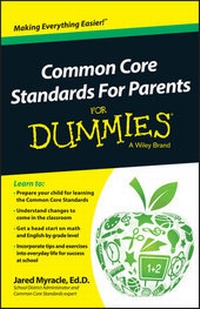
Common Core Standards For Parents For Dummies
Beschreibung

Weitere Details
Weitere Ausgaben
Andere Ausgaben
Person
Inhalt
2 - Introduction [Seite 13]
2.1 - About This Book [Seite 13]
2.2 - Foolish Assumptions [Seite 14]
2.3 - Icons Used in This Book [Seite 15]
2.4 - Where to Go from Here [Seite 15]
2.5 - Beyond the Book [Seite 16]
3 - Part I: Getting Up to Speed on Common Core Standards [Seite 17]
3.1 - Chapter 1: Exploring Common Core's Roots [Seite 19]
3.1.1 - Understanding the Rationale [Seite 20]
3.1.2 - Tracing Common Core's History [Seite 22]
3.1.3 - State Adoptions and Implementation [Seite 26]
3.2 - Chapter 2: Grasping the Basics of the Common Core Standards [Seite 29]
3.2.1 - Brushing Up on Mathematics Practice and Content Standards [Seite 30]
3.2.2 - Exploring the English Language Arts Standards [Seite 38]
3.2.3 - Focusing on Instructional Shifts [Seite 46]
3.3 - Chapter 3: Supporting Common Core at Home: Your Role as a Parent [Seite 49]
3.3.1 - Creating a Setting Conducive to Learning [Seite 50]
3.3.2 - Modeling Lifelong Learning [Seite 52]
3.3.3 - Encouraging and Nurturing a Curious Mind [Seite 53]
3.3.4 - Making Learning Resources Readily Available [Seite 55]
3.3.5 - Making Education Relevant to the Real World [Seite 57]
3.3.6 - Supporting the School's Efforts [Seite 58]
3.4 - Chapter 4: Teaming Up with Teachers [Seite 61]
3.4.1 - Communicating Effectively with Teachers and Administrators [Seite 61]
3.4.2 - Monitoring Your Child's Performance and Progress [Seite 63]
3.4.3 - Helping with Homework [Seite 66]
3.4.4 - Volunteering at School [Seite 67]
4 - Part II: Acquainting Yourself with the Standards [Seite 69]
4.1 - Chapter 5: Doing the Math in Kindergarten through Grade 8 [Seite 71]
4.1.1 - Looking at K-8 Content Standards [Seite 71]
4.1.2 - Meeting Numbers and Shapes in Kindergarten [Seite 72]
4.1.3 - Stepping Up with Numbers, Operations, and Shapes in Grade 1 [Seite 76]
4.1.4 - Laying the Groundwork for Multiplication in Grade 2 [Seite 78]
4.1.5 - Multiplying, Dividing, and Meeting Fractions in Grade 3 [Seite 80]
4.1.6 - Gaining Expertise in Multiplication, Division, and Shapes in Grade 4 [Seite 83]
4.1.7 - Honing Skills in Fractions, Division, and Volume in Grade 5 [Seite 86]
4.1.8 - Exploring Ratios, Rates, Variables, Exponents, and More in Grade 6 [Seite 89]
4.1.9 - Solving Real-World Problems Involving Fractions, Ratios, and More in Grade 7 [Seite 92]
4.1.10 - Gearing Up for Higher Math in Grade 8 [Seite 94]
4.2 - Chapter 6: Graduating to High School Math Standards [Seite 97]
4.2.1 - Revisiting Number and Quantity [Seite 98]
4.2.2 - Discovering the Unknowns with Algebra [Seite 111]
4.2.3 - Putting the "Fun" in Functions [Seite 115]
4.2.4 - Applying Mathematics to the Real World with Modeling [Seite 120]
4.2.5 - Shaping Up with Geometry [Seite 120]
4.2.6 - Crunching Numbers with Statistics and Probability [Seite 128]
4.3 - Chapter 7: Helping Your Child Achieve English Language Arts Standards in K-5 [Seite 133]
4.3.1 - Looking at the Anchor Standards [Seite 134]
4.3.2 - Mastering Foundational Reading Skills [Seite 138]
4.3.3 - Reading and Understanding Literature [Seite 140]
4.3.4 - Reading and Deciphering Informational Texts [Seite 9]
4.3.5 - Writing Clearly and Effectively [Seite 9]
4.3.6 - Speaking and Listening Standards [Seite 9]
4.3.7 - English Language Rules and Conventions [Seite 9]
4.4 - Chapter 8: Raising the Bar: English Language Arts Standards in Grades 6 - 12 [Seite 159]
4.4.1 - Reading More Sophisticated Literature and Informational Texts [Seite 160]
4.4.2 - Honing Your Child's Writing Skills [Seite 164]
4.4.3 - Mastering the Spoken Word: Speaking and Listening [Seite 10]
4.4.4 - Exploring Higher-Level Rules and Conventionsof Language [Seite 10]
4.5 - Chapter 9: Mastering Literacy in History/Social Studies, Science, and Technical Subjects [Seite 10]
4.5.1 - Improving Reading Comprehension in History/Social Studies [Seite 10]
4.5.2 - Deciphering Texts on Scientific and Technical Topics [Seite 10]
4.5.3 - Writing about History/Social Studies, Science, and Technical Subjects [Seite 10]
5 - Part III: Part of Tens [Seite 187]
5.1 - Chapter 10: Ten Tips for Parents [Seite 189]
5.1.1 - What's My Child Currently Working On? [Seite 190]
5.1.2 - How Well Is My Child Meeting Expectations? [Seite 190]
5.1.3 - May I See Samples of My Child's Work? [Seite 190]
5.1.4 - Is My Child Struggling in Any Subject Areas? [Seite 191]
5.1.5 - In Which Subject Areas Does My Child Excel? [Seite 192]
5.1.6 - What Can I Do to Help My Child Achieve the Standards? [Seite 192]
5.1.7 - If My Child Needs Help with Homework, What Resources Are Available? [Seite 192]
5.1.8 - Does the School Offer Any Opportunities for Academic Enrichment? [Seite 193]
5.1.9 - What Can My Child Be Doing to Develop Good Study Habits? [Seite 194]
5.1.10 - Which Classes Should My Child Be Taking [Seite 194]
5.2 - Chapter 11: Ten Ways to Help Your Child Achieve Common Core Standards [Seite 195]
5.2.1 - Know What Your Child Is Working on [Seite 196]
5.2.2 - Monitor Your Child's Performance [Seite 196]
5.2.3 - Have a Daily Homework/Study Routine [Seite 197]
5.2.4 - Provide a Study-Friendly Environment [Seite 198]
5.2.5 - Don't Do Your Child's Homework! [Seite 198]
5.2.6 - Praise Your Child's Efforts [Seite 199]
5.2.7 - Provide Interesting Reading Material [Seite 200]
5.2.8 - Encourage Your Child to Take Advantage of Academic Enrichment Opportunities [Seite 201]
5.2.9 - Take Fun, Educational Trips [Seite 201]
5.2.10 - Encourage Stimulating Hobbies [Seite 202]
6 - Appendix: Resources for the Common Core Standards [Seite 203]
7 - About the Author [Seite 217]
8 - Index [Seite 207]
Chapter 1
Exploring Common Core's Roots
In This Chapter
Grasping the rhyme and reason behind the Common Core Standards
Following the development of the standards
Tracking adoption and implementation
As I write this chapter, 45 states and the District of Columbia are in the process of implementing the Common Core Standards, representing one of the most widespread education reform movements in the history of public education in the United States. As a parent, you probably have lots of questions about these standards, including what they are, why they're important, and what impact they're likely to have on teachers and students. These questions are at the center of a growing discussion about education in the United States. As more states enter the final stages of implementation and more schools send home information about the Common Core Standards, more and more parents have unanswered questions.
In this chapter, I field some of those general questions. I explain the motivation and purpose for developing the Common Core Standards, discuss their history from birth to the present, and discuss how states are progressing in adopting the standards and implementing them in schools. With this background information at hand, you have a much better understanding of what the standards are, why they're being adopted, and where to go from here. This chapter prepares you for a more thorough discussion, in subsequent chapters, of what's in the standards and what you can do, as a parent, to help your child or teen achieve the standards.
Understanding the Rationale
The first question you may have is, “Why do we need new standards to begin with?” Year after year, studies show that a vast majority of students are ill-prepared academically to move on to college or secure employment with businesses that require a highly skilled workforce.
The motivation behind the development of the Common Core Standards is grounded in the idea that higher academic standards in schools, from kindergarten through high school, are likely to produce students who are better prepared to take on the challenges of a post-secondary education or a challenging and rewarding career directly out of high school.
Recognizing the standards
The Common Core Standards set consistent and clear expectations for what students must know at the completion of each grade from kindergarten through high school. The standards establish expectations in three academic areas:
- Mathematics: The Common Core Standards for mathematics focus on gaining essential understanding to help students acquire a deeper knowledge of only the most important concepts and develop the skills to tackle mathematical problems in the real world. The standards call on students to develop deeper knowledge and higher-level skills in each successive grade, so it's vitally important that students get a handle on the material covered in each grade before advancing to a higher grade level.
- English language arts (ELA): The ELA standards are structured to build foundational literacy skills in early grades and to continue to equip students with reading and writing skills as they progress into middle and high school. The standards gradually increase in complexity from grade to grade, so pay special attention to the additional concepts and skills added from one grade to the next.
- Literacy: The literacy standards establish reading and writing expectations for students in social studies, science, and technology. These standards provide few specifics on what students need to read or write, focusing instead on how students should read and write in these courses and how to evaluate what qualifies as good writing.
Recognizing the goals
The Common Core Standards address the shortcomings and build upon the strengths of current state standards. Governors, education officials, and educators who developed the Common Core Standards had several goals in mind, including the following:
- Raise the bar for students in Grades K–12. Higher academic standards represent higher expectations for student learning. Higher rigor and demand in classrooms increase the likelihood that more students will master essential skills and concepts in math, reading, and writing that will prepare them for success when they move to the next grade or course or on to college or a career.
- Clarify expectations for students, teachers, and parents. Inconsistent, complicated standards are difficult for everyone to understand and follow, from school administrators and teachers to parents and students. Common Core Standards are intended to be consistent and clear, so everyone involved in the learning process can collaborate on meeting expectations.
As you find out more about Common Core Standards, you're likely to hear the phrase “fewer, clearer, and higher” used to describe the first two goals on this list.
- Standardize benchmarks for academic achievement across all 50 states. Major discrepancies in the expectations of student performance from state to state make it difficult to determine which states are doing the best job of preparing students for college or career. Having the same benchmarks for students across state lines helps ensure that students from different states are being held to similar standards of academic achievement.
- Ensure that all students are prepared for college or career. One of the fundamental goals of all schools is preparing students to pursue their goals after they graduate from high school, whether they enter college or the workforce. This isn't something that just happens in Grade 12 or even in high school. College and career readiness is the outcome of an effective education in kindergarten through Grade 12. This is why higher, more-consistent standards are important at all grade levels.
- Communicate real-world expectations. Connecting what students are asked to do in school to the demands of the real world is a difficult job, but it's vital to making sure that students understand what's required of them when they go to college or get a job. The skills and concepts taught in schools need to be the same skills and concepts students use in higher learning or the job market.
Without high academic standards that outline the knowledge and skills students need in math, English, and reading and writing in other subjects, few students are ready to tackle college or a career after they graduate from high school.
Higher standards or not?
Critics of the Common Core Standards believe that the standards are less rigorous than the current standards in some states and also fail to meet the benchmarks set by some international education systems. However, a study conducted by the Thomas B. Fordham Institute in 2010, “The State of State Standards,” found that the Common Core Standards for mathematics were more rigorous than the standards in 39 states. The remaining states had standards in mathematics similar in rigor to the Common Core Standards. The same report found that only California, Indiana, and the District of Columbia had English language arts standards that were more demanding than the Common Core Standards.
Tracing Common Core's History
The push for common standards shared by multiple states isn't new. Conversations about “common” or “national” standards have been a significant part of the public discussion on education for several decades. However, efforts to agree on a common set of standards for state departments of education and, as a result, local school districts have often been sidetracked by concerns that the federal government would become overly involved.
In the following sections, I describe the hurdles and the history of attempts to standardize measures of academic achievement.
Identifying the barriers
Efforts under the administrations of President George H. W. Bush and President Bill Clinton to establish common standards among the states failed because of a few key issues:
- State leaders want to retain oversight. In general, each state has a department of education, although the name sometimes varies from state to state. Among other things, the departments of education oversee education policy, administer statewide assessments, distribute federal and state funding, and monitor compliance with state and federal laws. State lawmakers, policymakers, and leaders oversee a majority of the decisions relating to education. Differences of opinion over what's best for students and a desire to remain competitive with other states have made agreeing on national reforms very difficult.
- Educators want to maintain local control over curriculum. Some teachers and parents feel threatened by standards because they see standards as the government's attempt to dictate curriculum. They don't realize that standards dictate only what students need to know upon completion of each grade level. Curriculum choices, including which materials are used to teach certain subjects in each grade, are still left up to schools and districts. However, fears of government overreach are still a barrier for some people.
As I explain in Chapter 2, Common Core Standards don't dictate curriculum — how teachers teach and the specific materials they use to help their students meet the expectations outlined by the standards. The...
