

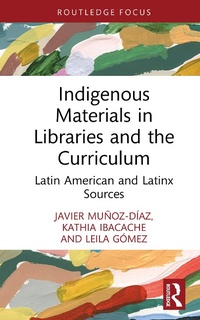
Indigenous Materials in Libraries and the Curriculum
Latin American and Latinx Sources
1. Auflage
Erschienen am 29. April 2024
100 Seiten
978-1-040-09524-9 (ISBN)
Beschreibung

Indigenous Materials in Libraries and the Curriculum: Latin American and Latinx Sources argues for a decolonial engagement with Indigenous peoples' creative work to build awareness of divergent epistemologies and foster healing in the learning community.
This book explores how faculty and librarians can collaborate to develop inclusive library collections and curricula by supporting Indigenous peoples' reclamation of lands and languages. The authors present practices to build and disseminate collections that showcase the work of Indigenous creators from Latin America and compensate for historical erasure and misrepresentation. Consideration is also given to developing a non-hegemonic curriculum in Indigenous languages and cultures for faculty and students from multicultural backgrounds, particularly Latinx students of Indigenous descent. Above all, the book aspires to facilitate the participation of Indigenous peoples in the scholarly conversation to counteract epistemic and material extractivism and transform the scaffolding of higher education in the current global climate crisis.
Indigenous Materials in Libraries and the Curriculum is inspired by a transhemispheric vision to elicit conversation between Indigenous peoples from Latin America (Abiayala) and North America (Turtle Island). The book will appeal to academics, librarians, students, and activists interested in Indigenous languages and cultures, decolonization, DEI initiatives, and library collection development policies that prioritize non-hegemonic narratives.
This book explores how faculty and librarians can collaborate to develop inclusive library collections and curricula by supporting Indigenous peoples' reclamation of lands and languages. The authors present practices to build and disseminate collections that showcase the work of Indigenous creators from Latin America and compensate for historical erasure and misrepresentation. Consideration is also given to developing a non-hegemonic curriculum in Indigenous languages and cultures for faculty and students from multicultural backgrounds, particularly Latinx students of Indigenous descent. Above all, the book aspires to facilitate the participation of Indigenous peoples in the scholarly conversation to counteract epistemic and material extractivism and transform the scaffolding of higher education in the current global climate crisis.
Indigenous Materials in Libraries and the Curriculum is inspired by a transhemispheric vision to elicit conversation between Indigenous peoples from Latin America (Abiayala) and North America (Turtle Island). The book will appeal to academics, librarians, students, and activists interested in Indigenous languages and cultures, decolonization, DEI initiatives, and library collection development policies that prioritize non-hegemonic narratives.
Weitere Details
Auflage
1. Auflage
Sprache
Englisch
Verlagsort
London
Großbritannien
Verlagsgruppe
Taylor & Francis Ltd
Zielgruppe
Für höhere Schule und Studium
Für Beruf und Forschung
Illustrationen
2 Halftones, black and white; 2 Illustrations, black and white
ISBN-13
978-1-040-09524-9 (9781040095249)
Copyright in bibliographic data and cover images is held by Nielsen Book Services Limited or by the publishers or by their respective licensors: all rights reserved.
Schweitzer Klassifikation
Weitere Ausgaben
Andere Ausgaben
Javier Munoz-Diaz | Kathia Ibacache | Leila Gomez
Indigenous Materials in Libraries and the Curriculum
Latin American and Latinx Sources
Buch
ca. 12/2025
1. Auflage
Routledge
36,40 €
Noch nicht erschienen

Javier Munoz-Diaz | Kathia Ibacache | Leila Gomez
Indigenous Materials in Libraries and the Curriculum
Latin American and Latinx Sources
Buch
06/2024
Routledge
Preis leider unbekannt
Artikel ist vergriffen; siehe andere Ausgabe
Javier Munoz-Diaz | Kathia Ibacache | Leila Gomez
Indigenous Materials in Libraries and the Curriculum
Latin American and Latinx Sources
Buch
04/2024
1. Auflage
Routledge
71,10 €
Versand in 10-20 Tagen
Personen
Javier Munoz-Diaz is a literary and cultural critic. His research focuses on Latin American and Latinx cultural studies, Indigenous and Native American studies, Quechua/Kichwa languages and cultures, Queer/Cuir studies, and environmental humanities. A person of Quechua descent, Munoz-Diaz is interested in the cultural history and contemporary processes of re-indigenization in the Andes and Amazon regions. Munoz-Diaz is starting the position of Assistant Professor of Spanish at Farmingdale State College in August 2024.
Kathia Ibacache is assistant professor and Romance languages librarian at the University of Colorado, Boulder. She is interested in advancing collection development with a user-centered approach and focusing on inclusion and diversity. Her research interest encompasses digital accessibility within teaching and learning technologies, collection development, and representing Latin American Indigenous language materials in university libraries.
Leila Gomez is a professor of women and gender studies at the University of Colorado, Boulder. She is the author of Impossible Domesticity: Travels in Mexico (Pittsburgh UP, 2021) and several other books. Her recent research focuses on documentaries and films on land issues and environmental justice by Latin American women filmmakers. She started the Quechua Language Program as director of the Latin American and Latinx Studies Center (LALSC) at CU Boulder from 2017 to 2023.
Kathia Ibacache is assistant professor and Romance languages librarian at the University of Colorado, Boulder. She is interested in advancing collection development with a user-centered approach and focusing on inclusion and diversity. Her research interest encompasses digital accessibility within teaching and learning technologies, collection development, and representing Latin American Indigenous language materials in university libraries.
Leila Gomez is a professor of women and gender studies at the University of Colorado, Boulder. She is the author of Impossible Domesticity: Travels in Mexico (Pittsburgh UP, 2021) and several other books. Her recent research focuses on documentaries and films on land issues and environmental justice by Latin American women filmmakers. She started the Quechua Language Program as director of the Latin American and Latinx Studies Center (LALSC) at CU Boulder from 2017 to 2023.
Inhalt
Introduction: A Decolonial Engagement with Indigenous Peoples' Creative Work; 1 Building an Underrepresented Collection; 2 Universities Libraries as More Than Repositories of Information; 3 How to Decolonize and Indigenize the Curriculum; 4 The Power of Healing and Indigenizing Feminism in the Classroom; Epilogue: The Quechua Language Program at the University of Colorado, Boulder
