

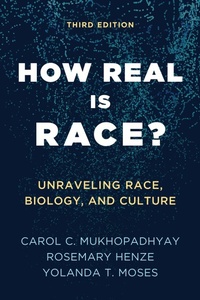
How Real Is Race?
Unraveling Race, Biology, and Culture
3. Auflage
Erschienen am 14. März 2025
334 Seiten
979-8-8818-6054-7 (ISBN)
Beschreibung

Biologically speaking, there is no such thing as race. Yet this seems to contradict the experiences of people in the United States and other countries where racial classification is used daily, by individuals and institutions. Race still matters, whether in wealth accumulation, educational achievement, health, the legal system, or in personal safety. How can race not be real when we experience its effects every day?
Mukhopadhyay, Henze, and Moses systematically deconstruct the myth of race as biology and address the reality of race as a cultural invention, drawing on biocultural, historical, and cross-cultural anthropological perspectives. In doing so, they shed light on the intricate interplay among race, biology, culture, power, and stratification. Part I, "The Fallacy of Race as Biology," unravels the myth that races are biologically valid divisions of humanity. Part II, "Culture Creates Race," explores race as a social construction; the emergence ofthe racial worldview as ideological justification for inequality; and how social processes, especially restrictions on interracial sex and marriage, maintained visible markers of racial hierarchy. Part III, "Contemporary Issues," examines current manifestations of racial stratification including the educational achievement gap, health disparities, and how the language of race embodies and reinforces a racial worldview.
New to this Edition:
· New Chapter 11, "Unpacking the Health Consequences of Racial Stratification," explores the continuing impacts of the racial worldview on race-related health disparities, using the COVID-19 pandemic, maternal health and "weathering," and exposure to environmental toxins as case studies
· New Chapter 12, "Dismantling the Racial World View," explores racial ideology, including language, and offers alternative approaches to racial language dilemmas.
· Updated and expanded discussion of human evolution includes contemporary critiques and alternative scenarios of long-standing models of human evolution and emphasizes our collective African roots.
· Updated and expanded coverage of genomics, DNA, epigenetic processes, and the enormous human variability at the molecular level, all challenging "nature" versus "nurture" models of how we become who we are.
· New data on immigrants, languages, religions, socio-economic and regional racial-ethnic patterns, interracial marriage and other trends explores contemporary diversity in the United States and suggests traditional racial ideology and categories are becoming obsolete.
Mukhopadhyay, Henze, and Moses systematically deconstruct the myth of race as biology and address the reality of race as a cultural invention, drawing on biocultural, historical, and cross-cultural anthropological perspectives. In doing so, they shed light on the intricate interplay among race, biology, culture, power, and stratification. Part I, "The Fallacy of Race as Biology," unravels the myth that races are biologically valid divisions of humanity. Part II, "Culture Creates Race," explores race as a social construction; the emergence ofthe racial worldview as ideological justification for inequality; and how social processes, especially restrictions on interracial sex and marriage, maintained visible markers of racial hierarchy. Part III, "Contemporary Issues," examines current manifestations of racial stratification including the educational achievement gap, health disparities, and how the language of race embodies and reinforces a racial worldview.
New to this Edition:
· New Chapter 11, "Unpacking the Health Consequences of Racial Stratification," explores the continuing impacts of the racial worldview on race-related health disparities, using the COVID-19 pandemic, maternal health and "weathering," and exposure to environmental toxins as case studies
· New Chapter 12, "Dismantling the Racial World View," explores racial ideology, including language, and offers alternative approaches to racial language dilemmas.
· Updated and expanded discussion of human evolution includes contemporary critiques and alternative scenarios of long-standing models of human evolution and emphasizes our collective African roots.
· Updated and expanded coverage of genomics, DNA, epigenetic processes, and the enormous human variability at the molecular level, all challenging "nature" versus "nurture" models of how we become who we are.
· New data on immigrants, languages, religions, socio-economic and regional racial-ethnic patterns, interracial marriage and other trends explores contemporary diversity in the United States and suggests traditional racial ideology and categories are becoming obsolete.
Weitere Details
Auflage
3rd edition
Sprache
Englisch
Verlagsort
USA
Verlagsgruppe
Bloomsbury Publishing Plc
Illustrationen
7 BW Photos, 1 Tables
ISBN-13
979-8-8818-6054-7 (9798881860547)
Copyright in bibliographic data and cover images is held by Nielsen Book Services Limited or by the publishers or by their respective licensors: all rights reserved.
Schweitzer Klassifikation
Weitere Ausgaben
Andere Ausgaben
Carol C. Mukhopadhyay | Rosemary Henze | Yolanda T. Moses
How Real Is Race?
Unraveling Race, Biology, and Culture
Buch
03/2025
3. Auflage
Rowman & Littlefield Publishers
44,90 €
Versand in 3-4 Wochen
Personen
Carol C. Mukhopadhyay is professor emerita of anthropology at San José State University.
Rosemary C. Henze is professor emerita of linguistics and language development at San José State University.
Yolanda T. Moses is professor emerita of anthropology, University of California, Riverside.
Rosemary C. Henze is professor emerita of linguistics and language development at San José State University.
Yolanda T. Moses is professor emerita of anthropology, University of California, Riverside.
Inhalt
Preface
Acknowledgments
Part I: The Fallacy of Race as Biology
Chapter 1: Why Contemporary Races Are Not Scientifically Valid
Chapter 2: Human Biological Variation: What We Don't See
Chapter 3: If Not Race, How Do We Explain Biological Differences?
Chapter 4: More Alike Than Different, More Different Than Alike
Part II: Culture Creates Race
Chapter 5: Culture Shapes How We Experience Reality
Chapter 6: Culture and Classification: Race Is Culturally Real
Chapter 7: Race and Inequality: Race as a Social Invention to Achieve Certain Goals
Chapter 8: Cross-cultural Overview of Race
Chapter 9: Race, Sex, and Gender: If Race Doesn't Exist, What Are We Seeing?
Part III: Contemporary Race Issues: Education, Health, and Language
Chapter 10: The Academic Achievement Gap: What Does Race Have to Do With It?
Chapter 11: Unpacking the Health Consequences of Racial Stratification
Chapter 12: Dismantling the Racial World View
Appendix A. Major Website Resources
Appendix B. Comprehensive List of Activities
References
Index
About the Authors
Acknowledgments
Part I: The Fallacy of Race as Biology
Chapter 1: Why Contemporary Races Are Not Scientifically Valid
Chapter 2: Human Biological Variation: What We Don't See
Chapter 3: If Not Race, How Do We Explain Biological Differences?
Chapter 4: More Alike Than Different, More Different Than Alike
Part II: Culture Creates Race
Chapter 5: Culture Shapes How We Experience Reality
Chapter 6: Culture and Classification: Race Is Culturally Real
Chapter 7: Race and Inequality: Race as a Social Invention to Achieve Certain Goals
Chapter 8: Cross-cultural Overview of Race
Chapter 9: Race, Sex, and Gender: If Race Doesn't Exist, What Are We Seeing?
Part III: Contemporary Race Issues: Education, Health, and Language
Chapter 10: The Academic Achievement Gap: What Does Race Have to Do With It?
Chapter 11: Unpacking the Health Consequences of Racial Stratification
Chapter 12: Dismantling the Racial World View
Appendix A. Major Website Resources
Appendix B. Comprehensive List of Activities
References
Index
About the Authors
