

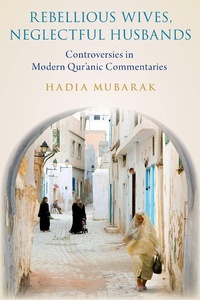
Rebellious Wives, Neglectful Husbands
Controversies in Modern Qur'anic Commentaries
Erschienen am 15. April 2022
978-0-19-755332-9 (ISBN)
Beschreibung
Rebellious Wives, Neglectful Husbands brings into conversation the distinct fields of tafsir (Qur'anic exegesis) studies and women's studies by exploring significant shifts in modern Qur'anic commentaries on the subject of women. Hadia Mubarak places three of the most influential, Sunni Qur'anic commentaries in the twentieth century- Tafsir al-Manar, Fi Zilal al-Qur'an, and al-Tahrir wa'l-Tanwir - against the backdrop of broader historical, intellectual, and political developments in modern North Africa. Mubarak illustrates the ways in which colonialism, nationalism, and modernization set into motion new ways of engaging with the subject of women in the Qur'an. Focusing her analysis on Qur'anic commentaries as a scholarly genre, Mubarak offers a critical and comparative analysis of these three modern commentaries with seven medieval commentaries, spanning from the ninth to fourteenth centuries, on verses dealing with neglectful husbands (4:128), rebellious wives (4:34), polygyny (4:3), and divorce (2:228). In contrast to assessments of the exegetical tradition as monolithically patriarchal, this book captures a medieval and modern tafsir tradition with pluralistic, complex, and evolving interpretations of women and gender in the Qur'an. Rather than pit a seemingly egalitarian Qur'an against an allegedly patriarchal exegetical tradition, Mubarak affirms the need for a critical engagement with tafsir studies among scholars concerned with women and gender in Islam. Mubarak argues that the capacity to bring new meanings to bear on the Qur'an is not only an intellectually viable one but inherent to the exegetical tradition.
Weitere Details
Weitere Ausgaben
Person
Hadia Mubarak is Assistant Professor of Religion at Queens University of Charlotte. Mubarak's publications include, "Violent, Oppressed and Un-American: Muslim Women in the American Imagination" in The Personal is Political, ed. Christine Davis and Jon Crane, "Gender and Qur'anic Exegesis" in The Routledge Handbook of Islam and Gender, ed. Justine Howe, and "Women's Contemporary Readings of the Qur'an" in The Routledge Companion to the Quran.
Inhalt
Acknowledgments
Chapter 1: Ruptures and Continuities in Modern Islamic Thought
Chapter 2: Modern Approaches to Qur'anic Interpretation
Chapter 3: Reflecting the Colonial Gaze: Women in Modern Qur'anic Exegesis
Chapter 4: Sexually Neglectful Husbands: Classical and Modern Interpretations of Q. 4:128
Chapter 5: Rebellious Wives: Medieval and Modern Interpretations of Q. 4:34
Chapter 6: A New Rationalization for Polygyny: Medieval & Modern Interpretations of Q. 4:3
Chapter 7: Men's "Degree:" An Unconditional Privilege?
Conclusion
