

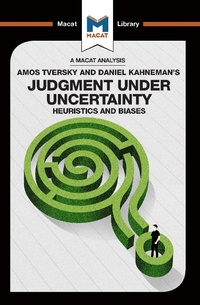
An Analysis of Amos Tversky and Daniel Kahneman's Judgment under Uncertainty
Heuristics and Biases
Erschienen am 5. Juli 2017
95 Seiten
978-1-351-35060-0 (ISBN)
Beschreibung
Amos Tversky and Daniel Kahneman's 1974 paper 'Judgement Under Uncertainty: Heuristics and Biases' is a landmark in the history of psychology. Though a mere seven pages long, it has helped reshape the study of human rationality, and had a particular impact on economics - where Tversky and Kahneman's work helped shape the entirely new sub discipline of 'behavioral economics.'
The paper investigates human decision-making, specifically what human brains tend to do when we are forced to deal with uncertainty or complexity. Based on experiments carried out with volunteers, Tversky and Kahneman discovered that humans make predictable errors of judgement when forced to deal with ambiguous evidence or make challenging decisions. These errors stem from 'heuristics' and 'biases' - mental shortcuts and assumptions that allow us to make swift, automatic decisions, often usefully and correctly, but occasionally to our detriment.
The paper's huge influence is due in no small part to its masterful use of high-level interpretative and analytical skills - expressed in Tversky and Kahneman's concise and clear definitions of the basic heuristics and biases they discovered. Still providing the foundations of new work in the field 40 years later, the two psychologists' definitions are a model of how good interpretation underpins incisive critical thinking.
The paper investigates human decision-making, specifically what human brains tend to do when we are forced to deal with uncertainty or complexity. Based on experiments carried out with volunteers, Tversky and Kahneman discovered that humans make predictable errors of judgement when forced to deal with ambiguous evidence or make challenging decisions. These errors stem from 'heuristics' and 'biases' - mental shortcuts and assumptions that allow us to make swift, automatic decisions, often usefully and correctly, but occasionally to our detriment.
The paper's huge influence is due in no small part to its masterful use of high-level interpretative and analytical skills - expressed in Tversky and Kahneman's concise and clear definitions of the basic heuristics and biases they discovered. Still providing the foundations of new work in the field 40 years later, the two psychologists' definitions are a model of how good interpretation underpins incisive critical thinking.
Weitere Details
Reihe
Sprache
Englisch
Verlagsort
London
Großbritannien
Verlagsgruppe
Taylor & Francis Ltd
Zielgruppe
Für höhere Schule und Studium
Dateigröße
4,55 MB
ISBN-13
978-1-351-35060-0 (9781351350600)
Copyright in bibliographic data and cover images is held by Nielsen Book Services Limited or by the publishers or by their respective licensors: all rights reserved.
Schweitzer Klassifikation
Weitere Ausgaben
Personen
Dr Camille Morvan is a psychologist, researcher and founder of the psychological human resources company Goshaba. She has taught at Sciences Politiques in Paris and at Harvard University, as well as working at the Ecole normale superieure.
Dr Bill Jenkins holds a PhD in psychology from the University of Michigan. He is currently co-chair of the Department of Psychology at Mercer University.
Dr Bill Jenkins holds a PhD in psychology from the University of Michigan. He is currently co-chair of the Department of Psychology at Mercer University.
Inhalt
Ways In to the Text Who are Amos Tversky and Daniel Kahneman? What does Judgment underUncertainty Say? Why does Judgment underUncertainty Matter? Section 1: Influences Module 1: The Author and the Historical Context Module 2: Academic Context Module 3: The Problem Module 4: The Author's Contribution Section 2: Ideas Module 5: Main Ideas Module 6: Secondary Ideas Module 7: Achievement Module 8: Place in the Author's Work Section 3: Impact Module 9: The First Responses Module 10: The Evolving Debate Module 11: Impact and Influence Today Module 12: Where Next? Glossary of Terms People Mentioned in the Text Works Cited
