

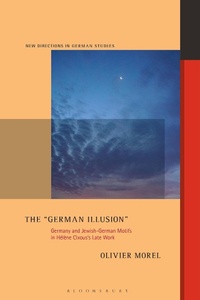
The "German Illusion"
Germany and Jewish-German Motifs in HeleNe Cixous's Late Work
1. Auflage
Erschienen am 14. Dezember 2023
288 Seiten
979-8-7651-0741-6 (ISBN)
Beschreibung
Examines Jewish-German "tropes" in Hélène Cixous's oeuvre and life and their impact on her work as a feminist, poet, and playwright.
Hélène Cixous is a poet, philosopher, and activist known worldwide for her manifesto on Écriture feminine (feminine writing) and for her influential literary texts, plays, and essays. While the themes were rarely present in her earlier writings, Germany and Jewish-German family figures and topics have significantly informed most of Cixous's late works. Born in Algeria in June 1937, she grew up with a mother who had escaped Germany after the rise of Nazism and a grandmother who fled the racial laws of the Third Reich in 1938. In her writing, Cixous refines the primitive scene of a "German" upbringing in French-occupied colonial, antisemitic Algeria.
Scholar and filmmaker Olivier Morel delves into the signs and influences that "Germany," "German," and "Osnabrück" have exerted over Cixous's work. Featuring an exclusive interview with Hélène Cixous and stills from their travel together to Osnabrück in Morel's 2018 documentary, Ever, Rêve, Hélène Cixous, Morel's The "German Illusion" examines the unique literary meditation on the Holocaust sustained throughout her later texts.
Morel helps us to understand an uncannily original oeuvre that embodies the complexities of modernity's genocidal history in a new way.
Hélène Cixous is a poet, philosopher, and activist known worldwide for her manifesto on Écriture feminine (feminine writing) and for her influential literary texts, plays, and essays. While the themes were rarely present in her earlier writings, Germany and Jewish-German family figures and topics have significantly informed most of Cixous's late works. Born in Algeria in June 1937, she grew up with a mother who had escaped Germany after the rise of Nazism and a grandmother who fled the racial laws of the Third Reich in 1938. In her writing, Cixous refines the primitive scene of a "German" upbringing in French-occupied colonial, antisemitic Algeria.
Scholar and filmmaker Olivier Morel delves into the signs and influences that "Germany," "German," and "Osnabrück" have exerted over Cixous's work. Featuring an exclusive interview with Hélène Cixous and stills from their travel together to Osnabrück in Morel's 2018 documentary, Ever, Rêve, Hélène Cixous, Morel's The "German Illusion" examines the unique literary meditation on the Holocaust sustained throughout her later texts.
Morel helps us to understand an uncannily original oeuvre that embodies the complexities of modernity's genocidal history in a new way.
Weitere Details
Reihe
Auflage
1. Auflage
Sprache
Englisch
Verlagsort
New York
USA
Verlagsgruppe
Bloomsbury Publishing Plc
Zielgruppe
Für Beruf und Forschung
Illustrationen
33 b&w illustrations
ISBN-13
979-8-7651-0741-6 (9798765107416)
Copyright in bibliographic data and cover images is held by Nielsen Book Services Limited or by the publishers or by their respective licensors: all rights reserved.
Schweitzer Klassifikation
Weitere Ausgaben
Personen
Olivier Morel is Associate Professor in the Department of Film, Television, and Theatre at the University of Notre Dame, USA. He is also a filmmaker, with cinematic work receiving prizes in international film festivals, and author of three books including Berlin légendes ou la mémoire des décombres (2013) and a graphic novel, Walking Wounded: Uncut stories from Iraq (2015).
Inhalt
Introduction: "An Originary Exile"
I. I call Germany: The Landline (1916-2016)
1. The first telephone
2. The dream call
3. The last phone call
II. "Os, na, brück": The Capital of Memory (1933-1935)
1. Ruins and remembrance: from "Os, na, brück" to "Rom'"
2. Osnabrück the instrument of Peace: "recorder," recorder
3. Remembrer-remember: a detour to Montaigne's Tower... and its ruins
(image)
4. "Je suis, nous sommes le 23 octobre 1935". The October 23, 1935 picture
5. N'ai-je pas vu (Have I not seen...) la neige pas vue (...the snow not seen)?
III. An Originary Move: The Move of the Origin (1938)
1. Omi was in Osnabrück...
2. "Bericht"
3. "Etwas"
4. Epilog
IV. Zugehör: The Jewish-German psyche
1. "Envoûté," delirium
2. "We"
3. Epilog: Zugehör
Conclusion: Frauenprotest
Afterword: A filmed-interrupted interview with Hélène Cixous
Acknowledgements
Bibliography
Index
I. I call Germany: The Landline (1916-2016)
1. The first telephone
2. The dream call
3. The last phone call
II. "Os, na, brück": The Capital of Memory (1933-1935)
1. Ruins and remembrance: from "Os, na, brück" to "Rom'"
2. Osnabrück the instrument of Peace: "recorder," recorder
3. Remembrer-remember: a detour to Montaigne's Tower... and its ruins
(image)
4. "Je suis, nous sommes le 23 octobre 1935". The October 23, 1935 picture
5. N'ai-je pas vu (Have I not seen...) la neige pas vue (...the snow not seen)?
III. An Originary Move: The Move of the Origin (1938)
1. Omi was in Osnabrück...
2. "Bericht"
3. "Etwas"
4. Epilog
IV. Zugehör: The Jewish-German psyche
1. "Envoûté," delirium
2. "We"
3. Epilog: Zugehör
Conclusion: Frauenprotest
Afterword: A filmed-interrupted interview with Hélène Cixous
Acknowledgements
Bibliography
Index
