

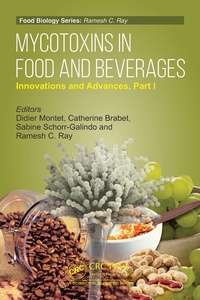
Mycotoxins in Food and Beverages
Innovations and Advances Part I
1. Auflage
Erschienen am 10. Juni 2021
308 Seiten
978-1-000-37013-3 (ISBN)
Beschreibung

Mycotoxins are secondary metabolites produced by fungi in a wide range of foods (cereals, peanut, tree nuts, dried fruits, coffee, cocoa, grapes, spices...) both in the field and after harvest, particularly during storage. They can also be found in processed foods of plant origin, or by transfer, in food products of animal (milk, eggs, meat and offal). Mycotoxins are of major concern since they can cause acute or chronic intoxications in both humans and animals which are sometimes fatal. Many countries, particularly in Europe, have set maximum acceptable levels for mycotoxins in food and feed.
The book reviews the latest literature and innovations on important aspects of mycotoxins, e.g. mycotoxin producing fungi and the related ecosystems, mycotoxin occurrence, toxicity, analysis and management. Quantitative estimations of impacts of climate change on mycotoxin occurrence have been made recently, using predictive modelling. There is also a growing interest in the occurrence and toxicity of multiple mycotoxins in food and feed, including emerging or modified forms of mycotoxins. Innovative tools were also developed to detect and quantify toxinogenic fungi and their toxins. In order to reduce the use of chemicals that are harmful to the environment and health of consumers, alternative methods of prevention and decontamination of mycotoxins were tested in pre- and post-harvest, using microorganisms, natural substances or radiation treatments.
The book reviews the latest literature and innovations on important aspects of mycotoxins, e.g. mycotoxin producing fungi and the related ecosystems, mycotoxin occurrence, toxicity, analysis and management. Quantitative estimations of impacts of climate change on mycotoxin occurrence have been made recently, using predictive modelling. There is also a growing interest in the occurrence and toxicity of multiple mycotoxins in food and feed, including emerging or modified forms of mycotoxins. Innovative tools were also developed to detect and quantify toxinogenic fungi and their toxins. In order to reduce the use of chemicals that are harmful to the environment and health of consumers, alternative methods of prevention and decontamination of mycotoxins were tested in pre- and post-harvest, using microorganisms, natural substances or radiation treatments.
Weitere Details
Reihe
Auflage
1. Auflage
Sprache
Englisch
Verlagsort
London
Großbritannien
Verlagsgruppe
Taylor & Francis Ltd
Zielgruppe
Für Beruf und Forschung
Illustrationen
26 Tables, black and white; 10 Illustrations, color; 5 Illustrations, black and white
ISBN-13
978-1-000-37013-3 (9781000370133)
Copyright in bibliographic data and cover images is held by Nielsen Book Services Limited or by the publishers or by their respective licensors: all rights reserved.
Schweitzer Klassifikation
Weitere Ausgaben
Andere Ausgaben
Didier Montet | Catherine Brabet | Ramesh C. Ray
Mycotoxins in Food and Beverages
Innovations and Advances Part I
Buch
06/2023
1. Auflage
CRC Press
124,20 €
Versand in 15-20 Tagen
Didier Montet | Catherine Brabet | Ramesh C. Ray
Mycotoxins in Food and Beverages
Innovations and Advances Part I
Buch
06/2021
1. Auflage
CRC Press
254,20 €
Versand in 15-20 Tagen
Personen
Dr Didier Montet obtained his PhD in food microbiology in 1984. He conducts research in food safety and microbial ecology. He is a national expert in biotechnology and additives at the French Food Safety Agency (ANSES). He is an international expert (FAO, French embassies, international foundations). He published 230 articles and 8 books in the field of fermentations, traceability, mycotoxins. He participated to 8 European projects. He has developed a collective expertise methodology to identify food hazards.
Dr Catherine Brabet obtained her PhD in Food Science. She conducts research in food safety and quality management in relation with market and regulatory requirements, and had 14 years' experience in Latin America and Africa, with 6 years in CGIAR research centers (CIAT and CIP). Since 2003, she has been coordinating and/or participating in European and international projects on mycotoxin prevention and control in food, and she carried out consultancy for the EU initiative BTSF (Better Training for Safer Food).
Prof. Sabine Schorr-Galindo obtained her PhD in food microbiology in 1996. She conducts research and training at the Montpellier University in food safety, microbial ecology and biological control. She is a national expert in fungal pathogens at the French Food Safety Agency (ANSES) and at the French Scientific Steering Committee "Research and Innovation" of the ecophyto2+ plan for sustainable agriculture. Since 2000, she has coordinated 6 French and European projects and published 50 articles, 3 special issues and 3 book chapters on prevention and control of fungi and mycotoxins.
Dr. Ramesh C. Ray is a former Principal Scientist (Microbiology) and Head of the ICAR- Central Tuber Crops Research Institute (Regional Centre), Bhubaneswar, India. He has 35 years of research experience in agriculture and food microbiology, published 140 research and review papers in international journals, 63 books chapters, edited 14 books and authored 3 books. He is a distinguished fellow of the prestigious National Academy of Agricultural Sciences, New Delhi, India and 10 other scientific societies.
Dr Catherine Brabet obtained her PhD in Food Science. She conducts research in food safety and quality management in relation with market and regulatory requirements, and had 14 years' experience in Latin America and Africa, with 6 years in CGIAR research centers (CIAT and CIP). Since 2003, she has been coordinating and/or participating in European and international projects on mycotoxin prevention and control in food, and she carried out consultancy for the EU initiative BTSF (Better Training for Safer Food).
Prof. Sabine Schorr-Galindo obtained her PhD in food microbiology in 1996. She conducts research and training at the Montpellier University in food safety, microbial ecology and biological control. She is a national expert in fungal pathogens at the French Food Safety Agency (ANSES) and at the French Scientific Steering Committee "Research and Innovation" of the ecophyto2+ plan for sustainable agriculture. Since 2000, she has coordinated 6 French and European projects and published 50 articles, 3 special issues and 3 book chapters on prevention and control of fungi and mycotoxins.
Dr. Ramesh C. Ray is a former Principal Scientist (Microbiology) and Head of the ICAR- Central Tuber Crops Research Institute (Regional Centre), Bhubaneswar, India. He has 35 years of research experience in agriculture and food microbiology, published 140 research and review papers in international journals, 63 books chapters, edited 14 books and authored 3 books. He is a distinguished fellow of the prestigious National Academy of Agricultural Sciences, New Delhi, India and 10 other scientific societies.
Inhalt
Foreword. Preface. Mycotoxin Surveillance in Low-Resource Settings. State of the art of mycotoxins and regulation in Cameroon. Mycotoxins during consumer food storage. Biodiversity of Aflatoxigenic Aspergillus section Flavi Species according to Food Matrices and Geographic Areas. Mycotoxins in foods and feeds in Morocco: Occurrence, sources of contamination, prevention/control and regulation. Mycotoxin information from Kenya. Recent Developments in the Analysis of Mycotoxins (Part 1) PART 1: Sampling, Sample Preparation and Sample Extraction and Clean-up for the analysis of mycotoxins. Developments in the Analysis of Mycotoxins (Part 2) PART 2: Quantitation Methods for the analysis of mycotoxins. Biochip Array Technology: Innovative Multi-Analytical Methodology for the Simultaneous Screening of a Broad Range of Mycotoxins from a Single Food or Feed Cereal Based Sample. Biosensor and aptamer: New in mycotoxins detection.
