

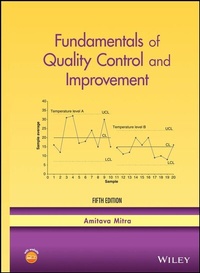
Fundamentals of Quality Control and Improvement
Beschreibung

In the newly revised and thoroughly updated Fifth Edition of Fundamentals of Quality Control and Improvement, accomplished academic, consultant, and author Dr. Amitava Mitra delivers a comprehensive and quantitative approach to quality management techniques. The book demonstrates how to integrate statistical concepts with quality assurance methods, incorporating modern ideas, strategies, and philosophies of quality management.
You'll discover experimental design concepts and the use of the Taguchi method to incorporate customer needs, improve lead time, and reduce costs. The new edition also includes brand-new case studies at the end of several chapters, references to the statistical software Minitab 19, and chapter updates that add discussions of trending and exciting topics in quality control.
The book includes access to supplementary material for instructors consisting of a new instructor's solutions manual and PowerPoint slides, as well as access to data sets for all readers.
Readers will also benefit from the inclusion of:
* A thorough introduction to the evolution of quality and definitions of quality, quality control, quality assurance, quality circles, and quality improvement teams
* An exploration of customer needs and market share, as well as the benefits of quality control and the total quality system
* Practical discussions of quality and reliability, quality improvement, product and service costing, and quality costs
* A concise treatment of how to measure quality costs, the management of quality, and the interrelationship between quality and productivity
Perfect for upper-level undergraduate and graduate students in quality control and improvement, the Fifth Edition of Fundamentals of Quality Control and Improvement will also earn a place in the libraries of business students and those undertaking training programs in Six Sigma.
Weitere Details
Weitere Ausgaben
Andere Ausgaben
Person
Amitava Mitra, PhD, is Professor in the Department of Systems and Technology and the former Associate Dean in the College of Business at Auburn University, Alabama. He has published over 70 journal articles and teaches quality assurance and improvement.
Inhalt
Preface xix
About the Companion Website xxiii
Part I Philosophy and Fundamentals 1
1 Introduction to Quality Control and the Total Quality System 3
2 Some Philosophies and Their Impact on Quality 47
3 Quality Management: Practices, Tools, and Standards 89
Part II Statistical Foundations and Methods of Quality Improvement 151
4 Fundamentals of Statistical Concepts and Techniques in Quality Control and Improvement 153
5 Data Analyses and Sampling 233
Part III Statistical Process Control 285
6 Statistical Process Control Using Control Charts 287
7 Control Charts for Variables 311
8 Control Charts for Attributes 405
9 Process Capability Analysis 471
Part IV Product and Process Design 527
10 Reliability 529
11 Experimental Design and the Taguchi Method 569
12 Process Modeling Through Regression Analysis 675
Appendixes 733
Index 755
PREFACE
This book covers the foundations of modern methods of quality conrol and improvement that are used in the manufacturing and service industries. Quality is key to surviving tough competition in a dynamic and global environment. Consequently, organizations need technically competent people who are well-versed in statistical quality control and improvement. This book should serve the needs of students in business and management and students in engineering, technology, and related disciplines. Professionals will find this book to be a valuable reference in the field.
An outgrowth of many years of teaching, research, and consulting in the field of quality assurance and statistical process control, the methods discussed in this book apply statistical foundations to real-world situations. Mathematical derivations and proofs are kept to a minimum to allow a better flow of material. Although an introductory course in statistics would be useful to a reader, the foundations of statistical tools and techniques discussed in Chapter 4 should enable students without a statistical background to understand the material.
Prominently featured are many real-world examples. For each major concept, at least one example demonstrates its application. The field of health care within the service sector is of immense importance. From an individual or a population perspective, creating processes that provide quality health care are desirable. Additionally, the growing escalation of the cost of providing quality care raises the question of improving the effectiveness and efficiency of all processes associated with the delivery of such services. For this reason, issues related to health care quality have been addressed in several chapters, for example, Chapters 3, 5, 7, 8, 10, and 12.
The book is divided into four parts. Part I, which deals with the philosophy and fundamentals of quality control, consists of three chapters. Chapter 1 is an introduction to quality control and the total quality system. In addition to introducing the reader to the nomenclature associated with quality control and improvement, it provides a framework for the systems approach to quality. Discussions of quality costs and their measurement, along with activity-based costing, are presented. In Chapter 2 we examine philosophies of such leading experts as Deming, Crosby, and Juran. Deming's 14 points for management are analyzed, and the three philosophies are compared. Features of quality in the service sector are introduced. Chapter 3 covers quality management practices, tools, and standards. Topics such as total quality management, balanced scorecard, quality function deployment, benchmarking, failure mode and effects criticality analysis, and tools for quality improvement are presented. Concepts of health care analytics and its associated challenges are discussed.
Part II deals with the statistical foundations of quality control and consists of two chapters. Chapter 4 offers a detailed coverage of statistical concepts and techniques in quality control and improvement. It present a thorough treatment of inferential statistics. Depending on the student's background, only selected sections of this chapter will need to be covered.
Chapter 5 covers some graphical methods of analyzing empirical distributions. Identification of the population distribution using probability plotting along with the several transformations to achieve normality are presented. Analysis of count data, including contingency table analysis and measures of association, are discussed. Strategic and operational decision making, through analyses of survey data from customers, is included. Finally, some common sampling designs and determination of an appropriate sample size are features of this chapter.
The field of statistical quality control consists of two areas: statistical process control and acceptance sampling. Part III deals with statistical process control and consists of four chapters. Chapter 6 provides an overview of the principles and use of control charts. A variety of control charts for variables are discussed in detail in Chapter 7. In additon to charts for the mean and range, those for the mean and standard deviation, individual units, cumulative sum, moving average, and geometric moving average are presented. Several types of risk-adjusted control charts are included. Multivariate control charts are also introduced. Control charts for attributes are discussed in Chapter 8. Charts such as the pchart, np-chart, c-chart, u-chart, g-chart, and U-chart are presented. Here also, risk-adjusted p-charts and u-charts are included. The topic of process capability analysis is discussed in Chapter 9. The ability of a process to meet customer specifications is examined in detail. Process capability analysis procedures and process capability indices are also treated in depth. The chapter covers proper approaches to setting tolerances on assemblies and components. Part III should form a core of material to be covered in most courses.
Part IV deals with product and process design and consists of three chapters. With the understanding that quality improvement efforts are generally being moved further upstream, these chapters constitute the backbone of current design methodology. Chapter 10 deals with reliability and explores the effects of time on the proper functioning of a product. The topic of survival analysis is included and health-care applications are provided. Chapter 11 provides the fundamentals of experimentals design and the Taguchi method. Different designs, such as the completely randomized design, randomized block design, and Latin square design are presented. Estimation of treatment effects using factorial experiments is included. This chapter also provides a treatment of the Taguchi method for design and quality improvement; the philosophy and fundamentals of this method are discussed. Chapter 12 discusses process modeling through regression analysis. Estimation of model parameters, making inferences from the model, and issues in multiple regression are covered. Logistic regression analysis is also introduced. Nominal polytomous and ordinal polytomous response variables are discussed. The problem of classification of a binary response variable and associated performence measures are covered. Various sections of Part V could also be included in the core material for a quality control course.
For a one-semester or one-quarter course, Part I, selected portions of Part II, selected portions of Part III, and selected portions of Part IV could be covered. For a two-semester or two-quarter course, all of Parts II and III, along with portions from Part IV, could be covered as well.
CHANGES IN THE FIFTH EDITION
Some major changes have been made keeping with the emphasis in the fourth edition. With the growing importance of the field of health care, an effort has been made to incorporate concepts, tools, and techniques to address issues in the domain of health care quality. These are dealt with over a multitude of chapters, that is, Chapters 3, 5, 7, 8, 10, and 12. Case studies have been included in several chapters.
Chapter 3 now includes a discussion of the uniqueness of the health care sector and the utilization of health care analytics using data, from various sources, to create a decision support system. Such a system will not only improve processes and patient outcomes as well as physician performance but also lead to an improved population health.
An important form of feedback from customers on a product or service is through surveys. In health care, patients, for example, indicate their degree of satisfaction, with the various processes/procedures encountered, through questionnaires that are usually based on a five-point ordinal Likert scale. Chapter 5 presents some methods for displaying and analyzing ordinal or count data based on questionnaires. Strategic implications on decisions for management are also discussed, based on the degree of satisfaction and the degree of importance of each question item included in the survey.
The concept of risk adjustment, as it applies to health care applications, has been incorporated in the material on variable control charts in Chapter 7. In this context, the risk-adjusted cumulative sum chart, risk-adjusted sequential probability ratio test, risk-adjusted exponentially weighted moving average chart, and variable life-adjusted display chart are presented in this chapter.
Under attribute control charts, risk-adjusted p-charts for the proportion of patients that survive a certain type of illness or surgical procedure and risk-adjusted u-charts for monitoring the number of nonconformities per unit, for example, the number of pressure ulcers per patient day, are presented in Chapter 8. Further, monitoring of low-occurrence nonconformities in health care, such as surgical wound infections or gastrointestinal infections, are also discussed. Such monitoring may be accomplished through tracking of the time between events, in this case, infections, through a g-chart.
Another important application in health care is that of survival analysis. Often, in observational studies dealing with patients, the exact time of death of a patient may not be known. Moreover, some patients may leave the observational study. In such instances, censored data are available. The Kaplan-Meier product...
