

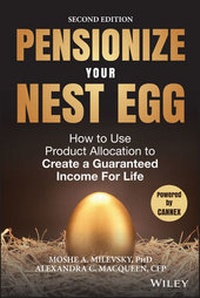
Pensionize Your Nest Egg
Beschreibung

Pensionize Your Nest Egg describes how adding the newapproach of "product allocation" to the tried-and-true assetallocation approach can help protect you from the risk of outlivingyour savings, while maximizing your income in retirement.
This book demonstrates that it isn't the investor with the mostmoney who necessarily has the best retirement income plan. Instead,it's the investor who owns the right type of investment andinsurance products, and uses product allocation to allocate theright amounts, at the right time, to each product category.
This revised second edition is expanded to include investorsthroughout the English-speaking world and updated to reflectcurrent economic realities.
Readers will learn how to distinguish between the various typesof retirement income products available today, including lifeannuities and variable annuities with living income benefits, andhow to evaluate the features that are most important to meet theirpersonal retirement goals.
* Evaluate the impacts of longevity, inflation, and sequence ofreturns risk on your retirement income portfolio
* Make sense of the bewildering array of today's retirementincome products
* Measure and maximize your Retirement SustainabilityQuotient
* Learn how your product allocation choices can help maximizecurrent income or financial legacy -- and how to select theapproach that's right for you
* Walk through detailed case studies to explore how to pensionizeyour nest egg using the new product allocation approach
Whether you do it yourself or work with a financial advisor,Pensionize Your Nest Egg gives you a step-by-step plan tocreate a guaranteed retirement income for life.
Alle Preise
Weitere Details
Weitere Ausgaben
Andere Ausgaben
Personen
ALEXANDRA C. MACQUEEN is a Certified Financial Planner professional in Toronto.
Inhalt
List of Exhibits xi
Preface xv
Preface to the Second Edition xv
Preface to the First Edition xvii
How to Use This Book xviii
Introduction: Why Retirement Income Is Better than Retirement Savings 1
PART ONE: WHY YOU NEED TO BUILD YOUR OWN PENSION PLAN: THE MOST PREDICTABLE CRISIS IN HISTORY 7
Chapter 1: The Real Pension Crisis 9
Up a Creek without a Pension Paddle 11
Mixing Defined Benefit Apples and Defined Contribution Oranges 12
It Takes Two to Tango: A Basic Lesson about the Nature of True Pensions 22
Guarantee versus Ruin 23
When Is a Pension Not a Pension? 24
There Ain't No Such Thing ... as a Free Pension 25
The First True Pensions 27
Chapter 2: Planning for Longevity: Risks While Waiting for Your Return 31
The Grim Reaper's Coin Toss 35
Introducing Longevity Risk 36
Predicting Future Longevity 39
How Should You Insure against Longevity Risk? 41
Will You Get Heads ... or Tails? 41
Chapter 3: How the Sequence of Returns Can Ruin Your Retirement 43
How Long Will the Money Last? 44
Clockwise Investment Returns 47
Counterclockwise Returns 49
Triangles, Bulls, and Bears: The Retirement Income Circus 51
Can Buckets Bail Out a Poor Sequence of Returns? 52
Chapter 4: Inflation: The Great Money Illusion 55
What Does This Mean for Retirees? 58
The CPI-ME and the CPI-YOU 60
Does the CPI Measure Your Spending? 62
A Reality Check for Your Retirement Spending 63
What Have We Learned So Far? 64
PART TWO: DEVELOPING A SUSTAINABLE RETIREMENT SOLUTION: THE MODERN APPROACH THAT IS HUNDREDS OF YEARS OLD 65
Chapter 5: Beyond Asset Allocation: Introducing Product Allocation 67
Product Allocation: New Baskets for Your Nest Egg 67
Three Product Silos 68
The Spectrum of Retirement Income Silos 70
How Do the Silos Stack Up? 72
Chapter 6: An Introduction to Life Annuities 73
Pension Contributions as Insurance Premiums 74
Buying a Personal Pension 75
When Should You Buy an Annuity? 77
Annuities versus Term Deposits 79
Is the Annuity Gamble Worth It? 81
Great-Grandma's Gamble 81
The Power of Mortality Credits 83
What about 50-Year-Olds-Should They Buy Personal Pensions? 84
What about Interest Rates? 87
How Can I Use Annuities to Protect against Inflation? 89
Unique and Personal Insurance 90
Chapter 7: A Review of Traditional Investment Accounts 93
Asset Allocation in Your SWP 95
What Should You Put in the SWP? 96
Chapter 8: Introducing the Third Silo-Annuities with Guaranteed Living Benefits 99
Guarantees and Growth: How Variable Annuities with Guaranteed Living Income Benefits Work 101
Evaluating an Annuity with Guaranteed Living Benefits: How Should You Choose? 104
Chapter 9: Your Retirement Sustainability: Fundamental Concepts in Retirement Income Planning 107
Which Glasses Will You Wear? 109
How Many Eggs Can You Withdraw from Your Nest? 110
What Should You Protect Against: Floods or Meteorites? 113
Do You Feel Lucky? Pensions, Survival Probabilities, and Spending in Retirement 114
Pensions Change the Game 114
How Does Pensionization Impact Your Retirement Sustainability Quotient? 116
Pension Annuities: Step-by-Step Math 122
The True Gift of Pensionization 124
Chapter 10: The Most Diffi cult Question You Will Ever Have to Answer (About Your Retirement) 125
Retirement Sustainability or Financial Legacy? 127
Pricing Your Inheritance 128
Finding Your Spot on the Frontier 130
Chapter 11: Divvying Up Your Nest Egg 133
Creating a Retirement Plan for Robert Retiree: Cases 1 through 10 133
What Is the Cost to Pensionize? 137
When Should You Pensionize? 140
When Should You Turn Your Living Benefi t On? 141
Chapter 12: A Deeper Look at the Promise of Pensionization: Revisiting the Two Gertrudes 147
Activating the Time Machine: Gertrude at Age 65 148
Lifetime Income: Now or Later? The Implied Longevity Yield 150
Lifetime Income: Now or Later? The Role of Changing Interest Rates 152
A Tool to Help with Your Decision: The "What If I Wait?" Analyzer 155
Moving Beyond Yield: Understanding the Cost-Benefit Trade-off of Pensionizing Your Nest Egg 157
Pensionizing: Financial and Nonfi nancial Benefits 160
Summary of Part Two 161
PART THREE: THE SEVEN STEPS TO PENSIONIZE YOUR NEST EGG 163
Chapter 13: Step 1: Identify Your Desired Retirement Income 165
Estimating Your Desired Income from the Top Down 169
Estimating Your Desired Income from the Ground Up 169
Chapter 14: Step 2: Estimate Your Existing Pensionized Income 173
Public Pensions in the United States, United Kingdom, Canada, Australia, and New Zealand 174
How Much Will You Receive? 174
Benefits from a Defined Benefit Pension Plan 175
What If I'm Worried about the Future of My DB Pension Plan? 177
Timing the Retirement Decision 177
Completing Step 2 177
Chapter 15: Step 3: Determine Your Pension Income Gap 179
Your Average Tax Rate 180
Your Pension Income Gap 181
Adjusting for Inflation 183
Chapter 16: Step 4: Calculate Your Retirement Sustainability Quotient 187
What Kind of Eggs Do You Have in Your Nest? 187
Filling the Gap 188
Chapter 17: Step 5: Assess Your Plan: Is It Sustainable? 193
Chapter 18: Step 6: Calculate Your Expected Financial Legacy 197
Chapter 19: Step 7: Use Product Allocation to Pensionize the Right Fraction of Your Nest Egg 199
Case Study: Jack and Jill Go Up the Hill (to Fetch a Retirement Income Plan) 200
Step 1: Identify Your Desired Retirement Income 201
Step 2: Estimate Your Existing Pensionized Income 202
Step 3: Determine Your Pension Income Gap 202
Step 4: Calculate Your Retirement Sustainability Quotient 203
Step 5: Assess Your Plan: Is It Sustainable? 204
Step 6: Calculate Your Expected Financial Legacy 206
Step 7: Use Product Allocation to Pensionize Your Nest Egg 207
Summary of Part Three 208
Final Thoughts 209
Notes 213
Bibliography 219
Acknowledgments 221
About the Authors 223
Index 225
1
The Real Pension Crisis
- The Wall Street Journal (United States), October 6, 2014-Pension Dropouts Cause Pinch: "Motorola Solutions Inc. and Bristol-Myers Squibb Co. are the latest companies to cast off billions in pension burdens, fueling a trend that could weaken the government's ability to protect the payouts other employers have promised millions of retired workers. . Only 14 percent of the nation's private-sector workers were covered by defined benefit plans in 2011, less than half the 38 percent in 1979. ."
- The Guardian (U.K.), February 22, 2013-Pension scheme membership at 15-year low: "Membership of workplace pension schemes fell for the 11th year running in 2012, to 46% of the British workforce, official figures have shown . Defined benefit pension schemes, also known as final salary, continue to disappear from workplaces . The figures show that 91% of public sector employees with workplace pensions had a final salary scheme in 2012, against just 26% in the private sector."
- The Globe and Mail (Canada), February 20, 2014-Shift from defined benefit pensions reinforces need for retirement planning: "For decades, most workers relied on a promise of how much they would receive in retirement from their company pensions. . But that pension certainty is fading as many companies-faced with large unfunded liabilities and deficits amid low interest rates-moved employees, especially new recruits, to defined contribution plans that guarantee contributions but not final monthly pensions."
- The Sunday Morning Herald (Australia), May 10, 2014-Superannuation well managed could avert a huge blowout on pensions: "A recent report by CPA Australia, based on analysis of more than 8,000 households across the nation, claims Boomers-those born between 1946 and 1965-are using super savings as a windfall to prop up lifestyles during their working lives rather than as an investment to be nurtured for the 25 years of retirement expected for the average person reaching 65 years. According to the Actuaries Institute, most people's superannuation account balances are increasing but will not be enough to meet even a modest lifestyle, regardless of whether it is paid out as a lump sum, converted to an income stream, or ploughed into other investments."
- The New Zealand Herald, May 9, 2014-Private pensions for the lucky few: "Today, 1 in 10 retired people have an income stream from an occupational pension. . However, by the time today's 48-year-old arrives at retirement, the number getting any private pension at all will be very few, let alone pensions that are inflation protected. . What will today's 48-year-old do when she reaches retirement in 2031? How will she make her nest egg last?"
Chances are, if you picked up a newspaper over the past few months, or even years, you saw many alarming articles reporting on the dire state of retirement income systems throughout the regions we are focusing on in this book: the United States, the United Kingdom, Canada, Australia, and New Zealand. Flipping through the pages of your morning newspaper, you can find facts, figures, and commentary on the declining place of pensions in these countries, along with lots of agreement about the need for changes, or discussion about changes that are already taking place. Right now, there's an active debate about the future of pensions around the world. We are awash in expert commissions, opinions from public-policy think tanks, and calls for reform from ordinary citizens and voters. But what's the crisis? Why the need for reform? What reform is needed? And what difference does any of this make for you?
Up a Creek without a Pension Paddle
The recent, and very public, debate about the safety of retirement income is replete with startling statistics. In particular, reports quoted by all participants in the discussion note the declining rates of participation in employer-sponsored occupational or workplace pension plans. So let's review what belonging to this kind of pension plan means for those who participate. The common understanding is that if you participate in a workplace pension plan, when you retire, your "work paycheck" will seamlessly convert to a "retirement paycheck" that you'll receive for the rest of your life (which means that your relationship with your employer never really ends, as long as you are alive).
The unspoken implication of these discussions, of course, is that people without an employer-sponsored pension are "up a creek . without a pension paddle." In contrast to the lucky population with employer-sponsored pensions, they will be living on cat food in retirement, counting every penny as the days go by, and constantly fretting about outliving their savings (or if they aren't worried, they should be!).
At first glance, the available data seem to support this rather bleak picture. Let's take a look at the pension landscape in the countries where we are focusing our attention:
- In the United States, only 45 percent of the workforce is covered by an employer-sponsored pension plan.
- In the United Kingdom, front-page stories in 2012 announced that the proportion of U.K. workers enrolled in workplace pensions had fallen below 50 percent.
- In Canada, statistics show that a mere 33 percent of the Canadian labor force participated in a registered pension plan in 2012.
- In Australia, the introduction of compulsory superannuation (government-sponsored workplace pension plans) has led to the closure of many of the employer-sponsored pension plans that existed before superannuation: in 1995, there were approximately 4,200 plans, but by 2010, only 168 remained.
- And in New Zealand, coverage of occupational pension plans has been falling over time: the ratio of workers in employer-sponsored pension plans as a percentage of the employed workforce fell from almost 14 percent in 2003 to just over 10 percent in 2011, while in June 2012 the number of people enrolled in KiwiSaver accounts-voluntary long-term savings accounts intended for retirement-was equal to roughly 34 percent of the working-age population.
Ergo, it is no surprise that the public policy question du jour is what to do about those people who aren't fortunate enough, or savvy enough, to participate in employer-sponsored workplace pension plans over the course of their careers. Surely, conventional wisdom suggests, these are the people most at risk of inadequate retirement savings.
Mixing Defined Benefit Apples and Defined Contribution Oranges
But allow us to be contrarians for a moment. We are actually quite concerned not just for those people with no employer-sponsored pension plan, but also for a large fraction of the so-called "lucky" workers-those who think they will retire to a guaranteed pension income, when in fact they have nothing of the sort.
To understand this concern, we need to examine what we mean when we talk about pensions. If you are among the people contemplating retirement in the next decade, cast your memory back to what the world of work was like when you first joined it. Thirty years ago, many of the largest employers in North America and the United Kingdom offered what are known as defined benefit (DB) pensions to their employees. These are voluntary, occupational pension plans (in that their establishment is voluntary, not mandatory, for employers-who are the sponsors of the plans, while employees are the beneficiaries). This form of pension promises a lifetime of income to each retiree when he or she stops working, with the potential for a survivor pension for your spouse after you die, too. Note our emphasis on "promise" and "lifetime of income"-these are key distinctions in the world of pensions. If you started work for a large company 30 years ago in North America or the United Kingdom, chances are pretty good that you have a DB pension plan.
But over the past few decades, the proportion of companies offering DB pensions to new employees has steadily dropped. Today, if you work in the public sector, chances are you (still) have a DB pension plan. But if you work in the private sector, your chances aren't so good-if you have a pension plan, it is likely a defined contribution (DC) plan, also known as a money purchase plan (or you may have a hybrid or "target benefit" plan, both of which mix elements of DB and DC pensions-see Exhibit 1.1 for an overview of the differences between the various kinds of pension plans). Now, DC pensions are still considered pension plans for statistical or census purposes, so people who participate in DC plans are typically counted in the "lucky" group of participants who belong to a registered pension plan.
Exhibit 1.1 Defined Benefit versus Defined Contribution, Hybrid, and Target Benefit Pension Plans
Defined Benefit Defined Contribution Hybrid Target Benefit Income is determined by a formula based on earnings history and years of service Income is determined by the amount the employee contributed, the amount the employer contributes, proper investment selection, and market...