

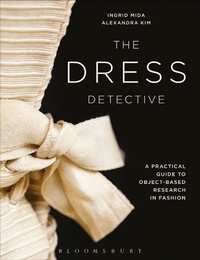
The Dress Detective
A Practical Guide to Object-Based Research in Fashion
1. Auflage
Erschienen am 19. November 2015
224 Seiten
978-1-4725-8053-5 (ISBN)
Beschreibung

The Dress Detective is the first practical guide to analyzing fashion objects, clearly demonstrating how their close analysis can enhance and enrich interdisciplinary research. This accessible book provides readers with the tools to uncover the hidden stories in garments, setting out a carefully developed research methodology specific to dress, and providing easy-to-use checklists that guide the reader through the process.
Beautifully illustrated, the book contains seven case studies of fashionable Western garments - ranging from an 1820s coat to a 2004 Kenzo jacket - that articulate the methodological framework for the process, illustrate the use of the checklists, and show how evidence from the garment itself can be used to corroborate theories of dress or fashion.
This book outlines a skillset that has, until now, typically been passed on informally. Written in plain language, it will give any budding fashion historian, curator, or researcher the knowledge and confidence to analyze the material in front of them effectively.
Beautifully illustrated, the book contains seven case studies of fashionable Western garments - ranging from an 1820s coat to a 2004 Kenzo jacket - that articulate the methodological framework for the process, illustrate the use of the checklists, and show how evidence from the garment itself can be used to corroborate theories of dress or fashion.
This book outlines a skillset that has, until now, typically been passed on informally. Written in plain language, it will give any budding fashion historian, curator, or researcher the knowledge and confidence to analyze the material in front of them effectively.
Weitere Details
Auflage
1. Auflage
Sprache
Englisch
Verlagsort
London
Großbritannien
Verlagsgruppe
Bloomsbury Publishing PLC
Zielgruppe
Für Beruf und Forschung
Für höhere Schule und Studium
Illustrationen
150 colour illus
ISBN-13
978-1-4725-8053-5 (9781472580535)
Copyright in bibliographic data and cover images is held by Nielsen Book Services Limited or by the publishers or by their respective licensors: all rights reserved.
Schweitzer Klassifikation
Weitere Ausgaben
Andere Ausgaben
Ingrid E. Mida | Alexandra Kim
The Dress Detective
A Practical Guide to Object-Based Research in Fashion
Buch
08/2018
Bloomsbury Visual Arts
40,00 €
Versand in 15-20 Tagen
Ingrid E. Mida | Alexandra Kim
The Dress Detective
A Practical Guide to Object-Based Research in Fashion
Buch
11/2015
Bloomsbury Academic
50,85 €
Artikel ist vergriffen; siehe andere Ausgabe
Personen
Ingrid Mida is a dress historian and curator. Responsible for the revival of the Ryerson Fashion Research Collection in Canada, Mida has written for various publications including Dress, Clothing Cultures, Costume Journal, Fashion Projects, Modeconnect, Worn, and Worn Through.
Alexandra Kim is a dress historian and museum professional. Kim has worked at the Ashmolean, Chertsey Museum, and Buckinghamshire County Museum and was most recently a curator at Kensington Palace, UK. She now combines research and writing with her work as an editor of Costume, the journal of the UK Costume Society.
Alexandra Kim is a dress historian and museum professional. Kim has worked at the Ashmolean, Chertsey Museum, and Buckinghamshire County Museum and was most recently a curator at Kensington Palace, UK. She now combines research and writing with her work as an editor of Costume, the journal of the UK Costume Society.
Inhalt
Foreword, Jean L. Druesedow, Kent State University Museum, USA
Acknowledgments
Introduction
Chapter 1: A Brief History of Object-based Research with Dress Artifacts
Chapter 2: How to Read a Dress Artifact
Chapter 3: Observation
Chapter 4: Reflection
Chapter 5: Interpretation
Chapter 6: Case Study of a Yellow Woolen Pelisse
Chapter 7: Case Study of a Gray-blue Sateen Corset
Chapter 8: Case Study of a Brown Velveteen and Wool Bodice
Chapter 9: Case study of a Man's Evening Suit Tailcoat and Trousers
Chapter 10: Case Study of a Lanvin Wedding Dress and Headpiece
Chapter 11: Case Study of a Ruby Red Velvet Jacket by Christian Dior
Chapter 12: Case study of a Kimono-Style Jacket by Kenzo
Appendix 1: Checklist for Observation
Appendix 2: Checklist for Reflection
Index
Acknowledgments
Introduction
Chapter 1: A Brief History of Object-based Research with Dress Artifacts
Chapter 2: How to Read a Dress Artifact
Chapter 3: Observation
Chapter 4: Reflection
Chapter 5: Interpretation
Chapter 6: Case Study of a Yellow Woolen Pelisse
Chapter 7: Case Study of a Gray-blue Sateen Corset
Chapter 8: Case Study of a Brown Velveteen and Wool Bodice
Chapter 9: Case study of a Man's Evening Suit Tailcoat and Trousers
Chapter 10: Case Study of a Lanvin Wedding Dress and Headpiece
Chapter 11: Case Study of a Ruby Red Velvet Jacket by Christian Dior
Chapter 12: Case study of a Kimono-Style Jacket by Kenzo
Appendix 1: Checklist for Observation
Appendix 2: Checklist for Reflection
Index
