

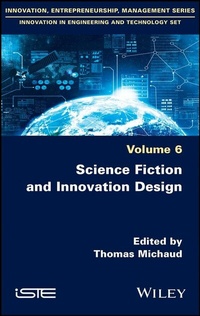
Science Fiction and Innovation Design
1. Auflage
Erschienen am 7. Oktober 2020
240 Seiten
978-1-119-77958-2 (ISBN)
Beschreibung

Science fiction is often presented as a source of utopia, or even of
prophecies, used in capitalism to promote social, political and
technoscientific innovations.
Science Fiction and Innovation Design assesses the validity of this
approach by exploring the impact this imaginary world has on the
creativity of engineers and researchers. Companies seek to
anticipate and predict the future through approaches such as
design fiction: mobilizing representations of science fiction to
create prototypes and develop scenarios relevant to
organizational strategy. The conquest of Mars or the weapons of
the future are examples developed by authors to demonstrate
how design innovation involves continuous dialogue between
multiple players, from the scientist to the manager, through to the
designers and the science fiction writers.
prophecies, used in capitalism to promote social, political and
technoscientific innovations.
Science Fiction and Innovation Design assesses the validity of this
approach by exploring the impact this imaginary world has on the
creativity of engineers and researchers. Companies seek to
anticipate and predict the future through approaches such as
design fiction: mobilizing representations of science fiction to
create prototypes and develop scenarios relevant to
organizational strategy. The conquest of Mars or the weapons of
the future are examples developed by authors to demonstrate
how design innovation involves continuous dialogue between
multiple players, from the scientist to the manager, through to the
designers and the science fiction writers.
Weitere Details
Weitere Ausgaben
Andere Ausgaben
Thomas Michaud
Science Fiction and Innovation Design
Buch
12/2020
1. Auflage
Wiley-ISTE
164,50 €
Artikel ist vergriffen; siehe andere Ausgabe
Person
Thomas Michaud holds a PhD in Management Science and an MBA. He is the author of Innovation, Between Science and Science Fiction (ISTE-Wiley, 2017) and studies the impact of the imagination on creativity and foresight.
Inhalt
- Cover
- Title Page
- Copyright Page
- Contents
- Introduction: Science Fiction: A Technical Imaginary World to be Deciphered
- Chapter 1 Technological Innovations in the Post-Apocalyptic World: Lessons Learned from Science Fiction Movies
- 1.1. Introduction
- 1.2. The future machine of humanity
- 1.3. A pending world?
- 1.4. Consuming the world
- 1.5. A finite world
- 1.6. Conclusion
- 1.7. References
- Chapter 2 Using Science Fiction in Engineering Education: Technological Imagination as an Element of Technical Culture
- 2.1. Introduction
- 2.2. What is technical culture?
- 2.2.1. In the name of autonomy
- 2.2.2. For a non-segmented technical culture
- 2.3. Science fiction, technology and narrative: fertile connections
- 2.3.1. Science fiction, a sociotechnical genre
- 2.3.2. Science fiction: a special genre in the service of technical culture
- 2.4. Science fiction and the imaginary world at the heart of training
- 2.4.1. Exploring science fiction representations
- 2.4.2. Science fiction to build an ethical approach
- 2.4.3. Perspectives: harvesting and building on science fiction imaginary worlds in order to innovate
- 2.5. Conclusion
- Chapter 3 Engineers Versus Designers: Transposition of the Technical Imaginary World into the Visual
- 3.1. Introduction
- 3.2. From applied science to applied art
- 3.3. The question of the "object" in contemporary society
- 3.4. The "transparency" of technology
- 3.5. "Transparent" objects
- 3.6. "Deconstructed" objects
- 3.7. "Printed" objects
- 3.8. "Skeleton" objects
- 3.9. "Impossible" objects
- 3.10. Conclusion
- 3.11. References
- Chapter 4 Imaginary Worlds to Be Projected or to Be Criticized? Methodological Considerations
- 4.1. Introduction
- 4.2. Challenges in the production of a corpus of imagination
- 4.3. Imaginary worlds of various qualities
- 4.4. Representations that are often appropriable and exploratory
- 4.5. New vulnerabilities
- 4.6. Context, a first point of entry for appropriating the imaginary worlds
- 4.7. Uses, another point of entry for appropriating the imaginary worlds
- 4.8. Conclusion
- 4.9. References
- Chapter 5 Marsism, from Science Fiction to Ideology
- 5.1. Introduction
- 5.2. The Mars Society's martian imaginary world
- 5.3. Elon Musk, a utopian entrepreneurial spirit
- 5.4. The technotype of the extraterrestrial base
- 5.5. Marsism, nasaism, communism and technoscientific microideologies
- 5.6. Conclusion
- 5.7. References
- Chapter 6 Engineering? Science Fiction as a Means to Expand the Epistemic Boundaries of Technoscientific Innovation
- 6.1. Introduction
- 6.2. Science fiction at the heart of engineering innovation
- 6.3. Figures of inevitability: the engineer at the confluence of discourses
- 6.3.1. The disruption-less discourses of disruption
- 6.3.2. The "convergence" discourse
- 6.3.3. The engineer character at the confluence of discourses
- 6.4. Instrumentalizing the social
- 6.4.1. "The art of the long view", or the theory of strategic foresight
- 6.4.2. The Engineer of 2020 or the "instrumentalization" of strategic forecasting theory
- 6.5. Science fiction as emancipation from the "problem-form"
- 6.6. Conclusion
- 6.7. References
- Chapter 7 Design Fiction, Technotypes and Innovation
- 7.1. Introduction
- 7.2. Altshuller, from science fiction to the TRIZ method
- 7.3. John Arnold's approach
- 7.4. The emergence of design fiction
- 7.5. From the plausibility of design fiction to possible disappointment
- 7.6. The theory of the failure of the imaginary world
- 7.7. Science fiction prototyping and design fiction
- 7.8. The pioneer, Julian Bleecker
- 7.9. Dreaming, a simulator of the dangers to come
- 7.10. Some approaches to design fiction
- 7.11. Science fiction, design fiction and foresight
- 7.12. Toward a new mythology because of storytelling
- 7.13. From utopian technologies to the technotype theory
- 7.14. Four proposals on technotypes
- 7.15. Beliefs and behavioral economics
- 7.16. Realistic, imaginary systems and their cyclicity
- 7.17. Conclusion
- 7.18. References
- Chapter 8 Science Fiction, Innovation and Organization: Where Do We Stand?
- 8.1. Introduction
- 8.2. Science fiction in its diversity
- 8.3. A focused review of academic literature on science fiction: method
- 8.4. Systematic literature review: findings
- 8.5. How science fiction sees technology and organizations
- 8.6. Dystopian visions of technologies and organizations
- 8.7. Highlighting ideologies behind technology and organizations
- 8.8. Science fiction as the source of new technological and organizational scenarios
- 8.9. Conclusion: three demonstrations and a possible research avenue
- 8.10. References
- List of Authors
- Index
- Other titles from in ISTE Innovation, Entrepreneurship and Management
- EULA
