

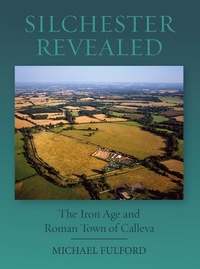
Silchester Revealed
The Iron Age and Roman Town of Calleva
Erschienen am 28. April 2021
240 Seiten
978-1-911188-86-5 (ISBN)
Beschreibung
With its apparently complete town plan, revealed by the Society of Antiquaries of London's great excavation project, 1890-1909, Silchester is one of the best known towns in Roman Britain and the Roman world more widely. Since the 1970s excavations by the author and the University of Reading on several sites including the amphitheater, the defenses, the forum basilica, the public baths, a temple, and an extensive area of an entire insula, as well as surveys of the suburbs and immediate hinterland, have radically increased our knowledge of the town and its development over time from its origins to its abandonment. This research has discovered the late Iron Age oppidum and allowed us to characterize the nature of the settlement with its strong Gallic connections and widespread political and trading links across southern Britain, to Gaul and to southern Europe and the Mediterranean.
Following a review of the evidence for the impact of the Roman conquest of A.D. 43/44, the settlement's transformation into a planned Roman city is traced, and its association with the Emperor Nero is explored. With the re-building in masonry of the great forum basilica in the early second century, the city reached the peak of its physical development. Defense building, first in earthwork, then in stone in the later third century are major landmarks of the third century, but the town can be shown to have continued to flourish, certainly up to the early fifth century and the end of the Roman administration of Britain. The enigma of the Silchester ogham stone is explored and the story of the town and its transformation to village is taken up to the fourteenth century.
Modern archaeological methods have allowed us to explore a number of themes demonstrating change over time, notably the built and natural environments of the town, the diet, dress, health, leisure activities, living conditions, occupations, and ritual behavior of the inhabitants, and the role of the town as communications center, economic hub and administrative center of the tribal 'county' of the Atrebates.
Following a review of the evidence for the impact of the Roman conquest of A.D. 43/44, the settlement's transformation into a planned Roman city is traced, and its association with the Emperor Nero is explored. With the re-building in masonry of the great forum basilica in the early second century, the city reached the peak of its physical development. Defense building, first in earthwork, then in stone in the later third century are major landmarks of the third century, but the town can be shown to have continued to flourish, certainly up to the early fifth century and the end of the Roman administration of Britain. The enigma of the Silchester ogham stone is explored and the story of the town and its transformation to village is taken up to the fourteenth century.
Modern archaeological methods have allowed us to explore a number of themes demonstrating change over time, notably the built and natural environments of the town, the diet, dress, health, leisure activities, living conditions, occupations, and ritual behavior of the inhabitants, and the role of the town as communications center, economic hub and administrative center of the tribal 'county' of the Atrebates.
Weitere Details
Weitere Ausgaben
Inhalt
- Cover
- Book title
- Copyright
- Table of Contents
- List of figures
- Acknowledgements
- Preface
- 1 Discovering Calleva
- Uncovering the town
- New techniques
- What next?
- And then .
- 2 Beginnings: the late Iron Age Royal Centre of Calleva
- Early defences, early settlement
- The earliest inhabitants
- Crafts and agriculture
- Trade networks
- Calleva in context
- 3 Caratacus, the Roman conquest, Nero and Calleva
- An unusual building
- Nero and Calleva
- Elsewhere in Calleva
- Over in Insula IX
- The Silchester Eagle
- Eating and drinking in Insula IX
- The Roman town takes shape
- 4 From town to city: Calleva, a regional centre
- No change on Insula IX
- The first forum basilica
- The baths
- A mansio
- Temples
- Private properties
- Back to Insula IX
- 5 The 2nd century: Calleva at its peak
- Water and waste
- Homes and gardens
- Urban economy
- Town and country
- Life and death
- 6 Calleva defended
- Labour and materials
- More changes
- 7 Late Roman Calleva
- A church?
- Town houses
- Smaller buildings
- 8 Living in late Roman Calleva
- Food and drink
- Breeding and growing
- Craft and industry
- Transport and economy
- Dogs and cats
- Ritual practices
- 9 The end
- Increasing insecurity
- The house of Tebicatos
- Where did all the people go?
- Medieval Silchester
- Postscript
- Further information and reading
- Index
- Back Cover
