

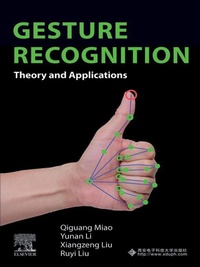
Gesture Recognition
Theory and Applications
Erschienen am 9. Juli 2024
200 Seiten
978-0-443-28960-6 (ISBN)
Beschreibung
Gesture Recognition: Theory and Applications covers this important topic in computer science and language technology that has a goal of interpreting human gestures via mathematical algorithms. The book begins by examining the computer vision-based gesture recognition method, focusing on the theory and related research results of various recent gesture recognition technologies. The book takes the evolutions of gesture recognition technology as a clue, systematically introducing gesture recognition methods based on handcrafted features, convolutional neural networks, recurrent neural networks, multimodal data fusion, and visual attention mechanisms.Three gesture recognition-based HCI (Human Computer Interaction) practical cases are introduced. Finally, the book looks at emerging research trends and application.
- Focuses on the theory and application of gesture recognition, providing a systematic introduction to commonly used datasets in the field as well as algorithms based on handcrafted features, convolutional neural networks, multimodal fusion, and attention mechanisms
- Introduces the practical applications of gesture recognition in real-world scenarios, enabling readers to enhance their practical application skills while learning about relevant technologies
- Demonstrates four main categories of gesture recognition methods and analyzes their associated challenges
Weitere Details
Weitere Ausgaben
Personen
Professor Qiguang Miao is based at the School of Computer Science and Technology, Xidian University, China. He received his PhD degree from Xidian University in 2005. He is now the dean of school of networking and continuing education in Xidian University. His research interests include intelligent image/video understanding and big data.Yunan Li is an associate professor based at the School of Computer Science and Technology, Xidian University, China. His research interests include computer vision, image/video enhancement and intelligent human behavior analysis.Xiangzeng Liu is an associate professor based at the School of Computer Science and Technology, Xidian University, China. His research interests include multi-source remote sensing image registration and fusion, target recognition and tracking, infrared image nonuniformity correction.Dr Ruyi Liu is based at the School of Computer Science and Technology, Xidian University, China. Dr Liu received her PhD degree from Xidian University in 2018. Dr Liu has published over 20 papers on international journals or conferences.
Inhalt
1. Basic Concepts and Development of Gesture Recognition2. Common Datasets in Gesture Recognition3. Handcrafted Features Based Gesture Recognition Methods4. Convolutional Neural Networks Based Gesture Recognition Methods5. Gesture Recognition Methods Based on Recurrent Neural Networks and Variants6. Multimodal Data Fusion Based Gesture Recognition Methods7. Gesture Recognition and Attention Mechanism8. Human-Computer Interaction Cases Based on Gesture Recognition9. Development Discussion on the Application of Gesture Recognition in Future HumanComputer Interaction
