

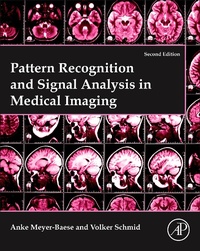
Pattern Recognition and Signal Analysis in Medical Imaging
2. Auflage
Erschienen am 21. März 2014
466 Seiten
978-0-12-416615-8 (ISBN)
Beschreibung
Medical imaging is one of the heaviest funded biomedical engineering research areas. The second edition of Pattern Recognition and Signal Analysis in Medical Imaging brings sharp focus to the development of integrated systems for use in the clinical sector, enabling both imaging and the automatic assessment of the resultant data.
Since the first edition, there has been tremendous development of new, powerful technologies for detecting, storing, transmitting, analyzing, and displaying medical images. Computer-aided analytical techniques, coupled with a continuing need to derive more information from medical images, has led to a growing application of digital processing techniques in cancer detection as well as elsewhere in medicine.
This book is an essential tool for students and professionals, compiling and explaining proven and cutting-edge methods in pattern recognition for medical imaging.
- New edition has been expanded to cover signal analysis, which was only superficially covered in the first edition
- New chapters cover Cluster Validity Techniques, Computer-Aided Diagnosis Systems in Breast MRI, Spatio-Temporal Models in Functional, Contrast-Enhanced and Perfusion Cardiovascular MRI
- Gives readers an unparalleled insight into the latest pattern recognition and signal analysis technologies, modeling, and applications
Weitere Details
Weitere Ausgaben
Personen
Professor in the Department of Scientific Computing at Florida State University. Professor Meyer-Baese has a PhD in Electrical and Computer Engineering and has been active in the field of pattern recognition applied to bioengineering and systems biology problems both in teaching and research for the past twenty years. Her research has been sponsored by NIH, NSF and private foundations and she won many international and national research awards. She is author of over 200 journal and conference publications, and three books.Professor in the Bioimaging Group at the Department of Statistics, Ludwig-Maximilians-University, Munich. Professor Schmid has a PhD in Statistics and is an expert in Bayesian methods and spatial statistics for medical and microscopy imaging. Previously, he was a Postdoctoral Research Fellow at the Institute for Biomedical Engineering, Imperial College, London.
Inhalt
Foundations of Medical Imaging; Feature Selection and Extraction; Theory of Subband Decomposition and Wavelets; The Wavelet Transform in Medical Imaging; Genetic Algorithms; Statistical Pattern Recognition; Syntactic Pattern Recognition; Neural Networks; Theory; Neural Networks: Applications; Fuzzy Logic: Theory and Clustering Algorithms; Computer Aided Diagnosis Systems
