

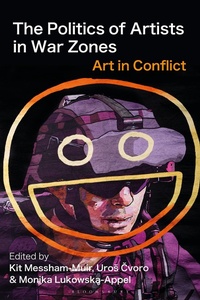
The Politics of Artists in War Zones
Art in Conflict
1. Auflage
Erschienen am 14. Dezember 2023
272 Seiten
978-1-350-38599-3 (ISBN)
Beschreibung

What exactly is contemporary war art in the West today? This book considers the place of contemporary war art in the 2020s, a whole generation after 9/11 and long past the 'War on Terror'.
Exploring the role contemporary art plays within conversations around war and imperialism, the book brings together chapters from international contemporary artists, theorists and curators, alongside the voices of contemporary war artists through original edited interviews.
It addresses newly emerged contexts in which war is found: not only sites of contemporary conflicts such as Ukraine, Yemen and Syria, but everywhere in western culture, from social media to 'culture' wars. With interviews from official war artists working in the UK, the US, and Australia, such as eX de Medici (Australia) and David Cotterrell (UK), as well as those working in post-colonial contexts, such as Baptist Coelho (India), the editors reflect on contemporary processes of memorialisation and the impact of British colonisation in Australia, India and its relation to historical conflicts. It focuses on three overlapping themes: firstly, the role of memory and amnesia in colonial contexts; secondly, the complex role of 'official' war art; and thirdly, questions of testimony and knowing in relation to alleged war crimes, torture and genocide.
Richly illustrated, and featuring three substantial interview chapters, The Politics of Artists in War Zones is a hands-on exploration of the complexities and challenges faced by war artists that contextualises the tensions between the contemporary art world and the portrayal of war. It is essential reading for researchers of fine art, curatorial studies, museum studies, conflict studies and photojournalism.
Exploring the role contemporary art plays within conversations around war and imperialism, the book brings together chapters from international contemporary artists, theorists and curators, alongside the voices of contemporary war artists through original edited interviews.
It addresses newly emerged contexts in which war is found: not only sites of contemporary conflicts such as Ukraine, Yemen and Syria, but everywhere in western culture, from social media to 'culture' wars. With interviews from official war artists working in the UK, the US, and Australia, such as eX de Medici (Australia) and David Cotterrell (UK), as well as those working in post-colonial contexts, such as Baptist Coelho (India), the editors reflect on contemporary processes of memorialisation and the impact of British colonisation in Australia, India and its relation to historical conflicts. It focuses on three overlapping themes: firstly, the role of memory and amnesia in colonial contexts; secondly, the complex role of 'official' war art; and thirdly, questions of testimony and knowing in relation to alleged war crimes, torture and genocide.
Richly illustrated, and featuring three substantial interview chapters, The Politics of Artists in War Zones is a hands-on exploration of the complexities and challenges faced by war artists that contextualises the tensions between the contemporary art world and the portrayal of war. It is essential reading for researchers of fine art, curatorial studies, museum studies, conflict studies and photojournalism.
Weitere Details
Auflage
1. Auflage
Sprache
Englisch
Verlagsort
London
Großbritannien
Verlagsgruppe
Bloomsbury Publishing PLC
Zielgruppe
Für Beruf und Forschung
Illustrationen
100 colour illus
ISBN-13
978-1-350-38599-3 (9781350385993)
Copyright in bibliographic data and cover images is held by Nielsen Book Services Limited or by the publishers or by their respective licensors: all rights reserved.
Schweitzer Klassifikation
Weitere Ausgaben
Personen
Kit Messham-Muir, Professor in Art, School of Media, Creative Arts and Social Inquiry, Curtin University, Australia, and UroS Cvoro, Associate Professor of Art Theory, Arts, Design & Architecture, University of New South Wales, Sydney, Australia are the authors of Images of War in Contemporary Art: Terror and Conflict in the Mass Media (Bloomsbury, 2021) and The Trump Effect in Contemporary Art and Visual Culture: Populism, Politics, and Paranoia (Bloomsbury, 2022).
Monika Lukowska-Appel is Research Assistant for 'Art in Conflict' at Curtin University, Australia.
Monika Lukowska-Appel is Research Assistant for 'Art in Conflict' at Curtin University, Australia.
Inhalt
List of Illustrations
Acknowledgements
Introduction: Contemporary War Art, Kit Messham-Muir (Curtin University, Australia), UroS Cvoro (UNSW, Australia) and Monika Lukowska-Appel (Curtin University, Australia)
Part One: Colonisation, Memory and Amnesia
Introduction
1. Unsettling Colonial Postamnesia: Contemporary Art, the WW1 Centenary and Beyond, Ana Carden-Coyne (Manchester University, UK)
2. Above all Else: Art as a Weapon, Lisa Slade (Art Gallery of South Australia)
3. WAR (ART): what is it good for?, Anthea Gunn and Laura Webster (Australian War Memorial)
4. Colonisation, Memory and Amnesia: Interviews with Baptist Coelho, Alana Hunt and Abdul Abdullah
Part Two: War Art, official and unofficial
Introduction
5. The War at Home, Charles Green (University of Melbourne, Australia)
6. Soldier/Artist: Negotiating the complexities of military service and critical practice, Kit Messham-Muir (Curtin University, Australia) and UroS Cvoro (UNSW, Australia)
7. War Art, Official and Unofficial: Interviews with eX de Medici, David Cotterrell, Karen Bailey and Phillip Cheung
Part Three: Knowing and Testimony
Introduction
8. The Art of Testimony, Paul Lowe (University of the Arts London, UK)
9. Inconvenient Narratives: Addressing moral ambiguity in the national war museum, Kit Messham-Muir (Curtin University, Australia)
10. Knowing and Testimony: Interviews with Todd Stone, Andrew Sneddon and Joanna Bourke
Bibliography
Index
Acknowledgements
Introduction: Contemporary War Art, Kit Messham-Muir (Curtin University, Australia), UroS Cvoro (UNSW, Australia) and Monika Lukowska-Appel (Curtin University, Australia)
Part One: Colonisation, Memory and Amnesia
Introduction
1. Unsettling Colonial Postamnesia: Contemporary Art, the WW1 Centenary and Beyond, Ana Carden-Coyne (Manchester University, UK)
2. Above all Else: Art as a Weapon, Lisa Slade (Art Gallery of South Australia)
3. WAR (ART): what is it good for?, Anthea Gunn and Laura Webster (Australian War Memorial)
4. Colonisation, Memory and Amnesia: Interviews with Baptist Coelho, Alana Hunt and Abdul Abdullah
Part Two: War Art, official and unofficial
Introduction
5. The War at Home, Charles Green (University of Melbourne, Australia)
6. Soldier/Artist: Negotiating the complexities of military service and critical practice, Kit Messham-Muir (Curtin University, Australia) and UroS Cvoro (UNSW, Australia)
7. War Art, Official and Unofficial: Interviews with eX de Medici, David Cotterrell, Karen Bailey and Phillip Cheung
Part Three: Knowing and Testimony
Introduction
8. The Art of Testimony, Paul Lowe (University of the Arts London, UK)
9. Inconvenient Narratives: Addressing moral ambiguity in the national war museum, Kit Messham-Muir (Curtin University, Australia)
10. Knowing and Testimony: Interviews with Todd Stone, Andrew Sneddon and Joanna Bourke
Bibliography
Index
