

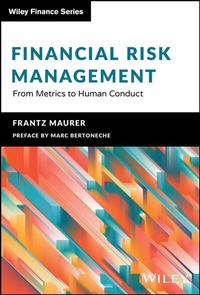
Financial Risk Management
Beschreibung

In Financial Risk Management: From Metrics to Human Conduct, Frantz Maurer delivers a thorough and practical review of the core methods used by professionals in the real world to reduce the risk of financial misconduct. Starting with the key points of banking regulation, the author then describes in simple terms the most extensively used risk metrics in the banking industry. Readers can fully grasp and implement the techniques discussed within without a strong background in probabilities or statistics. The last part of the book focuses on conduct risk markers and show how to implement a conduct risk index that benchmarks the conduct of natural risk-takers like traders.
The author describes how to marry this simple approach to financial risk with a conduct risk index that benchmarks the conduct of natural risk-takers, like traders.
Readers will also find:
* Step-by-step guidance on how to apply common risk indicators to real-world situations
* Actionable advice for improving the resilience of financial institutions against individual misconduct and misbehavior
A holistic and non-quantitative approach to a subject of critical importance, Financial Risk Management: From Metrics to Human Conduct will earn a place in the libraries of risk managers, compliance professionals, and master's level students in business administration and finance.
Weitere Details
Weitere Ausgaben
Nachauflagen
Andere Ausgaben
Person
FRANTZ MAURER is a Professor of Finance and the head of the accounting, finance and economics department at KEDGE Business School. He has also taught at HEC Paris, the University of Bordeaux, ESCP Business School, and University Paris Saclay.
Inhalt
Foreword ix
Acknowledgements xi
List of Acronyms and Symbols xiii
Introduction xvii
Part One Navigating Banking Regulation
Chapter 1 A Brief History of the Basel Framework 3
Chapter 2 The Basel I Regulatory Framework and the Cooke Ratio 7
Chapter 3 Amendment to the Basel I Framework to Incorporate Market Risks 15
Chapter 4 Implementation of the Basel II Framework 21
Chapter 5 A Guided Tour of the Basel III Framework 29
Chapter 6 Climate- Related Financial Risks 41
Part Two The Financial Risk Measurement Landscape
Chapter 7 Historical Approach to Risk 47
Chapter 8 The Gaussian Framework 61
Chapter 9 A Brief Overview of Monte Carlo Simulation 75
Chapter 10 Risk Contribution 79
Chapter 11 Shortcomings of Risk Metrics 93
Chapter 12 Ex- Post Evaluation of a Risk Model: Backtesting 103
Chapter 13 A Forward- Looking Evaluation of Risk: Stress Testing 109
Part Three Getting Conduct Risk to Scale
Chapter 14 The Big Picture of Conduct Risk 119
Chapter 15 Markers of Conduct Risk 123
Chapter 16 Worked Example 7: Building a Conduct Risk Score 127
Chapter 17 Fostering a Culture of Appropriate Conduct Outcomes 137
Chapter 18 Worked Example 8: Calculating a Risk-Taker's Conduct Risk Index 143
Chapter 19 Hot Questions Still Pending 159
Chapter 20 Understanding the Root Causes of Poor Conduct 163
Appendix 173
References 181
Contents 183
List of Figures 187
List of Tables 189
Index 191
CHAPTER 2
The Basel I Regulatory Framework and the Cooke Ratio
CAPITAL ADEQUACY
With the aim to protect internationally active banks in the G10 countries against bankruptcy, the Basel Committee developed in 1988 a common solvency ratio, known as the Cooke ratio, named after Peter Cooke, the Chairman of the Basel Committee at this time. According to BCBS (1988), through this new solvency ratio, the fundamental objective is to "strengthen the soundness and stability of the international banking system [.] with a view to diminishing competitive inequality among international banks". Stated differently, credit institutions competing for the same loans should comply with the same capital-backing constraints, and thus set aside roughly the same amount of capital. Although the Cooke ratio focuses on credit risk, the Committee acknowledges that other types of risk, such as interest risk, exchange rate risk, concentration risk and the investment risk on securities, should also be considered in assessing overall capital adequacy.1
The Cooke ratio is a solvency ratio because it requires international banks to hold capital for credit equal to at least 8% of the Risk-Weighted Assets (RWA). For example, it means that to lend ?100m, a bank should own at least ?8m of capital. The Cooke ratio is defined as follows:
where RWA is defined as the bank's asset weighted by its Risk Weight (RW). These asset weights or scores serve to differentiate the capital load according to their quality in terms of credit standing. The risk scale of on-balance-sheet assets starts at 0% for the least risky, up to 100% for the riskiest.2 The following assets are risk-weighted at 0%:
- Cash
- Gold
- Claims on OECD governments and central banks
- Claims on governments and central banks outside the OECD and denominated in the national currency
The following assets are risk-weighted at 100%:
- Longer-term claims on banks incorporated outside the OECD
- Claims on commercial companies owned by the public sector
- Claims on private-sector commercial enterprises
In between, two categories of on-balance-sheet assets are risk-weighted at 20% and 50%, respectively. The first category includes:
- Claims on all banks with residual maturity < 1 year
- Longer-term claims on OECD incorporated banks
- Claims on public-sector entities within the OECD
Loans secured on residential property are risk-weighted at 50%.
The required capital or capital charge under the Basel I framework through the Cooke ratio is straightforward to calculate. You may do this by simply multiplying the assets in each risk category by the risk weight, and then multiply the result by 8%. Let us consider a commercial loan of value $100. As indicated above, this asset is risk-weighted at 100%. The resulting capital charge for credit risk is thus $100 × 100% × 8% = $8. In this toy example, a risk weight of 100% results in a Cooke ratio of 8%. For a mortgage, backed by real property, the same loan will result in a capital charge of $100 × 50% × 8% = $4, because this asset is risk-weighted at 50%.
To calculate the Cooke ratio, we also need to know the Basel Committee on Banking Supervision (BCBS)'s definition of capital. The Committee places the emphasis on equity capital and disclosed reserves as the key constituents of capital. The rationale is that it is wholly visible in the published accounts and common to all countries' banking systems. The Committee further adds that this component of capital has a significant impact on profit margins and a bank's ability to compete. This explains why it is called Core Capital or Tier 1 Capital.
- Core Capital (Tier I Capital)
- Paid-up capital (issued and fully paid ordinary shares/common stock)
- Disclosed reserves (general and legal reserves)
The Committee also includes other important and legitimate constituents of a bank's capital base, defining the Supplementary Capital or Tier 2 Capital.
- Supplementary Capital (Tier 2 Capital)
- Undisclosed reserves (other provisions against probable losses)
- Assets revaluation reserves
- General provisions/general loan-loss reserves
- Subordinated term debt (maturity > 5 years)
- Hybrid debt/equity instruments
The sum of Tier 1 and Tier 2 elements is eligible for inclusion in the capital base.3 Besides, the following deductions must be made from this capital base in order to calculate the Cooke ratio:
- Investment in unconsolidated banking and financial subsidiary companies and investments in the capital of other banks and financial institutions
- Goodwill
There are two additional constraints for banks:
- They must hold at least 50% of their capital base in Tier 1 Core Capital. As seen before, Tier 1 Core Capital includes equity capital and published reserves from post-tax earnings. This condition can be expressed as
- Tier 1 Core Capital = Tier 2 Supplementary Capital
- Their ratio of Tier 1 Core Capital to risk-weighted assets must be equal to or higher than 4%. This condition can be expressed as
Tier 1 Core Capital/RWA = 4%
WORKED EXAMPLE 1: COMPUTATION OF THE COOKE RATIO
The assets of a bank are composed of $50m of cash, $250m of French OATs (government bonds), $150m of Singapore T-bills, $80m of loans fully secured by mortgage on residential property and $300m of corporate loans tailored to the funding of short-term cash flow issues and growth projects. The bank liabilities structure includes $35m of common stocks and $15m of subordinated debt.4
Figure 3 shows a simplified typical bank balance sheet, which reports some items mentioned in the example above.
We also reproduce the capital adequacy ratio: Cooke ratio = 8%.
FIGURE 3 A simplified bank balance sheet
The data given in our example are either uses or sources of funds. Obviously, common stocks and subordinated debt are liabilities because they refer to equity and borrowings in Figure 3, respectively. Cash is the most liquid asset and can be used to purchase other assets. This explains why cash is registered as a source of funds in the balance sheet. Financial analysts worldwide say "cash is king". Then, we have the French OATs, Singapore T-bills, and residential mortgage and corporate loans. All of these are assets referred to interest-earning securities (OATs and T-bills) and loans (residential mortgage and corporate loans) in Figure 3. Some insights about these different assets and liabilities are provided in Box 1.
Both assets and liabilities are related to "Capital" in the Cooke ratio (numerator). As seen before, the common stocks are paid-up capital and are thus defined as Tier 1 Core Capital under the Basel I framework. Subordinated term debt is referred to as Tier 2 Supplementary Capital. We thus have the following:
The next step is the calculation; that is, the Cooke ratio denominator. For this, each asset is weighted by its corresponding risk weight as defined previously:
- $50m of cash = 0%
- $250m of French OAT = 0%
- $150m of Singapore T-bills = 100%
- $80m of residential mortgage loans = 50%
- $300m of corporate loans = 100%
The French OATs are risk-weighted at 0% because France is an OECD member country. The Singapore T-bills are risk-weighted at 100% because Singapore is a non-OECD member country. The s are obtained by multiplying each bank's asset value with the corresponding risk weight:
- Cash = $50m × 0% = 0
- French OAT = $250m × 0% = 0
- Singapore T-bills = $150m × 100% = $150m
- Residential mortgage loans = $80m × 50% = $40m
- Corporate loans = $300 × 100% = $300m
Total = $490m
The risk-weighted assets of the bank are then equal to $490m. The capital adequacy Cooke ratio is thus
We conclude that this bank complies with the regulatory requirements because its Cooke ratio is higher than 8%, and its Tier 1 Core Capital ratio is also higher than 4%:
Now, let's assume that the bank in our example makes the decision to change its liabilities structure in this way: $15m of common stocks and $35m of subordinated debt. Its Cooke ratio is still equal to
However, its Tier 1 Core Capital ratio is modified as follows:
Therefore, the Tier 1 Core Capital ratio is no longer equal to or higher than 4%, meaning that the condition (ii) Tier 1 Core Capital/RWA = 4% is violated. Moreover, the condition (i) Tier 1 Core Capital = Tier 2 Supplementary Capital is also violated, since the Tier 2 Supplementary Capital ratio is equal to
We know that the Tier 2 capital ratio (7.14%) cannot exceed the Tier 1 capital ratio (3.06%). As a conclusion, our bank is no longer compliant with the Basel I regulatory...
