

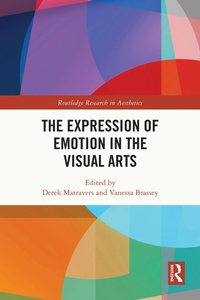
The Expression of Emotion in the Visual Arts
1. Auflage
Erschienen am 8. November 2024
170 Seiten
978-1-040-25356-4 (ISBN)
Beschreibung

The visual arts have long been held to have an intimate link with emotions. Despite this, the topic remains underexplored; when the expression of emotion is discussed, it is usually in relation to music.
This volume corrects this lacuna and presents a variety of perspectives on the expression of emotion in the visual arts with contributions from both established and early career academics. There are chapters on the empathy theory of beauty; enaction and artistic expression; emotion and experimental psychology; a 'persona' theory of visual expression; and self-expression in portraiture. There are also chapters discussing the contributions to the topic by Susanne Langer and Richard Wollheim as well as a chapter comparing the work of R.G. Collingwood and Maurice Merleau-Ponty.
The Expression of Emotion in the Visual Arts will be of interest to students and researchers in the philosophy of art and aesthetics, as well as those interested in conceptual issues in the visual arts.
This volume corrects this lacuna and presents a variety of perspectives on the expression of emotion in the visual arts with contributions from both established and early career academics. There are chapters on the empathy theory of beauty; enaction and artistic expression; emotion and experimental psychology; a 'persona' theory of visual expression; and self-expression in portraiture. There are also chapters discussing the contributions to the topic by Susanne Langer and Richard Wollheim as well as a chapter comparing the work of R.G. Collingwood and Maurice Merleau-Ponty.
The Expression of Emotion in the Visual Arts will be of interest to students and researchers in the philosophy of art and aesthetics, as well as those interested in conceptual issues in the visual arts.
Weitere Details
Reihe
Auflage
1. Auflage
Sprache
Englisch
Verlagsort
London
Großbritannien
Verlagsgruppe
Taylor & Francis Ltd
Zielgruppe
Für höhere Schule und Studium
Illustrationen
1 Line drawings, black and white; 10 Halftones, black and white; 11 Illustrations, black and white
ISBN-13
978-1-040-25356-4 (9781040253564)
Copyright in bibliographic data and cover images is held by Nielsen Book Services Limited or by the publishers or by their respective licensors: all rights reserved.
Schweitzer Klassifikation
Weitere Ausgaben
Andere Ausgaben
Derek Matravers | Vanessa Brassey
The Expression of Emotion in the Visual Arts
Buch
05/2026
1. Auflage
Routledge
57,50 €
Versand in 10-20 Tagen

Derek Matravers | Vanessa Brassey
The Expression of Emotion in the Visual Arts
Buch
12/2024
Taylor & Francis
Preis leider unbekannt
Lieferbar (Termin auf Anfrage)
Derek Matravers | Vanessa Brassey
The Expression of Emotion in the Visual Arts
Buch
11/2024
1. Auflage
Routledge
195,80 €
Versand in 10-20 Tagen
Personen
Derek Matravers is a Professor of Philosophy at The Open University and a Fellow of Churchill College, Cambridge, UK. He has written Art and Emotion (1998), Introducing Philosophy of Art: Eight Case Studies (2013); Fiction and Narrative (2014); Empathy (2017); and, with Helen Frowe, Stones and Lives: The Ethics of Protecting Heritage in War (2024). He has been the co-editor of several collections and is the author of numerous articles on aesthetics, ethics, and the philosophy of mind. He edits, with Paloma Atencia-Linares, The British Journal of Aesthetics.
Vanessa Brassey is a Visiting Research Fellow at King's College London, UK, and Co-Director of the Centre for Philosophy and Art. Her research focuses on the malleability and adeptness of our perspective-taking and the role this plays in our appreciation of the visual arts. She was previously a postdoctoral fellow for the British Society of Aesthetics and is also an exhibiting figurative painter.
Vanessa Brassey is a Visiting Research Fellow at King's College London, UK, and Co-Director of the Centre for Philosophy and Art. Her research focuses on the malleability and adeptness of our perspective-taking and the role this plays in our appreciation of the visual arts. She was previously a postdoctoral fellow for the British Society of Aesthetics and is also an exhibiting figurative painter.
Inhalt
Introduction Derek Matravers and Vanessa Brassey 1. Empathy, the Aesthetic Emotion, and Expression in the Visual Arts Derek Matravers 2. Empathy, Enaction, and Artistic Expression Jesse Prinz 3. Affective Expression in the Visual Arts Mitchell Green 4. What Makes a Painting Sad? Vanessa Brassey 5. Susanne K. Langer on Art as Expression of the Form of Feeling Adrienne Dengerink Chaplin 6. Articulating the Visible: Collingwood and Merleau-Ponty on Expression in Painting David Collins 7. Portraits, Expression, and Morality Matteo Ravasio 8. The Viewer's Share: An Examination of the Role of Projection in Pictorial Expression Elisa Galgut. Index
