

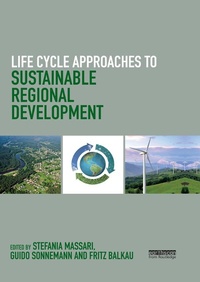
Life Cycle Approaches to Sustainable Regional Development
Erschienen am 8. Dezember 2016
362 Seiten
978-1-317-37853-2 (ISBN)
Beschreibung

Life Cycle Approaches to Sustainable Regional Development explains the ways life cycle methodologies and tools can be used to strengthen regional socio-economic planning and development in a more sustainable manner. The book advocates the adoption of systematic and long-term criteria for development decision-making, taking into account the full life cycle of materials and projects. It describes life cycle practices from both a scientific and a practitioner point of view, highlighting examples and case studies at regional level. The applications are relevant to key economic sectors, as well as for internal planning and administrative procedures. It concludes with a synthesis chapter that distills the key messages from the authors into practical guidance points on how best to use such approaches to enhance sustainability in regional development. The book is essential reading for regional and urban planners who are integrating life cycle thinking into their policy regimes, as well as for researchers working to further evolve life cycle methodologies.
Weitere Details
Sprache
Englisch
Verlagsort
London
Großbritannien
Verlagsgruppe
Taylor & Francis Ltd
Zielgruppe
Für Beruf und Forschung
Illustrationen
15 Tables, black and white; 40 Line drawings, black and white; 15 Halftones, black and white
Dateigröße
4,04 MB
ISBN-13
978-1-317-37853-2 (9781317378532)
Copyright in bibliographic data and cover images is held by Nielsen Book Services Limited or by the publishers or by their respective licensors: all rights reserved.
Schweitzer Klassifikation
Weitere Ausgaben
Andere Ausgaben
Stefania Massari | Guido Sonnemann | Fritz Balkau
Life Cycle Approaches to Sustainable Regional Development
Buch
09/2020
1. Auflage
Routledge
42,15 €
Versand in 15-20 Tagen
Stefania Massari | Guido Sonnemann | Fritz Balkau
Life Cycle Approaches to Sustainable Regional Development
Buch
12/2016
1. Auflage
Routledge
215,77 €
Versand in 10-20 Tagen
Personen
Stefania Massari became full Professor in Commodity Sciences in 2004. She works at the Faculty of Economics at the University of Salento, Lecce, Italy. She is the Coordinator of the degree courses in the business area of the Faculty and she is the Director of the 'Life cycle approaches to sustainable regional development' summer school. She holds an MSc in Biology from the University of Bari. She did research at UNEP Paris and King's College London.
Guido Sonnemann is full Professor at the University of Bordeaux, France, where he heads a research group on life cycle assessment in the Institute of Molecular Sciences at the Department of Sciences and Technology. From 2002 to 2012, he worked as UNEP Programme Officer for Innovation and Life Cycle Management in Paris. In this function, he served as Science Focal Point for UNEP's Resource Efficiency subprogramme. Guido holds a PhD in Chemical Engineering from the University Rovira and Virgili, Spain (2002), and an MSc in Environmental Chemistry from the University of Poitiers, France (1996), and he graduated as an environmental engineer from the Technical University of Berlin, Germany (1995).
Fritz Balkau is an independent international advisor on sustainable development, focusing on sustainable production and consumption practices, enhanced resource efficiency, and risk reduction in society. He has extensive environmental policy experience in government (Australia) and intergovernmental organisations, and has carried out professional consultancy projects for national governments and independent associations, as well as the OECD and UN.
Guido Sonnemann is full Professor at the University of Bordeaux, France, where he heads a research group on life cycle assessment in the Institute of Molecular Sciences at the Department of Sciences and Technology. From 2002 to 2012, he worked as UNEP Programme Officer for Innovation and Life Cycle Management in Paris. In this function, he served as Science Focal Point for UNEP's Resource Efficiency subprogramme. Guido holds a PhD in Chemical Engineering from the University Rovira and Virgili, Spain (2002), and an MSc in Environmental Chemistry from the University of Poitiers, France (1996), and he graduated as an environmental engineer from the Technical University of Berlin, Germany (1995).
Fritz Balkau is an independent international advisor on sustainable development, focusing on sustainable production and consumption practices, enhanced resource efficiency, and risk reduction in society. He has extensive environmental policy experience in government (Australia) and intergovernmental organisations, and has carried out professional consultancy projects for national governments and independent associations, as well as the OECD and UN.
Inhalt
Preface
Foreward
Section 1. Introduction - Providing the context
1. Summary
2. Sustainable regional development in a life cycle context (Fritz Balkau, Stefania Massari, Guido Sonnemann)
3. Regional development and frameworks for sustainable development (Donatella Porrini, Fabrizio Striani)
4. Financial instruments and procedures for sustainable regional development investments (William Rivenbark, Fritz Balkau)
5. Life cycle approaches to improve resource efficiency in a regional context (Guido Sonnemann, Philip Strothmann, Fritz Balkau)
6. Life cycle management for regions (Fritz Balkau, Guido Sonnemann)
Section 2. Analytical basis for life cycle approaches
7. Ecological footprint principles and methodology (Marcello Ruberti, Stefania Massari)
8. Environmentally extended input output analysis for sustainable regional development (Eskinder Gemechu, Guido Sonnemann. Francesc Castells, Isabela Butnar, Maria Llop)
9. Material flow accounts (Aldo Femia, Renato Marra Campanale)
10. Life cycle assessment - LCA (Giuseppe Tassielli, Pietro Renzulli, Bruno Notarnicola)
11. Carbon footprint principles (Harish Jeswani)
12. Water footprint principles (Philippe Loubet, Guido Sonnemann)
13. System dynamic and spatial modelling in LCA (Bertrand Laratte, Guido Sonnemann)
14. Towards life cycle sustainability assessment, including social life cycle assessment (Bernard Mazijn)
15. Organizational life cycle assessment for regional and local organizations (Julia Martinez-Blanco, Atsushi Inaba, Matthias Finkbeiner)
Section 3. Converting analysis into life cycle tools
16. Certification, standardisation and instruments for regional sustainable development- a life cycle view (Cristiana Reho, Pia Wiche)
17. Eco-design and Product-Service Systems (Ben Walker)
18. Eco-labels in sustainable development (Ben Walker)
19. Life cycle basis of sustainable procurement (Fritz Balkau)
20. Industrial ecology and sustainable performance of business parks (Jean-Francois Valles)
21. Natural resource use efficiency and economic productivity (Pierluigi Toma, Stefania Massari, Pier Paolo Miglietta)
22. Environmental and Landscape Management System ( ELMS) (Riccardo Beltramo)
23. Environmental product declarations to support regional development (Annik M. Fet)
Section 4. Using life cycle approaches at regional level
24. Ecological footprint: a local policy perspective (Pier Paolo Miglietta, Federica De Leo, Pierluigi Toma)
25. Economic analysis of regional sustainability - Hungary (Klara Szita Tothne, Judit Roncz)
26. Circular economy and regional implications (Fritz Balkau)
27. Life cycle management for regional development in France: example of building sector (Naeem Adibi, Marie Darul, Vanessa Pasquet, Christelle Demaretz, Christian Traisnel)
28. From product LCAs to territorial LCAs: methodological principles (Eleonore Loiseau, Philippe Roux)
29. Integrated life cycle and risk assessment of human health impacts in Catalonia (Guido Sonnemann, Marta Schuhmacher, Francesc Castells)
30. LCA application in regional waste management in Chile (Alberto Bezama)
31. Water footprint assessment at the regional level (Guoping Zhang, Mesfin M. Mekonnen)
32. Carbon footprint of biofuels (Harish Jeswani)
33. Sustainable procurement based on life cycle costing (Bernard Mazijn)
34. Sustainable performance of industrial parks (Jean-Francois Valles)
35. Sustainable redevelopment of degraded land and landscapes (Peter Whitbread-Abrutat)
Section 5. Integrated use of life cycle approaches in key economic sectorS
36. Sustainable agri-food chains and LCA (Bruno Notarnicola, Pietro Renzulli, Giuseppe Tassielli)
37. Integration of LCA, LCC and social LCA for assessing a bioeconomy region (Alberto Bezama, Anke Siebert, Jakob Hildebrandt, Daniela Thraen)
38. Responsible Mining - from a life cycle to a stewardship approach (Ross Hamilton, Andrew S. Parsons)
39. Trends and Considerations of Renewable Energy Development: A Regional Perspective (Mark Radka, Giulia Ferrini, Agathe Laure, Ravina Brizmohun)
40. Closing the loop: the example of Packaging (Massimo Lombardi)
41. Life cycle aspects of the Walloon wood sector (Nelle Thyssen, Vanessa Zeller )
42. Global warming assessment of Himalayan buildings (Silu Bhochhibhoya, Raffaele Cavalli)
43. Integrated waste management and resource recovery in India (Asha Panwar)
44. Biodiversity restoration and sustainable tourism in South-western Australia (Keith Bradby)
Section 6. Life cycle perspectives for regional socio-economic development
45. Synthesis - Life cycle approaches and perspectives for sustainable regional development (Guido Sonnemann, Fritz Balkau)
Foreward
Section 1. Introduction - Providing the context
1. Summary
2. Sustainable regional development in a life cycle context (Fritz Balkau, Stefania Massari, Guido Sonnemann)
3. Regional development and frameworks for sustainable development (Donatella Porrini, Fabrizio Striani)
4. Financial instruments and procedures for sustainable regional development investments (William Rivenbark, Fritz Balkau)
5. Life cycle approaches to improve resource efficiency in a regional context (Guido Sonnemann, Philip Strothmann, Fritz Balkau)
6. Life cycle management for regions (Fritz Balkau, Guido Sonnemann)
Section 2. Analytical basis for life cycle approaches
7. Ecological footprint principles and methodology (Marcello Ruberti, Stefania Massari)
8. Environmentally extended input output analysis for sustainable regional development (Eskinder Gemechu, Guido Sonnemann. Francesc Castells, Isabela Butnar, Maria Llop)
9. Material flow accounts (Aldo Femia, Renato Marra Campanale)
10. Life cycle assessment - LCA (Giuseppe Tassielli, Pietro Renzulli, Bruno Notarnicola)
11. Carbon footprint principles (Harish Jeswani)
12. Water footprint principles (Philippe Loubet, Guido Sonnemann)
13. System dynamic and spatial modelling in LCA (Bertrand Laratte, Guido Sonnemann)
14. Towards life cycle sustainability assessment, including social life cycle assessment (Bernard Mazijn)
15. Organizational life cycle assessment for regional and local organizations (Julia Martinez-Blanco, Atsushi Inaba, Matthias Finkbeiner)
Section 3. Converting analysis into life cycle tools
16. Certification, standardisation and instruments for regional sustainable development- a life cycle view (Cristiana Reho, Pia Wiche)
17. Eco-design and Product-Service Systems (Ben Walker)
18. Eco-labels in sustainable development (Ben Walker)
19. Life cycle basis of sustainable procurement (Fritz Balkau)
20. Industrial ecology and sustainable performance of business parks (Jean-Francois Valles)
21. Natural resource use efficiency and economic productivity (Pierluigi Toma, Stefania Massari, Pier Paolo Miglietta)
22. Environmental and Landscape Management System ( ELMS) (Riccardo Beltramo)
23. Environmental product declarations to support regional development (Annik M. Fet)
Section 4. Using life cycle approaches at regional level
24. Ecological footprint: a local policy perspective (Pier Paolo Miglietta, Federica De Leo, Pierluigi Toma)
25. Economic analysis of regional sustainability - Hungary (Klara Szita Tothne, Judit Roncz)
26. Circular economy and regional implications (Fritz Balkau)
27. Life cycle management for regional development in France: example of building sector (Naeem Adibi, Marie Darul, Vanessa Pasquet, Christelle Demaretz, Christian Traisnel)
28. From product LCAs to territorial LCAs: methodological principles (Eleonore Loiseau, Philippe Roux)
29. Integrated life cycle and risk assessment of human health impacts in Catalonia (Guido Sonnemann, Marta Schuhmacher, Francesc Castells)
30. LCA application in regional waste management in Chile (Alberto Bezama)
31. Water footprint assessment at the regional level (Guoping Zhang, Mesfin M. Mekonnen)
32. Carbon footprint of biofuels (Harish Jeswani)
33. Sustainable procurement based on life cycle costing (Bernard Mazijn)
34. Sustainable performance of industrial parks (Jean-Francois Valles)
35. Sustainable redevelopment of degraded land and landscapes (Peter Whitbread-Abrutat)
Section 5. Integrated use of life cycle approaches in key economic sectorS
36. Sustainable agri-food chains and LCA (Bruno Notarnicola, Pietro Renzulli, Giuseppe Tassielli)
37. Integration of LCA, LCC and social LCA for assessing a bioeconomy region (Alberto Bezama, Anke Siebert, Jakob Hildebrandt, Daniela Thraen)
38. Responsible Mining - from a life cycle to a stewardship approach (Ross Hamilton, Andrew S. Parsons)
39. Trends and Considerations of Renewable Energy Development: A Regional Perspective (Mark Radka, Giulia Ferrini, Agathe Laure, Ravina Brizmohun)
40. Closing the loop: the example of Packaging (Massimo Lombardi)
41. Life cycle aspects of the Walloon wood sector (Nelle Thyssen, Vanessa Zeller )
42. Global warming assessment of Himalayan buildings (Silu Bhochhibhoya, Raffaele Cavalli)
43. Integrated waste management and resource recovery in India (Asha Panwar)
44. Biodiversity restoration and sustainable tourism in South-western Australia (Keith Bradby)
Section 6. Life cycle perspectives for regional socio-economic development
45. Synthesis - Life cycle approaches and perspectives for sustainable regional development (Guido Sonnemann, Fritz Balkau)
