

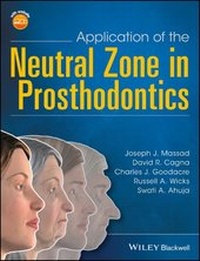
Application of the Neutral Zone in Prosthodontics
Beschreibung

Weitere Details
Weitere Ausgaben
Andere Ausgaben
Personen
Inhalt
Foreword ix
Preface xi
About the Companion Website xiii
1 Assessment of Edentulous Patients 1
Introduction 1
The Patient Interview 1
Patient Interview: Age 2
Patient Interview: Attitude 2
Patient Interview: Expectations 2
Patient Interview: Chief Complaint 3
Patient Interview: General Health 3
Patient Interview: Complete Denture Experience 3
Patient Interview: Denture Remake Frequency 4
Patient Interview: Patient Satisfaction 4
Patient Interview: Photographs, Diagnostic Casts, and Radiographs 4
The Facial Analysis 4
Facial Analysis: Facial Tissue Tone 5
Facial Analysis: Tooth and Denture Base Display 6
Facial Analysis: Midlines 6
Facial Analysis: Lip Mobility 7
Facial Analysis: Lip Dimension 7
Prosthetic Factors 8
Prosthetic Factors: Vertical Dimensions 8
Prosthetic Factors: Existing Dentures 8
Prosthetic Factors: Skeletal Relationship 9
Prosthetic Factors: Saliva 9
Prosthetic Factors: Oral Tolerance 10
Prosthetic Factors: Temporomandibular Joints 10
Prosthetic Factors: Oral Cancer Review 10
Oral Characteristics 11
Oral Characteristics: Palatal Throat Form 11
Oral Characteristics: Arch Size 11
Oral Characteristics: Maxillary Ridge Height 11
Oral Characteristics: The Palate 12
Oral Characteristics: Maxillary Ridge Contour 13
Oral Characteristics: The Maxillary Denture Foundation 13
Oral Characteristics: Mandibular Ridge Height 14
Oral Characteristics: Mandibular Ridge Contour 14
Oral Characteristics: Mandibular Muscle Attachments 14
Oral Characteristics: Mandibular Denture Foundation 15
Oral Characteristics: Maxillary Tuberosity Curve 15
Oral Characteristics: Vestibule 16
Oral Characteristics: Frenula Attachments 16
Oral Characteristics: Pterygomandibular Raphe 16
Oral Characteristics: Denture Bearing Soft Tissues 16
Oral Characteristics: Retromolar Pads 17
Oral Characteristics: Maxillary Ridge Crest to Resting Lip Length (Esthetic Space) 17
Oral Characteristics: Mandibular Ridge Crest to Resting Lip Length (Esthetic Space) 17
Oral Characteristics: Maximal Oral Opening 17
Oral Characteristics: Retromylohyoid Space 18
Oral Characteristics: Tongue Size 19
Oral Characteristics: Tongue Position 19
Oral Characteristics: The Neutral Zone 20
Summary 21
References 21
2 Orthopedic Resolution of Mandibular Posture 25
Introduction 25
Conditioning Abused Tissues and Stabilizing the Existing Prosthesis 26
Materials Properties and Technique 26
Technique 26
Re?-establishing Orthopedic Mandibular Position 28
Summary 33
References 33
3 Definitive Impressions 35
Preimpression Considerations 35
Background 35
Impression Fundamentals 35
Impression Materials 36
Edentulous Impression Trays 37
Technique for Making Single Appointment Definitive Impressions for Conventional Complete Dentures 37
Tray Selection and Tray Adaptation 37
Fabrication of Tray Stops 38
Border Molding the Impression Tray 39
Final (Definitive) Impression 41
Techniques for Making Single Appointment Definitive Impressions for Implant?-Assisted Complete Dentures and Immediate Dentures 43
Attachment Selection 43
Implant?-Retained Overdentures 43
Tray Selection 43
Impression Technique 44
Implant?-Retained and Supported Overdentures 45
Immediate Dentures 46
Master Cast Production 47
Summary 48
References 48
4 Fabricating Record Bases, Occlusal Rims, and Mounting a Central Bearing Device 51
Introduction 51
Fabrication of Record Base and Occlusal Rims 51
Fabrication of Maxillary Wax Occlusal Rim 52
Fabrication of Neutral Zone Mandibular Occlusal Rim 56
Technique 56
Jaw Recorder Device (Central Bearing Device) 59
Jaw Recorder Device Assembly 59
Mounting the Jaw Recorder Device on Record Bases 59
Mounting of the Jaw Recorder for Implant Overdentures 61
Mounting the Jaw Recorder Device on Partially Edentulous Arches 61
Procedure 62
Summary 62
References 64
5 Developing an Esthetic Blueprint 65
Introduction 65
Contouring and Shaping the Maxillary Occlusal Rim 65
Summary 72
References 72
6 Registering the Maxillo?-Mandibular Jaw Relationship 75
Introduction 75
Facebow Recording 75
Centric Relation Recording for the Edentulous Patient 76
Centric Relation Recording for the Partially Dentate Patient 83
Summary 86
References 86
7 Neutral?-Zone Registration 89
Introduction 89
Recording the Physiologic Neutral Zone for Edentulous Patients 89
Technique 90
Recording the Physiologic Neutral Zone for a Dentate Patient 94
Technique 94
Summary 96
References 96
8 Second Laboratory Procedure: Selection and Arrangement of Prosthetic Teeth 99
Introduction 99
Indexing the Esthetic Blueprint Record 99
Indexing the Neutral Zone Record 100
Selection of Anterior Teeth 101
Maxillary Anterior Teeth Arrangement 102
Mandibular Anterior Teeth Arrangement 103
Selection of Posterior Teeth 105
Mandibular Posterior Teeth Arrangement 106
Maxillary Posterior Tooth Arrangement 108
Tooth Selection and Arrangement for the Partially Edentulous Patient 109
Summary 111
References 111
9 Trial Placement Appointment 113
Trial Placement 113
Evaluation of Esthetics 113
Evaluation of Phonetics 114
Evaluation of Occlusal Vertical Dimension (OVD) 116
Evaluation of Centric Contact Position 116
External Impressions 117
Technique 118
Summary 124
References 125
10 Denture Placement 127
Introduction 127
Placement of Immediate Dentures 127
Placement Procedures 129
Evaluation and Adjustment of Intaglio Surface 129
Technique 129
Evaluation and Adjustment of Denture Borders 131
Evaluating the Cameo Surface 133
Occlusal Evaluation and Correction 133
Subtractive Correction Technique 135
Additive Correction Technique 136
Patient Education and Instructions 137
Technique for Adhesive Application 138
Technique for Adhesive Removal 138
Home Care Instructions for Denture Patients 140
Postplacement Problems with New Dentures 140
Retention Problems 140
Soreness 141
Sore Throat 141
Speech Problems 141
Gagging 141
Summary 142
References 142
11 Use of CAD/CAM Technology for Recording and Fabricating Neutral?-Zone Dentures 145
Introduction 145
Registering the Neutral Zone during Impression Making 145
Technique 145
Registering the Neutral Zone during Maxillo?-Mandibular Records 147
Technique 147
Registering the Neutral Zone during the Trial Placement 147
Technique 147
Summary 150
References 151
Index 153
1
Assessment of Edentulous Patients
Introduction
A critical and somewhat perplexing aspect of the management of the edentulous condition is the prediction of therapeutic outcomes and patient satisfaction. The most fundamental factor determining a precise prognosis is a thorough and accurate pretreatment examination [1-3]. Even though patients may receive the best therapy, the treatment will fail if underlying conditions remain undiagnosed.
This chapter reviews a method for the pretreatment evaluation of edentulous patients and existing prostheses to arrive at a sound understanding of factors that will affect therapy and the probability that the treatment's objective can be achieved. Using appropriate assessment tools, the practitioner can better determine if the patient's expectations can be met.
Much has been published in the dental literature regarding anatomic [4, 5] and psychological variations [6, 7] in edentulous patients. Before considering management of these challenging patients, objectives include thorough examination, diagnosis of existing conditions, consideration of available therapy, and assessment of the prognosis of each available treatment option [1, 2]. Both subjective and objective patient factors must be taken into consideration [1]. A rational stepwise pretreatment protocol will help to prevent critical diagnostic information from being overlooked. Detailed documentation of findings is essential from a dento-legal standpoint.
The pretreatment protocol provided is relatively easy to follow, quick to perform, and easy to reproduce. It yields summary findings that correspond with specific prognostic conclusions. The protocol is divided into: (i) patient interview; (ii) examination of existing facial characteristics; and (iii) examination of edentulous conditions, i.e., anatomic, morphologic, and muscular status.
The Patient Interview
Successful therapy is facilitated by the provider coming to know the patient, from both personal and logistical perspectives; this includes how the patient arrived in the practice. If the patient was referred, the referral source should be known and contacted, and the reason for the referral noted. If the patient arrived due to marketing of the practice, care must be taken to investigate if the patient's needs are consistent with therapy provided by the practitioner.
The initial patient interview permits the patient and the practitioner to know one another [8]. Quality time spent at the beginning sets the stage for an optimized patient-provider relationship. Both the physical and psychological status of the patient should be triaged during the first appointment [8]. Anticipation of communication problems and interception of commonly encountered interpersonal problems are frequently as important as clinical findings. Discerning the primary etiology of existing patient dissatisfaction is essential for breaking the cycle of unsuccessful treatment attempts. Complaints and expectations expressed by the patient, and treatment obstacles encountered by previous dentists, can provide a critical influence on the acceptance of the patient into the practice and the treatment offered.
Be aware that the pretreatment protocol provided might initially appear to consume an inordinate amount of time and effort. Some might say that this is financially unjustifiable. However, once understood and skillfully conducted, the protocol reduces overall management time, permits appreciation of the treatment rendered, and significantly contributes to overall therapeutic success.
Some patients may be fearful, nervous, or shy, and inadvertently fail to respond directly to questions. Recognition of these individuals early in the interview process is critical. In many cases, a dental auxiliary can better elicit patient responses than the practitioner. Obtaining honest and accurate patient responses will affect outcomes. The pretreatment protocol and associated electronic documentation presented incorporate data-gathering processes designed to elicit thorough, concentrated, and accurate answers from patients.
Patient Interview: Age
The patient's chronological age should be critically compared with general physical health and existing oral conditions. Older patients may be afflicted with poor neuromuscular coordination [9, 10], suboptimal nutritional status [11, 12], diminished adaptability [9, 10], and salivary secretion (both quantity and quality) [11], and highly vulnerable denture-bearing tissues [10, 11]. These factors adversely influence aging edentulous patients' ability successfully to tolerate and function with conventional complete dentures, which should be discussed prior to initiating treatment [8]. Analogies such as "when dentures move and there's limited saliva, the pink plastic acts like sand paper against your gums creating irritation" help patients to understand better the problems that they face.
Patient Interview: Attitude
Coming to appreciate patient attitude may be as simple as presenting nonleading questions and permitting the patient time to respond. Questions that may be used to gauge patient attitude include:
- How are you feeling today?
- How was your experience with the previous dentist that treated you?
- What do you think about your current and previous dentures?
Based on patient responses and ensuing discussions, qualifications of patient attitude as good, average, or poor may be made. Of course, additional questioning may be necessary to arrive at a reasonable determination.
Patient Interview: Expectations
If not thoroughly investigated prior to initiating treatment, patient expectations may not be apparent until problems unexpectedly emerge in the course of therapy, and the patient's demeanor begins to decline [9, 13]. Direct and specific questioning of the patient regarding expectations will permit documentation of responses and qualification of expectations as high, medium, low, or still unsure. Patients can also be asked the following questions to understand further the nature of their expectations:
- What kind of improvement in appearance do you expect from your new dentures? In response to this question, a 50-year-old patient may provide a picture of an 18-year-old celebrity stating, "I want my teeth to look like hers." This would indicate that the patient possesses unrealistic expectations. A subsequent patient may suggest, "I want perfect teeth," necessitating a better understanding of what is meant by "perfect."
- What kind of improvement in chewing ability do you expect from new dentures?
- What kind of improvement in fit do you expect from the new dentures?
- How long do you expect new dentures to last?
- How often do you expect to return to the dentist for examinations and adjustments?
The nature of the patient's desires and demands relative to proposed treatment must be considered by the practitioner within the context of his?/?her level of experience and expertise. If the patient expects more than the practitioner can comfortably provide, definitive treatment should not commence and referral to a more experienced colleague should be in order. Additionally, if the patient is unable to appreciate the limitations of the therapy offered, it is inappropriate to initiate treatment.
It is the responsibility of the practitioner to address unattainable expectations fairly and honestly, through frank discussion with the patient, communicating what can and cannot be accomplished with treatment; this is particularly true with complete denture therapy. Failure to address unrealistic expectations often leads to treatment failure and rapid deterioration of the patient-provider relationship. Patients that refuse to accept known limitations of therapy and express inflexibility in this regard are generally challenging to manage successfully. Not initiating definitive treatment for these individuals is ethically, professionally, and financially appropriate.
Patient Interview: Chief Complaint
Providing state-of-the-art treatment that does not manage the patient's main concerns may provide a level of personal satisfaction for the provider but is rarely successful in the long run. It is therefore important to: (i) request that patients specifically voice their greatest dental concern?/?concerns; (ii) document these chief concerns using the patients' exact words, and (iii) review the chief concern?/?concerns, as documented, with the patients to confirm accuracy [13].
Most dental patients are not familiar with professional and dental terminology. It is therefore important to ensure that the practitioner understand clearly the patient's chief concerns as expressed. Asking the following questions may permit a greater appreciation for the nature of the chief concerns:
- Are your dentures loose?
- Can you eat most foods?
- Do your gums get sore?
- Do you have pain now?
- Are you happy with the appearance of your smile?
- Is there anything else that bothers you?
Patient Interview: General Health
General health is a significant factor that can affect the overall success of...
