

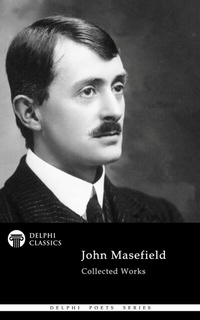
Delphi Collected Works of John Masefield (Illustrated)
Beschreibung
The English Poet Laureate from 1930 until 1967, John Masefield produced a wide range of literary masterpieces, encompassing ballads, nature poetry, adventure novels, social dramas and mythological children's works. His long narrative poems, including the much-celebrated 'The Everlasting Mercy' (1911), shocked the literary orthodoxy of the time with its colloquial expressions and coarseness of themes. Masefield is revered for his endeavour to make poetry a popular art and for his influence on the Georgian movement, advocating respect for formalism, as well as bucolic and romantic subject matter. The Delphi Poets Series offers readers the works of literature's finest poets, with superior formatting. This volume presents Masefield's collected works, with related illustrations and the usual Delphi bonus material. (Version 1)
* Beautifully illustrated with images relating to Masefield's life and works
* Concise introduction to Masefield's life
* The most complete poetry edition possible in the US
* Images of how the poetry books were first printed, giving your eReader a taste of the original texts
* Rare poetry collections digitised here for the first time
* Excellent formatting of the poems
* Special chronological and alphabetical contents tables for the poetry
* Easily locate the poems you want to read
* Includes a selection of Masefield's novels and non-fiction- spend hours exploring his varied works
* Ordering of texts into chronological order and literary genres
Please visit www.delphiclassics.com to see our wide range of poet titles
CONTENTS:
The Poetical Works
Brief Introduction: John Masefield
Salt-Water Ballads (1902)
Ballads and Poems (1910)
The Everlasting Mercy (1911)
The Widow in the Bye Street (1912)
Dauber (1912)
The Story of a Round-House and Other Poems (1912)
The Daffodil Fields (1913)
Philip the King and Other Poems (1914)
Good Friday (1916)
Lollingdon Downs and Other Poems with Sonnets (1917)
Rosas (1918)
Reynard the Fox (1919)
Enslaved and Other Poems (1920)
Right Royal (1920)
Selected Poems (1922)
King Cole and Other Poems (1923)
A King's Daughter (1923)
Poems from 'Sard Harker' (1924)
Poems from 'Odtaa' (1926)
The Poems
List of Poems in Chronological Order
List of Poems in Alphabetical Order
The Novels
Multitude and Solitude (1909)
Martin Hyde: The Duke's Messenger (1909)
Jim Davis (1911)
Sard Harker (1924)
ODTAA (1926)
The Non-Fiction
On the Spanish Main (1906)
William Shakespeare (1911)
John M. Synge (1915)
Gallipoli (1916)
The Old Front Line (1917)
The War and the Future (1918)
Please visit www.delphiclassics.com to browse through our range of poetry titles or buy the entire Delphi Poets Series as a Super Set
Alle Preise
Weitere Details
Inhalt
Brief Introduction: John Masefield
John Masefield was born in Ledbury, Herefordshire, to George Masefield, a solicitor, and his wife Caroline, who died giving birth to his sister when Masefield was six. He went to live with his aunt and his father died soon afterwards, following a mental breakdown. After an unhappy education at the King's School in Warwick, he left in 1891 to board HMS Conway, both to train for a life at sea and to break his addiction to reading, which his aunt thought would be best for him. He spent several years aboard the ship, devoting much of his time to reading and writing. It was on the Conway that Masefield's love of story-telling grew, as he listened to the yarns and sea-lore told by the sailors and so he decided to become a writer himself.
In 1894 he boarded the Gilcruix, destined for Chile, on which voyage he experienced extreme weather and observed exotic wildlife. He was awed by the beauty of nature, including a rare sighting of a nocturnal rainbow. On reaching Chile he suffered from sunstroke and was hospitalised. He eventually started his homeward voyage to England as a passenger aboard a steamship. In 1895, when the ship approached New York City, the urge to become a writer overtook him and he jumped ship. For several months he lived as a vagrant, drifting between odd jobs, before he returned to New York City and found work as a barkeeper's assistant. During the Christmas of 1895 he read a poem in the December edition of Truth, a New York periodical, which would have a lasting influence on the course of his life. The poem was "The Piper of Arll" by Duncan Campbell Scott, inspiring him to become a poet.
Up until 1897 he was employed at a large carpet factory in Yonkers, New York, where long hours were expected and conditions were demanding. He purchased up to 20 books a week, devouring both modern and classic literature. His interests at this time were diverse and his reading included works by George du Maurier, Dumas, Thomas Browne, Hazlitt, Dickens, Kipling, and R. L. Stevenson. Chaucer also became very important to him, as well as Keats and Shelley. In time, Masefield decided to return home to England.
In 1901, when Masefield was twenty-three, he met Constance de la Cherois Crommelin (1867-1960), who was twelve years his senior and of Huguenot descent. They were married two years later. Constance held a mathematics teaching position and she was educated in classics and English Literature, so she was a good match for the budding poet, despite the difference in their ages. The couple went on to have two children, Isabel Judith and Lewis Crommelin.
A year after his marriage, Masefield was put in charge of the fine art section of the Arts and Industrial Exhibition in Wolverhampton. By this time, his poems were already being published in periodicals and his first collection of verse, Salt-Water Ballads, had recently appeared, featuring the now famous poems "Sea Fever" and "Cargoes".
Masefield was an adept writer in almost all genres. He wrote his first two novels, Captain Margaret (1908) and Multitude and Solitude (1909), before giving poetry up for a time to concentrate on fiction. He returned to verse in 1911, with the publication of the narrative poem The Everlasting Mercy, which was styled as the confession of a man that has turned from sin to Christianity. It was the work that made Masefield famous, shocking early twentieth century British sensibilities with its direct, honest and often harsh language. In the poem, the life of the protagonist Saul Kane, a violent, drunken womanizer, is presented in frank detail. It was widely praised by the critics, resulting in Masefield winning the annual Edmond de Polignac Prize the following year. He then produced two more narrative poems, "The Widow in the Bye Street" and "Dauber" to much acclaim.
When war broke out in 1914 Masefield was old enough to be exempted from military service, though he decided to join the staff of a British hospital for French soldiers, serving a six-week term in the spring of 1915; he later published a revealing account of his experiences.
Masefield had set up his country retreat at Lollingdon Farm in Cholsey, Oxfordshire. It would inspire a number of his finest poems and sonnets under the title Lollingdon Downs, published in 1917. Constance did not like the reclusive nature of the old country manor and they feared for their son's health due to dampness caused by a leaking roof, which was playing havoc with Lewis' health. Thus, they moved to Boars Hill, near Oxford, where they could still see and visit the Berkshire Downs.
The Old Front Line was published in December 1917 and Masefield was invited to the United States on a three-month lecture tour. Although his primary purpose was to lecture on English literature, he also intended to collect information on the mood and views of Americans regarding the war in Europe. When he returned to England he submitted a report to the British Foreign Office and suggested that he should write a book about the failure of the Allied effort in the Dardanelles that might be used in the United States to counter German propaganda. The resulting work, Gallipoli, was a success.
In 1918 Masefield returned to America on his second lecture tour, spending much of his time speaking to American soldiers waiting to be sent to Europe. These speaking engagements were very successful. On one occasion a battalion of black soldiers danced and sang for him after his lecture. During this tour he matured as a public speaker and discovered his unique ability to touch the emotions of his audience, speaking publicly from his heart rather than from dry scripted words. Towards the end of his visit, both Yale and Harvard Universities conferred honorary doctorates of letters on the poet.
With the advance of the Roaring Twenties, Masefield was an accomplished and respected writer. His family were comfortable at Boar's Hill, a somewhat rural setting, where Masefield took up beekeeping, goat-herding and poultry-keeping. His poetry continued to be popular, with the first edition of his Collected Poems (1923) selling as many as 80,000 copies. After publishing King Cole (1921), a difficult poem exploring the relationship between humanity and nature, Masefield turned away from long poems and back to novels. Between 1924 and 1939 he published 12 novels of differing genres, as well as several powerful dramatic pieces. Most of these were based on Christian themes and Masefield was startled to receive a ban on the performance of plays on biblical subjects. This prohibition actually originated from the time of the Reformation and had been revived a generation earlier to prevent a production of Oscar Wilde's Salome. However, a compromise was reached and in 1928 The Coming of Christ was the first play to be performed in an English cathedral since the Middle Ages.
In 1921 Masefield received an honorary doctorate of literature from the University of Oxford and two years later he organised the Oxford Recitations, an annual contest that sought "good speakers of verse" and "the beautiful speaking of poetry", which was generally deemed a success. He was also a founding member of the Scottish Association for the Speaking of Verse. He later came to question whether the Oxford events should continue as a contest, considering that they might be better run as a festival. However, in 1929, after he broke with the competitive element, the Oxford Recitations came to an end.
In 1930 the Poet Laureate Robert Bridges died and a successor was required. On the recommendation of the Prime Minister, Ramsay MacDonald, King George V appointed Masefield, who remained in the post until his death in 1967. The only person to hold the office for a longer period was Alfred, Lord Tennyson. On his appointment, The Times wrote of Masefield: "his poetry could touch to beauty the plain speech of everyday life". He took his appointment seriously and produced a large quantity of poems for royal occasions, which were sent to The Times for publication. His modesty was shown by his inclusion of a stamped and self-addressed envelope with each submission, so that the poem could be returned if it was deemed unacceptable.
Next, Masefield was awarded the Order of Merit by King George V and received numerous honorary degrees from British universities. In 1937 he was elected President of the Society of Authors. He encouraged the continued development of English literature and poetry, founding an annual awarding of Royal Medals for Poetry for a first or second published edition of poems by a poet under the age of thirty-five. Although his speaking engagements often called him away on long tours, he still produced significant amounts of literary work.
It was not until he reached the age of seventy that Masefield slowed his pace, mainly due to illness. In 1960 Constance died, aged ninety-three, after a long illness. Although he had spent a traumatic year nursing his wife, he continued his duties as Poet Laureate. By late 1966 Masefield had developed gangrene in his ankle, which spread to his leg and he died of the infection on 12 May 1967. In accordance with his wishes, he was cremated and his ashes were placed in Poets' Corner in Westminster Abbey. His last volume of poetry, In Glad Thanksgiving, was published only months before his death, aged eighty-eight.
John Masefield's literary career was rich and varied, and although his reputation waned in later years,...
