

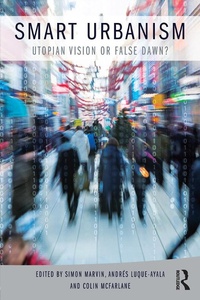
Smart Urbanism
Utopian vision or false dawn?
Erschienen am 14. Dezember 2015
212 Seiten
978-1-317-54932-1 (ISBN)
Beschreibung

Smart Urbanism (SU) - the rebuilding of cities through the integration of digital technologies with buildings, neighbourhoods, networked infrastructures and people - is being represented as a unique emerging 'solution' to the majority of problems faced by cities today. SU discourses, enacted by technology companies, national governments and supranational agencies alike, claim a supremacy of urban digital technologies for managing and controlling infrastructures, achieving greater effectiveness in managing service demand and reducing carbon emissions, developing greater social interaction and community networks, providing new services around health and social care etc. Smart urbanism is being represented as the response to almost every facet of the contemporary urban question.
This book explores this common conception of the problematic of smart urbanism and critically address what new capabilities are being created by whom and with what exclusions; how these are being developed - and contested; where is this happening both within and between cities; and, with what sorts of social and material consequences. The aim of the book is to identify and convene a currently fragmented and disconnected group of researchers, commentators, developers and users from both within and outside the mainstream SU discourse, including several of those that adopt a more critical perspective, to assess 'what' problems of the city smartness can address.
The volume provides the first internationally comparative assessment of SU in cities of the global north and south, critically evaluates whether current visions of SU are able to achieve their potential; and then identifies alternative trajectories for SU that hold radical promise for reshaping cities.
This book explores this common conception of the problematic of smart urbanism and critically address what new capabilities are being created by whom and with what exclusions; how these are being developed - and contested; where is this happening both within and between cities; and, with what sorts of social and material consequences. The aim of the book is to identify and convene a currently fragmented and disconnected group of researchers, commentators, developers and users from both within and outside the mainstream SU discourse, including several of those that adopt a more critical perspective, to assess 'what' problems of the city smartness can address.
The volume provides the first internationally comparative assessment of SU in cities of the global north and south, critically evaluates whether current visions of SU are able to achieve their potential; and then identifies alternative trajectories for SU that hold radical promise for reshaping cities.
Rezensionen / Stimmen
'This collection of essays is destined to become a key reference point in debates about smart cities. The contributors offer a rich series of theoretically informed case studies that critically examine the discourses, infrastructures and practices that constitute "smart"; together they significantly advance our understanding of the histories and geographies of smart cities as well as the diversities and uncertainties of their governance, economics, sustainability and sociality.'Gillian Rose, Professor of Cultural Geography at The Open University, UK, and Fellow of the British Academy'Smart Urbanism' is a major reference point in key debates about smart urban governance. The rich and theoretically informed case studies on the Global North and South as well make the book a must-read for graduate students and early career researchers in urban studies.Laszlo Cseke1, Hungarian Geographical Bulletin 65, 2016
Weitere Details
Sprache
Englisch
Verlagsort
London
Großbritannien
Verlagsgruppe
Taylor & Francis Ltd
Zielgruppe
Für höhere Schule und Studium
Produkt-Hinweis
Reflowable
Illustrationen
1 s/w Tabelle, 22 s/w Photographien bzw. Rasterbilder, 1 s/w Zeichnung, 23 s/w Abbildungen
1 Tables, black and white; 1 Line drawings, black and white; 22 Halftones, black and white; 23 Illustrations, black and white
Dateigröße
3,66 MB
ISBN-13
978-1-317-54932-1 (9781317549321)
Copyright in bibliographic data and cover images is held by Nielsen Book Services Limited or by the publishers or by their respective licensors: all rights reserved.
Schweitzer Klassifikation
Weitere Ausgaben
Andere Ausgaben

Buch
11/2015
1. Auflage
Routledge
206,20 €
Versand in 10-20 Tagen
Buch
11/2015
1. Auflage
Routledge
71,60 €
Versand in 10-20 Tagen
Personen
Simon Marvin is Professor and Director of the Urban Institute at Sheffield University.
Andres Luque-Ayala is a Lecturer in the Department of Geography at Durham University.
Colin McFarlane is a Reader in the Department of Geography, Durham University.
Andres Luque-Ayala is a Lecturer in the Department of Geography at Durham University.
Colin McFarlane is a Reader in the Department of Geography, Durham University.
Inhalt
Introduction
Andres Luque-Ayala, Colin McFarlane and Simon Marvin
Smart cities and the politics of urban data
Rob Kitchin, Tracey Lauriault and Gavin McArdle
IBM and the visual formation of smart cities
Donald McNeill
The smart entrepreneurial city: Dholera and a 100 other utopias in India
Ayona Datta
Getting smart about smart cities in Cape Town: Beyond the rhetoric
Nancy Odendaal
Programming environments: Environmentality and citizen sensing in the smart city
Jennifer Gabrys
Smart-city initiatives and the Foucauldian logics of governing through code
Francisco Klauser and Ola Soederstroem
Geographies of smart urban power
Gareth Powells, Harriet Bulkeley and Anthony McLean
Test-Bed as urban epistemology
Nerea Calvillo, Orit Halpern, Jesse LeCavalier and Wolfgang Pietsch
Beyond the corporate smart city?: Glimpses of other possibilities of smartness
Robert G. Hollands
Conclusions
Colin McFarlane Andres Luque-Ayala and Simon Marvin
Andres Luque-Ayala, Colin McFarlane and Simon Marvin
Smart cities and the politics of urban data
Rob Kitchin, Tracey Lauriault and Gavin McArdle
IBM and the visual formation of smart cities
Donald McNeill
The smart entrepreneurial city: Dholera and a 100 other utopias in India
Ayona Datta
Getting smart about smart cities in Cape Town: Beyond the rhetoric
Nancy Odendaal
Programming environments: Environmentality and citizen sensing in the smart city
Jennifer Gabrys
Smart-city initiatives and the Foucauldian logics of governing through code
Francisco Klauser and Ola Soederstroem
Geographies of smart urban power
Gareth Powells, Harriet Bulkeley and Anthony McLean
Test-Bed as urban epistemology
Nerea Calvillo, Orit Halpern, Jesse LeCavalier and Wolfgang Pietsch
Beyond the corporate smart city?: Glimpses of other possibilities of smartness
Robert G. Hollands
Conclusions
Colin McFarlane Andres Luque-Ayala and Simon Marvin
