

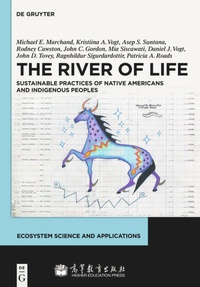
The River of Life
Sustainable Practices of Native Americans and Indigenous Peoples
1. Auflage
Erschienen am 29. Oktober 2013
XVI, 278 Seiten
978-3-11-027588-9 (ISBN)
Beschreibung

Sustainability defines the need for any society to live within the constraints of the land's capacity to deliver all natural resources the society consumes. This book compares the general differences between Native Americans and western world view towards resources. It will provide the 'nuts and bolts' of a sustainability portfolio designed by indigenous peoples.
This book introduces the ideas on how to link nature and society to make sustainable choices. To be sustainable, nature and its endowment needs to be linked to human behavior similar to the practices of indigenous peoples. The main goal of this book is to facilitate thinking about how to change behavior and to integrate culture into thinking and decision-processes.
Weitere Details
Weitere Ausgaben
Andere Ausgaben
Michael E. Marchand | Kristiina A. Vogt | Asep S. Suntana
The River of Life
Sustainable Practices of Native Americans and Indigenous Peoples
Buch
10/2013
1. Auflage
De Gruyter
174,95 €
Versand in 7-9 Tagen
Personen
Michael E. Marchand, Kristiina A. Vogt, University of Washington, Seattle, WA; Asep S. Suntana, Forest Systems and Bioenergy and LEI (Lembaga Ekolabel Indonesia), Bogor, Indonesia; Rodney Cawston, University of Washington, Seattle, WA; John C. Gordon, Portland, OR; Mia Siscawati, Sajogyo Institute, Bogor, Indonesia; Daniel J. Vogt, University of Washington, Seattle, WA; John D. Tovey, University of Washington, Seattle, WA; Ragnhildur Sigurdardottir, Agricultural University, Iceland; Patricia A. Roads, Miamisburg, OH, USA.
Inhalt
1 - Sustainability: Learning from the Past [Seite 17]
1.1 - 1 The Context for Our Sustainability Story [Seite 19]
1.1.1 - 1.1 Post-1492: European Colonialism Impacts on Peoples of the Americas [Seite 19]
1.1.2 - 1.2 Post-1492: European Colonialism: Thirst for Resource-rich Lands [Seite 21]
1.1.3 - 1.3 We Need A Different Glue to Make Sustainability Work [Seite 24]
1.1.4 - 1.4 Essential Sustainability: Insights from A Water Metaphor [Seite 27]
1.1.4.1 - 1.4.1 Water-A Scarce Global Common Resource [Seite 27]
1.1.4.2 - 1.4.2 Water as A Sacred Resource [Seite 29]
1.1.4.3 - 1.4.3 Water, Water Everywhere but Still Scarce [Seite 32]
1.1.5 - 1.5 Our Coyote Mascot Blends the Dual Nature of Sustainability [Seite 36]
1.1.6 - 1.6 A Tribal Perspective on Sustainability [Seite 37]
1.1.7 - Coyote Essentials [Seite 41]
1.2 - 2 Battles to Eliminate Native American Traditions and Cultures [Seite 43]
1.2.1 - 2.1 European Colonial "Manifest Destiny" [Seite 44]
1.2.1.1 - 2.1.1 Taming Indian Lands through Agriculture [Seite 45]
1.2.1.2 - 2.1.2 Euro-Americans Settling the "Wild West" [Seite 46]
1.2.1.3 - 2.1.3 Becoming Civilized: Redemption and Westward Migration [Seite 49]
1.2.2 - 2.2 War on Native American Cultures and Traditions [Seite 52]
1.2.2.1 - 2.2.1 U.S. Relocation, Termination and Assimilation Policies [Seite 53]
1.2.2.2 - 2.2.2 Removal of Buffalo for "Manifest Destiny" [Seite 66]
1.2.2.3 - 2.2.3 Removal of Salmon in the Pacific Northwest [Seite 67]
1.2.2.4 - 2.2.4 Building Dams on Tribal Lands [Seite 71]
1.2.3 - 2.3 Contemporary Context of Native American Lands and Resources [Seite 78]
2 - A Lens on Cultures and Traditions of Indigenous Peoples and Local Communities [Seite 83]
2.1 - 3 Introduction to Folklore and Cultural Survival [Seite 85]
2.1.1 - 3.1 Western World Stories [Seite 85]
2.1.2 - 3.2 Inter-generational Indigenous Cultural Stories [Seite 87]
2.1.2.1 - 3.2.1 Learning Nez Perce Culture while Growing Up as Remembered by Rodney [Seite 93]
2.1.3 - 3.3 What Does It Mean to Be A Traditional Ecological Practitioner? [Seite 96]
2.1.3.1 - 3.3.1 Break the Law When Practice Culture [Seite 96]
2.1.3.2 - 3.3.2 Indian Spirituality [Seite 100]
2.1.3.3 - 3.3.3 Native American Languages [Seite 107]
2.1.4 - Coyote Essentials [Seite 110]
3 - Portfolio for Sustainability: Native American Behavior Blended with Western Science [Seite 111]
3.1 - 4 The Nuts and Bolts of A Sustainability Portfolio [Seite 113]
3.1.1 - 4.1 Practicing Indigenous Cultures and Traditions [Seite 116]
3.1.1.1 - 4.1.1 Cultural Forest Practices in the Halimun Ecosystem Area, Indonesia [Seite 118]
3.1.1.2 - 4.1.2 Essential Practices of A Sustainable Portfolio as Summarized by John D Tovey [Seite 121]
3.1.2 - 4.2 Humanizing Sustainable Practices [Seite 127]
3.1.3 - 4.3 Western World Ecosystem and Adaptive Management [Seite 129]
3.1.4 - 4.4 Recognize Western World and Indigenous Community Differences in How Humanize Sustainability [Seite 133]
3.1.5 - Coyote Essentials [Seite 136]
3.2 - 5 Portfolio Element : How to Connect Society with Nature [Seite 137]
3.2.1 - 5.1 Divergent Models of "Wild" Nature and How Different Societies Connect to It [Seite 137]
3.2.2 - 5.2 Western World Model: Nature Bounded by Borders [Seite 141]
3.2.2.1 - 5.2.1 Nature Needs to Be Controlled [Seite 143]
3.2.2.2 - 5.2.2 Zoo Becomes A Nature Experience [Seite 145]
3.2.2.3 - 5.2.3 Today's Nature: Bounded Larger Artificial Landscapes [Seite 149]
3.2.3 - 5.3 Native American Model: Borderless Nature [Seite 150]
3.2.3.1 - 5.3.1 American Tribes: Nature, Sense of Property Is Culture-based as Told by Mike [Seite 152]
3.2.3.2 - 5.3.2 No Walls: Active Landscape Management, Nature Not Wasted [Seite 155]
3.2.4 - Coyote Essentials [Seite 158]
3.3 - 6 Portfolio Element : How to Make Practical and Realistic Decisions [Seite 159]
3.3.1 - 6.1 To Become Sustainable Don't "Throw Out the Baby with the Bathwater" [Seite 159]
3.3.2 - 6.2 Leave Your Individual Biases Outside the Door [Seite 162]
3.3.2.1 - 6.2.1 "False" Indian Stories [Seite 162]
3.3.2.2 - 6.2.2 Stories of "Real" Indians [Seite 167]
3.3.2.3 - 6.2.3 The Life of John McCoy [Seite 171]
3.3.3 - 6.3 Think Slowly and for the 7th Generation [Seite 172]
3.3.4 - 6.4 Long Scientific History but Short Human Memory [Seite 175]
3.3.5 - 6.5 Inter-generational Adaptation and Grandmothers as Told by John D Tovey [Seite 179]
3.3.6 - 6.6 Cultural Diversity the Norm in Regional Landscapes: Iban Tribe, Indonesian Borneo [Seite 180]
3.3.7 - Coyote Essentials [Seite 183]
3.4 - 7 Portfolio Element : Follow a Native American Business Model [Seite 185]
3.4.1 - 7.1 Company Business Plans or Village Economics [Seite 185]
3.4.1.1 - 7.1.1 Non-tribal Business Plans [Seite 186]
3.4.1.2 - 7.1.2 Tribal Business Plans [Seite 188]
3.4.2 - 7.2 Western World Moving towards Humanizing Business Practices [Seite 192]
3.4.2.1 - 7.2.1 Historical Recognition of Need to Humanize Economics [Seite 192]
3.4.2.2 - 7.2.2 Human Development Index Rankings [Seite 193]
3.4.2.3 - 7.2.3 Beyond Western Business Plans [Seite 196]
3.4.3 - 7.3 How the Energy Intensive Business Model Made the Environment and People of Iceland Less Resilient as Told by Raga [Seite 199]
3.4.4 - 7.4 Reservation Lands Historically Undesirable but Rich in Economic Resources Today [Seite 204]
3.4.5 - 7.5 Trustee Exploitation of Tribal Resources on Reservations [Seite 205]
3.4.6 - Coyote Essentials [Seite 208]
3.5 - 8 Portfolio Element : Creative Governance from Consensual Flexible Partnerships [Seite 209]
3.5.1 - 8.1 Long Western World History: Few Stories of Consensual and Equitable Governance [Seite 209]
3.5.1.1 - 8.1.1 Historical Top Down Governance [Seite 209]
3.5.1.2 - 8.1.2 Historical Western World Governance Structures that Did Include People [Seite 211]
3.5.2 - 8.2 American Indians: Village and Confederacies Make Natural Resource Decisions [Seite 217]
3.5.3 - 8.3 Link Taboos to Non-negotiable Values When Making Economic Decisions [Seite 221]
3.5.4 - Coyote Essentials [Seite 226]
4 - Culture as the Core of Native American Resource Leadership [Seite 227]
4.1 - 9 Traditions Are Not JustWritings Found in Library Archives: Native Americans Driving and Controlling Resources Today [Seite 229]
4.1.1 - 9.1 Salmon Restoration and Tribal Co-management [Seite 232]
4.1.2 - 9.2 Dams-Removal, Mitigation and Redesign [Seite 235]
4.1.3 - Coyote Essentials [Seite 239]
4.2 - 10 Final Words on Essential Native American Leadership [Seite 241]
4.2.1 - 10.1 "Melting Pot" versus "Salad Bowl Assimilation" Discussion [Seite 242]
4.2.2 - 10.2 Lessons from My Grandfather by Mike [Seite 243]
4.2.3 - 10.3 Essential Tribal Leadership through Partnerships, Governance and Sovereignty [Seite 245]
4.2.3.1 - 10.3.1 One Tribal Business Model: Tulalip Tribes Building A Federal City [Seite 249]
4.2.3.2 - 10.3.2 Increasing Collaboration on Nature Using the Native American Approach [Seite 255]
4.2.4 - 10.4 Essential Sustainability: Building A Native American Behavior and Thinking Toolkit [Seite 259]
4.2.5 - 10.5 How to Do Business in A "Boom and Bust" Economy [Seite 262]
4.2.6 - Coyote Essentials [Seite 266]
4.3 - 11 Summary of All Book Coyote Essentials [Seite 269]
5 - References [Seite 273]
6 - Index [Seite 283]
1.1 - 1 The Context for Our Sustainability Story [Seite 19]
1.1.1 - 1.1 Post-1492: European Colonialism Impacts on Peoples of the Americas [Seite 19]
1.1.2 - 1.2 Post-1492: European Colonialism: Thirst for Resource-rich Lands [Seite 21]
1.1.3 - 1.3 We Need A Different Glue to Make Sustainability Work [Seite 24]
1.1.4 - 1.4 Essential Sustainability: Insights from A Water Metaphor [Seite 27]
1.1.4.1 - 1.4.1 Water-A Scarce Global Common Resource [Seite 27]
1.1.4.2 - 1.4.2 Water as A Sacred Resource [Seite 29]
1.1.4.3 - 1.4.3 Water, Water Everywhere but Still Scarce [Seite 32]
1.1.5 - 1.5 Our Coyote Mascot Blends the Dual Nature of Sustainability [Seite 36]
1.1.6 - 1.6 A Tribal Perspective on Sustainability [Seite 37]
1.1.7 - Coyote Essentials [Seite 41]
1.2 - 2 Battles to Eliminate Native American Traditions and Cultures [Seite 43]
1.2.1 - 2.1 European Colonial "Manifest Destiny" [Seite 44]
1.2.1.1 - 2.1.1 Taming Indian Lands through Agriculture [Seite 45]
1.2.1.2 - 2.1.2 Euro-Americans Settling the "Wild West" [Seite 46]
1.2.1.3 - 2.1.3 Becoming Civilized: Redemption and Westward Migration [Seite 49]
1.2.2 - 2.2 War on Native American Cultures and Traditions [Seite 52]
1.2.2.1 - 2.2.1 U.S. Relocation, Termination and Assimilation Policies [Seite 53]
1.2.2.2 - 2.2.2 Removal of Buffalo for "Manifest Destiny" [Seite 66]
1.2.2.3 - 2.2.3 Removal of Salmon in the Pacific Northwest [Seite 67]
1.2.2.4 - 2.2.4 Building Dams on Tribal Lands [Seite 71]
1.2.3 - 2.3 Contemporary Context of Native American Lands and Resources [Seite 78]
2 - A Lens on Cultures and Traditions of Indigenous Peoples and Local Communities [Seite 83]
2.1 - 3 Introduction to Folklore and Cultural Survival [Seite 85]
2.1.1 - 3.1 Western World Stories [Seite 85]
2.1.2 - 3.2 Inter-generational Indigenous Cultural Stories [Seite 87]
2.1.2.1 - 3.2.1 Learning Nez Perce Culture while Growing Up as Remembered by Rodney [Seite 93]
2.1.3 - 3.3 What Does It Mean to Be A Traditional Ecological Practitioner? [Seite 96]
2.1.3.1 - 3.3.1 Break the Law When Practice Culture [Seite 96]
2.1.3.2 - 3.3.2 Indian Spirituality [Seite 100]
2.1.3.3 - 3.3.3 Native American Languages [Seite 107]
2.1.4 - Coyote Essentials [Seite 110]
3 - Portfolio for Sustainability: Native American Behavior Blended with Western Science [Seite 111]
3.1 - 4 The Nuts and Bolts of A Sustainability Portfolio [Seite 113]
3.1.1 - 4.1 Practicing Indigenous Cultures and Traditions [Seite 116]
3.1.1.1 - 4.1.1 Cultural Forest Practices in the Halimun Ecosystem Area, Indonesia [Seite 118]
3.1.1.2 - 4.1.2 Essential Practices of A Sustainable Portfolio as Summarized by John D Tovey [Seite 121]
3.1.2 - 4.2 Humanizing Sustainable Practices [Seite 127]
3.1.3 - 4.3 Western World Ecosystem and Adaptive Management [Seite 129]
3.1.4 - 4.4 Recognize Western World and Indigenous Community Differences in How Humanize Sustainability [Seite 133]
3.1.5 - Coyote Essentials [Seite 136]
3.2 - 5 Portfolio Element : How to Connect Society with Nature [Seite 137]
3.2.1 - 5.1 Divergent Models of "Wild" Nature and How Different Societies Connect to It [Seite 137]
3.2.2 - 5.2 Western World Model: Nature Bounded by Borders [Seite 141]
3.2.2.1 - 5.2.1 Nature Needs to Be Controlled [Seite 143]
3.2.2.2 - 5.2.2 Zoo Becomes A Nature Experience [Seite 145]
3.2.2.3 - 5.2.3 Today's Nature: Bounded Larger Artificial Landscapes [Seite 149]
3.2.3 - 5.3 Native American Model: Borderless Nature [Seite 150]
3.2.3.1 - 5.3.1 American Tribes: Nature, Sense of Property Is Culture-based as Told by Mike [Seite 152]
3.2.3.2 - 5.3.2 No Walls: Active Landscape Management, Nature Not Wasted [Seite 155]
3.2.4 - Coyote Essentials [Seite 158]
3.3 - 6 Portfolio Element : How to Make Practical and Realistic Decisions [Seite 159]
3.3.1 - 6.1 To Become Sustainable Don't "Throw Out the Baby with the Bathwater" [Seite 159]
3.3.2 - 6.2 Leave Your Individual Biases Outside the Door [Seite 162]
3.3.2.1 - 6.2.1 "False" Indian Stories [Seite 162]
3.3.2.2 - 6.2.2 Stories of "Real" Indians [Seite 167]
3.3.2.3 - 6.2.3 The Life of John McCoy [Seite 171]
3.3.3 - 6.3 Think Slowly and for the 7th Generation [Seite 172]
3.3.4 - 6.4 Long Scientific History but Short Human Memory [Seite 175]
3.3.5 - 6.5 Inter-generational Adaptation and Grandmothers as Told by John D Tovey [Seite 179]
3.3.6 - 6.6 Cultural Diversity the Norm in Regional Landscapes: Iban Tribe, Indonesian Borneo [Seite 180]
3.3.7 - Coyote Essentials [Seite 183]
3.4 - 7 Portfolio Element : Follow a Native American Business Model [Seite 185]
3.4.1 - 7.1 Company Business Plans or Village Economics [Seite 185]
3.4.1.1 - 7.1.1 Non-tribal Business Plans [Seite 186]
3.4.1.2 - 7.1.2 Tribal Business Plans [Seite 188]
3.4.2 - 7.2 Western World Moving towards Humanizing Business Practices [Seite 192]
3.4.2.1 - 7.2.1 Historical Recognition of Need to Humanize Economics [Seite 192]
3.4.2.2 - 7.2.2 Human Development Index Rankings [Seite 193]
3.4.2.3 - 7.2.3 Beyond Western Business Plans [Seite 196]
3.4.3 - 7.3 How the Energy Intensive Business Model Made the Environment and People of Iceland Less Resilient as Told by Raga [Seite 199]
3.4.4 - 7.4 Reservation Lands Historically Undesirable but Rich in Economic Resources Today [Seite 204]
3.4.5 - 7.5 Trustee Exploitation of Tribal Resources on Reservations [Seite 205]
3.4.6 - Coyote Essentials [Seite 208]
3.5 - 8 Portfolio Element : Creative Governance from Consensual Flexible Partnerships [Seite 209]
3.5.1 - 8.1 Long Western World History: Few Stories of Consensual and Equitable Governance [Seite 209]
3.5.1.1 - 8.1.1 Historical Top Down Governance [Seite 209]
3.5.1.2 - 8.1.2 Historical Western World Governance Structures that Did Include People [Seite 211]
3.5.2 - 8.2 American Indians: Village and Confederacies Make Natural Resource Decisions [Seite 217]
3.5.3 - 8.3 Link Taboos to Non-negotiable Values When Making Economic Decisions [Seite 221]
3.5.4 - Coyote Essentials [Seite 226]
4 - Culture as the Core of Native American Resource Leadership [Seite 227]
4.1 - 9 Traditions Are Not JustWritings Found in Library Archives: Native Americans Driving and Controlling Resources Today [Seite 229]
4.1.1 - 9.1 Salmon Restoration and Tribal Co-management [Seite 232]
4.1.2 - 9.2 Dams-Removal, Mitigation and Redesign [Seite 235]
4.1.3 - Coyote Essentials [Seite 239]
4.2 - 10 Final Words on Essential Native American Leadership [Seite 241]
4.2.1 - 10.1 "Melting Pot" versus "Salad Bowl Assimilation" Discussion [Seite 242]
4.2.2 - 10.2 Lessons from My Grandfather by Mike [Seite 243]
4.2.3 - 10.3 Essential Tribal Leadership through Partnerships, Governance and Sovereignty [Seite 245]
4.2.3.1 - 10.3.1 One Tribal Business Model: Tulalip Tribes Building A Federal City [Seite 249]
4.2.3.2 - 10.3.2 Increasing Collaboration on Nature Using the Native American Approach [Seite 255]
4.2.4 - 10.4 Essential Sustainability: Building A Native American Behavior and Thinking Toolkit [Seite 259]
4.2.5 - 10.5 How to Do Business in A "Boom and Bust" Economy [Seite 262]
4.2.6 - Coyote Essentials [Seite 266]
4.3 - 11 Summary of All Book Coyote Essentials [Seite 269]
5 - References [Seite 273]
6 - Index [Seite 283]
