

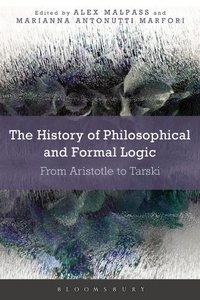
The History of Philosophical and Formal Logic
From Aristotle to Tarski
1. Auflage
Erschienen am 29. Juni 2017
256 Seiten
978-1-4725-0525-5 (ISBN)
Beschreibung
The History of Philosophical and Formal Logic introduces ideas and thinkers central to the development of philosophical and formal logic. From its Aristotelian origins to the present-day arguments, logic is broken down into four main time periods:
Antiquity and the Middle Ages (Aristotle and The Stoics)
The early modern period (Bolzano, Boole)
High modern period (Frege, Peano & Russell and Hilbert)
Early 20th century (Godel and Tarski)
Each new time frame begins with an introductory overview highlighting themes and points of importance. Chapters discuss the significance and reception of influential works and look at historical arguments in the context of contemporary debates. To support independent study, comprehensive lists of primary and secondary reading are included at the end of chapters, along with exercises and discussion questions.
By clearly presenting and explaining the changes to logic across the history of philosophy, The History of Philosophical and Formal Logic constructs an easy-to-follow narrative. This is an ideal starting point for students looking to understand the historical development of logic.
Antiquity and the Middle Ages (Aristotle and The Stoics)
The early modern period (Bolzano, Boole)
High modern period (Frege, Peano & Russell and Hilbert)
Early 20th century (Godel and Tarski)
Each new time frame begins with an introductory overview highlighting themes and points of importance. Chapters discuss the significance and reception of influential works and look at historical arguments in the context of contemporary debates. To support independent study, comprehensive lists of primary and secondary reading are included at the end of chapters, along with exercises and discussion questions.
By clearly presenting and explaining the changes to logic across the history of philosophy, The History of Philosophical and Formal Logic constructs an easy-to-follow narrative. This is an ideal starting point for students looking to understand the historical development of logic.
Weitere Details
Auflage
1. Auflage
Sprache
Englisch
Verlagsort
London
Großbritannien
Verlagsgruppe
Bloomsbury Publishing PLC
Zielgruppe
Für Beruf und Forschung
ISBN-13
978-1-4725-0525-5 (9781472505255)
Copyright in bibliographic data and cover images is held by Nielsen Book Services Limited or by the publishers or by their respective licensors: all rights reserved.
Schweitzer Klassifikation
Weitere Ausgaben
Personen
Alex Malpass is a Teaching Fellow in the Department of Philosophy, University of Bristol, UK.
Marianna Antonutti Marfori is Research Associate in Philosophy at the University of Bristol, UK.
Marianna Antonutti Marfori is Research Associate in Philosophy at the University of Bristol, UK.
Inhalt
Introduction
Part I: The Origins of Formal Logic
1. Aristotle's Logic, Adriane Rini
2. Stoic Logic, Katerina Ierodiakonou
3. Medieval Logic, Sara Uckleman
Part II: The Early Modern Period
4. Bolzano, Jönne Speck
5. Boole, Giulia Terzian
Part III: Mathematical Logic
6. C. S. Peirce, Peter Ohrstrom
7. Frege, Walter Pedriali
8. Peano and Russell, Alexander Bird
9. Hilbert, Curtis Franks
Part IV: Twentieth Century Logic
10. Gödel, Philip Welch
11. Tarski, Benedict Eastaugh
Index
Part I: The Origins of Formal Logic
1. Aristotle's Logic, Adriane Rini
2. Stoic Logic, Katerina Ierodiakonou
3. Medieval Logic, Sara Uckleman
Part II: The Early Modern Period
4. Bolzano, Jönne Speck
5. Boole, Giulia Terzian
Part III: Mathematical Logic
6. C. S. Peirce, Peter Ohrstrom
7. Frege, Walter Pedriali
8. Peano and Russell, Alexander Bird
9. Hilbert, Curtis Franks
Part IV: Twentieth Century Logic
10. Gödel, Philip Welch
11. Tarski, Benedict Eastaugh
Index
