

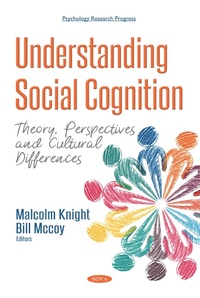
Understanding Social Cognition: Theory, Perspectives and Cultural Differences
Erschienen am 11. November 2020
146 Seiten
978-1-5361-3161-1 (ISBN)
Beschreibung

Understanding Social Cognition: Theory, Perspectives and Cultural Differences opens with a study exploring the social-signaling, ethological predictions that: a) smaller body stature (e.g., height) is associated with greater reported belief in God; and b) physical stature may mediate the association between gender and faith reporting. Following this, the empirical evidence for the types of current theories of social-cognitive interventions for children and adolescents with ASD are reviewed. The authors examine the evidence-based effectiveness of social-cognitive interventions, based on the categorization of theories identified in this review, to promote social participation for individuals with ASD. Also in this compilation, a new paradigm is presented for a more creatively enhanced and socially inclusive evolution of human reality construct building than can be projected using current physicalist models. A chapter is included which describes the development process of the SCIT-Hong Kong Version since 2011, defining key modifications of the SCIT for use with Chinese populations in Hong Kong, and shared preliminary findings on effectiveness of SCIT. An expert panel of clinicians reviewed the cultural relevance and content validity of the SCIT for application in Hong Kong. Based on this review, the researcher modified and translated the content of original SCIT. Subsequently, an evaluation of social cognitive function assessments in Chinese populations is presented. The authors review 10 social cognitive assessments, summarize the strengths and weaknesses of these assessments and propose a battery that could provide a quick assessment of multiple social cognitive domains.
Weitere Details
Weitere Ausgaben
Andere Ausgaben
Malcolm Knight | Bill McCoy
Understanding Social Cognition
Theory, Perspectives and Cultural Differences
Buch
02/2018
Nova Science Publishers Inc
145,18 €
Versand in 15-20 Tagen
Inhalt
- Intro
- Contents
- Preface
- Chapter 1
- Are Shorter People Closer to God? The Associations between Gender, Body Size, and Spiritual Beliefs
- Abstract
- Introduction
- Current Study
- Method
- Subjects and Procedure
- Materials
- Data Analyses
- Results
- Discussion
- References
- Chapter 2
- Research Evidence of Social Cognitive Intervention: Implications for People with Autism
- Abstract
- Introduction
- Empirical Evidence of Four Dominant Theories of Social Cognitive Interventions
- Social Learning Theory
- Cognitive-Behavioral Theory
- Social-Emotional Learning Theory
- Theory of Mind
- Examination of Evidence
- Social Learning Theory
- Cognitive-Behavioral Theory
- Theory of Mind
- Social-Emotional Learning
- Intervention Strategies for Promoting Social Development for Individuals with ASD
- Acknowledgments
- References
- Biographical Sketch
- Chapter 3
- The Players Who Build the World
- Abstract
- Introduction
- The Mind-Body Problem and Trans-Intelligence
- Material Reality as Play
- Conscious Agents as Infinite Players: The Players Who Build the World
- Conclusion
- Notes
- References
- Chapter 4
- Adaptation of the Social Cognition and Interaction Training (SCIT) for Promoting Functional Recovery in Chinese Persons with Schizophrenia in Hong Kong
- Abstract
- Introduction
- Part I: Social Cognition and Interaction Training
- Part II: Translation and Adaptation of SCIT
- Challenge 1: Variations on Degree of Neurocognitive Impairments Affect Learning of SCIT Strategies of Patients in Different Phases of Illness
- Challenge 2: Generalization of Social Cognitive Strategies to Functional Outcome
- Challenge 3: Higher Attrition Rates in In-Patients and Patients with First Episode Psychosis
- Part III: Enriched Curriculum of SCIT-Hong Kong Version
- Enrichment 1: Screening Assessment
- Enrichment 2: Booster Sessions
- Example Worksheet of Booster Session
- Social Cognition
- Enrichment 3: Metacognitive Exercises
- Summary
- Part IV: Development of Disease Specific Protocol for First Episode Psychosis Population
- Training Structure and Duration of Training
- Training Medium
- Self-Practice Exercise- Session 1: Understanding Social Cognition
- Training Content - Age-Relevant Social Scenarios
- Conclusion
- References
- Chapter 5
- A Review of Social Cognition Assessments for Persons with Schizophrenia in a Chinese Population
- Abstract
- Introduction
- Part I. Review on Social Cognitive Domains and Key Assessment Parameters
- Emotion Perception
- 1. Inclusion of Faces with Neutral Emotions in Test Photo Sets
- 2. Balanced Presentation of Posers with Different Genders
- 3. Use of "Same-Race" or "Other-Race" Faces in Test Photos?
- 4. Use of "Static" vs "Dynamic" Faces in Test Photos?
- Theory of Mind
- Attributional Style/Bias
- Part II. Review on Common Social Cognitive Assessments
- Assessment of Emotion Perception
- Assessment of Theory-of-Mind
- Assessment on Attributional Style (AS)
- Assessment on Jumping-to-Conclusion (JTC)
- Multi-Domain Assessment
- Summary
- Part III. Propose a Social Cognitive Battery
- Modifications of the FEIT
- Modifications, Translation and Content Validity of SCSQ
- Preliminary Psychometric Properties
- References
- Index
- Blank Page
- Blank Page
