

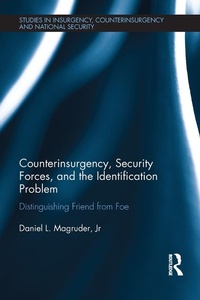
Counterinsurgency, Security Forces, and the Identification Problem
Distinguishing Friend From Foe
Erschienen am 28. Juli 2017
236 Seiten
978-1-351-78477-1 (ISBN)
Beschreibung

This book presents a theory and empirical evidence for how security forces can identify militant suspects during counterinsurgency operations.
A major oversight on the part of academics and practitioners has been to ignore the critical antecedent issue common to persuasion and coercion counterinsurgency (COIN) approaches: distinguishing friend from foe. This book proposes that the behaviour of security forces influences the likelihood of militant identification during a COIN campaign, and argues that security forces must respect civilian safety in order to create a credible commitment to facilitate collaboration with a population. This distinction is important as conventional wisdom has wrongly assumed that the presence of security forces confers control over terrain or influence over a population. Collaboration between civilian and government actors is the key observable indicator of support in COIN. Paradoxically, this theory accounts for why and how increased risk to government forces in the short term actually improves civilian security in the long run. Counterinsurgency, Security Forces, and the Identification Problem draws on three case studies: the Huk Rebellion in the Philippines post-World War II; Marines Corps' experiences in Vietnam through the Combined Action Program; and Special Operations activities in Iraq after 2003. For military practitioners, the work illustrates the critical precursor to establishing "security" during counterinsurgency operations. The book also examines the role and limits of modern technology in solving the identification problem.
This book will be of interest to students of counterinsurgency, military history, strategic studies, US foreign policy, and security studies in general.
A major oversight on the part of academics and practitioners has been to ignore the critical antecedent issue common to persuasion and coercion counterinsurgency (COIN) approaches: distinguishing friend from foe. This book proposes that the behaviour of security forces influences the likelihood of militant identification during a COIN campaign, and argues that security forces must respect civilian safety in order to create a credible commitment to facilitate collaboration with a population. This distinction is important as conventional wisdom has wrongly assumed that the presence of security forces confers control over terrain or influence over a population. Collaboration between civilian and government actors is the key observable indicator of support in COIN. Paradoxically, this theory accounts for why and how increased risk to government forces in the short term actually improves civilian security in the long run. Counterinsurgency, Security Forces, and the Identification Problem draws on three case studies: the Huk Rebellion in the Philippines post-World War II; Marines Corps' experiences in Vietnam through the Combined Action Program; and Special Operations activities in Iraq after 2003. For military practitioners, the work illustrates the critical precursor to establishing "security" during counterinsurgency operations. The book also examines the role and limits of modern technology in solving the identification problem.
This book will be of interest to students of counterinsurgency, military history, strategic studies, US foreign policy, and security studies in general.
Weitere Details
Reihe
Sprache
Englisch
Verlagsort
London
Großbritannien
Verlagsgruppe
Taylor & Francis Ltd
Zielgruppe
Für höhere Schule und Studium
Für Beruf und Forschung
Produkt-Hinweis
Reflowable
Illustrationen
4 Tables, black and white; 2 Line drawings, black and white
Dateigröße
1,79 MB
ISBN-13
978-1-351-78477-1 (9781351784771)
Copyright in bibliographic data and cover images is held by Nielsen Book Services Limited or by the publishers or by their respective licensors: all rights reserved.
Schweitzer Klassifikation
Weitere Ausgaben
Andere Ausgaben
Jr Magruder
Counterinsurgency, Security Forces, and the Identification Problem
Distinguishing Friend From Foe
Buch
12/2019
1. Auflage
Routledge
68,30 €
Versand in 15-20 Tagen
Jr Magruder
Counterinsurgency, Security Forces, and the Identification Problem
Distinguishing Friend From Foe
Buch
07/2017
1. Auflage
Routledge
206,40 €
Versand in 10-20 Tagen
Person
Daniel L. Magruder, Jr holds a PhD in Political Science from the University of Chicago, USA, and is currently Commander, 22nd Special Tactics Squadron, Joint Base Lewis-McChord, Dupont, Wasington, USA.
Inhalt
Preface 1. Revisiting Counterinsurgency: The Identification Problem 2. Explaining Insurgent Identification 3. Philippines Armed Forces, Huk Rebellion 4. Marine Corps Combined Action Program, Vietnam 5. American Special Operations Forces, Iraq 6. Conclusion
