

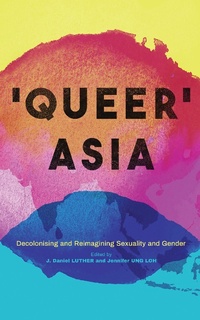
Queer Asia
Decolonising and Reimagining Sexuality and Gender
1. Auflage
Erschienen am 15. Mai 2019
1 Seiten
978-1-78699-583-4 (ISBN)
Beschreibung
Queer studies is now a rapidly expanding field, as scholars from a variety of disciplines seek to address the long-running marginalisation of queer perspectives and experiences. But there has so far been little effort to unify the study of queer communities outside the West, and much of the current writing views these communities through a narrowly Western lens.
Building on the work of the annual Queer Asia conference, which the editors helped to establish, this collection represents the most comprehensive work to date on queer studies in an Asian context. Featuring case studies and original research from across the continent, covering the Middle East, South and East Asia, and Asian diasporas, the collection offers a genuinely pan-Asian perspective which places queer Asian identities and movements in dialogue with each other, rather than within a Western framework.
By considering how queerness is imagined within plural Asian experiences and contexts, the contributors show a that re-envisioning of 'queer' through Asian perspectives has the potential to challenge existing discourses and debates in the wider field of contemporary gender, sexuality, and queer studies.
Building on the work of the annual Queer Asia conference, which the editors helped to establish, this collection represents the most comprehensive work to date on queer studies in an Asian context. Featuring case studies and original research from across the continent, covering the Middle East, South and East Asia, and Asian diasporas, the collection offers a genuinely pan-Asian perspective which places queer Asian identities and movements in dialogue with each other, rather than within a Western framework.
By considering how queerness is imagined within plural Asian experiences and contexts, the contributors show a that re-envisioning of 'queer' through Asian perspectives has the potential to challenge existing discourses and debates in the wider field of contemporary gender, sexuality, and queer studies.
Rezensionen / Stimmen
Both being queer and being Asian remain alienating experiences today. This sophisticated volume examines their negotiated syncopation in diverse ordinary contexts. The chapters build a timely solidarity across disciplinary, professional, identitarian, and geopolitical lines to de-universalize Western privilege and unleash the power of liminal synergies * Howard H. Chiang, University of California, Davis * Bursting forth online and in various spaces, 'Queer' Asia is certainly one of the most energetic and exciting phenomena to emerge in gender and sexuality studies, and queer politics, over recent years. Blending academic research and critical theory with the cultural and the political the 'Queer' Asia network has successfully contributed to redefining the landscape and geopolitics of global queer studies * Matthew Waites, University of Glasgow *Weitere Details
Auflage
1. Auflage
Sprache
Englisch
Verlagsort
London
Großbritannien
Verlagsgruppe
Bloomsbury Publishing PLC
Zielgruppe
Für höhere Schule und Studium
ISBN-13
978-1-78699-583-4 (9781786995834)
Copyright in bibliographic data and cover images is held by Nielsen Book Services Limited or by the publishers or by their respective licensors: all rights reserved.
Schweitzer Klassifikation
Weitere Ausgaben
Personen
J. Daniel Luther is a doctoral researcher at SOAS, University of London, UK and is beginning a Visiting Research Fellowship at Kings College London. Luther is also co-founder of the annual Queer Asia international conference and film festival.
Jennifer Ung Loh is a research associate with the South Asia Institute at SOAS, University of London, UK and previously lectured at De Montfort University, UK. She is also a committee member and conference organiser for the Queer Asia conference.
Jennifer Ung Loh is a research associate with the South Asia Institute at SOAS, University of London, UK and previously lectured at De Montfort University, UK. She is also a committee member and conference organiser for the Queer Asia conference.
Inhalt
Foreword - Matthew Waites
Introduction - J. Daniel Luther and Jennifer Ung Loh
Part I: Negotiations
1. Under Empire and the Modern State: Unravelling 'Queer Precarities' Inside Global Assemblages - Ahmad Ibrahim
2. Reimagining HIV in Indonesian online media: a discussion of two recent Indonesian webseries - Ben Murtagh
3. Rich In Desire: Sexualities and Fantasies Deriving from Poverty, Stigmatisation and Oppression - He Xiaopei
4. Mithliyy, mithlak: language and LGBTQ Activism in Lebanon and Palestine - Gabriel Semerene
Interview with Alana EISSA: Trans Activism in Malaysia and the UK Asylum Process
Part II: Traces and Ambiguities
5. Queer Desires and Satirised Empires: Notes on Aubrey Menen's A Conspiracy of Women (1965) - David Lunn
6. Queer Objects: An Archive for the Future - Loo Zihan
7. The Isolated Queer Body: Harisu's Dodo Cosmetics Advertisement - Kate Korroch
Interview with Floyd Tiogangco: Filmmaking and Gender Expression in The Philippines
Part III: Coalitions and Fractures
8. Intersex Advocacy in Chinese/Sinophone Contexts - A Primer, accompanied by an Interview with Activist Small LUK - Geoffrey Yeung
9. Queer Asia's Body Without Organs: In the Making of Queer/Decolonial Politics - Po-Han Lee
10. Feminist and Queer Perspectives in West Asia: Complicities and Tensions - Nadje AL-ALI and Ghiwa Sayegh
Interview with Alqumit Alhamad: Art and Intersections from Syria to Sweden
Epilogue - J. Daniel Luther and Jennifer Ung Loh
Introduction - J. Daniel Luther and Jennifer Ung Loh
Part I: Negotiations
1. Under Empire and the Modern State: Unravelling 'Queer Precarities' Inside Global Assemblages - Ahmad Ibrahim
2. Reimagining HIV in Indonesian online media: a discussion of two recent Indonesian webseries - Ben Murtagh
3. Rich In Desire: Sexualities and Fantasies Deriving from Poverty, Stigmatisation and Oppression - He Xiaopei
4. Mithliyy, mithlak: language and LGBTQ Activism in Lebanon and Palestine - Gabriel Semerene
Interview with Alana EISSA: Trans Activism in Malaysia and the UK Asylum Process
Part II: Traces and Ambiguities
5. Queer Desires and Satirised Empires: Notes on Aubrey Menen's A Conspiracy of Women (1965) - David Lunn
6. Queer Objects: An Archive for the Future - Loo Zihan
7. The Isolated Queer Body: Harisu's Dodo Cosmetics Advertisement - Kate Korroch
Interview with Floyd Tiogangco: Filmmaking and Gender Expression in The Philippines
Part III: Coalitions and Fractures
8. Intersex Advocacy in Chinese/Sinophone Contexts - A Primer, accompanied by an Interview with Activist Small LUK - Geoffrey Yeung
9. Queer Asia's Body Without Organs: In the Making of Queer/Decolonial Politics - Po-Han Lee
10. Feminist and Queer Perspectives in West Asia: Complicities and Tensions - Nadje AL-ALI and Ghiwa Sayegh
Interview with Alqumit Alhamad: Art and Intersections from Syria to Sweden
Epilogue - J. Daniel Luther and Jennifer Ung Loh
