

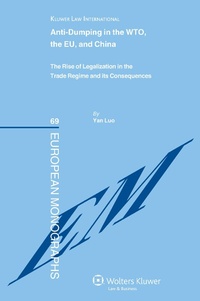
Anti-dumping in the WTO, the EU and China
The Rise of Legalization in the Trade Regime and its Consequences
Erschienen am 4. März 2010
248 Seiten
978-90-411-5514-6 (ISBN)
Beschreibung

With its virtually universal treaty network and its binding dispute settlement mechanism (DSM), has the World Trade Organization (WTO) become a "legalized" international organization? To a large extent, the positive effect of the move to a higher level of legalization in the WTO is commonly acknowledged. Nevertheless, contrary to the high expectations of trade 'legalists', empirical studies suggest that the policy goal of trade liberalization cannot always be achieved by the functioning of the WTO legal system. Indeed, legalization at the international level often affects domestic systems in ways that are not only unintended, but often provoke unanticipated reactions.
This incisive new study analyzes the proliferation of legalization in the WTO and two vital aspects of its consequences. The author illustrates the rise of legalization in the trade regime by examining the pragmatic process of legalization and its consequences in the field of anti-dumping. She particularly sketches the historical development of legalization in the multilateral anti-dumping framework by identifying significant events which illustrate the increased obligation, greater precision, and stronger delegation in the regime. She then explores the impact of international legalization on the EU's anti-dumping regime and China's dispute settlement activities in this area since the country's relatively recent accession. She demonstrates that, even after decades of legalization, domestic anti-dumping investigations often fail to fulfill the expectations of global legalists, and that the results of those investigations are not always challengeable in the DSM.
The author's focus brilliantly illuminates two features of the role of legalization played in the development of the WTO system that are widely discussed:
(1) the correlation between legalization in GATT/WTO law and corresponding changes in domestic policy-making, policy administration, and judicial review; and
(2) the impact of legalization on the utilization of the DSM to settle disputes in particular subject areas.
Concluding that the evolution of the GATT/WTO system is an illustrative example of the phenomenal rise of legalization in international organizations, the book is a valuable contribution to the broader debate of 'constitutionalization' in the international economic law literature. This is the first study to systematically analyze the rise of legalization in the WTO and its impact on domestic systems in this context. In its analysis of the discourse, dynamics, and effects of legalization in the trade regime, and in its empirical examples, this book will prove of great value to all professionals, legal or otherwise, involved with international trade and the economics of globalization.
This incisive new study analyzes the proliferation of legalization in the WTO and two vital aspects of its consequences. The author illustrates the rise of legalization in the trade regime by examining the pragmatic process of legalization and its consequences in the field of anti-dumping. She particularly sketches the historical development of legalization in the multilateral anti-dumping framework by identifying significant events which illustrate the increased obligation, greater precision, and stronger delegation in the regime. She then explores the impact of international legalization on the EU's anti-dumping regime and China's dispute settlement activities in this area since the country's relatively recent accession. She demonstrates that, even after decades of legalization, domestic anti-dumping investigations often fail to fulfill the expectations of global legalists, and that the results of those investigations are not always challengeable in the DSM.
The author's focus brilliantly illuminates two features of the role of legalization played in the development of the WTO system that are widely discussed:
(1) the correlation between legalization in GATT/WTO law and corresponding changes in domestic policy-making, policy administration, and judicial review; and
(2) the impact of legalization on the utilization of the DSM to settle disputes in particular subject areas.
Concluding that the evolution of the GATT/WTO system is an illustrative example of the phenomenal rise of legalization in international organizations, the book is a valuable contribution to the broader debate of 'constitutionalization' in the international economic law literature. This is the first study to systematically analyze the rise of legalization in the WTO and its impact on domestic systems in this context. In its analysis of the discourse, dynamics, and effects of legalization in the trade regime, and in its empirical examples, this book will prove of great value to all professionals, legal or otherwise, involved with international trade and the economics of globalization.
Weitere Details
Weitere Ausgaben
Andere Ausgaben
Yan Luo
Anti-dumping in the WTO, the EU and China
The Rise of Legalization in the Trade Regime and its Consequences
Buch
03/2010
1. Auflage
Kluwer Law International
190,48 €
Versand in 10-20 Tagen
Inhalt
- Cover
- Half Title Page
- Editorial Board
- Title Page
- Copyright Page
- Table of Contents
- List of Abbreviations
- Foreword
- Acknowledgements
- Chapter 1 Introduction
- Chapter 2 Conceptualizing Legalization in the WTO System
- 1 INTRODUCTION
- 2 DEFINING LEGALIZATION IN INTERNATIONAL RELATIONS
- 2.1 ELEMENTS OF LEGALIZATION
- 2.2 THE UNEVEN EXPANSION OF LEGALIZATION
- 2.3 CONSEQUENCES OF LEGALIZATION
- 2.4 A RICHER VIEW OF LEGALIZATION?
- 3 APPLYING LEGALIZATION IN THE WTO SYSTEM
- 3.1 ELEMENTS OF LEGALIZATION IN THE WTO
- 3.2 UNEVEN EXPANSION OF LEGALIZATION IN THE WTO
- 3.3 CONSEQUENCES OF LEGALIZATION IN THE WTO
- 3.3.1 'Legalizing' National Trade Policy in the GATT/WTO System
- 3.3.2 Building up Capacity to Utilize the DSM
- 3.4 CONCLUSION
- Chapter 3 Rise of Legalization in the Multilateral Framework
- 1 INTRODUCTION
- 2 RISE OF LEGALIZATION IN THE MULTILATERAL FRAMEWORK
- 2.1 FROM POLITICS TO 'DIPLOMAT'S JURISPRUDENCE': THE EVALUATION OF THE GATT
- 2.1.1 Elements of Legalization in the GATT
- 2.1.1.1 Decision-making
- 2.1.1.2 Surveillance
- 2.1.1.3 Adjudication
- 2.1.2 Uneven Expansion of Legalization in the GATT
- 2.2 A NEW HOPE OF LEGALIZATION: THE ESTABLISHMENT OF THE WTO
- 2.2.1 Decision-making
- 2.2.2 Surveillance
- 2.2.3 Adjudication
- 3 THEORETICAL DEBATES RELATED TO JUDICIALIZATION
- 3.1 THE ROLE OF THE DSM
- 3.2 STANDARD OF REVIEW
- 3.3 REMEDIES AND COMPLIANCE IN THE DSM
- 4 CONCLUSION
- Chapter 4 Legalization of Anti-dumping Rules at the International Level
- 1 INTRODUCTION
- 2 PHENOMENON OF DUMPING AND THE DEVELOPMENT OF AD LAWS
- 3 'LEGALIZING' AD RULES AT THE INTERNATIONAL LEVEL
- 3.1 TRADE NEGOTIATIONS AND INTERNATIONAL AD RULES
- 3.1.1 AD Negotiations in Pre-Uruguay Trade Rounds
- 3.1.1.1 GATT Article VI
- 3.1.1.2 GATT Report of Group of Experts (1961)
- 3.1.1.3 The Anti-dumping Code of Kennedy Round (the 1968 Code)
- 3.1.1.4 The Anti-dumping Code of Tokyo Round (the 1979 Code)
- 3.1.2 The Uruguay Round and the WTO Anti-dumping Agreement (ADA)
- 3.1.2.1 The Uruguay Round Negotiation
- 3.1.2.2 Legal Status of the ADA
- 3.1.2.2.1 An Overview
- 3.1.2.2.2 Obligation
- 3.1.2.2.3 Precision
- 3.1.2.2.4 Delegation
- 3.1.3 Anti-dumping in the Doha Round
- 3.2 SURVEILLANCE MECHANISM AND THE AD RULES
- 3.3 ANTI-DUMPING IN THE DISPUTE SETTLEMENT MECHANISM
- 4 THE UNEVEN EXPANSION OF LEGALIZATION IN THE AD REGIME
- 4.1 THE UNEVEN EXPANSION OF OBLIGATION
- 4.2 THE UNEVEN EXPANSION OF PRECISION
- 4.3 THE UNEVEN EXPANSION OF DELEGATION
- 5 CONCLUSION
- Chapter 5 WTO-transposed and WTO-plus Features of the EU AD Regime
- 1 INTRODUCTION
- 2 WTO-TRANSPOSED FEATURES OF THE EU ANTI-DUMPING REGIME
- 2.1 EVOLUTION OF COMMUNITY AD INSTRUMENTS
- 2.1.1 Pre-ADA Community AD Instruments
- 2.1.2 An Overview of Regulation 384/96 (the Basic Regulation)
- 2.2 ADMINISTRATION OF COMMUNITY AD RULES
- 2.2.1 The Commission and the Administration of AD Proceedings
- 2.2.2 Control of Administration within the EU
- 2.3 JUDICIAL REVIEW OF COMMUNITY AD POLICY
- 3 WTO-PLUS FEATURES OF THE EU ANTI-DUMPING REGIME
- 3.1 INJURY MARGIN
- 3.1.1 Lesser Duty Rule in the WTO
- 3.1.2 Injury Margin Calculation in the EU
- 3.2 COMMUNITY INTEREST
- 3.2.1 Public Interest in WTO Law
- 3.2.2 Community Interest Test in the EU Law
- 3.2.2.1 Procedural Aspects of the Community Interest Test
- 3.2.2.2 Substantive Assessment of the Community Interest
- 3.2.2.3 Reflections on Green Paper
- 3.3 ANTI-CIRCUMVENTION
- 3.3.1 Anti-circumvention in the WTO
- 3.3.2 Anti-circumvention in the EU Anti-dumping Law
- 3.3.2.1 Change in the Pattern of Trade
- 3.3.2.2 Practice, Process or Work
- 3.3.2.3 Insufficient Due Cause or Economic Justification
- 3.3.2.4 Remedial Effects of the Duty
- 3.3.2.5 Like Product
- 3.3.2.6 The 60% Value of Parts Test and the 25% Value-added Test
- 4 CONCLUSION
- Chapter 6 China's AD-related WTO Activities
- 1 INTRODUCTION
- 2 ENGAGING PRIVATE SECTORS
- 2.1 BACKGROUND OF CHINA'S AD PROBLEMS
- 2.2 REGULATION ON RESPONDING TO ANTI-DUMPING INVESTIGATIONS
- 2.3 AD HOC PUBLIC-PRIVATE NETWORKS IN RESPONDING TO FOREIGN AD INVESTIGATIONS
- 3 LITIGATE THE UNLITIGATABLE: NON-MARKET ECONOMY (NME)
- 3.1 NME IN CHINA'S WTO ACCESSION PROTOCOL AND THE WORKING PARTY REPORT
- 3.2 AD METHODOLOGY TOWARDS NON-MARKET ECONOMY IN NATIONAL LAWS
- 3.2.1 The US
- 3.2.2 The EU
- 3.2.2.1 First Criterion of Article 2(7)(c): 'State Interference'
- 3.3 US-AD AND CVD ON CHINESE PRODUCTS
- 3.3.1 Background of US-AD and CVD on Chinese Products
- 3.3.2 Double Remedy and Fair Comparison
- 3.3.2.1 GATT/WTO Rules on Simultaneous AD and CVD Investigations
- 3.3.2.2 The US's Arguments on Double Remedy
- 3.3.2.3 Unanswered Question under the ADA: Fair Comparison?
- 4 CONCLUSION
- Chapter 7 Conclusion
- Bibliography
- Cases and Regulations
- Index
- Back Cover
