

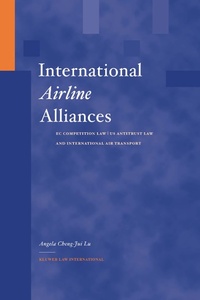
International Airline Alliances: EC Competition Law/US Antitrust Law and International Air Transport
EC Competition Law/US Antitrust Law and International Air Transport
Erschienen am 1. Oktober 2002
448 Seiten
978-90-411-7262-4 (ISBN)
Beschreibung

This new study takes a keen look at the problems facing the international community due to conflicts arising from applications of varying competition laws by different competition authorities to international airline alliances. As a result of privatisation, deregulation, liberalisation and globalisation, international air carriers form alliances with one another in order to cope with growing competition in the international air transport market.
This book clearly provides an introduction to the background to and origin of airline alliances, different models of alliances and the related anti-competitive practices resulting from existing international airline alliances. The potential anti-competitive practices resulting from these cross-border alliances trigger a great deal of concern from various competition authorities. Thus, this study goes on to provide a detailed analysis regarding the relevant EC competition law and US antitrust law and their applications to alliance activities. The comparison of different applications of EC competition law and US antitrust law to international airline alliances provides leading research results first-hand. In the conclusion, the essential elements regarding establishing a level playing field in the international air transport market are identified and the author provides possible solutions for the harmonisation of different applications of competition law to international airline alliances.
This book clearly provides an introduction to the background to and origin of airline alliances, different models of alliances and the related anti-competitive practices resulting from existing international airline alliances. The potential anti-competitive practices resulting from these cross-border alliances trigger a great deal of concern from various competition authorities. Thus, this study goes on to provide a detailed analysis regarding the relevant EC competition law and US antitrust law and their applications to alliance activities. The comparison of different applications of EC competition law and US antitrust law to international airline alliances provides leading research results first-hand. In the conclusion, the essential elements regarding establishing a level playing field in the international air transport market are identified and the author provides possible solutions for the harmonisation of different applications of competition law to international airline alliances.
Weitere Details
Weitere Ausgaben
Andere Ausgaben
Angela Cheng-Jui Lu
International Airline Alliances : EC Competition Law/US Antitrust Law and International Air Transport
EC Competition Law/US Antitrust Law and International Air Transport
Buch
10/2002
Kluwer Law International
403,87 €
Versand in 10-20 Tagen
Inhalt
- Cover
- Half Title Page
- Title Page
- Copyright Page
- Dedication
- About the Author
- Table of Contents
- Preface
- Acknowledgements
- List of Abbreviation
- Foreword
- Introduction
- Chapter 1 Relevant Background to International Airline Alliances
- 1. Historical Background
- 1.1. ESTABLISHMENT OF THE DOCTRINE OF SOVEREIGNTY OVER AIRSPACE - PARIS CONVENTION 1919
- 1.2. SOVEREIGNTY AND EXCHANGE OF AIR OPERATING AND TRAFFIC RIGHTS
- 1.2.1. Chicago Conference 1944
- 1.2.2. Chicago Convention 1944
- 1.3. BILATERAL AIR SERVICE AGREEMENTS
- 1.3.1. Substantial Ownership and Effective Control Clause
- 1.3.2. Prohibition of Cabotage
- 1.4. NEW DEVELOPMENTS, QUESTIONS AND PROBLEMS
- 2. Economic Background
- 2.1. DEREGULATION IN THE UNITED STATES 1978
- 2.2. LIBERALISATION IN THE EUROPEAN UNION 1993
- 2.2.1. Three Liberalisation Packages
- 2.2.2. Relationship between the EC and Third Countries
- 2.2.2.1. General
- 2.2.2.2. Open Skies Agreements
- 2.2.2.3. Reactions to the ECJ Judgment
- 2.2.2.4. Comments on the ECJ Judgments on Open Skies Agreements
- 3. Modern Trends
- 3.1. LIBERAL BILATERAL AND OPEN SKIES AGREEMENTS
- 3.2. CONSOLIDATION, GLOBALISATION AND CONCENTRATION
- 3.3. DIFFICULTIES IN MERGERS AND TAKE-OVERS BETWEEN AIRLINES OF DIFFERENT NATIONALITIES
- 3.4. DIFFICULTIES IN EXCHANGING TRAFFIC RIGHTS ON A MULTILATERAL BASIS
- 3.5. FORMING ALLIANCES TO MEET CONSUMERS' PREFERENCES
- 4. Airline Alliances
- 4.1. DIFFERENT MODELS OF INTERNATIONAL AIRLINE ALLIANCES AND THEIR GROWTH
- 4.2. BENEFITS OF INTERNATIONAL AIRLINE ALLIANCES FOR AIRLINES
- 4.3. BENEFITS OF INTERNATIONAL AIRLINE ALLINACES FOR CONSUMERS
- 4.4. DISADVANTAGES OF INTERNATIONAL AIRLINE ALLIANCES: ANTI-COMPETITIVE PRACTICES
- 4.5. ANTITRUST IMMUNITY FOR INTERNATIONAL AIRLINE ALLIANCES
- 4.6. COMMENTS ON INTERNATIONAL AIRLINE ALLIANCES
- 5. Application of Competition/Antitrust Law to the International Air Transport Sector
- 5.1. INEVITABILITY OF APPLICATION OF COMPETITION/ANTITRUST LAW
- 5.2. SPECIAL ATTENTION REQUIRED IN INTERNATIONAL AIR TRANSPORT
- 5.3. ESCALATION OF CONFLICTS AND DIFFERENCES IN APPLICATION OF COMPETITION/ANTITRUST LAWS TO INTERNATIONAL ECONOMIC ACTIVITIES
- 5.4. EFFECTS OF APPLYING COMPETITION/ANTITRUST LAW TO INTERNATIONAL ECONOMIC ACTIVITIES
- Concluding Remarks
- Chapter 2 An Overview of European Community Competition Law and Its Applications to Transatlantic Airline Alliances
- 1. Basic Background to EC Competition Law
- 1.1. BRIEF INTRODUCTION TO THE EUROPEAN UNION
- 1.1.1. The European Community and Its Legal Institutions
- 1.1.2. The Legal Instruments
- 1.2. SOURCES OF EC COMPETITION LAW
- 1.3. RELATIONSHIP BETWEEN THE EUROPEAN COMMUNITY AND MEMBER STATES REGARDING COMPETITION LAW
- 1.4. EC COMPETITION LAW AND THE AIR TRANSPORT SECTOR
- 2. Substantive EC Competition Law
- 2.1. ARTICLE 81 OF THE EC TREATY
- 2.1.1. The Prohibition of Article 81(1)
- 2.1.2. The Legal Effects of An Infringement of Article 81(1)
- 2.1.3. Block and Individual Exemptions under Article 81(3)
- 2.2. ARTICLE 82 OF THE EC TREATY
- 2.2.1. General Concepts
- 2.2.2. Relevant Market
- 2.2.3. Existence of Dominant Position
- 2.2.4. Abuse of Dominant Position
- 2.2.5. Application of Article 82 in the Air Transport Sector
- 2.2.6. Interface of Articles 81 and 82
- 2.3. THE IMPLEMENTATION OF EC COMPETITION LAW
- 2.3.1. General Implementation: Council Regulation No. 17/62
- 2.3.2. Special Exemption in Air Transport Sector
- (A) Council Regulation No. 141/62
- (B) Case: Nouvelle Frontière
- (C) Council Regulation No: 3975/87
- (D) Council Regulation No. 3976/87
- (E) Case: Ahmed Saeed
- (F) Commission Proposal for Amending Council Regulation No. 3975/87
- 2.4. MERGER CONTROL AND JOINT VENTURE
- 2.4.1. Background to the European Community Merger Regulations ("ECMR")
- 2.4.2. The Relationship between the ECMR and Articles 81 & 82
- 2.4.3. The ECMR and Air Transport
- 2.4.4. An Overview of the ECMR
- 2.4.4.1. Basic Elements of the ECMR
- 2.4.4.2. Notification and Procedure
- 2.4.5. Applications of the ECMR in the Air Transport Sector
- 3. Applications of EC Competition Law to Economic Activities with Foreign Elements Involved
- 3.1. APPLICATIONS UNDER ARTICLES 81 AND 82 OF THE EC TREATY
- 3.1.1. Before the Wood Pulp Case
- 3.1.2. The Wood Pulp Case
- 3.1.3. Other Relevant Developments
- 3.2. APPLICATIONS OF THE ECMR
- 4. EC Competition Policy
- 4.1. OVERVIEW
- 4.2. INTERNATIONAL CO-OPERATION AND THE COMMISSION'S MANDATE
- 4.3. THE LIMITED SCOPE OF 1991 AND 1998 COMITY AGREEMENTS
- 5. EC Competition Policy in the Air Transport Sector
- 6. Applications of EC Competition Law to International Airline Alliances
- 6.1. COMMISSION DECISIONS ON LH/SAS, LH/SAS/BMI AND LH/OS AIRLINE ALLIANCES
- 6.1.1. LH/SAS Alliance
- 6.1.2. LH/SAS/BMI Alliance
- 6.1.3. LH/OS Airlines Alliance
- 6.1.4. AF/AZ Alliance
- 6.2. COMMISSION NOTICES ON TRANSATLANTIC AIRLINE ALLIANCES
- 6.2.1. KLM/Northwest ("Wings ") Alliance
- 6.2.2. LH/United/SAS ("Star") Alliance
- 6.2.3. BA/AA ("Oneworld'') Alliance
- 6.2.4. Air France/Delta ("SkyTeam") Alliance
- 6.3. COMMENTS ON THE COMMISSION NOTICES ON THE KLM/NW, LH/UNITED/SAS AND BA/AA ALLIANCES
- Concluding Remarks
- Chapter 3 Overview of US Antitrust Law Governing International Air Transport and Its Applications to Transatlantic Airline Alliances
- 1. Overview of Substantive US Antitrust Laws
- 1.1. BASIC ECONOMICS OF US ANTITRUST LAWS
- 1.2. SUBSTANTIVE US ANTITRUST LAWS
- 1.2.1. The Sherman Act
- 1.2.1.1. Section 1 of the Sherman Act ("Section 1")
- 1.2.1.2. Section 2 of the Sherman Act ("Section 2")
- 1.2.1.3. Relationship between the Sherman Act and Oligopoly
- 1.2.1.4. Major Differences between Sections 1 and 2 of the Sherman Act
- 1.2.2. The Clayton Act - Mergers and Acquisitions
- 1.3. ENFORCEMENT OF US ANTITRUST LAWS AND RELATED LEGAL DEPARTMENTS
- 2. Applications of US Antitrust Laws to Economic Activities with Foreign Elements Involved
- 2.1. JUDICIAL INTERPRETATIONS: FROM AMERICAN BANANA TO LAKER AIRWAYS
- 2.2. LEGISLATIVE CONTRIBUTION: DIRECT, SUBSTANTIAL, AND FORESEEABLE EFFECT DOCTRINE
- 2.3. ACADEMIC CONTRIBUTION: REASONABLENESS
- 2.4. A STEP BACKWARD: HARTFORD FIRE INSURANCE
- 2.5. EXECUTIVE CONTRIBUTION: ANTITRUST ENFORCEMENT GUIDELINES FOR INTERNATIONAL OPERATIONS
- 2.5.1. Overview
- 2.5.2. Defences against US Applications
- 3. US International Antitrust Policy
- 4. US Antitrust Laws and International Air Transportation
- 4.1. SPECIAL PROVISIONS FOR INTERNATIONAL AIR TRANSPORTATION
- 4.2. ANTITRUST IMMUNITY AND PUBLIC INTEREST TEST
- 4.2.1. The United States Code
- 4.2.2. Procedural Rules
- 4.3. Specific Regulatory Department
- 5. US Policy in International Air Transportation
- 6. DOT Decisions on Transatlantic Alliance Agreements
- 6.1. OPEN SKIES AGREEMENTS REQUIRED
- 6.2. PUBLIC INTEREST TEST
- 6.3. MERGER GUIDELINES INVOKED
- 6.4. DEFINITION OF RELEVANT MARKET AND THE CARVING-OUT OF IMMUNITY
- 6.5. NEED FOR COMPETITIVE REMEDIES
- 6.6. REQUIREMENT OF WITHDRAWAL FROM ALL IATA TARIFF CO-ORDINATION ACTIVITIES
- 6.7. COMPUTER RESERVATION SYSTEM ISSUE
- 6.8. SEPARATE ISSUES
- Concluding Remarks
- Chapter 4 Comparison of Applications of EC Competition Law and US Antitrust Law to International Air Transport
- 1. Introduction
- 2. General Similarities and Differences
- 2.1. SIMILARITIES
- 2.1.1. Substance
- 2.1.2. Implementation of Competition Law to the International Air Transport Sector
- 2.2. DIFFERENCES
- 2.2.1. Genesis of Competition Law
- 2.2.2. Authorities
- 3. Different Procedures for Granting Approval of Antitrust Immunity or Exemption
- 3.1. AIRLINE ALLIANCES AND CODE-SHARING AGREEMENTS
- 3.1.1. Introduction to Airline Alliance Agreements
- 3.1.2. Introduction to Code-Sharing Agreements
- 3.2. COMPARISON OF PROCEDURES
- 4. Differences in Laws
- 4.1. OVERVIEW OF THE TARIFF CONSULTATION AGREEMENT
- 4.1.1. Background to the International Air Transport Association and Its Tariff Co-ordination Process
- 4.1.2. Rationale for Tariff co-ordination Agreements
- 4.1.3. Anti-Competitive Risks of Tariff Co-ordination Agreements
- 4.2. COMPARISON OF THE EC COMPETITION AND US ANTITRUST LAWS APPLICABLE TO THE TARIFF CO-ORDINATION/CONSULTATION AGREEMENT
- 5. Differences in Interpretations and Applications of Laws
- 5.1. DEFINING RELEVANT MARKET
- 5.2. MARKET POWER AND DOMINANT POSITION
- 5.3. APPROACHES TO THE APPLICATION OF COMPETITION/ANTITRUST LAW TO INTERNATIONAL ECONOMIC ACTIVITIES
- 6. Comparison of the EC and US Authorities' Reviews of Transatlantic Airline Alliances
- 6.1. DIVERGENT EVALUATIONS OF MARKET CONCENTRATION
- 6.2. CONCEPT OF ANTI-COMPETITIVE PRACTICES
- 6.3. DIFFERENT REMEDIES
- 7. Differences in Merger Control and Alliances (Joint Ventures)
- 7.1. DIFFERENCES IN APPLICATIONS OF LAWS TO ALLIANCES
- 7.2. APPLICATIONS OF MERGER REGULATIONS: SIMILAR RULES BUT CONTRADICTORY DECISIONS
- 7.3 CLASHES IN INDIVIDUAL CASES
- 8. Differences in Policies
- 8.1. EC COMPETITION POLICY WITH REGARD TO INTERNATIONAL AIR TRANSPORT
- 8.1.1. From the Judicial Point of View
- 8.1.2. From the Executive Point of View
- 8.1.3. Case Studies
- 8.2. US ANTITRUST POLICY WITH REGARD TO INTERNATIONAL AIR TRANSPORT
- 8.2.1. Application of US Antitrust Law to International Economic Activities
- 8.2.2. From the Perspective of Deregulation
- 8.2.3. Exporting "Open Skies
- 8.2.4. DOT's Approval of Antitrust Immunity for Alliance Agreements
- 8.2.5. Approval of the Merger between Boeing and McDonnell Douglas
- 8.2.6. Analysis of US Antitrust and International Air Transport Policy
- Concluding Remarks
- Chapter 5 Current International Competition Regulations regarding International Air Transport
- 1. Introduction
- 2. Multilateral Approaches
- 2.1. A UNIFIED INTERNATIONAL COMPETITION LAW
- 2.1.1. Havana Charter
- 2.1.2. United Nations Conference on Trade and Development Code
- 2.1.3. Munich Proposal: Draft International Antitrust Code
- 2.2. REVIEW OF MULTILATERAL APPROACHES
- 2.3. SPECIAL CONCERNS IN INTERNATIONAL AIR TRANSPORT
- 3. Special Proposal for Applying Competition Law to International Air Transport
- 3.1. INTERNATIONAL CIVIL AVIATION ORGANISATION
- 3.1.1. Role of the ICAO
- 3.1.2. Contributions of the ICAO
- 3.1.3. Review of the ICAO's Contributions
- 3.2. WORLD TRADE ORGANISATION
- 3.2.1. GATT/GATS Mechanism
- 3.2.2. Different Considerations regarding Applying GATS to International Air Transport
- 3.2.3. Trade and Competition Policy under the WTO
- 3.2.4. Limits of GATS with regard to Trade in Services in International Air Transport
- 3.3. OTHER INTERNATIONAL ASSOCIATIONS
- 4. Regionalism
- 4.1. SUPRANATIONAL APPROACH
- 4.2. Transatlantic Common Aviation Area
- 5. Doctrine of Comity and Co-operation between Governments
- 5.1. BILATERAL AND CO-OPERATIVE APPROACH
- 5.1.1. US and EC Comity Agreements
- 5.1.2. Review of US and EC Comity Agreements
- 5.2. ORGANISATION OF ECONOMIC CO-OPERATION AND DEVELOPMENT
- 5.3. BENEFITS OF THE COMITY DOCTRINE AND CO-OPERATION
- 5.4. LIMITS OF THE COMITY DOCTRINE AND CO-OPERATION
- 6. Synthesis
- 7. Convergence of Competition Law
- 7.1. OECD: GLOBAL FORUM ON COMPETITION
- 7.2. US: GLOBAL COMPETITION INITIATIVE
- 7.3. EC: INTERNATIONAL COMPETITION NETWORK
- 7.4. REVIEW OF THE GCF, GCI AND ICN
- Concluding Remarks
- Chapter 6 Conclusion and Recommendations
- 1. Introduction
- 2. Brief Review of the Essential Elements for Fair and Free Competition in the International Air Transport Market
- 2.1. ELEMENTS IN AVIATION LAW
- 2.2. ELEMENTS IN APPLICATIONS OF COMPETITION LAWS TO INTERNATIONAL AIR TRANSPORT
- 3. Recommendations
- 3.1. AN INTERNATIONAL AIR TRANSPORT MARKET WITH FREE COMPETITION
- 3.1.1. Multilateral Approaches to Exchanging Traffic Rights
- 3.1.2. Eliminating the Limitations on Ownership/Control and Cabotage
- 3.2. RULES FOR REDUCING CONFLICTS OVER APPLICATIONS OF COMPETITION LAWS TO INTERNATIONAL ECONOMIC ACTIVITIES
- 3.2.1. Safeguarding Public Interests via the Application of Competition Law
- 3.2.2. Harmonising Approaches to Applying Competition Laws to International Economic Activities
- 3.2.3. Harmonisation in Procedures and Institutions
- 3.2.4. Unified Criteria for Granting Immunity/Exemption
- 3.2.5. Harmonisation of Divergent Evaluations of Market Access
- 3.2.6. Harmonising the Concept of Anti-Competitive Practices
- 3.2.7. Providing Reliable Remedies
- 3.2.8. Convergence of Competition Policies
- 4. Supplements to Present Solutions
- 4.1. BILATERAL AGREEMENTS
- 4.1.1. Expanding Application and Strengthening Binding Force
- 4.1.2. Suggestions on Harmonising Substantive Laws
- 4.1.3. Unified Procedural Rules
- 4.1.4. Forum for Convergence of Competition Policies
- 4.2. TRANSATLANTIC COMMON AVIATION AREA
- 5. Assistance from International Organisations
- Concluding Remarks
- Selected Bibliography
- Subject Index
- Back Cover
