

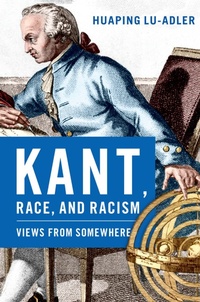
Kant, Race, and Racism
Views from Somewhere
Erschienen am 21. April 2023
425 Seiten
978-0-19-768522-8 (ISBN)
Beschreibung
Kant scholars have paid relatively little attention to his raciology. They assume that his racism, as personal prejudice, can be disentangled from his core philosophy. They also assume that racism contradicts his moral theory. In this book, philosopher Huaping Lu-Adler challenges both assumptions. She shows how Kant's raciology--divided into racialism and racism--is integral to his philosophical system. She also rejects the individualistic approach to Kant and racism. Instead, she uses the notion of racism as ideological formation to demonstrate how Kant, from his social location both as a prominent scholar and as a lifelong educator, participated in the formation of modern racist ideology.
As a scholar, Kant developed a ground-breaking scientific theory of race from the standpoint of a philosophical investigator of nature or Naturforscher. As an educator, he transmitted denigrating depictions of the racialized others and imbued those descriptions with normative relevance. In both roles, he left behind, as one of his legacies, a worldview that excluded non-whites from such goods as recognitional respect and candidacy for cultural and moral achievements. Scholars who research and teach Kant's philosophy therefore have an unshakable burden to take part in the ongoing antiracist struggles, through their teaching practices as well as their scholarship. And they must do so with a pragmatic attention to nonideal social realities and a deliberate orientation toward substantial racial justice, equality, and inclusion.
Lu-Adler pushes the discourse about Kant and racism well beyond the old debates about whether he was racist or whether his racism contaminates his philosophy. By foregrounding the lasting legacies of Kant's raciology, her work calls for a profound reorientation of Kant scholarship.
Weitere Details
Weitere Ausgaben
Person
Huaping Lu-Adler is Associate Professor of Philosophy at Georgetown University. She specializes in seventeenth- and eighteenth-century Western philosophy (particularly epistemology, metaphysics, philosophy of science, and logic). She is the author of Kant and the Science of Logic (Oxford, 2018).
Inhalt
Note on Sources and Abbreviations
General Introduction
1. The debate continues
2. It is not just about Kant: reconceptualizing his relation to racism
3. Is there really a ?contradiction??
4. Locating Kant's racial views in his system
5. Kant's philosophy and antiracism
6. About the title and plan of this book
Part I Reframe the Discourse
Chapter 1 Whence Comes the Contradiction? -Reconsider the Place of Race in Kant's System
1. Introduction
2. Arguing from an assumed contradiction: a literature review
3. Racism and Kant's moral universalism: a noncontradictory pairing
4. From what nature makes of man to what man can make of himself: raciology in Kant's system
4.1. Physical geography as the original home of racialism
4.2. Racist upshot in pragmatic anthropology
5. Three levels of discourse: pure morals, anthropology, and geography
6. Conclusion
Chapter 2 ?Racism? in What Sense?-Reconceptualize Kant's Relation to Racism
1. Introduction
2. Characterizations of Kant's ?racism?: a preliminary overview
3. Which ?racism??-in search of a better way to conceptualize Kant's relation to racism
3.1. How interpreters of Kant have conceptualized racism
3.2. How some race theorists have analyzed 'racism'
4. Kant and the racist-ideological formation
5. Conclusion
Part II Seeing ?Race?
Chapter 3 Investigating Nature under the Guidance of Reason-Kant's Approach to ?Race? as a Naturforscher
1. Introduction
2. Race from the standpoint of a Naturforscher: a sketch of Kant's view
3. Commitments of a Naturforscher: some telling clues in Kant's early works
4. A theory of hypothesis for the Kantian Naturforscher
5. Interlude: Kant's methodological turn after his first essay on race
6. The influence of reason on the investigation of nature: unity and teleology
6.1. Systematic unity and regulative principles of reason in the first Critique
6.2. Kant on the use of teleological principles in the 1788 essay on race
7. A teleological-mechanical mode of explanation: how the third Critique solidifies Kant's race theory
8. Conclusion
Chapter 4 From Baconian Natural History to Kant's Racialization of Human Differences-A Study of Philosophizing from Locations of Power
1. Introduction
2. Francis Bacon, the Royal Society, and a global data production
2.1. Bacon and the program of natural history
2.2. Boyle and a scientific attention to skin color
3. The beginning of a paradigm shift: Linnaeus's Systema Naturae and human varieties
4. Buffon: scientific monogenesis, degeneration, and the problem of slavery
4.1. Buffon on natural history, with a critique of the Linnaean taxonomy
4.2. Mapping human ?varieties,? with passing remarks on slavery
4.3. Climate, moule interieur, and degeneration: Buffon's scientific monogenism
4.4. Degeneration and human perfectibility: an entanglement of theory and practice
5. Going beyond Buffon: Kant on ?race,? monogenesis, and slavery
5.1. Kant's Naturgeschichte and a new model of monogenesis
5.2. Kantian monogenism, human progress, and racial slavery
6. Conclusion
Part III A Worldview Transformed by ?Race?
Chapter 5 What is Seen Cannot Be Unseen-What Kant Can(not) Tell Us about Racial (Self-)Perceptions
1. Introduction
2. From race concepts to racial ideology
3. Kant on abstraction, or why it is so hard to unsee race
4. Kleist: ?Kant crisis? and the tragic trap of racialization
5. William der Neger: the double consciousness of a ?Negro?
6. Conclusion
Chapter 6 Race and the Claim to True Philosophy-Kant and the Formation of a Exclusionary History of Philosophy
1. Introduction
2. Eclecticism, system making, and critique: competing ways of philosophizing
2.1. Eclecticism versus dogmatic systematization: an eighteenth-century debate
2.2. Kant on the ?eye of true philosophy?: systematicity with a worldly orientation
3. Beholding the history of philosophy with a true philosophical eye
3.1. The Kantian rational history of philosophy
3.2. From Brucker's historia to Kant's Geschichte of philosophy
4. Kant on the origin of ?true philosophy?: toward a racially exclusionary history of philosophy
5. Conclusion
A Forward-Looking Conclusion
1. Kant as a scholar and as an educator: how I have interpreted his relation to racism
2. How we move forward with Kant's philosophy: some programmatic ideas
2.1. Normative reorientation and standpoint awareness: the work of a liberal Kantian scholar
2.2. Students as situated meaning makers: the work of a liberal Kantian educator
Acknowledgements
Bibliography
Index
