

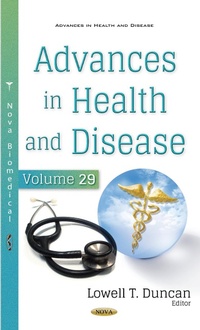
Advances in Health and Disease. Volume 29
Erschienen am 22. Juni 2021
266 Seiten
978-1-5361-8867-7 (ISBN)
Beschreibung

Advances in Health and Disease. Volume 29 begins with a focus on Aeromonas species, Gram-negative rods belonging to the family Aeromonadaceae. Next, the authors discuss the implications of gut microbiota in children with autism spectrum disorders, assessing the hypothesis that there is a relationship between emotional state and gut microbe abundance through the microbiota-gut-brain axis. The many ways mitochondrial functions are compromised in the diseased state of the kidney are explored, targeting mitochondrial quality control as a promising therapeutic option for treating kidney dysfunctions. Continuing, this compilation aims to set a new path for vaping through electronic cigarette or vaping associated lung injury analysis in terms of use, regulation and research. One study attempts to explore parents' perceptions of cerebral palsy, particularly the implications of cerebral palsy on the family in Italy. Following this, the authors report on the role of the registered nurse advanced practitioner and registered nurses in the initiation, development and structuring of a child/family-centered pediatric neurosurgery healthcare system. The concluding review focuses on tumor lysis syndrome, a high mortality complication accompanied by metabolic disorders seen after massive cell destruction as a result of spontaneous or cytotoxic treatment.
Weitere Details
Weitere Ausgaben
Andere Ausgaben
Buch
11/2020
Nova Science Publishers Inc
328,88 €
Versand in 15-20 Tagen
Inhalt
- Intro
- Contents
- Preface
- Aeromonas: An Overview
- Abstract
- 1. Introduction
- 2. Historical Background of the Taxa Aeromonas
- 3. Taxonomy and Identification Methods
- 3.1. Biochemical Tools
- 3.2. Molecular Markers
- 3.2.1. Sequencing the 16S rRNA Gene
- 3.2.2. Constitutive Genes
- 3.2.3. Genotyping Methods
- 3.2.4. Genomics
- 4. Ecology and Epidemiology
- 4.1. Aeromonas in Aquatic Environments
- 4.2. Aeromonas in Food
- 4.3. Aeromonas in Animals
- 4.4. Aeromonas in Human Infections
- 5. Virulence Factors
- 5.1. Surface Polysaccharides
- 5.1.1. Capsule
- 5.1.2. Lipopolysaccharide (LPS)
- 5.1.3. Surface a-Glucan
- 5.1.4. S-Layers
- 5.1.5. Exotoxins and Other Extracellular Enzymes
- 5.2. Extracellularly Secreted Enzymes
- 5.3. Secretion Systems
- 5.4. Quorum Sensing
- 5.5. Iron Accession Mechanisms
- 5.6. Adhesins
- 6. Host-Pathogen Interaction
- 7. Pathogenicity Studies
- 7.1. Clinical Microbiology and Detection
- 8. Unique Phenomenon in Aeromonads
- 8.1. Suicide Phenomenon
- 8.2. Viable but Nonculturabe State
- 8.3. Tetrodotoxin (TTX) Production
- 9. Antimicrobial Susceptibilities of Aeromonas Species
- Conclusion
- Acknowledgments
- References
- Biographical Sketch
- Implications of Gut Microbiota and Gastrointestinal Symptoms in Autism
- Abstract
- 1. Diagnosis and Theoretical Framework in ASD
- 2. Microbiota - Gut - Brain Axis in ASD
- 2.1. Immune Modulatory Metabolites
- 2.1.1. Short-Chain Fatty Acids
- 2.1.2. Other Metabolites
- 2.2. Neurotransmitters and the Enteric Nervous System
- 2.3. The Innate Immune System in the Gut
- 3. Dysbiosis in ASD
- 3.1. Bacteroidetes Phylum
- 3.1.1. Bacteroides
- 3.1.2. Prevotella
- 3.1.3. Parabacteroides
- 3.2. Firmicutes Phylum
- 3.2.1. Lactobacillus
- 3.2.2. Ruminococcus
- 3.2.3. Streptococcus
- 3.2.4. Lachnospira
- 3.2.5. Enterococcus
- 3.2.6. Faecalibacterium
- 3.2.7. Clostridium
- 3.2.8. Blautia
- 3.2.9. Roseburia
- 3.3. Actinobacteria Phylum
- 3.3.1. Bifidobacterium
- 3.3.2. Eggerthella
- 3.4. Proteobacteria Phylum
- 3.4.1. Sutterella
- 4. Gastro-Intestinal Symptoms in ASD
- 5. Intervention by Prebiotics, Probiotics and Fecal Microbiota Transplantation in the ASD
- 5.1. Prebiotics and Probiotics
- 5.1.1. Efects of Prebiotics
- 5.1.2. Efects of Probiotics
- 5.2. Microbiota Transfer Therapy (MTT) or Fecal Microbiota Transplantation (FMT)
- References
- Mitochondrial Quality Control in Kidney Dysfunctions - Recent Perspectives
- Abstract
- Introduction
- Mitochondrial Quality Control
- Mitochondrial Biogenesis
- Mitochondrial Dynamics: Fission and Fusion
- Mitophagy
- Nuclear (Erythroid-Derived 2) Factor 2 (Nrf2) and Mitochondria
- Renin-Angiotensin System (RAS)
- Conclusion
- Perspectives
- Acknowledgments
- References
- The Mysterious Electronic Cigarette/Vaping Associated Lung Injury Syndrome (EVALI)
- Abstract
- At a Glance
- Introduction
- Epidemiology
- Disease Definition/Case Recognition
- Prevalence Data
- Geographical Patterns of the Endemic Outburst
- Socio-Economic Factors
- Toxicology
- The Problem of Exposure
- The Quest for the Guilty Agent
- Potential Toxicological Explanations
- The Vitamin E Acetate Theory
- Toxicological Review of VEA and Its Derivatives
- Future Consideration
- Challenges of Quantitative Research
- Endnote
- References
- Families Raising a Child with Cerebral Palsy in Italy
- Abstract
- Introduction
- Methods
- Participants
- Measures
- Procedure
- Analysis
- Results
- Representations of Cerebral Palsy
- Representations of a Family Raising a Child with CP
- Descriptions of the Condition of CP in a Family
- Family Aspects that Most Worry Parents
- Family Aspects that Satisfy Parents Most
- Discussion
- Limitations of the Study
- Conclusion
- References
- The Role of Nurse Practitioners in a Pediatric Neurosurgery Healthcare System: Providing Child/Family-Centered Care
- Abstract
- Introduction
- Materials and Methods
- Initiation and Development of the Pediatric Neurosurgery Service (PNS)
- Initiation and Development of the Pediatric Neurosurgery Healthcare System (PNHS)
- Fetal Diagnosis and Therapy Center
- Spinal Defects Clinic
- Pediatric Neurosciences Clinic
- Spasticity Program and Clinic
- Brachial Plexus Program and Clinic
- Craniosynostosis/Craniofacial Program and Clinic
- Epilepsy Surgery Program
- Neuro-Oncology Clinic
- Telemedicine Clinics
- Preliminary Outcomes
- Discussion
- Conclusion
- Acknowledgments
- References
- About the Author
- Tumor Lysis Syndrome
- Abstract
- 1. Introduction
- 2. Definition
- 3. Etiology and Risk Factors
- 3.1. High Risk Disease (HRD) (& 5 Percent Risk of TLS)
- 3.2. Intermediate Risk Disease (IRD) (Risk of TLS 1 to 5 Percent)
- 3.3. Low Risk Disease (LRD) (&1 Percent Risk)
- 4. Symptoms and Findings
- 4.1. Hyperuricemia
- 4.2. Hyperkalemia
- 4.3. Hyperphosphatemia
- 4.4. Xanthinuria
- 4.5. Hypocalcemia
- 5. Treatment
- 5.1. Hydration
- 5.2. Urinary Alkalization
- 5.3. Hypouricemic Drugs
- 5.3.1. Allopurinol
- 5.3.2. Rasburicase
- 5.3.3. Febuxostat
- References
- Biographical Sketch
- Contents of Earlier Volumes
- Index
