

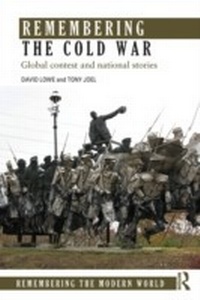
Remembering the Cold War
Global Contest and National Stories
1. Auflage
Erschienen am 21. Januar 2014
280 Seiten
978-1-317-91259-0 (ISBN)
Beschreibung

Remembering the Cold War examines how, more than two decades since the collapse of the Soviet Union, Cold War legacies continue to play crucial roles in defining national identities and shaping international relations around the globe. Given the Cold War's blurred definition - it has neither a widely accepted commencement date nor unanimous conclusion - what is to be remembered? This book illustrates that there is, in fact, a huge body of 'remembrance,' and that it is more pertinent to ask: what should be included and what can be overlooked?
Over five sections, this richly illustrated volume considers case studies of Cold War remembering from different parts of the world, and engages with growing theorisation in the field of memory studies, specifically in relation to war. David Lowe and Tony Joel afford careful consideration to agencies that identify with being 'victims' of the Cold War. In addition, the concept of arenas of articulation, which envelops the myriad spaces in which the remembering, commemorating, memorialising, and even revising of Cold War history takes place, is given prominence.
Over five sections, this richly illustrated volume considers case studies of Cold War remembering from different parts of the world, and engages with growing theorisation in the field of memory studies, specifically in relation to war. David Lowe and Tony Joel afford careful consideration to agencies that identify with being 'victims' of the Cold War. In addition, the concept of arenas of articulation, which envelops the myriad spaces in which the remembering, commemorating, memorialising, and even revising of Cold War history takes place, is given prominence.
Rezensionen / Stimmen
'Lowe and Joel's thematic approach to remembrance of the Cold War provides an important, and hitherto overlooked, lens upon the epoch defining contest: seemingly ubiquitous, the differing national experiences of the Cold War are expertly considered.'Dr J. Simon Rofe, SOAS, University of London
'Scholarship on historical memory of twentieth century wars and the holocaust have been highly fashionable in the past decade. Remembering the Cold War opens up a vast new field of investigation into the historical memories of the Cold War. The introductory chapter introduces the general reader to the vast theoretical literature on memory studies in easily comprehensible form. The Cold War was a global event and this innovative study covers sites of memory from Vietnam to Australia, from Berlin, Prague and Budapest to California. Numerous pictures taken by the authors of Cold War lieux de memoire add a stunning visual history to this fine text, opening up a fertile new field of study. This book is a must read.'
Dr Guenter Bischof, University of New Orleans, USA
'Remembering the Cold War is an accessible and innovative exploration of the ways that this extraordinary era in world politics is evoked and recast in our contemporary moment. The book is unique in its approach to the Cold War as an object of our common memories. It is a timely and welcome contribution to the general field of Memory Studies.'
Andrew Oppenheimer, formerly of Maastricht University, The Netherlands 'Lowe and Joel's thematic approach to remembrance of the Cold War provides an important, and hitherto overlooked, lens upon the epoch defining contest: seemingly ubiquitous, the differing national experiences of the Cold War are expertly considered.'
Dr J. Simon Rofe, SOAS, University of London
'Scholarship on historical memory of twentieth century wars and the holocaust have been highly fashionable in the past decade. Remembering the Cold War opens up a vast new field of investigation into the historical memories of the Cold War. The introductory chapter introduces the general reader to the vast theoretical literature on memory studies in easily comprehensible form. The Cold War was a global event and this innovative study covers sites of memory from Vietnam to Australia, from Berlin, Prague and Budapest to California. Numerous pictures taken by the authors of Cold War lieux de memoire add a stunning visual history to this fine text, opening up a fertile new field of study. This book is a must read.'
Dr Guenter Bischof, University of New Orleans, USA
'Remembering the Cold War is an accessible and innovative exploration of the ways that this extraordinary era in world politics is evoked and recast in our contemporary moment. The book is unique in its approach to the Cold War as an object of our common memories. It is a timely and welcome contribution to the general field of Memory Studies.'
Andrew Oppenheimer, formerly of Maastricht University, The Netherlands
Weitere Details
Reihe
Sprache
Englisch
Verlagsort
London
Großbritannien
Verlagsgruppe
Taylor & Francis Ltd
Zielgruppe
Für höhere Schule und Studium
Illustrationen
2 s/w Abbildungen, 54 s/w Photographien bzw. Rasterbilder
54 Halftones, black and white; 2 Illustrations, black and white
Dateigröße
3,32 MB
ISBN-13
978-1-317-91259-0 (9781317912590)
Copyright in bibliographic data and cover images is held by Nielsen Book Services Limited or by the publishers or by their respective licensors: all rights reserved.
Schweitzer Klassifikation
Weitere Ausgaben
Andere Ausgaben
Buch
12/2013
1. Auflage
Routledge
63,90 €
Versand in 15-20 Tagen
Buch
12/2013
1. Auflage
Routledge
214,82 €
Versand in 15-20 Tagen
Personen
David Lowe is Professor of History at the Alfred Deakin Research Institute, Deakin University. His research interests include the end of empires in Asia and the uses of history by politicians. He is the author/editor of seven books, including Australian Between Empires (2010) and Menzies and the Great World Struggle (1999).
Tony Joel is Lecturer in History at Deakin University. A former German Academic Exchange Service (DAAD) scholarship holder, his research interests include war memory and commemoration. Publications include The Dresden Firebombing: Memory and the Politics of commemorating Destruction (2013).
Tony Joel is Lecturer in History at Deakin University. A former German Academic Exchange Service (DAAD) scholarship holder, his research interests include war memory and commemoration. Publications include The Dresden Firebombing: Memory and the Politics of commemorating Destruction (2013).
Inhalt
Introduction. 1. Conceptualizing Cold War Remembrance 2. Nuclear World 3. Cities and Sites 4. Defining Our Times 5. Endings
