

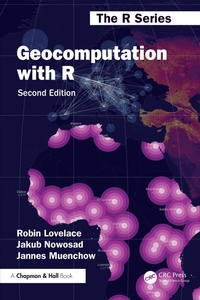
Geocomputation with R
2. Auflage
Erschienen am 23. Mai 2025
420 Seiten
978-1-040-22683-4 (ISBN)
Beschreibung

Geocomputation with R is for people who want to analyze, visualize, and model geographic data with open source software. The book provides a foundation for learning how to solve a wide range of geographic data analysis problems in a reproducible, and therefore scientifically sound and scalable way. The second edition features numerous updates, including the adoption of the high-performance terra package for all raster data processing, detailed coverage of the spherical geometry engine s2, updated information on coordinate reference systems and new content on openEO, STAC, COG, and gdalcubes. The data visualization chapter has been revamped around version 4 of the tmap package, providing a fresh perspective on creating publication-quality maps from the command line. The importance of the book is also highlighted in a new foreword by Edzer Pebesma.
The book equips you with the knowledge and skills necessary to tackle a wide range of issues manifested in geographic data, including those with scientific, societal, and environmental implications. The book is especially well-suited to:
Data scientists and engineers interested in upskilling to handle spatial data.
People with existing geographic data skills interested in developing powerful geosolutions via code.
Anyone who needs to work with spatial data in a reproducible and scalable way.
The book is divided into three parts: Foundations, Extensions, and Applications, covering progressively more advanced topics. The exercises at the end of each chapter provide the necessary skills to address various geospatial problems, with solutions and supplementary materials available at r.geocompx.org/solutions/.
The book equips you with the knowledge and skills necessary to tackle a wide range of issues manifested in geographic data, including those with scientific, societal, and environmental implications. The book is especially well-suited to:
Data scientists and engineers interested in upskilling to handle spatial data.
People with existing geographic data skills interested in developing powerful geosolutions via code.
Anyone who needs to work with spatial data in a reproducible and scalable way.
The book is divided into three parts: Foundations, Extensions, and Applications, covering progressively more advanced topics. The exercises at the end of each chapter provide the necessary skills to address various geospatial problems, with solutions and supplementary materials available at r.geocompx.org/solutions/.
Rezensionen / Stimmen
Praise for the first edition"Geocomputation with R offers several advantages. Firstly, it uses up-to-date packages, mainly the 'sf' package for vector processing which was not available at the time the previous books were written. 'sf'' is truly a game-changer in the field of working with spatial data in R. I believe this alone makes writing the new book worthwhile. Secondly, the book offers a very broad overview, trying-and in my opinion succeeding-to encompass all non-statistical themes involved in geo-computation, including subjects such as location and transport modeling in R (chapters 7-8) which were never published before. Thirdly, the book offers a lot of illustrations and clearly demonstrates key concepts in GIS and geo-computation from the R point of view. I believe these characteristics will give the book an advantage and quite possibly make it the most popular choice in the category of spatial analysis in R for several years to come...The book can be used both as reference and as a textbook...The present book will definitely become the main textbook for this course once published."
~Michael Dorman, Ben-Gurion University of the Negev
Weitere Details
Reihe
Auflage
2nd edition
Sprache
Englisch
Verlagsort
London
Großbritannien
Verlagsgruppe
Taylor & Francis Ltd
Zielgruppe
Für höhere Schule und Studium
Für Beruf und Forschung
Illustrationen
21 Tables, black and white; 92 Line drawings, color; 28 Line drawings, black and white; 8 Halftones, color; 100 Illustrations, color; 28 Illustrations, black and white
Dateigröße
29,97 MB
ISBN-13
978-1-040-22683-4 (9781040226834)
Copyright in bibliographic data and cover images is held by Nielsen Book Services Limited or by the publishers or by their respective licensors: all rights reserved.
Schweitzer Klassifikation
Weitere Ausgaben
Andere Ausgaben
Robin Lovelace | Jakub Nowosad | Jannes Muenchow
Geocomputation with R
Buch
05/2025
2. Auflage
Chapman & Hall/CRC
264,00 €
Versand in 10-20 Tagen
Robin Lovelace | Jakub Nowosad | Jannes Muenchow
Geocomputation with R
Buch
05/2025
2. Auflage
Chapman & Hall/CRC
117,00 €
Versand in 10-20 Tagen
Personen
The authors are well-established geospatial researchers and teachers. Dr. Robin Lovelace is an Associate Professor at the University of Leeds, is the developer of high impact applications for more data-driven transport planning and policy. Dr. Jakub Nowosad is an Associate Professor at the Adam Mickiewicz University in Poznan, where his focus is on methods for analyzing and understanding spatial patterns in the environment. Dr. Jannes Muenchow is a researcher, engineer and developer at the data science consultancy Cynkra, where he holds a dual role as a senior data scientist and supporting DevOps engineer.
Inhalt
Foreword (2nd Edition) Preface 1. Introduction 2. Geographic data in R 3. Attribute data operations 4. Spatial data operations 5. Geometry operations 6. Raster-vector interactions 7. Reprojecting geographic data 8. Geographic data I/O Part 1: Foundations 9. Making maps with R 10. Bridges to GIS software 11. Scripts, algorithms and functions 12. Statistical learning Part 2: Extensions 13. Transportation 14. Geomarketing 15. Ecology 16. Conclusion Bibliography Index
