

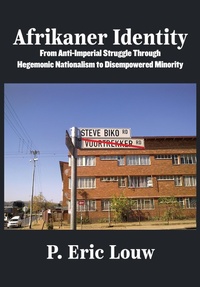
Afrikaner Identity
From Anticolonial Struggle Through Hegemonic Nationalism to Disempowered Minority
Erschienen am 16. Januar 2025
320 Seiten
978-1-68053-342-2 (ISBN)
Beschreibung

Afrikaners have long been portrayed as the villains of South Africa's apartheid state. Because they were such intensely vilified pariahs, many Americans and Europeans remain intrigued by Afrikaners as a vestige of white nationalism living in Africa who nevertheless peacefully transferred political power to South Africa's black majority. Afrikaner Identity tells the longer story of the Afrikaners, starting with the emergence of an accidental Dutch colony at Cape Town in the seventeenth century, and explores how these people came to see themselves distinctly as Afrikaners (?Africans?) and why this identity assumed the shape that it did over time. Further, the book unpacks the complex interactions between the emergent identity of ?Afrikaner-ness? and the slaves they imported from Asia, Cape-based Khoisan clans, British settlers, and (later) the tribes of the African interior. Eric Louw explains how 150 years of Afrikaner conflict with British imperialism played a pivotal role in shaping Afrikaner identity and also gave rise to the phenomenon of Afrikaner nationalism. Louw also tells how Afrikaner migration modified the community's identity as it came into contact with black Africans. This encounter not only shaped the future of Southern Africa but also influenced how Afrikaners came to view themselves as they faced the new challenges of British hegemony, the Boer War, and the rise of Afrikaner nationalism over the first half of the twentieth century, a process that eventually replaced British power with Afrikaner hegemony and imposed apartheid, in part to deconstruct the British-made state of South Africa. Afrikaner Identity concludes with the transition to black-majority rule since 1994 and Afrikaners' new role as a politically disempowered white minority with new challenges to their identity.
Weitere Details
Weitere Ausgaben
Andere Ausgaben
Eric Louw
Afrikaner Identity
From Anticolonial Struggle Through Hegemonic Nationalism to Disempowered Minority
Buch
08/2024
Academica Press
100,50 €
Versand in 3-4 Wochen
Person
Eric Louw's career spanned universities in both South Africa and Australia. Prior to that, he was a journalist at the Pretoria News and also ran an NGO engaged in development work in South Africa. Louw has been a Visiting Research Fellow at the University of Cape Town and at the University of South Africa and has served on the editorial boards of four academic journals. His publications in the fields of political communication and South African politics include 12 books, over 60 journal articles and over 40 book chapters. Dr. Louw's books include Decolonization and White Africans: The 'Winds of Change,' Resistance, and Beyond (Academica Press) as well as Roots of the Pax Americana, The Rise, Fall and Legacy of Apartheid, and New Voices Over the Air: The Transformation of the South African Broadcasting Corporation in a Changing South Africa.
Inhalt
- Afrikaner Identity.From Anti-Imperial Struggle ThroughHegemonic Nationalism to Disempowered Minority
- P. Eric Louw
- Afrikaner Identity.From Anti-Imperial Struggle ThroughHegemonic Nationalism to Disempowered Minority
- P. Eric Louw
- Academica PressWashington~London
- Library of Congress Cataloging-in-Publication Data
- Names: Louw, Eric. (author)
- Title: Afrikaner identity : from anticolonial struggle through hegemonic nationalism to disempowered minority | Eric Louw
- Description: Washington : Academica Press, 2025. | Includes references.
- Identifiers: LCCN 2025930053 | ISBN 9781680533415 (hardcover) | 9781680533422 (e-book)
- Copyright 2025 Eric Louw
- Contents
- Abbreviations x
- Dedication xii
- Chapter 1Introduction: A South African story of identity, nationalism and context 1
- Chapter 2Afrikaner Identity Construction under Dutch and British Hegemony 63
- Chapter 3Building an Afrikaner Nationalist Hegemony 117
- Chapter 4Making Identity, Nationalism and Ideology: The role of the media 153
- Chapter 5Beyond Afrikaner nationalism:Disempowered minority status and identity shifts 211
- Bibliography 281
- Index 297
- Abbreviations
- ACDP - African Christian Democratic Party
- ANC - African National Congress
- ATKV - Afrikaanse Taal- en Kultuurvereniging (Afrikaans Language and Culture Association)
- AWB - Afrikaner Weerstand Beweeging (Afrikaner Resistance Movement)
- BEE - Black Economic Empowerment
- CNE - Christian National Education
- Cosatu - Congress of South African Trade Unions
- CP - Conservative Party
- DA - Democratic Alliance
- DRC - Dutch Reform Church
- EFF - Economic Freedom Fighters
- Eskom - Electricity Supply Commission
- FF - Freedom Front
- GNU - Government of National Unity
- IFP - Inkatha Freedom Party
- KZN - KwaZulu-Natal
- MK - Mkhontu weSizwe
- MKP - Mkhontu weSizwe Party
- NP - National Party
- NSMS - National Security Management System
- OB - Ossewabrandwag
- OFS - Orange Free State
- PA - Patriotic Alliance
- PAC - Pan Africanist Congress
- PFP - Progressive Federal Party
- PM - Prime Minister
- RET - Radical Economic Transformation
- SABC - South African Broadcasting Corporation
- SACP - South African Communist Party
- SADF - South African Defence Force
- SAP - South African Party
- S&S - Saints and Sinners media model
- SOE - State Owned Enterprise
- SWA - South West Africa (Namibia)
- SWAPO - South West African People's Organization
- UCDP - United Christian Democratic Party
- UCT - University of Cape Town
- UDF - United Democratic Front
- UDI - Unilateral Declaration of Independence
- UP - United Party
- VOC - Verenigde Oostindische Compagnie (Dutch East India Company)
- WMC - White Monopoly Capital
- ZAR - Zuid Afrikaanse Republiek (South African Republic/Transvaal)
- Dedication
- For my father, Mike from whom I learned so much. It was during our many road-trips around Rhodesia that my earliest interest was kindled in the way that Anglo-Afrikaner relationships played a role in shaping Afrikaner attitudes and identity.
- Chapter 1 Introduction: A South African story of identity, nationalism and context
- The Cape fulcrum of Afrikaner Identity
- British Imperial impact on development of Afrikanerness
- Boer Republics and Afrikanerness
- South African white hegemony 1: Anglo period 1910-1948
- South African white hegemony 2: Afrikaner Nationalist Period 1948-1993
- Black-ruled South Africa and Afrikaner post-nationalism
- Afrikaners became a much-vilified pariah-group during the second half of the twentieth century (especially in the Anglosphere) and many of the negative stereotypes of this past demonization have proved to be quite resilient. This pariah status derived from two sources. Firstly, a century-long struggle within the white South African population between Anglos and Afrikaners which diffused negative Anglo-portrayals of Afrikaners throughout the Anglosphere. (The first set of negative portrayals date
- Afrikaners are only one of South Africa's many ethnic groups. The percentage of speakers of the 11 main languages (in 2024) serves to demonstrate this diversity. Zulu (22%), Xhosa (16%), Afrikaans (14%), English (10%), Pedi (9%), Tswana (8%), Sotho (8%), Tsonga (4%), Swazi, 3%), Venda 2%, and Ndebele (2%). (Some 40% of Afrikaans-speakers identify as Afrikaners). This book focusses on just one of South Africa's ethnic groups, namely Afrikaners, and it seeks to answer a number of questions about t
- This book begins with the story of (Dutch, French and German) people initially brought together by a seventeenth century Dutch settlement at Cape Town (Beiwenga, 1998) who over time congealed into a group who saw themselves as a new ethnicity called "Boere" (Boers) and/or "Afrikaners" (Africans). The book then traces out the story of these Boere/Afrikaners as they migrated eastwards and northwards, settling new lands in the Eastern Cape plus the highveld interior. Nineteenth century wars fought
- Given the way so much of twentieth century South African politics revolved around the phenomenon of Afrikaner nationalism the book will spend some time examining the emergence of Afrikaner nationalism (during the early decades of the twentieth century) and the way in which Afrikaner nationalists came to dominate the political system from 1948 to 1993. Understanding this nationalism will also involve examining the role this nationalism played in shaping the evolution of Afrikaner identity, and of
- The pre-nationalist phase is especially interesting because this is when the very idea of 'Afrikaner' was born. There was a time when the people who evolved into Afrikaners were just thought of as Dutchmen at the Cape or Kaapse Hollanders (Cape Dutch). Anglos often just called them 'Dutchmen.' But these people, especially after they intermarried with French Huguenots (Bryer & Theron, 1987), stopped thinking of themselves as Dutch. Those living away from Cape Town began defining themselves as Boe
- But it was a long journey from Biebouw's outburst to the formation of a fully-fledged Afrikaner nationalism in the twentieth century. Indeed it was not until the twentieth century that "Afrikaner" was regularized as the way Afrikaners named themselves, with the terms "Boere" and "Afrikaner" being used interchangeably until the nineteenth century. Similarly, Afrikaner/Boere identity-formation also involved a long and complex journey that unfolded over time in three quite different contexts, namel
- The Dutch East India Company (Verenigde Oostindische Compagnie/VOC) ruled the Cape Colony from 1652 until 1795 (McCall, 2022). This era of VOC governance was the fulcrum within which two new ethnic groups emerged at the Cape. One came to be called "Afrikaners" and the other "Coloureds" (or Kleurlinge).
- The emergence of a new ethnic group called Afrikaners was the unintended consequence of a series of VOC decisions. The VOC was a global trading company not a colonizing/ imperialist enterprise (Boxer, 1965). The VOC established a resupply station at Cape Town to restock ships sailing between Amsterdam and Java (to stop their crews getting scurvy). The Cape station was staffed with VOC employees who did tours of duty at various VOC stations around the Indian Ocean. The Cape was never intended to
- So what were the VOC decisions that ultimately led to the creation of an Afrikaner ethnicity? Cape Town was transformed from a company outpost into a European settlement colony by two VOC decisions. Firstly, the VOC decided company-run farms would stop producing the food needed to supply passing ships. Instead, henceforth this food would be produced by private farmers running their own businesses. Consequently, in 1657 some VOC employees were allowed to become vryburgers (free citizens) (Olivier
- A third important decision taken by the VOC was to import slaves to meet the Cape's labour needs instead of running an assisted immigration scheme to bring European labourers to the Cape (Giliomee, 2003: 12-13). The VOC had decided the Khoisan (who were indigenous to the Cape) were too primitive to use as labourers. On two occasions - in 1716 and 1750 - the VOC seriously discussed whether they should initiate assisted immigration or free immigration schemes to recruit labourers from Holland and
- Although the VOC constantly tried to restrict the expansion of the Cape Colony they failed because the Boers kept moving northwards and eastwards beyond the official boundaries established by the VOC. Those colonizing new lands beyond the company's control called themselves trekboers (Guelke, 1979: 58-67). These trekboers simply ignored the VOC's boundaries because beyond these boundaries they saw huge areas of available land with only a few small clans of nomadic Khoisan hunter-gathers roaming
- The fact that the VOC could never control the trekboer migrations serves to illustrate an important feature of VOC governance. The VOC were a commercial company whose focus was on trading with Asia. Their interest was in Cape Town as a stop-over station on their long Amsterdam-Java trade-route. The company was not going to spend large sums of money establishing a machinery of government beyond the immediate vicinity of Cape Town. Africa's arid interior was of little interest to these VOC traders
- When the British annexed the Cape, a British governor simply replaced the VOC governor in Cape Town, and they took over the VOC's seven landrost districts and system of local Veld cornets/commandos. For the first few decades of British rule Afrikaners/Boere experienced few meaningful changes in their lives. But once the British got into their stride and began changing the social, economic and political landscape in Southern Africa, the impact on Afrikaners/Boere became deep and significant. Inde
- Britain seized the Cape in 1795 to prevent it from falling into French hands during the Napoleonic wars (after France conquered the Netherlands). In 1806 the Cape Colony was formally transferred from the Netherlands to Britain. The British introduced to the Cape: monarchy, Anglo liberalism, and the English language.
- When Britain annexed the Cape it was occupied by two ethnic groups, Boere/Afrikaners and Coloureds. There were no black-African inhabitants of the Cape Colony in 1806 because whites and blacks had only just encountered each other at the Fish River frontier towards the end of the Dutch period (Giliomee, 1979). By annexing the Cape Britain inherited from the VOC an eastern frontier problem. This problem had begun in 1778 when the VOC governor annexed all land up to the Fish River. The Fish River b
- Along this Eastern Cape border wars were fought for 100 years (until the British finally defeated the Xhosa in 1879). Britain's attempts to pacify this frontier led to two major British settlement schemes in the Eastern Cape. In 1820 Britons were settled along the western banks of the Fish River to create an obstacle to Xhosa tribesmen crossing into the Cape Colony (Bryer, & Hunt, 1984). These 1820 Settlers are deemed the founder-population of Anglo South Africans. Then in 1857 the British gover
- In 1822 the British governor made English the official language of the Cape Colony (abolishing the use of Dutch). The change of official language coupled with the introduction of a sizeable English population into the Cape represented a significant reconfiguration of the cultural environment. This triggered political turmoil amongst Afrikaners/Boere who during the 1820s began sending scouts beyond the northern borders of the Cape to see if they could find new lands which they might potentially c
- The second major socio-economic change implemented by the British was the 1834 abolition of slavery (Huzzey, 2012). Slavery was initially replaced with a transitional apprentice system for 6 years (when slaves became apprentices prior to being completely freed). This seriously disrupted the Cape's farming economy, and the lack of consultation caused great unhappiness amongst the Boere, so that many farmers joined the migration northwards to the Boer republics. The ending of slavery coupled with
- Anglo liberalism was further strengthened at the Cape by the introduction of Representative government in 1854 whereby Cape Colony voters got to elect representatives to a new parliament in Cape Town. The Cape had a multi-racial qualified franchise, based on wealth and education (Trapido, 1964). In practice that meant only a few western-educated blacks had the vote, with most voters being white or coloured. The Cape became the twelfth British colony to be granted full Westminster Responsible gov
- In the 1840s the reach of British power in Southern Africa was extended beyond the Cape when Britain annexed Natal. A large Anglo migration scheme, the Byrne settlers (1849-51) consolidated Britain's hold over Natal. This annexation of Natal was to have a significant impact on the shaping of Afrikaner identity because Britain had seized Natal from Afrikaner/Boere control (Cubbin, 1992). The Republic of Natalia had been one of the Boer republics established by the Great Trek, and Britain terminat
- Another element within the Afrikaner 'persecution narrative' of British imperialism raised the issue of how the English language/culture was imposed upon subject peoples. As a result of English being made the Cape's sole official language (plus attempts to Anglicize Cape Afrikaners), many Afrikaners became concerned about the survival of their language and culture. In 1875 Stephanus du Toit (a Calvinist church minister) and C.P. Hoogenhout (a teacher) started an Afrikaans language movement in th
- But the British Empire did more than impact on South Africa's cultural and linguistic milieu. The British also transformed the South African economy. The key moment in this transformation was the discovery of the Kimberley diamond fields. These diamonds were discovered inside a Boer republic called the Orange Free State/OFS on a farm owned by a Boer farmer called Diederik De Beer (who lost his farm after it was occupied by Anglo diamond rush diggers). In 1877 the British annexed the area of the
- Diamonds transformed the Cape Colony's economy. After Cecil Rhodes had industrialized Kimberley's diamond production (through his De Beers company) wealth flowed throughout the Colony resulting in a major period of railway construction and economic development. It also drew many new Anglo settlers into the Colony. Rhodes also pioneered a new model of mining which took advantage of Africa's plentiful unskilled (low-wage) labour. In Kimberely Rhodes built a black migrant labour system nestled with
- An important outcome of the discovery of diamonds and gold was how this transformed Southern Africa from an arid sparsely populated backwater into a place that became attractive to the British Empire. Previously the British were primarily interested in the Cape as a naval base to secure their London-India trade route. But now Southern Africa began to look like a place able to generate enough wealth to help fund the costs of securing Britain's Indian Ocean empire. This new way of seeing Southern
- The 1886 discovery of the world's largest gold field in the ZAR, not long after the ZAR had successfully secured its independence at Majuba, turned out to be a massively transformative event because not only did it ultimately reconfigure the whole Southern African economy, but it also led to the second Boer War. Significantly, Rhodes' Kimberley mining model (grounded in low wage black migrant labour and segregation) was exported to the new Witwatersrand gold mines. From this grew Johannesburg as
- The Boer Republics created as a result of the Great Trek only existed from 1835 until 1902 (Giliomee, 2003: Chapter 6 & 8). Despite this brief existence these republics had a huge impact on shaping Afrikaner/Boere identity. Further, the defeat of these republics during the Boer War and their incorporation into the British Empire played a central role in the growth of Afrikaner nationalism during the twentieth century.
- The Great Trek saw 20 percent of the population of the Cape Colony migrate north to escape British rule and to establish Boer republics. These Afrikaner migrants called themselves Boere (farmers) or voortrekkers (pioneers). Their migration and settlement in new northern lands was facilitated by the Mfecane ("the crushing") which was a period of conflict and upheaval across Southern Africa during the 1820s (Maylam, 1986: Chapter 4). Incessant African tribal warfare during the Mfecane caused the d
- Boer scouting parties reported this depopulation of the OFS-highveld back to Cape Colony Afrikaners, leading to this OFS highveld being targeted for Afrikaner/Boere settlement during the Greak Trek. But voortrekkers settling on the OFS highveld soon became the targets of Matabele booty raiding parties. This led to a series of battles between the voortrekkers and Matabele at Vegkop, Mosega and Gabeni (Retief, 2015
- 2016
- 2016a). After losing these three battles Mzilikazi concluded the Afrikaner/B
- One voortrekker group decided to keep trekking to Natal and negotiate with the Zulu King Dingane to be allowed to settle in Natal (on land vacated by Bhaca fleeing Shaka's raids). After signing an agreement with voortrekker leaders, Dingane sent his army to massacre Boere settlers. This resulted in the Blood River battle. After defeating the Zulus at Blood River, the Boer republic of Natalia was founded. However, the British annexed Natalia and replaced it with the new British colony of Natal. M
- The mergers and amalgamations of voortrekker republics on the highveld ultimately produced two Boer republics, namely the ZAR and OFS. These republics were very much extensions of Cape trekboer culture and throughout the nineteenth century their populations continued to grow because of a continual trickle of Afrikaners/Boere migrants from the Cape Colony. Indeed the continual movement of people between the Boer republics and the Cape Colony meant these republics maintained very strong cultural a
- But the discovery of diamonds and gold initiated a serious challenge to the agrarian cultural identity of the northern Afrikaners. Anglo migrants poured into the diamond and gold fields and Kimberley and Johannesburg became highveld cities with predominantly Anglo cultures. Mineral wealth also attracted railway building into the Boer republics plus the growth of factories (and hence urbanisation) to supply the mining economy. Anglos even began settling in the smaller towns of the Boer republics
- The ZAR government grew increasingly alarmed at the way the Johannesburg gold rush was transforming their country's demography through an influx of Anglos and tribal-Africans into the ZAR. (Anglo Randlords were importing large number of tribal black labourers). The ZAR's President Paul Kruger (Fisher, 1974) refused to enfranchise this flood of uitlanders (foreigners) because he said this would eventually mean ZAR Afrikaners/Boere would become a minority population and so lose political control o
- When the Boer War (Parkenham, 1979) turned into a guerilla conflict the British adopted counter-insurgency methods aimed at cutting guerilla access to the civilian population so as to deny them food and shelter. One method involved a scorched earth policy (Pretorius, 2001) of burning down both farm houses and small rural service towns in the Boer republics. In addition all farm-livestock was either seized or slaughtered, crops were burned and seed-stock was destroyed. The British army then round
- Although Britain won the Boer War, and thereby gained control of Southern Africa for the Empire, this war turned into a nightmare for the British government because the Boers (unexpectedly) inflicted humiliating defeats on the British
- the concentration camps became a public relations disaster
- and the costs of the war were considerably higher than expected. Although the two Boer republics could only mobilize 88-thousand citizen-soldiers they put up such a good fight that eventually the British
- This begs the question - when did Afrikaner nationalism come into being? Certainly after the founding of the National Party (NP) in 1914 there were people calling themselves Afrikaner nationalists and political activists worked to disseminate Afrikaner nationalists ideology and to recruit supporters for the nationalist cause. Does that mean Afrikaner nationalism was only born in 1914? Although people were not calling themselves Afrikaner nationalists in the nineteenth century it is a moot point
- The work of Smith (1991), Anderson (1983) and Connor (1994) will be used to develop a definition of nationalism to apply to both the nineteenth century Boer republics and the twentieth century Union of South Africa. Nationalists place great importance on group formation, and on how group members identify with, and are loyal to these groups based upon the sharing of language and culture
- and the sharing of history and memories. (Groups develop mechanisms to curate which group memories are remembe
- In addition, Smith places emphasis on the existence of a state (a defined territory over which nationalists exercise meaningful control/sovereignty). There can be no nationalism without a nation state. This state organizes the national territory or heimat (homeland) through a system of laws, rights and obligations. Nation states work best when these laws have legitimacy. Legitimacy flows from the volk (people) agreeing with how the laws are made and administered and when people conclude they ben
- So what does this definition of nationalism say about the relationship between the Boer republics and Afrikaner nationalism? It seems that three elements of this definition are important when considering the Afrikaner/Boere people of the Boer republics, namely how did they self-identify
- what did they share
- and what was their relationship to a nation state/territory.
- The question of self-identification is important. The citizens of the ZAR and OFS (and Natalia) self-identified as "Die Boere" (The Boers). As the Boers they shared the same language, culture, history, memories, origin myth, and a common ancestry. At first glance it could be suggested that those who called themselves Afrikaners/Boere in the Cape Colony shared the same language, culture, history, memories, origin myth, and a common ancestry as the Boere of the ZAR, OFS and Natalia. And although t
- But it was the death of the ZAR and OFS at the hands of the British during the Boer War, coupled with the killing of the women and children in the concentration camps that served to create near perfect conditions for the building of a twentieth century Afrikaner nationalism. It should be noted that the Boer War had served to alienate a majority of Cape Afrikaners from the British government. Most Cape Afrikaners opposed Britain's war against their northern cousins
- were horrified by the concentr
- Significantly those building post-Boer War nationalism (geared to servicing the new British-made Union of South Africa) specifically referred to 'Afrikaner nationalism' and not to 'Boere nationalism' because they sought to include both northern and southern Afrikaners in a shared nationalist project. Consequently, for the first half of the twentieth century NP activists needed to carefully build a nationalist rhetoric able to appeal to republicans from the former Boer states plus to the 'Queen's
- But overall, the Boer War created a perfect set of narratives for the building of Afrikaner nationalism - Britain's scorched earth/farm-burning policies
- the concentration camps
- the David-and-Goliath struggle between heroic Boer fighters and a huge imperialist army
- plus how many Afrikaners had been impoverished due to being driven off the land after the Boer War. These all served as wonderful material to build a 'persecution narrative' which Afrikaner nationalists could use to stir deep resent
- Effectively the persecution narrative available to Afrikaner nationalists was both lengthened and intensified by the Boer War. The old nineteenth century persecution narratives of Cape Colony Anglicization
- Britain seizing the Boer Natalia Republic
- Britain seizing the Kimberley diamond fields
- and Britain provoking a war to grab the Transvaal gold fields were of course still used. But now added to this list were the twentieth century narratives of British-conduct during the Boer War, the concen
- Thus did the Boer republics and their destruction greatly facilitate the work of NP nationalist activists in the twentieth century by bringing into being a pre-existing (nineteenth century) community of heroic "Boere-ness," which was then extinguished by British imperial brutality. Connor (1994) notes how successful nationalists build a sense of being a group with unique characteristics. The Boer republics and Boer War helped Afrikaner nationalists do precisely this by providing an ideal narrati
- Having won the Boer War Britain was able to turn Southern Africa into one of the political and economic lynchpins of its Indian Ocean empire. Lord Alfred Milner and his kindergarten of bureaucratic-planners were given the task of reconfiguring post-Boer War South Africa (Nimocks, 1968). Britain applied its Canadian/Australian model to Southern Africa and unified its colonies into a single state. This new state became one of the four settler Dominions of the British Empire. Milner's plan, as set
- Milner's kindergarten were successful in reconfiguring South Africa's economy. Milner's planners did shift the economic (and social) heart of South Africa from the Cape Colony to the Transvaal. (The ZAR was renamed as the Transvaal province). Johannesburg (and gold mining) became the new heart of Southern Africa's economy. Significantly, Rhodes' migrant (low wage black) labour system was placed at the heart of Johannesburg-mining, and hence at the heart of the whole economy being reconfigured ar
- Because the Union of South Africa was being designed as a new British Empire settler Dominion the franchise was not given to tribal black-Africans (and only a few black-Africans with Western education were enfranchised). This was in keeping with enfranchisement policies in all European empires in Africa - none gave the vote to tribal-Africans. (Instead tribal people were governed by their own tribal chiefs). Milner regarded tribal-Africans as primitive 'children' who were to be slowly 'raised-up
- Although the franchise ensured that South Africa was a white hegemony from 1910 until 1993, there were periods when Anglos dominated this white hegemony, and periods when Afrikaners were dominant. There were also some periods of Anglo-Afrikaner co-operation. Usually 1948 is regarded as a watershed year when political power was transferred from Anglos to Afrikaner nationalists. The 1910 to 1948 period is generally seen as an era when Anglo interests were dominant even though the country always ha
- The British selected an Afrikaner (and former Boer War general), Louis Botha, to be the Union of South Africa's first Prime Minister. This was in keeping with an often-used strategy in the British Empire of identifying non-Anglos who were pragmatically compliant with Empire needs, and putting them into leadership roles. It was assumed that the best way to try and build post-Boer War Afrikaner loyalty to the Union and Empire, was to appoint a Boer War general as PM. Botha's key task was to delive
- The other two leaders who rose to prominence during the 1910-1948 era of Anglo-dominance, were Barry Hertzog (Van den Heever, 1944) and Daniel Malan (Koorts, 2014). Hertzog and Malan built their careers opposing Botha and Smuts for being lackeys of British imperialism (building two versions of Afrikaner nationalism as counterweights to this imperialism). Barry Hertzog's moderate nationalists proposed a "South Africanism" (based upon an Afrikaner-Anglo partnership). Hertzog's version of Afrikaner
- Barry Hertzog founded the National Party/NP in 1914 after he was expelled from Botha's cabinet for suggesting that South African interests should take precedence over British imperial interests. Hertzog had concluded that Botha's version of Anglo-Boer reconciliation benefited Anglos more (socially, culturally and economically), and that it actively disadvantaged Afrikaner culture and the Afrikaans language because English was being used as the de facto premier language. Hertzog became a champion
- Importantly the NP invested in the building of an Afrikaans-language print industry (including De Burger Newspaper) and this served to help grow an imagined community in the way described by Anderson (1983). Chapter 4 will focus on the role of the media in building Afrikaner nationalism and the Afrikaner imagined community. The imagined community that shaped up within the fulcrum of Hertzog's NP promoted an Afrikaner identity (not Boere identity). This was an identity (and imagined community) as
- The Afrikaner imagined community that grew up in the first half of the twentieth century developed an identity shaped by three phenomena. Firstly they lived in a society (and empire) dominated by Anglos who treated Afrikaners as a lower class. Secondly, many Afrikaners had been driven off the land and into urban slums after the Boer War. The Carnegie Report (Wilcocks, 1932) showed how the post-war British-built economy plus rapid urbanization had impoverished some 25 percent of Afrikaners. All A
- For British imperialists the first half of the twentieth century delivered success in Southern Africa. Britain won the Boer war. Established the Union of South Africa as a British Dominion. Anglo settlers were economically and culturally dominant in this Union, and this Union functioned to strengthen the power Britain wielded globally, for example, South Africa fought for Britain in two World Wars. However, although Britain successfully exercised hegemonic control over South Africa from 1910 to
- The way Botha and Smuts handled the 1914-15 rebellion served to seriously undermine their attempt to build post-Boer War reconciliation. With the outbreak of the First World War, the British government asked South Africa to conquer Germany's African colonies of South West Africa and Tanganyika. This triggered a major rebellion in the South African army. Many (Afrikaner) soldiers opposed the idea of fighting any wars on behalf of the British (who they had only recently been fighting in the Boer w
- The 1922 Rand rebellion turned into a significant transformation moment in South African politics. It began as a strike by white miners on the Witwatersrand gold fields to resist the Randlords replacing skilled white miners with (cheaper) unskilled black miners. But the strike escalated into an armed uprising against the state as miners seized control of two gold mining towns (Benoni and Brakpan) and two Johannesburg suburbs (Fordsburg and Jeppe). The insurrectionists raised both the red flag an
- The 1922 Rand rebellion produced two major shifts in South African politics. Firstly it gave birth to a pact between Hertzog's NP and Frederic Creswell's Labour Party. This pact defeated Smut's SAP at the 1924 election which resulted in a PACT government led by Hertzog. For the rest of the era of Anglo hegemony (lasting until 1948) Hertzog was seen as the politician representing the largest number of Afrikaners, while Smuts was seen as an Anglophile politician whose support-base was mostly Anglo
- But in the immediate aftermath of the 1922 rebellion, it was Hertzog's PACT government that introduced a new dimension to South African politics (Kruger, 1969: Chapter 9). PACT industrial relations legislation showed the decline in Randlord influence on government plus the growth in working class influence. PACT legislation stopped mining capitalists from replacing skilled white miners with unskilled black migrant labour. So although the Rhodes-Milner model of migrant black labour coupled to seg
- The next step in the process of building Afrikaner nationalism was undertaken by Malan's radical nationalists. This happened after Malan split with Hertzog's NP to create his own Afrikaner 'purified' nationalist party. The Hertzog-Malan split happened because Hertzog's NP and Smuts' SAP fused to form the United Party (UP) in 1934. Hertzog was UP leader (and Prime Minister) and Smuts was deputy-leader. The UP leaned more towards conservative liberalism than nationalism. Hertzog saw the UP as an e
- During the 1930s and 1940s Malan's Purified NP developed a new approach to building Afrikaner nationalism called kultuurpolitiek (cultural politics). Cultural politics focussed upon building Afrikaner pride in their culture, history and language. Significantly, Malan who had previously been a DRC church minister, placed great emphasis on the role to be played by Calvinism in developing Afrikaner identity, culture and nationalism (Koorts, 2014). In the 1930-1940s Malan brought together his Purifi
- The cultural politics project run by Malan's Christian Nationalists effectively built an Afrikaner imagined community that integrated both Cape and Boer identity into a new shared Afrikaner identity and Afrikaner nationalist vision for the unified South African state. In 1938 Malan's team of cultural activists organized a four month-long centenary celebration which re-enacted the Great Trek. Replica pioneer ox-wagons converged on Pretoria from across the country. In this way the past was visuall
- World War 2 was a gift to Malan's NP because it resulted in Smuts becoming Prime Minister. In 1939 most South African Anglos wanted to join the war on Britain's side, but most Afrikaners (including Hertzog) wanted to remain neutral. So the Governor General dismissed Hertzog as PM and appointed Smuts. Prime Minister Smuts declared war on Germany. In addition to being South Africa's Prime Minister during World War II, Smuts was made a British Field Marshall, participated in the policy-making of th
- As a result of the Governor General's actions, Hertzog and his followers left the UP and rejoined Malan in a herenigde (reunited) NP. Those Afrikaners who for so long had voted for Hertzog's Afrikaner-Anglo partnership now switched to Malan's radical nationalism. Consequently, the NP defeated the UP in the 1948 election and Malan became Prime Minister. This defeat of Smuts' UP came to be regarded as a turning-point at which British hegemony over South Africa was lost because after 1948, Anglo in
- Malan's radical nationalists invented apartheid because they argued that South Africans had to choose between three options, namely integration, segregation and apartheid. Segregation versus integration had been long-discussed in the Anglosphere, but Malan's NP argued the debate needed to be widened to include a third option, namely full-partition (or apartheid).
- Integration involved bringing different ethnic groups together economically, socially and politically into one shared country. There would be no distinction or separation between these ethnicities. Instead all would mix together freely. Hybridization and cultural homogenization would be the likely outcome. South African political parties like the ANC, SACP, Liberal Party, and DA advocated integration. Malan's NP rejected integration because it would result in minority groups (like Afrikaners) be
- Segregation involved bringing different ethnic groups together into one shared economy, but then socially separating them after work-hours (e.g. residential segregation). A working together/living separately model facilitated cultural homogenization but discouraged hybridization. The British Empire had introduced segregation in many places (including South Africa). The Rhodes/Milner model was grounded in segregation. South African political parties like the SAP and UP advocated segregation. Apar
- Apartheid involved the full-partition of ethnic groups into separate nation states/countries. Each ethnic group would be given its own homeland, own state, own economy, and own government. Whereas segregation involved half-partition/half-integration, apartheid involved full partition/separation. Malan's NP rejected both segregation and integration in favour of apartheid. (Curiously liberal intellectuals and journalists have steadfastly refused to recognize that apartheid was a rejection of segre
- For Malan's NP, apartheid represented a radical survival plan for Afrikaners. This begs the question, survival from what?
- It seems Malan's version of Afrikaner nationalism saw apartheid as saving Afrikaners from three challenges. Firstly, the British Empire had put into place a socio-economic system that Christian Nationalists believed threatened the long-term survival of Afrikaners. Secondly, after 1945 the Pax Americana reconfigured the international order by introducing new rules of the game (Louw, 2010). Thirdly, post-1945 demands for majoritarian democracy threatened all minority groups (such as Afrikaners) wi
- The NP believed South Africa had a 'minority problem' (not a race problem). This minority problem was common across Africa because of the way European imperialists had drawn African political/state boundaries so as to randomly throw together ethnic groups. South Africa's boundaries were drawn by the British, and the NP said that in creating the South African state, the British had thrown people together who did not belong together.
- The Pax Americana's insistence on imposing decolonization plus one-person-one-vote majoritarian democracy onto these artificial-states necessarily threatened ethnic minorities (including Afrikaners) because these minorities would suddenly find themselves at the mercy of ethnic majorities. The NP's radical solution to this minority problem was to redraw South Africa's boundaries in order to create a state wherein whites would be a demographic majority. For the NP, this radical survival plan was t
- That is why apartheid (as a radical survival plan) involved the full (radical) partition of South Africa's races/ethnicities into separate nation states. Each black nation (Zulu, Xhosa, Pedi, Tswana, etcetera) was to be given their own independent nation state. (Black people were to be given political rights (the vote) in their own separate states). This meant dividing the single (British-made) state of South Africa up into 11 separate states. After the full partition process was complete and Af
- So apartheid was built upon five NP principles. Firstly, Malan's Christian Nationalists said each ethnic group had a right to its own cultural identity and language (Louw, 2004: Chapter 2). Secondly, because South Africa had multiple different ethnic groups, a full partition model (not segregation) was needed to give each ethnic group its own rights and institutions. Each ethnic group had a right to its own cultural institutions (e.g. schools and government)
- sovereign national homeland
- and ins
- It is revealing to look at the first laws and policies Malan's nationalists implemented after coming to power in 1948. What they show is that the NP was primarily concerned with creating a secure Afrikaner 'cultural space' within which Afrikaners could culturally reproduce themselves and the Afrikaans language could survive and thrive. For the NP this meant ending two threats to Afrikaner cultural reproduction. One was anglicization plus the threat of being swamped by global Anglo culture. The s
- The NP may have conceptualized apartheid as a radical survival plan, but implementing it proved to be more difficult than anticipated. These difficulties, plus how the NP responded to them, will be looked at in more detail in Chapter 4. But briefly, the NP encountered resistance from six sources. The liberal-Anglo business sector was always hostile to apartheid because, if successfully implemented, apartheid would have deprived business of their low-wage black labour. Anglo-liberals were also op
- In its 1950s iteration the apartheid plan was very much the creation of Afrikaner nationalists concerned that the survival of Afrikaners was threatened from two directions. One was the view that Afrikaners as a "klein volkie" (small people) would lose their language and culturally disappear because of the way global Anglo culture (represented in South Africa by the British Empire) assimilated small cultural groups. Afrikaner nationalists feared the enormous pressures of anglicization and Anglo-A
- So 1950s apartheid was associated with a version of Afrikaner nationalism developed by Malan's NP. South African Anglos (who nearly all voted for the conservative-liberal UP) opposed apartheid because it was illiberal
- threatened to upend the British-made South African economy (which depended upon importing cheap black labour)
- and raised taxes (to pay for black homeland development, and the projects to rehouse those from demolished slums). Anglo South Africans were also hostile to the NP's Afri
- However, the association of apartheid with only Afrikaners was to weaken over time as Afrikaners and South African Anglos grew closer together from the mid-1960s. In a counter-intuitive way the NP's success in turning South Africa into a republic in 1961 began this process of rapprochement. Most South African Anglos voted "no" in the republic referendum. But once the republic was a fait accompli and South Africa was thrown out of the British Commonwealth, the old monarchy-republican hostilities
- This 1960s Anglo-Afrikaner rapprochement resulted in a shift in South African Anglo identity and a shift in Afrikaner identity plus an adjustment in Afrikaner nationalism. Malan's NP had its roots in an Afrikaner 'persecution narrative' that saw British imperialism as the persecutor. From within this narrative Afrikaner nationalists had called South African Anglos "soutpiele" (pickled penises). This pejorative term encoded Afrikaner nationalist hostility to British imperialism/imperialists. Afri
- From the mid-1970s there was growing debate within the NP as to whether full partition as envisaged by the apartheid model could actually be achieved and the left-wing of the NP (verligtes) began arguing that apartheid needed to be reformed. The NP's right-wing Verwoerdians (verkramptes) resisted the idea of reforming apartheid. However, the verligtes won the debate, and in 1982 the NP under P.W. Botha reached the conclusion that the radical survival plan of apartheid-as-full-partition was unimp
- Ultimately, the NP settled upon consociationalism as their post-apartheid model and new survival plan. Hence in 1984 consociationalism was institutionalised as South Africa's Tricameral Parliament. Consociationalism, developed by Arendt Lijphart (1977), proposes that in states characterized by deep ethnic cleavages, each group retains its own governmental structures, while power sharing is exercised through grand coalitions of the heads of these autonomous governments, plus coalition cabinets. C
- At the same time that the securocrats were fighting the UDF's uprising inside South Africa, Botha's government was also fighting a war along the Angola/SWA border against Soviet-backed SWAPO guerillas. This anti-SWAPO war escalated into a major conflict in Angola once the Soviet Union deployed forces to fight the South Africans in the 1980s (Steenkamp, 1989). This led to the South African Defence Force fighting a major war in Angola against a combined army of Cubans, Soviets, Angolans, East Germ
- All these 1980s conflicts (in South Africa, SWA/Namibia and Angola) were portrayed by the global media (especially liberal journalists in the Anglosphere) as black-white race wars, and the South Africans were mischaracterized as a mixture of diehard racist colonialists plus Nazis. Even Hollywood got in on the act of demonizing white South Africans. Afrikaners in particular were represented as a pariah group of racist (Nazi) "sinners" who were repressing 'black victims' ("saints"). This "saints v
- Afrikaners were naturally exasperated by these media portrayals, and given the intensity of these media attacks in the 1980s it is noticeable how little energy was invested in trying to counter these portrayals. Successive NP governments (plus Afrikaners as a people) were noticeably less "public relations" minded than Anglos. This is partly explained by a fatalism that stems from Afrikanerdom's deep Calvinism. But it is also a function of the way Afrikaners became hardened to how haughty Anglos
- When President Botha had a stroke he was replaced with F.W. de Klerk. The end of South Africa's white hegemony began with De Klerk's announcement that the ANC, SACP and PAC would be unbanned and their leaders (like Mandela) released from prison. De Klerk's plan was to take the reform of apartheid to the next level, which meant the holding of multiparty constitutional negotiations to draw up a new constitution. This essentially meant negotiations between the two dominant political parties in Sout
- When the British created the South African state in 1910 they intended it to be another British Dominion like Canada or Australia. The political system (a Westminster representative democracy) created in 1910 gave Anglos and Afrikaners hegemonic control over the new state. From the NP's perspective a South African white-Western nation (forged from an Afrikaner-Anglo partnership) should run this state as their sovereign homeland. The NP regarded black-African nations (e.g. Zulus, Xhosas and Pedi)
- The post-1994 (post-nationalist) shifts that Afrikaners had to contend with can be separated into two types of changes. Firstly, there were major contextual changes to the external milieu within which Afrikaners lived (as it did not take long for ANC governance to reveal a hostility to Afrikaner values and interests). Secondly the internal lived experience of Afrikaners necessarily travelled through a number of shocks as they were buffeted by major changes wrought to their world by ANC policies.
- The first few years of ANC-rule were relatively gentle, compared to what happened later, because during the first few years of ANC-rule the white South African hegemony had not yet been displaced. Consequently, the ANC required white goodwill if power was to be transferred from white to black hands. As a result Mandela consciously worked to calm white fears by advocating both reconciliation and black-white 'sharing' of the country. By successfully playing the role of a 'kindly grandfather' Mande
- The ANC's Marxist-Africanism had evolved out of an ANC-SACP alliance that emerged in the 1950s (Louw, 2004: 118). But for the first decade the ANC avoided a radical implementation of Marxist-Africanism which might frighten white South Africans or the Pax Americana, and instead contented itself with putting into place the building blocks of a development-state, plus implementing policies that left-liberals would find acceptable. Unsurprisingly, during the early years Anglo-liberals expressed sati
- The aggressiveness with which affirmative action was implemented created concern because so many Afrikaners (especially males) lost their jobs. The ANC quickly learned how to deploy a radical interpretation of (American) affirmative action so as to create black-dominated South African organizations (and black domination translated into ANC-capture of these organizations) (Louw & Milton, 2012: Chapter 4). The ANC used affirmative action (coupled with ANC cadre deployment) to quickly transform (an
- Soon after the ANC came to power they began attacking the Afrikaans language (Louw, 2004a). From 1948 to 1994 the NP's language policy for government bureaucracies was bilingualism (English and Afrikaans). The ANC dropped the use of Afrikaans as a language of governance/bureaucracy. Central, provincial & local government, plus state-owned enterprises and government research institutes were switched to English only. The Ministry of Justice changed the language of record in the Court system to Eng
- The early years of ANC rule also saw the Truth and Reconciliation Commission (TRC) conduct hearings to give the victims of violence and human rights abuses a platform to tell their stories. The perpetrators were also invited to tell their stories and to ask for forgiveness/amnesty. The TRC was built upon the villain-victim model of 'restorative justice' which proposed that the telling and hearing of these stories would be cathartic and would help in the ANC's nation building process (Allais, 201
- Then came Mandela's speech at the 1997 ANC National Conference where he effectively renounced reconciliation and told whites they needed to apologise for the crime of apartheid. Most Afrikaners would have seen apartheid as a 'radical survival plan' that had turned out to be unimplementable, and which had been abandoned when it was seen to hurt people. But calling apartheid a crime sounded like hyperbole and ANC overreach. This signalled that reconciliation was now over, and (like the TRC) it did
- By the late 1990s many Afrikaners and South African Anglos were expressing disquiet (amongst themselves) and it was becoming commonplace to hear white South Africans wryly say "I want my yes vote back" (referring to having voted yes at the 1992 referendum to agree to De Klerk negotiating an end to apartheid).
- During the presidencies of Mbeki and Zuma disquiet turned to concern and then alarm as ANC actions (spelled out below) were perceived as attacking the interests of both Afrikaners and Anglos. Afrikaners were the first to publicly express their concern in 2005, with Anglos joining in 2007. The 2005 trigger was when the ANC began replacing Afrikaner-sounding place names with black-African names in the northern part of the country. Afrikaners responded angrily to the renaming of Pretoria plus a str
- By this stage a South African diaspora was becoming visible overseas due to the steady emigration of non-black South Africans. Two (interconnected) ANC discourses did much to encourage this exodus, namely the "transformation" discourse and "majority" discourse. The "transformation" discourse was about the necessity to change South Africa towards a proper African society (Louw, 2022: 192-194). This "transformation" discourse promoted a Marxist-Africanist interpretation of South African history an
- For the first decade of its rule the ANC avoided explicitly racist terminology. Instead the ANC referred to "the majority" (meaning black) and "the minority" (meaning white). The minority were constantly told that South Africa belonged to "the majority" and that the government served the interests of "the majority." Over time an ANC narrative emerged which told whites that "the minority" should feel ashamed of their past because 'colonialism' and 'apartheid' were evil. The implication was that w
- White South Africans passed from alarm to despair once infrastructure decay reached a point where services were collapsing in a range of areas including, electricity supply, sewerage, roads, urban commuter trains, inter-city trains, freight rail, and ports. It became clear that cadre deployment, corruption, maladministration and incompetence were driving municipalities and parastatals (e.g. South African Airways) toward bankruptcy (Naidoo & Sguazzin, 2023). The failure in policing produced a col
- So what was the Afrikaner experience of South Africa's post-apartheid phase, and how did they feel about what happened to their country? Below follows a brief answer, while Chapter 5 will provide a fuller discussion of these questions.
- The fundamental change was the loss of political power. And this loss was permanent because the ANC persuaded its constituency to think of themselves as "black" (rather than Zulu, or Xhosa, etcetera). Once this racial category (black) was adopted, then Afrikaners (or whites) were condemned to being a permanent minority group viz a vis blacks. Political power was therefore lost forever. And when a minority loses power, they lose the ability to control the conditions within which their own lives a
- The fight option was best exemplified by the Solidarity Movement. Flip Buys (2019) of the Solidarity Movement has argued that Afrikaners must realize that they now live in a failing state that is hostile to Afrikaner interests. The solution, according to Buys/Solidarity is for Afrikaners to realize they cannot rely on the state for anything. Instead they must stand their ground, build self-reliance and organize their own communities to achieve autonomy plus be able to sustain themselves and prot
- But the other option for those who feared for their children's future was flight or emigration. Research suggests that an important driver of Afrikaner emigration has been the way ANC governance and rhetoric has undermined the sense of belonging Afrikaners feel for the "transformed" South Africa. Research into how Afrikaners experienced the 1994 shift of political power to black-Africans suggests that the most profound impact has been this loss of "belonging" (Jagtenberg, 2019). Both Afrikaners
- Afrikaners have exhibited a number of responses to this grief which will be discussed more fully at the end of this book (see Chapter 5). Broadly, there were four responses from Afrikaners. The earliest response occurred during the first few years of ANC-rule characterised by what might be called the "rainbow nation" phase. In these early years Afrikaners responded with stunned silence to De Klerk having negotiated away their nation's sovereignty. De Klerk had told white South Africans that the
- The period of silence and apparent acquiescence (which lasted a decade) ended with the De la Rey phenomenon when Afrikaners re-emerged into the public arena. Thereafter Afrikaners could once again be heard expressing their views. It became clear that most Afrikaners were deeply unhappy with ANC governance and that their sense of belonging had been shattered by ANC talk about South Africa belonging to "the (black) majority" plus by ANC "transformation" policies which never served Afrikaner intere
- The first sign that many Afrikaners were re-engaging in active politics came 20 years after political power was transferred into black hands. This re-engagement in active politics was the third response. By the time the political re-engagement began the NP was long dead, and a majority of Afrikaners had switched their allegiance to the (conservative-liberal) DA. So when in 2015 the DA called for mass demonstrations against the ANC's corruption and incompetence, Afrikaners joined the #zumamustfal
- Over time Afrikaners habituated themselves to their new reality. Being a minority group without political power became their new way of being. It became 'normal' to live in a state/society where the rules of the political system disadvantaged you
- but one had to accept that these rules were permanent. The new reality was that the new rules of the game would always work against you, and there was nothing you could do about it. Also part of the new normal was that those controlling the political s
- This search for asserting autonomy has, so far, resulted in three projects (all of which are outlined more fully in Chapter 5). Significantly, these three South African autonomy assertion projects contradict what whiteness studies/critical race theory proposes will flow from 'white distress' caused by losing power. The three projects show white South Africans have not imploded or become passive in the face of a black majority population enforcing Marxist-Africanism. Instead, each of the three pr
- It should be noted that none of these three is an Afrikaner nationalist project, or a white nationalist project, or indeed a nationalist project in any way. Cape Independence does seek to build a new state, but it would be a multi-ethnic state, and not a nationalist state building project. So all are grounded in a post-Afrikaner nationalist context, where there is no possibility of building an Afrikaner nationalist (sovereign) state. But all three are an attempt to assert autonomy. Each is tryin
- But there has been one other response to the way the post-1994 South African state alienated Afrikaners (and Anglos) plus generated a sense of 'not belonging' to the post-1994 state. That response has been emigration. For many Afrikaners the thought of leaving was a bridge too far, and for others (including the early Afriforum) the act of leaving South Africa permanently was a sort of betrayal. However, as the mess created by the ANC's Marxist-Africanism and mal-administration has grown, so emig
- The Afrikaner journey has had many twists and turns. The unlikely start of this story began with a small group of VOC employees being sent by the then-largest global trading corporation in the world to establish a VOC supply-station at Cape Town. This company did not want to create a settlement colony, but this is what occurred. The journey from Cape Town to the interior of Africa included losing their Europeanness and Dutchness and becoming Africans. It included over a century of conflict with
- Chapter 2 Afrikaner Identity Construction under Dutch and British Hegemony
- Cape crucible of Afrikaner Identity Construction
- A community concerned with boundary-maintenance
- English as the new 'Other'
- Unifying South Africa intensifies identity struggles
- Second classness as a spur to action
- Era of the Nationalist social engineers
- The creation of an Afrikaner imagined community was the outcome of innumerable serendipitous events coupled with some acts of deliberate ideological construction, ethnicity construction and language-building. Examining the emergence of this imagined community is interesting because it encodes both a fascinating story and because it is an almost classic example of how vernacular printing served to construct an imagined community in the way described by Anderson (1983).
- Afrikaner identity and the Afrikaner imagined community have their roots in a set of socio-economic relationships that predate the existence of the Afrikaans language or of Afrikaners as a self-conscious group. The origins of this imagined community lie in the small Dutch settlement of Cape Town which was founded as a resupply station to restock Dutch East India Company/VOC (Vereenigde Oost-Indische Compagnie) ships sailing between Amsterdam and Java. This Cape resupply station was staffed with
- The kind of society that was forged in Cape Town between 1652 and 1795 was to be profoundly important for all of South Africa because the pattern of human interactions invented by early Dutch settlers eventually served as the template for building South African society as a whole - and was even exported to places like Namibia, Zimbabwe, Botswana and Zambia. Because Cape Town came to serve as the cultural crucible for both South Africa and for the Afrikaner imagined community it is worth mapping
- When the British seized the Cape Colony from the Dutch in 1795 they found Cape Town and its rural hinterland were run as a slave-based economy inhabited by three categories of people. Firstly, there was a community of free burgers (vryburgers) consisting of Dutch East India Company officials, administrators, and free settlers. Most of the free community were of Dutch, German or French descent, but there were also freed slaves, some of whom had intermarried into the white-settler community. This
- The importance of this Cape slave community plus a separate caste of Khoisan was that the Afrikaner imagined community and Afrikaner identity came to be defined, from the very outset, against two "other" (non-white) communities both of which were deemed socially inferior. The existence of a separate caste of Khoisan people, living in conditions far worse than the slave community, was especially important in creating a social template for the Cape Colony, and then for all South Africa. Significan
- Constructing identity involves defining who is seen to be 'inside' and who is 'outside
- ' who is deemed to be 'like us' and who is deemed to be 'unlike us
- ' who shares our narrative (of who we are) and who does not. It also involves constructing a narrative about the relationship between those 'inside' ('what connects us') and those 'outside' (why we do not connect with 'them' and do not want to connect with 'them'). Defining this relationship/s with the other/s often becomes an important feature
- Contemporary Afrikaner identity still draws on its roots in seventeenth and eighteenth century Cape Dutch society, with two features of Cape Dutch society being especially important for understanding the emergence of Afrikaner identity. Firstly, Cape Dutch society drew its settlers from three different European ethnicities. So the Cape colony, like the United States, became a polyglot settler society. Intermarriage between Dutch, French and Germans meant Cape settlers were quite literally no lon
- Ranked at the top of Cape Dutch society were European settlers. This is hardly surprising since they were the people who established the new port/settlement. In this regard, Cape Town simply replicated the colonial hierarchies then being set up by the Spanish, Portuguese, English, French and Dutch colonists in the Caribbean and America. Essentially a European-derivative society was founded in Cape Town at a time when Holland/Amsterdam were at the cutting edge of building a new European-led globa
- One important boundary marker for these Cape Dutch settlers was religion - a key marker of being Cape Dutch was their Christianity. The dominant religion amongst the slaves was Islam - originally imported from Indonesia, but then strengthened by successful Islamic proselytizing within the slave community (Elphick & Shell, 1979:123). Significantly, the early white colonists were reluctant to baptize slaves or even their own children of mixed ancestry (Elphick & Shell, 1979:123) since this would h
- The first of these new groups were the Basters and Griqua, formed from the intermixing of runaway slaves, Khoisan and European sailors who jumped ship in Cape Town and then fled into the interior. These Basters and Griqua colonized the lands to the north of the Cape Colony (including parts of today's Namibia). But once Basters and Griqua (outside the Colony) and coloureds (inside the Colony) joined Christian churches, boundary maintenance between Afrikaners and these Afrikaans-speaking mixed rac
- The second new group was black-Africans in the form of Xhosa tribesmen in the Eastern Cape Zuurveld. The 1770s were a momentous period in South African history because whites and black-Africans encountered each other for the first time. This happened when Afrikaner settlers migrated into the Zuurveld (between the Sundays and Fish rivers) from the west, while Xhosa settlers migrated into the Zuurveld from the east. Both Afrikaner and Xhosa settlers were engaging in the same exercise of displacing
- An important feature of the Cape's borderlands was that no government control was exercised from Cape Town. Instead the burgers were expected to defend themselves through a veldwachtmeester or veldcornet system (from which eventually grew the Afrikaner system of commandos). This system - based on all male burgers performing military service in their local commando - led to an Afrikaner identity emerging on the frontiers characterised by a reluctance to submit to central government authority, and
- So from the 1770s onwards Afrikaners were 'differentiating' themselves from four 'other' groups, namely slaves, Khoisan, Basters/Griquas and Xhosas. The only characteristic that differentiated Afrikaners from each of the 'other' four groups was that Afrikaners did not have dark skins. (They shared the same language with the slaves and Basters/Griquas
- and the same religion with the Basters/Griquas). So, not surprisingly, the term 'whites' began to be deployed as a generic term for creating a bou
- One and a half centuries of Dutch rule at the Cape created the basic template for how Afrikaners came to 'imagine' themselves as a distinct community. Importantly, the way in which this community traditionally imagined itself, has involved investing much energy on defining their community in relationship to 'others' (i.e. out-group communities). The resultant Afrikaner identity construction consequently placed great importance on maintaining the boundaries of the Afrikaner imagined community - w
- The roots of this strong boundary-maintenance behaviour can be traced back to the early colonial period at the Cape because it was during that era when the early white settlers came to 'imagine' the way in which they should regulate their relationships with the 'other' groups they encountered in the Cape. In particular, the way in which the burgers came to define themselves in relation to the Khoisan and the Cape slave community was crucial not just for 'burger identity' at the time, but also fo
- The Dutch colony at the Cape was created as part of the process by which entrepreneurial Europeans built global trade networks (and a new global economy). Cape Town was founded by the Dutch East India Company - which was the world's first multinational corporation based upon the raising of capital through shareholding. This was at a time when the Dutch were in the forefront of driving this globalization process. This East India Company was a pioneering organization at the cutting edge of buildin
- Slavery at the Cape was to produce a particular kind of free burger identity and imagined community based on the free burgers experience of being a small European-derived community who found themselves surrounded by people who were culturally very different to themselves (i.e. slaves and Khoisan). It is important to remember that for the Dutch this was an era of great self-confidence - they would have seen themselves as being a creative and civilized people engaged in a progressive (trading) ent
- But if the boundary between free burgers and slaves was important in identity construction, the boundary between free burgers and (free) Khoisan was even more important because these Hottentots and Bushmen were regarded with complete disdain by Europeans. As European explorers, traders and settlers travelled about the globe in the sixteenth and seventeenth centuries they encountered a huge diversity of other cultures, and through experiential learning they came to rank these on a scale ranging f
- The Khoisan were amongst those groups ranked very poorly by Europeans. One example of the disdain felt by white settlers at the Cape for the Khoisan is that although these people were, like the settlers, deemed free under Dutch law, the free burgers preferred to have sexual relations with their slaves rather than Hottentots (Elphick & Shell, 1979:127-131). Because the Dutch, French and German settlers saw the Khoisan as barbaric heathens there was a powerful propensity towards strict boundary ma
- Ironically, however, the group originally called kaffirs - the Khoisan - were eventually removed from the category of 'kaffir.' The process by which this happened was as follows. Until 1713 there were two separate dark skinned underclasses in the Cape colony - slaves and the Khoisan. The slaves were rapidly assimilated into the dominant European culture and a creole form of Dutch (which grew into Afrikaans) became their mother-tongue. This happened because in the Cape white settlers never owned
- The British seized the Cape in 1795 to prevent Napoleon from using the Cape to disrupt British shipping to India (after Napoleonic forces had established the Batavian Republic in the Netherlands). This set off a chain of events that transformed not only the Cape, but all of Southern Africa because it led to a sizeable percentage of Afrikaners emigrating from the Cape Colony and trekking into the African interior to set up their own republics. This Great Trek not only led to a transformation of h
- The early decades of British rule saw most of the Cape Dutch become bilingual. However, although they became fluent in English they continued to use Dutch and/or its creole-form 'kitchen-Dutch.' A visit to the Cape by Henry Ellis, Undersecretary in the Colonial Office persuaded the British government that something needed to be done to end the use of Dutch in the colony (Scholtz, 1964: 13). The result was Lord Somerset's 1822 proclamation that English would become the sole official language of t
- Somerset's new language policy did indeed generate a successful process of "mental miscegenation especially once English-language schools were set up and teachers imported from Britain. Two outcomes of severing the links between the Cape and the Netherlands were that there was a decline in the use of formal Dutch, but ironically the daily use of creole-Dutch (early Afrikaans) was strengthened. The Cape Dutch elite, in particular, became ever-more inclined to use English, with many ultimately fee
- But the British did more than introduce the English language and Anglo culture to the Cape. In addition, they brought a new socio-economic order. Free trade, liberalism and the emancipation of slaves brought about a state of affairs close to disastrous for Afrikaner farmers (Giliomee, 2003: 200). This, coupled with the sense of becoming permanently subordinate to Englishmen, the downgrading of their language, 'no longer feeling at home in their own country,' the closing of the Cape Colony's land
- That a mass migration of Afrikaners - the Great Trek (1835-1846) - did actually eventuate out of these discussions was due to a series of fortuitous events that took place just north of the Cape Colony between 1818 and 1835. These events known as the Mfecane ('the crushing') were triggered by the processes of Zulu state-formation which had been set in motion by Shaka (Maylam, 1986: ch 4). (Sotho speakers use the term Difaqane). The Mfecane generated a genocidal destruction of populations across
- Without the depopulation of large tracts of the Highveld by the Mfecane, it is doubtful whether the voortrekkers would have been able to settle the highveld areas of the Free State, Northwest Province and Mpumalanga. But from the perspective of Afrikaner identity building the way they settled these regions was significant because it enabled Afrikaners/Boers to construct historical narratives within which the Highveld was 'their land' given that no-one was occupying it when they established their
- The interconnected events of the Mfecane and Great Trek transformed the demographics of Southern Africa and thereby completely altered the context within which all future South African identity construction/s would take place. As far as the construction of Afrikaner/Boer identity (and an Afrikaner imagined community) is concerned, the Great Trek was a key transformative event which made possible the re-scripting of the Afrikaner narrative. For one thing the event made it possible to build Boer a
- So although a majority of Afrikaners continued to live under direct British rule in the Cape Colony, the existence of two Boer republics (OFS and ZAR) changed the Afrikaner imagined community for both northern and southern Afrikaners. Central to this process of re-imagining of 'Afrikaner-ness' was the figure of ZAR President Paul Kruger who became symbolic of Afrikaner frontier farmers in the deep north (Giliomee, 2003: 234). Oom Paul ("Uncle Paul"), as Kruger was affectionately called, became a
- Kruger's nineteenth century speeches also served to encode into the new narratives underpinning Boer identity building a powerful sense of grievance about the injustices and wrongs inflicted upon Afrikaners by a rapacious British Empire. Kruger's anti-imperialist grievance discourses were picked up again after the Boer War and recycled to construct twentieth century Afrikaner nationalism. So one aspect of Afrikaner identity construction was the idea of 'victimhood' at the hands of British imperi
- Significantly, the new Afrikaner/Boer imagined community shaping up in the ZAR and OFS also fed back to the Cape Colony where the majority of Afrikaners still lived. Voortrekker victories over the Matabele/Ndebele and Zulu generated great pride amongst many Cape-Afrikaners, for whom these victories by their northern cousins somehow lessened their sense of being second-class (born of what Anderson called "permanent subordination" to English colonists). This pride was reflected in the pages of the
- Although a shared sense of (trans-national) Afrikaner identity linked Afrikaners across the boundaries of the ZAR, OFS and Cape Colony, Afrikaners living in the Cape were in reality part of a very different imagined community to their northern Boer cousins. The defining characteristics of Cape Afrikaners is that they were living in an Anglo-dominated society alongside English-settlers, and they had opted to remain subjects of the British crown at the time when their voortrekker cousins had decid
- The Cape patriotic movement was given an enormous boost in1881 after Britain annexed the ZAR. This annexation produced the first Boer War during which the British were defeated at the Battle of Majuba. This defeat for the British became a key moment in the formation of Afrikaner identity because it kindled powerful Afrikaner nationalist feelings in the ZAR and OFS which then spilled over into the Cape Colony to energise the Cape patriotic movement. Majuba redefined Afrikaner identity by ending t
- The earliest forms of Afrikaans as a print language emerged in the Cape Colony where Afrikaansche-Hollands (African-Dutch) letters and columns piggy-backed on English and Dutch journalism after small newspapers were set up during the nineteenth century. The earliest newspapers were printed in English, but creative editors began to include Dutch stories and advertising to widen their market. This led to Dutch newspapers. Thereafter some Dutch (and even English) newspapers in the Cape Colony and O
- What is significant about the early relationship between newspapers and this emergent Afrikaner imagined community, is that Afrikaner identity construction was facilitated by not one, but three different print languages. This is because Afrikaners lived within a complex multilingual environment. In the Cape Colony English was the official language
- Afrikaans was the majority language
- but Dutch and English were the languages used by the Afrikaner educated-elite. So many Afrikaners were effective
- The way in which Afrikaans replaced Dutch as the language of the Afrikaner imagined community serves to illustrate an important feature of the Cape burgher community. Afrikaans emerged from cross-pollination between Dutch, French and Malay and from the need for a language to communicate with slaves. Not surprisingly then, the process of turning Afrikaans into a print language (which eventually resulted in Afrikaans replacing Dutch in the South African context) also involved the coloured communit
- Pannevis was a Dutch migrant who became a teacher at the Paarl Gymnasium in the 1860s. As a teacher he recognized the huge gulf between the (Afrikaans) language his pupils spoke and written Dutch, and he concluded it was almost impossible to use written Dutch to teach Afrikaans-speaking children. Pannevis also came to the conclusion that in the long run Dutch was doomed in South Africa because he recognized Somerset's Anglicization policy was being immensely successful amongst the Cape-Dutch eli
- So Du Toit was a seminal character in creating conditions within which Afrikaner identity could be built. He effectively transformed the Paarl language movement away from being a lobby group for making Afrikaans-language Bibles available to coloureds, into a movement that was also embraced by many (white) Afrikaners. Essentially, after Du Toit's interventions Afrikaans language codification was no longer only a 'coloured thing.' By persuading descendants of Cape-Afrikaners to take pride in the A
- The Society for Proper Afrikaners was also successful in putting language policy onto the Cape's political agenda. These language activists were effectively trying to challenge the acceptability of Somerset's Anglicization policy. Their success led to the abandonment of the sixty-year old Anglicization policy when (at the behest of the Cape Colony's English and Dutch-speaking elites) Dutch was reintroduced as an official language alongside English from 1884. This was quite an achievement for the
- But if Du Toit and his Cape patriots opened the door for the creation of a new print language, this should not be taken to mean that the Paarl group of language activists were successful in turning Afrikaans into a successful and flourishing language overnight. Quite the contrary, amongst the educated English and Dutch-speaking elites (including DRC church Ministers), Afrikaans continued to be stigmatized as a pidgin language stained by its slave origins. And so, in the Cape Colony, OFS and ZAR
- Voortrekker settlers on the Highveld referred to themselves as Boere (Boers). The British tolerated their semi-autonomous Boer republics because they made no impact on overall British strategic interests. However, the discovery of mineral wealth in the OFS and ZAR during the 1870s and 1880s set in motion a chain of events that eventually swept away the Boer republics and transformed the lives of everybody in the Southern African region.
- As soon as diamonds were found the British annexed that part of the OFS and incorporated it into the Cape Colony as a region they called Griqualand West. The city of Kimberley which grew up on the diamond fields from 1871 effectively created an entirely new kind of urban socio-economic order by attracting adventurers from across the world - but mostly from Britain, America and Australia. It did not take long before these adventurers required low-wage labour to extract diamonds from the diggings,
- However, Kimberley was but a small-scale harbinger of that was to come. In 1873 gold was discovered in the Eastern Transvaal region of the ZAR. Then in 1886 the largest gold field in the history of the world was discovered in the ZAR's Witwatersrand region. This gave rise to the birth of Johannesburg as adventurers from across the world poured into the Witwatersrand goldfields. Once again white-Anglo settlers built (and dominated) Johannesburg's economic and social infrastructures. The Kimberley
- For the ZAR Boers, the growth of Johannesburg presented both an opportunity and a problem. The opportunity was that the ZAR was transformed from an impoverished backwater, occupied by a handful of farmers (Boers), into a state with enormous resources. But the problem was this wealth brought with it the growth of a huge urban settlement occupied by non-Afrikaners right in the very heart of their republic. The dominant group (economically and socially) in Johannesburg was white Anglo settlers. And
- In the ZAR Parliament, Kruger emerged as leader of the faction arguing against enfranchising Anglo foreigners/uitlanders and against the Anglo model of modernization. Another faction under Joubert argued for modernization (Gordon, 1970). When Kruger's view prevailed he became the symbol of a struggle to preserve Boer-Afrikaner identity in the face of British imperialism/anglicization pressures. This led to Kruger being demonized by the global Anglo media as an intransigent uneducated conservativ
- The clash between British imperialism and Boer republicans led to the Boer War (1899-1902). This war became a defining event for the Afrikaner imagined community - an event from which was born a new twentieth century Afrikaner identity associated with a radical nationalism. This was a nationalism systematically created by intellectuals and activists who constructed a network of cultural and political organizations dedicated to mobilizing Afrikaner nationalism. The work of these nationalist organ
- The significance of the Boer War as an event that transformed how Afrikaners came to see themselves during the twentieth century cannot be overstated. The war effectively reconfigured the narratives used by Afrikaners to construct their identity. And the war and its aftermath (i.e. the creation of a unified South African state that was culturally and economically dominated by Anglos) promoted the invention of an entirely new imagined community - one that reintegrated the northern (Boer) and sout
- Afrikaner-Boer model of colonization/state-building
- Anglo model of colonization/state-building
- Colonization driven by need for heimat
- Imperialism/colonization driven by trade
- Land annexed to facilitate settlement
- Land annexed when useful for trade, economic development, securing resources or for strategic needs
- Tribal people live in separate socio-political entities (under their chiefs) - i.e. not integrated into a common society, nor are they Westernized. Only small numbers of captured children (in the 'apprentice' system) were Afrikaans-ized, Afrikaners developed a quasi-feudal patronage relationship to defeated black tribes. Farm labourers recruited seasonally
- Conquered people are made economically productive by being anglicized & Westernized (achieved through education or 'civilization through mingling'). Conquered people assimilated/integrated as units of labour into a shared economy. Segregation or class relationships keep most conquered people socially distant from Anglo settlers
- Settlers and natives seen as part of same state. Whites and blacks integrated into the same economy but Anglos segregate themselves from 'natives' (socially). 'Native reserves' are integrated into the colonial state's bureaucracy (administered by colonial District Commissioners) but African tribesmen not enfranchised in a common political system
- Feudal patchwork of different ethnicities. Afrikaners set up republics to administer the areas they settle. African tribesmen continue to be governed by their own chiefs within tribal areas that are not politically or culturally integrated with the republics (Principle of ethnic/cultural separation applied)
- Oppose multi-ethnic polities. Prefer small states that are as ethnically homogeneous as possible (so that Afrikaners are a majority in their own state), e.g. ZAR sees mass immigration of Anglo uitlanders and black workers as threatening the maintenance of Afrikaner identity
- A multi-ethnic empire seen as good for trade and economic development. If Anglo settlers are not a majority in the multi-ethnic colony this is not deemed a problem or a threat to Anglo identity because Anglos feel secure as part of a huge global Anglo community
- Non-Afrikaners in Afrikaner-run states are 'guests,' allowed in on Afrikaner terms. Being granted entry to the state does not guarantee being allowed to integrate as members of these societies or to become citizens. Instead status of permanent 'guest' (gastarbeiter) is a possibility).
- Anglos are politically dominant in all Empire administrative units (even if Anglos not the demographic majority). Non-Anglos are seen as members of these empire's administrative units (i.e. they are 'empire subjects' not 'guests'). However, an Empire-wide class-race ranking system (hierarchy) means membership of colonial society does not mean equality with Anglos
- Table 1: Comparison of Anglo and Afrikaner colonization and state-formation
- The Boer War generated a powerful discourse of victimhood amongst Afrikaners - a discourse that positioned Afrikaners as victims of British imperialism. This discourse focussed on their republics being overwhelmed by a huge imperialist army
- the loss of a heimat where Afrikaners had been free to develop their own culture
- Britain's scorched earth policy (of burning Afrikaner farms and towns)
- Britain's internment of women and children in concentration camps
- and the selling of Afrikaner farms to
- It is worth noting that the Boer War was not only important for generating a new set of Afrikaner narratives, but also for generating anti-imperialism at a global level. The work of John Hobson (1968) was especially important in this regard. Hobson used the Boer War as a case study upon which to develop a hugely influential critique of British imperialism. Hobson's critique became the key font from which sprang twentieth century anti-imperialism, with American liberals, Lenin and Afro-Asia natio
- In the case of Afrikaner nationalists, the argument that resonated best within the Afrikaner imagined community was that British imperialists were intent upon anglicizing South Africa which meant the destruction of the Afrikaans language and Afrikaner culture. In this regard Afrikaner nationalists were given much assistance by the actions of Lord Alfred Milner when he became High Commissioner of all Britain's Southern African territories following the Boer War. Because Milner's policies were so
- Lord Milner had two objectives - one economic and one cultural. His key objective was to reconstruct South Africa into a modern capitalist state with mining at the heart of the economy. Within this new state Anglos would be politically and economically dominant to ensure the new state was loyal to the Empire. To achieve this Milner believed Afrikaners needed to be demographically swamped - i.e. he believed sixty percent of the white population needed to be British. Milner believed there would be
- Milner's desire to assimilate Afrikaners into Anglo society points to an interesting difference between the two competing (twentieth century South African) nationalisms of the National Party (NP) and the African National Congress (ANC). Milner's desire to merge Afrikaners and Anglo settlers into a single (English-speaking) white community with a shared (Anglo South African) national identity produced an Afrikaner nationalism that was intensely anti-Anglicization, anti-assimilationist, and driven
- Ultimately Milner's Afrikaner-assimilation scheme coupled with his Anglo-migration scheme never achieved the outcome he wanted of an Anglo-settler South Africa securely controlled by a large white-Anglo population. A key reason for Milner's failure to replicate the Anglo-colonization of Australia was that he never managed to build the mass migration program required for Anglos to demographically swamp Afrikaners. However, this does not mean his migration policies were a complete failure, as seen
- The second half of Milner's cultural program was the anglicization of Afrikaners. It was this anglicization scheme that was especially important in inadvertently kindling twentieth century Afrikaner nationalism. By way of launching his anglicization scheme, Milner made English the sole official language in the newly conquered ZAR and OFS. Further, the civil service, courts, police service and schools established by Milner in these conquered Boer Republics were all staffed by Anglos and run exclu
- A core feature of Milner's British-ization program was an attempt to anglicize Afrikaner children through a state-run education system where teaching was done through the medium of English (Headlam, 1933: 242-243). Milner attached great importance to education as an assimilation-mechanism - he understood the importance of the education system for creating literacy in English and then using this literacy to fill the minds of the young with 'appropriate' nation building narratives. Milner's policy
- Afrikaners resented Milner's Anglicization of the civil service, courts and police. However, the enforcement of English into the schools stirred especially deep hostility. The result was a backlash organized by elected parents committees, the Dutch Reformed Churches and by former ZAR and OFS teachers who were unemployed due to Milner's policies. Milner's inadvertent mobilization of the Calvinist churches was especially significant because this activist Calvinism aligned itself with Afrikaner nat
- So Milner's Anglicization policy may have been intended to "denationalize" Afrikaners, but instead, it became one of the roots of twentieth century Afrikaner nationalism and apartheid - i.e. the notion Afrikaners had a god-given right to preserve their cultural autonomy and "separateness" from others. (Because "own-ness" was born from a struggle to resist anglicization, its original meaning encoded the notion of linguistic/cultural difference
- but by the time "own-ness" got encoded into aparthei
- The importance of Lord Milner's restructuring of South Africa, his British-ization of the socio-economic order and his anglicization policies cannot be overstated. These policies had an enormous impact upon the Afrikaner imagined community and Afrikaner identity-formation.
- Milner's economic modernization program (built upon an economy grounded in gold mining) impacted upon Afrikaners in two ways. Firstly, northern agriculture was capitalized during the first two decades of the twentieth century, creating a class of Afrikaner agrarian-capitalists (Keegan, 1986:198). Secondly, large-scale Afrikaner urbanization resulted from the destruction of Boer pastoral society (Grosskopf, 1932: xxi). These Boere (Boer farmers) being driven off the land and into the cities had r
- But urbanization also built a small Afrikaner middle class. This middle class became the leaders of the National Party (NP). Many of these NP activists were the unintended consequence of Milner's modernization program. These activists built Afrikaner nationalism in response to British imperialism, anglicization and the Empire's ethnic-ranking system which ranked Afrikaners as second-class. Over decades their nationalist ideology took root and spread because so many Afrikaners felt a deep alienat
- They [Afrikaners] had been a defeated people. Their traditional society, in the process of defeat and post-war reconstruction, had been shaken to its foundations...They had . gathered in fringe areas of the cities. They had already formed a wage-earning class
- and alongside but also below them, another had been forming. It was black. The dominant white [Anglo] classes of the cities were no comfort, because they too were strange. The cities were still citadels of Anglo-Saxon culture and British e
- As De Klerk notes, both Afrikaners and blacks shared "the common experience of being indigenous have-nots in the cities of 'foreign' haves' (De Klerk, 1975: 105). The alienation of being ranked second class was to feed the fires of Afrikaner nationalism.
- A particular kind of twentieth century Afrikaner identity (and imagined community) emerged from what was for most Afrikaners a stressful encounter with rapid urbanization. Most wanted to be boere ('farmers'), and the fact that they could not be farmers was blamed on Britain dispossessing of their Volk after the war. Now they found themselves living in blikkiesdorpe ('tin shack slums') doing demeaning low paid jobs and working for the very Englishmen who had defeated them. And so the identities t
- Being made to feel second class generated not only a sense of victimhood, but more importantly it produced resentment and anger. Importantly this became a spur to action. So instead of sliding into a form of identity building which focussed on helpless victimhood, Afrikaner identity building instead adopted defiance, resistance and rebellion. This was not the politics of envy, it was the politics of sullen anger. The result was the emergence of activists from amongst the small Afrikaner middle c
- But in addition to these regularized church-gatherings, there were also two events during the early twentieth century that served as key moments for both the re-affirmation of Afrikaner identity and for inscribing nationalist narratives into the way many Afrikaners were starting to imagine their community. These two events were the rebellions of 1914 and 1922.
- The 1914 rebellion sprang from feelings of being a vanquished people. At the outbreak of World War I, the South African government agreed to comply with a British request to conquer the German colonies of South West Africa/SWA (Namibia) and Tanganyika. For Boer-Afrikaners this meant they would now be fighting for the British, who had only recently defeated them. For some this was a step too far so Boer war hero (and now Senator), Koos de la Rey, advocated neutrality in the war. Afrikaner hostili
- The 'help each other' idea of collective action became an important feature of Afrikaner identity construction and community building during the first half of the twentieth century because it was a way for nationalist activists to, on the one hand, harness Afrikaner resentment and anger and, on the other hand, creatively provide a mechanism by which poor marginal people could feel that even they were able to play a part in the collective action project - i.e. their small contributions were a way
- Louw had argued that Anglos would continue to dominate South Africa for as long as they owned and managed the economy. The way to end the Afrikaner's second class status, according to Louw, was via Volkskapitalisme - i.e. he advocated collective action to build Afrikaner-led and owned businesses (so that Afrikaners were not dominated by Anglo-capitalism). At a 1939 economic congress in Bloemfontein, Louw developed the idea that Afrikaners needed to lift themselves up through a "people rescues it
- The second rebellion which served to rescript the narratives of the Afrikaner imagined community occurred in 1922. Significantly the Rand Revolt was driven by a mix of both communist and Afrikaner nationalist narratives. This event became a turning point from which ultimately grew the ascendancy of nationalist ideology within the Afrikaner imagined community over the next three decades as NP organisers worked to build trade unions aligned to Afrikaner nationalism and to undo successful Communist
- By the 1920s the proletarianization of many Afrikaners became a threat to both the state and to South Africa's Anglo capitalists. This threat was best summed up in cartoons depicting the Hoggenheimer character that were being regularly printed in Die Burger (the flagship newspaper of Afrikaner nationalism). In these cartoons a repulsive and greedy Hoggenheimer character represented Anglo capitalism (especially the mining houses). Significantly, Hoggenheimer was often seen to get Botha and Smuts
- Barry Hertzog was a moderate Afrikaner nationalist, prepared to work within the framework of the British Empire. Hertzog had founded the NP in 1914 after being expelled from the cabinet for advocating that the governing South Africa Party/SAP should adopt a 'South Africa first' policy of putting South African interests ahead of British Empire interests (Pirow, 1958: 60). Hertzog's tenure as Prime Minister (1924-1939) created the conditions within which the Afrikaner imagined community was able t
- Ultimately, the 1922 revolt threw into relief four political options. And over the next quarter of a century a struggle for Afrikaner loyalties played itself out over these four options. Whichever option was chosen carried with it implicit decisions about identity and the sort of 'imagined community' to which one would choose to belong.
- Firstly, a minority of Afrikaners became Anglophiles, who wholeheartedly associated themselves with British imperialism, the British monarchy and the liberal-capitalist economic order introduced by Milner. These people identified more with Anglo-settler culture than with the Afrikaner imagined community. Jan Smuts, who represented this group, became a classic comprador/ally of the Anglo-imperial establishment - a man whom London and local Anglo-capitalists could trust. Smuts' terms as Prime Mini
- Secondly, there were Afrikaners who rejected assimilation into Anglo culture. However, as pragmatists they recognised the reality of Britain's imperial power which meant Afrikaners could at best negotiate a 'two-stream' partnership deal with Anglo settlers to co-share an autonomous Dominion within the Empire. Within this model an Afrikaans-speaking imagined community and an English-speaking imagined community would co-exist and co-govern South Africa as a state that would remain permanently with
- Thirdly, there were radical Afrikaner nationalists who were anti-imperialist republicans. They wanted an independent Afrikaner state and rejected each of the comprador-deals done with the Empire as represented by Botha, Smuts and Hertzog. These radical nationalists used the spaces created by Hertzog's moderate nationalists to build their own alternative nationalist vision of Afrikaner identity. One of the key features of these radical nationalists was that they built explicitly nationalist organ
- Fourthly, during the early years of Afrikaner urbanization/proletarianization, communist trade unionists (like Solly Sachs) succeeded in unionizing many Afrikaners (especially working-class women). The 1922 revolt was a wakeup call to middle class Afrikaner nationalist activists about the extent to which communist ideas were circulating amongst the Afrikaner underclass. This triggered a huge effort to build Christian Nationalist trade unions geared to making sure Afrikaner workers were steered t
- But during the years between 1922 and 1948 it was Hertzog's moderate nationalists (rather than the radical nationalists) who were the more successful political players. These were important years for stimulating changes to the way Afrikaners imagined themselves and their identity. They were also important years for the growth of Afrikaner nationalism. The Hertzog era was pivotal for moving Afrikaners from a vanquished, hesitant and disoriented people to a community that could once again imagine
- In 1925 Afrikaans became one of South Africa's two official languages. At one level it symbolised Hertzog's two-stream nation-building policy within which Afrikaners were now recognised as 'equal' partners to Anglos. Hertzog had always pushed back hard against attempts by British imperial authorities to try and Anglicize Afrikaners (Pirow, 1958: 43-44
- 48
- 51
- 55). At another level, when Afrikaans became an official language, it symbolised the final severing of Afrikaner links with Dutch. This w
- Hertzog had long been a strong campaigner for Afrikaans, and the elevation of Afrikaans to the status of an official language was undoubtedly due to Hertzog's efforts. But Hertzog stood on the shoulders of many others - such as Cape patriot activists like Pannevis, Hofmeyer and the Du Toit brothers who, fifty years earlier, had begun the whole process of legitimating the Hotnotstaal as a language that Afrikaners should recognize as their own and be proud of. In addition there was the second lang
- It was from this context that a second group of language activists arose. These activists effectively fought a curious double-battle (Steyn, 1980: 191) - firstly, they struggled to have the official status of Dutch actually implemented (i.e. although Dutch was an official language, in reality only English was used). Secondly, they worked to have Dutch abolished as an official language and replaced with Afrikaans. Nationalist politicians like Barry Hertzog and Daniel Malan began calling on Afrika
- Amongst the initiatives to flow from the 'cultural space' Hertzog created for the flowering of Afrikaans was a group called the Federation of Afrikaans Cultural Associations (Federasie van Afrikaanse Kultuurvereniginge/FAK). These FAK activists set about creating guidelines and standards for Afrikaans, which included developing lists of approved words for use in commerce and the civil service. But the FAK cultural activists also played an enormous role in altering the Afrikaner imagined communit
- Significantly, the kultuurpolitiek organizing committees, built for the Voortrekker Centenary celebrations, remained in place after the celebrations ended and these became important fulcrums for the subsequent growth of both cultural and political nationalism. This will be discussed further in chapter 3.
- Until the 1930s the Afrikaner imagined community had emerged and evolved organically. But from the 1930s onwards a new phenomenon arose, namely the arrival of nationalist activists who were systematic organization builders and organic intellectuals who built and disseminated nationalist ideology. Their objective was to build not just any kind of community-but to build a nationalist community. And so henceforth a new kind of identity construction emerged - and significant elements of the Afrikane
- The key location of these nationalist activists was Johannesburg - the very place where Afrikaners were being most humiliated, impoverished and traumatized by British imperialism. Most Afrikaners in Johannesburg were either miners, workers or lumpenproletariat. But there was a small marginalized Afrikaner middle class in Johannesburg. It was from these people who most strongly felt the frustrations of marginalization that an initiative arose which was to have profound consequences for the future
- The Broederbond's big breakthrough came in 1929 when they organized a cultural conference in Bloemfontein. From this conference emerged the FAK. And from the FAK was born the 'organization Afrikaner' (Giliomee, 2003: 401) - a person dedicated to waging a (nationalist) cultural and language struggle not as an individual, but as someone who was consciously part of a nation-wide organization. These people became organization men who believed one could organize and engineer a nation into existence.
- Twenty years of organization building and national consciousness building by these nationalist activists did indeed transform the Afrikaner imagined community. The payoff for these nationalist activists was the electoral victory of Malan's radical nationalists in 1948 (which heralded four decades of Afrikaner nationalist hegemony over South Africa). This NP election victory brought with it a new kind of society, wherein nationalist social engineers attempted to socially re-engineer the South Afr
- Chapter 3 Building an Afrikaner Nationalist Hegemony
- Afrikaans, identity and nation
- Boer nationalism
- Twentieth century Afrikaner nationalism
- Cultural politics and Radical nationalism
- The era of Christian Nationalist social engineers
- Nationalism involves a particular kind of identity - wherein individuals identify themselves as part of a particular 'imagined community,' where that community is deemed to be a 'nation' associated with a particular 'state.' What is noteworthy about this type of identity is the relationship between the 'imagined community' and a 'nation state.'
- Regarding nationalism, Afrikaans-speakers have experienced five stages to date.
- Firstly, the pre-nationalist phase. Until the founding of the Boer republics there were no nation states with which Afrikaans-speakers could identity. It was only after the Battle of Majuba (1881) that one could identify the stirrings of something that looked like an early form of nationalism taking hold amongst Afrikaans-speakers. This early nationalism was strongest in the northern Boer republics, but also trickled southwards where it spread amongst some Cape Colony Afrikaners after impacting
- Secondly, the Boer-nationalist phase. It was the Battle of Majuba, the Jameson Raid, the uiltlander (foreigner) franchise issue, plus Paul Kruger's policies as ZAR President that sparked a Boer-nationalism amongst northern Afrikaans-speakers. This nationalism, which was characterised by being republican and hostile to British-imperialism, served as a precursor to twentieth century Afrikaner nationalism.
- Thirdly, an early Afrikaner nationalism phase. This arose with the founding of a unified South African state in 1910 that brought most Afrikaans-speakers together within a single state. Reuniting southern and northern Afrikaans-speakers generated an imagined community that called itself 'Afrikaner,' not 'Boer.' Further, this community now explicitly identified itself with the Afrikaans language (not with Dutch) - a switch associated with the work of the second language movement. With this the co
- Fourth, the Christian Nationalist phase. Radical nationalists (who called themselves 'Christian Nationalists) systematically organised the construction of an Afrikaner imagined community that sought to capture the South African state. Once they captured this state they implemented a nationalist plan called apartheid to deconstruct the British-made South African state into 11 nation states (one of which was to 'house' the Afrikaner nation).
- Fifth, a post-nationalist phase. In 1994 Afrikaners lost control of the South African state which meant the Afrikaner imagined community had to learn to re-imagine itself as a post-nationalist community. This shift occurred because Afrikaner nationalists negotiated themselves out of power and handed control of the state they had run for forty years to black South Africans. This turned Afrikaners into a politically disempowered (white) minority. Many responded to becoming a disempowered (and even
- There is no necessary connection between Afrikaans as a language, an identity called 'Afrikaner' and the phenomenon of Afrikaner nationalism. But during the first half of the twentieth century these three - Afrikaans, Afrikaner and Afrikaner nationalism - were systematically connected. And they were connected by the work of nationalist activists engaged in kultuurpolitiek (cultural politics). How 'Afrikaans' became connected to 'Afrikaner' and then to 'nationalism' reveals much about how identit
- Originally Afrikaans had nothing to do with nationalism. Instead Afrikaans simply emerged as a means whereby VOC company employees and Dutch free settlers could talk to the slaves. From these origins, Afrikaans grew into the language of two communities - the free settler burgers (who eventually came to call themselves Afrikaners) plus the kleurlinge (coloureds). Although these two communities were profoundly economically and socially inter-connected, they remained separated by social convention
- But despite the social inferiority attached to Afrikaans (by both English colonists and high status Dutch burgers), the reality was that the burger and trekboer populations grew less and less able to speak Dutch - because they effectively became a tri-lingual population, speaking Afrikaans
- writing in English
- while Dutch became increasingly a formalistic language learned at school and used in church sermons. This meant a rather curious relationship emerged between the imagined community called
- However, this twentieth century Afrikaner nationalism did have a precursor in the form of late nineteenth century 'Boer' nationalism - i.e. a group identity tied to two Afrikaner-governed states, the ZAR and the OFS. The ZAR, in particular, built its own nationalism - which although it was not identical with Afrikaner nationalism
- was a precursor to twentieth century Afrikaner nationalism and also impacted upon this twentieth century phenomenon. The ZAR loomed especially large in the narratives
- Despite the fact that twentieth century Afrikaner nationalists used the ZAR as one of their origin myths, nineteenth century ZAR 'Boer nationalism' actually differed in a number of respects from the nationalism of twentieth century Afrikaners. Some key differences were the following. The ZAR developed nationalism that was a "Boer" rather than an 'Afrikaner' nationalism. The ZAR's nationalism was an anti-Anglo imperialism phenomenon that fought for Dutch not Afrikaans (in fact the ZAR became clos
- The ZAR policies which provide the best insight into the nature of 'Boer nationalism' (and its associated 'Boer identity'), were this state's education policy and its policy regarding enfranchising migrants. At heart, both these policies reveal a nationalism that is grounded in a fear that their small republic is threatened with being swallowed up by "English power" (Gordon, 1970: 200). This was seen to threaten 'Boer identity' because British imperial power brought with it the global language o
- The event that actually triggered a shift to Boer nationalism was Britain's annexation of the ZAR in 1881. From this annexation flowed the first Boer War, and Britain's defeat at the Battle of Majuba. This Boer victory became a key moment in transforming Afrikaner identity across all of Southern Africa because it kindled Boer nationalism in the ZAR and OFS which also spilled over into the Cape Colony to energise the Cape Afrikaans patriotic movement. Majuba redefined the Afrikaner imagined commu
- Not surprisingly it was immediately after Majuba that one saw the first signs of Boer nationalism manifest themselves in ZAR policy - when Education Superintendant S.J. du Toit made Dutch the sole medium of instruction in ZAR schools. (Before migrating from the Cape to the ZAR, Du Toit had founded the Genootskap van Regte Afrikaners/Society for Proper Afrikaners and Di Patriot). However, this Dutch-only policy was not enforced until the arrival of a new Superintendant in 1891, Dr N. Mansvelt (Go
- Another ZAR policy grounded in Boer-nationalism was the refusal to enfranchise the migrant uitlanders (foreigners) who poured into the ZAR after the discovery of gold. For ZAR Boers this was a deeply emotional issue because it involved their ability to maintain their cultural identity (as non-Anglo) and their political identity (as non subjects of the British crown). Boer fears sprang from the fact that the bulk of the uitlander population were English-speaking (and subjects of the British crown
- But the ZAR not only engaged in 'defensive' boundary maintenance measures to protect Boer culture against 'the English.' The ZAR also pursued nationalist identity-building geared to generating both in-group solidarity and pride in belonging to the Boer-Afrikaner group. An example was the ZAR's declaration of 16 December as a public holiday in 1865. This holiday, called Dingaan's Day (referring to the name of the Zulu king defeated at the Battle of Blood River in 1838), created a ritual meshing n
- Britain's Boer War victory generated the conditions for the creation of a unified South African state. This had the effect of placing the majority of Afrikaners into a single state. But this new state was embedded within the British Empire and Anglos were economically and culturally dominant within this state. In this new unified and Britishized Union of South Africa, Afrikaners felt second class. This second-classness derived from the fact that English became the sole language of government and
- Firstly, there were the radical nationalists (who called themselves Christian Nationalists) whose goal was to make the Union of South Africa serve Afrikaner interests by capturing this (British-made) state and de-Britishizing (Afrikanerizing) it. For Malan's radical nationalists this meant getting a majority of Afrikaners to identify themselves with the Afrikaner 'imagined community' proposed by the nationalist intelligentsia in order to get Afrikaners to vote as a unified ethnic bloc for Malan'
- Secondly, there were the moderate nationalists under Hertzog, who advocated something less extreme. The moderates proposed a 'two-stream' partnership deal in which the Afrikaner nation would share South Africa with Anglos. Moderate nationalists believed an autonomous South African Dominion within the Empire (within which Afrikaners would be subjects of the British crown) was compatible with building an Afrikaner nation. This South African state would contain two nations - Afrikaner and Anglo - w
- It was Muller's writing in the wake of the Boer War, that best articulated what lay at the heart of all twentieth century Afrikaner nationalism, namely a sense of distress that Afrikaners would lose their unique national identity because they would now be Anglicized. This belief was due to a number of factors - there was trauma derived from the Boer War defeat
- Milner's post-war policies emphasized Anglicization plus building an economy dependent upon the mass importation of low-wage black labou
- Although Muller's ideas were much closer to Hertzog's moderate interpretation of nationalism, it was Malan's radical nationalists who were ultimately to become the heirs of Muller's nationalism and to reconstruct the South African state around this Afrikaner nationalist vision. The reason the radical nationalists were successful in doing this, is because they built effective cultural, media, political and even business organizations (Giliomee, 2003: 386-387). Some of these organizations were gea
- Kultuurpolitiek was invented by a new class of urban-based Afrikaner intellectuals who joined Malan's nationalist camp. It was these intellectuals who created the nationalist narratives, ideology and identity narratives which Malan used to mobilize political support for his take-over of the state. Effectively, during the 1930s-1940s this nationalist intelligentsia systematically constructed an Afrikaner imagined community that integrated both Cape and Boer identity into a new shared identity and
- It was the radical nationalists who first grasped the potential that 16th December Blood River commemorations possessed to function as a vehicle for summoning the people (volk). In 1938 these nationalists organized a nation-wide centenary celebration of the Great Trek geared to end with a mass gathering in Pretoria to lay the foundation stone of a Voortrekker Monument on 16th December 1938 (the 100th anniversary of the Blood River Battle). The building of this monument changed the nature of 16th
- These nationalists learned to deploy an aggressive new form of nationalist mobilization that they called cultural politics. In the process they founded a nation-wide network of grassroots cultural organization skakelkommittees geared to promoting the Afrikaans language and culture. These committees were eventually meshed into the Federation of Afrikaans Cultural organizations (FAK) which thereafter provided Christian-Nationalist cultural activists with a valuable vehicle for disseminating their
- The result was an extraordinarily successful cultural campaign of mass ethnic mobilization that did much to lay the foundations for the NP's 1948 electoral victory. The four month-long centenary celebration involved re-enacting the Great Trek. Replica pioneer ox-wagons converged on Pretoria from across the country. In this way the past was visually encoded into the present as replica wagons passed through town after town. Centenary celebration liaison committees were formed in every town and cit
- This ATKV choreographed politico-cultural theatre encoded two themes. Firstly, it powerfully reinforced a sense of in-group solidarity and a separate Afrikaner identity based upon shared kinship, history, culture, religion & language. Secondly, it popularized the narrative of a heroic Afrikaner past. Significantly, this narrative highlighted defeating the Zulus at Blood River. Because Zulus were regarded as the most powerful tribe, defeating Zulus was seen to translate into Afrikaners inheriting
- The centenary celebration events were constructed around the nation-building message of "people's unity" - and did much to popularize Afrikaner nationalist & republican themes, build grassroots nationalist networks (tied to the FAK), popularize the Afrikaans radio service, and drive up the readerships of Afrikaner nationalist newspapers, like Die Burger and Die Transvaaler, that were aligned to Malan's Christian-Nationalists. The centenary celebrations culminated in the laying of a foundation st
- In 1949, the 40-meter-high Voortrekker Monument was completed, ringed by a laager of 64 granite wagons that replicated the size of the Battle of Blood River defensive laager. (A laager being a defensive circling of the wagons). It was officially opened on 16th December 1949 and from its opening was clearly enmeshed with Malan's NP - it effectively became the holy ground of Afrikaner nationalism where "the People" (volk) could gather once a year and re-commit themselves to their nation. In 1952 t
- For the next forty-years (1949 to 1989) the Voortrekker Monument became the centrepiece of annual Christian Nationalist ceremonies that were held across the country. Throughout this period of Afrikaner nationalist hegemony a core Day of the Vow ceremony - which meshed religion and nationalism -was held at the Voortrekker Monument at 12 noon every 16th December. Although other Day of the Vow ceremonies were held around the country, the Voortrekker Monument ceremony became the main event - where t
- The 1938 centenary celebrations of the Great Trek did more than successfully construct an Afrikaner nationalist identity. Just as important the organization of these nation-wide ceremonies mobilized and trained grassroots nationalist activists
- identified leaders and left a legacy of organizational skills across the country. When the celebrations were over, a network of nationalist organizers (tied to the FAK) was left in place. From this emerged the phenomenon of Christian Nationalist social en
- The Christian Nationalists achieved two things. Firstly, they (eventually) united virtually all Afrikaners (volkseenheid) into a unified nationalist 'imagined community' who then, for decades, voted as an ethnic bloc. Secondly, they used this voting-bloc to capture the South African state. To achieve this Christian Nationalists had first required four preconditions to be met:
- Afrikaners needed to live in one state so they could learn to think of themselves as belonging to a single nation. Ironically it was the British who brought this about by creating the Union of South Africa.
- Afrikaners needed to feel repressed, resentful and humiliated. The British also created these conditions by conquering the Boer republics and then creating a socio-economic order in which Afrikaners felt second class. A mix of British imperialism plus English settler 'others' provided Christian Nationalist activists with a visible 'enemy' to mobilize against.
- The nationalists needed to learn how to persuade Afrikaners to join the 'imagined community' they were constructing. They achieved this goal through the invention of 'cultural politics' and by building an Afrikaans print media industry - newspapers, magazines and book publishers (discussed in chapter 4). Thereafter the nationalists needed to learn how to organize the people they had mobilized into a long-term ethnic voting-bloc. By achieving this, they won the 1948 elections - and continued to d
- The nationalists needed to develop plausible projects (goals) to strive for. Ultimately these Christian Nationalists organized different projects over six decades, namely: building an Afrikaner imagined community
- capturing the British-made state
- developing apartheid
- and creating a range of Afrikaans cultural and educational organizations.
- The Christian Nationalists' first project was to construct an imagined community called the 'Afrikaner nation.' Significantly, this 'nation' was not seen as a God-given or preordained ethnic entity (Giliomee, 2003: 419) - rather these nationalists recognized this nation, and the identity associated with it, needed to be made by collective Afrikaner action (Giliomee, 2003: 428) - i.e. made by nationalist social engineers who constructed narratives and ideologies. The 1938 Centenary Trek was an ex
- Without the network of nationalist organizers that had been left in place following the 1938 Centenary celebrations it would have been impossible to build the (nationalist) imagined community which eventually voted Malan's NP into office in 1948. But significantly, this network of nationalist organizers did more than engage in cultural politics and identity building. In addition the Christian Nationalist social engineers also developed an economic plan - i.e. they conceptualized a way in which t
- The Christian Nationalists' second project was to try and capture the South African state in order to achieve Afrikaner self-determination within a republic independent of Britain. The second project was intermeshed with the first project because these nationalists needed to both create a 'belief' in such a project and then develop the mechanics for achieving it. The belief dimension consisted of two parts. Firstly there was the need to build widespread resentment against Anglo hegemony - to por
- But it was not just a case that the NP successfully sold the apartheid idea as an alternative to Smuts'(UP) segregation model. It was also that the Second World War that changed everything for Malan's NP. This war gave Malan two political 'gifts.' Firstly, during World War II British armament factories were located in Canada, Australia and South Africa to put them beyond the reach of German bombers. Hence the 1940s saw South Africa become industrialized. But just as new workers were required to
- Secondly, in 1939 South Africa was divided. Most SA Anglos wanted to join the war on Britain's side, but most Afrikaners wanted South Africa to remain neutral in World War II. Prime Minister Hertzog opted for an election to decide the matter. However, Britain feared such an election would decide in favour of neutrality so they instructed the Governor General to dismiss Hertzog as PM and appoint Smuts. Prime Minister Smuts declared war on Germany. This was a gift to Malan's NP because the NP had
- Although World War II helped deliver voters to Malan, the War also generated problems for Malan because it stimulated the growth of a far-right group, the Ossewabrandwag (OB) who espoused sympathy for the Nazis in Germany. The OB represented a minority of the population but they none-the-less caused disruption in rightwing politics by threatening to pull potential voters away from Malan's NP. Malan made it clear that he was a believer in Western democracy, rejected totalitarianism and so opposed
- Malan also said that Christian Nationalism regarded the Nazis as "unChristian," and consequently he opposed Naziism (Koorts, 2014: 356). During the conflict between Malan and the OB, he made it clear that OB sympathizers were unwelcome as members of his NP (Koorts, 2014: 360). And when in 1948 the NP did a coalition deal with Havenga's Afrikaner Party (so the NP could win the election), Malan was worried that Havenga's party was bringing some OB sympathizers into this coalition.
- After winning the 1948 election, Malan's nationalists showed their priorities through their actions. Significantly, their first concern was with the 'Anglo issue' (and de-Britishizing South Africa), not with the issue of black people. So once in charge of the state, the NP began by focusing on the question of Afrikaner identity and promoting the use of Afrikaans. The 1950s saw the NP invest much energy into creating Afrikaans-language education facilities - with a clear focus on Afrikaners havin
- However, Malan's government did move quickly to take control of schools for black people run by English missionaries. (Mission schools had been, until then, responsible for educating the few black people who actually went to school). Malan had long opposed the way Anglo missionaries tore black-Africans away from their own culture and destroyed their self-respect for African culture (Koorts, 2014: 89). The NP replaced these mission schools with a state-run black mass education system called Bantu
- It was only once the Christian Nationalists had addressed the 'Anglo-issue' (i.e. taken moves to halt Anglicization) that the NP turned to addressing the question of black people, which they tried to resolve through their policy of apartheid.
- The Christian Nationalists' third project was an attempt to design and implement a survival plan in face of black demographic pressures. Malan's NP won the 1948 election by promising Afrikaner voters that they would create an Afrikaner nation state. The objective therefore was Afrikaner self-determination. But having taken control of the South African state Malan's NP had to deal with the uncomfortable reality that the British-made state they now governed was demographically dominated by black p
- The solution that was developed by the NP was the policy of apartheid. Apartheid grew from the thinking of a handful of Christian Nationalist intellectuals trying to develop a radical survival plan. Nico Diederichs -who would one day become South Africa's president - laid the basic theoretical cornerstone of this radical Afrikaner nationalism. His book (Diederichs, 1936) expounded a vision of Afrikaner "Christian Nationalism" infused with the logic of verzuiling (pillarization) derived from Dutc
- Geoff Cronje also played an important role in stimulating the logic of nationalist "apartness" (apartheid) with his books (Cronje, 1945
- Cronje et al, 1947). He was highly critical of Anglo imperialism and capitalism for impoverishing Afrikaners as well as for exploiting and detribalizing black people. Cronje argued Afrikaners needed to build a cultural-political "space" separate from Anglos, blacks, coloureds, and Indians. The alternative was that Afrikaans culture would be swamped by a combina
- By 1943, a basic concept of apartheid was in place and this conceptualization was solidified at a 1944 People's Congress in Bloemfontein (Jansen, 1944). Apartheid was proposed as an alternative to both integration/assimilation (creating a single South African nation) and segregation. Apartheid theorists argued that apartheid (full partition) was superior to segregation (Eiselen, 1948: 76) because Smut's United Party advocated segregation. The NP's key political opponent was the UP, and both the
- South Africa's liberal-business sector was deeply hostile to apartheid because they saw it as a huge waste of taxpayers' money. Indeed, South African Anglo capitalists were horrified by this apartheid model because it involved dismantling the unified liberal-capitalist state built by the British which would necessarily undermine their supply of low wage black labour plus destroy the unified market created by this British-made state. They also understood that these radical Afrikaner Nationalists
- During the period the NP ruled South Africa (1948-1994) Christian Nationalists encountered resistance from a range of sources including liberals (who wanted low wage black labour)
- black nationalists (who wanted a single united South Africa under black majority rule)
- and communists (who wanted a black working class revolution). South Africa's communists allied themselves with the black nationalists in the ANC and their joint battle with apartheid took the form of an extra-parliamentary national
- Firstly, building ten black states (called 'homelands') lay at the very heart of the apartheid project. This involved huge expenditures on buying white farmland to consolidate these black homelands. (One of the reasons Christian Nationalists struggled to implement apartheid was that even white farmers who supported apartheid did not want to lose their farms to homeland consolidation). It also involved government expenditure on the relocation of people (and forced removals) so as to put them into
- Secondly, apartheid could only be made to work through building and maintaining a huge migration-control system to keep people within apartheid's ethnically designated states and to locate and deport transgressors. But apartheid's full partition model necessarily meant ending South Africa's dependence on black migrant labour which lay at the heart of the South African economy built by Anglo capitalists. Ending this migrant labour system entrenched during the Milner-to-Smuts era meant denying cap
- Thirdly, if the ten new black states were to become self-governing (and then independent) black people had to be educated to run their separate states. During the British segregation period black education was left up to missionaries (which was a common practice across British-Africa). The NP closed these mission schools, and instead built a state-run education system as an ideological-machine geared to selling apartheid (called "separate development") to black people. The NP invested enormous s
- Fourth, the NP initiated a huge slum removal program. Informal shack slums that had grown up during World War II's rapid urbanization were demolished in the 1950s-1960s, and black workers relocated to new formal townships (like Soweto). Black township houses were state-built and owned because black people were to have no permanent property rights in "white" cities. Verwoerd pushed to spend large sums on these housing programs because he regarded slums as potential hotbeds of communist agitation.
- Fifth, the NP also made direct investments into the economy by establishing state-owned enterprises when these were deemed necessary for state security. Hence in 1950 SASOL was established to produce oil from coal. And in 1977 ARMSKOR (Armaments Corporation) was established to produce weapons of war. Both SASOL and ARMSKOR grew into enormous industries.
- For liberal-capitalists these NP interventions were illiberal. But for the NP they were necessary to ensure the survival of the Afrikaner nation
- or as Giliomee (2003: 447) has argued they were part of a "radical survival plan." The NP believed that the partition of South Africa into 11 states would ultimately create the conditions for building a "normal" Western democracy in Africa once the pain of partition/'apart-making' was over. Christian Nationalists believed without this partition the eth
- Chapter 4 Making Identity, Nationalism and Ideology: The role of the media
- Using media to build Afrikaner nationalism
- Christian Nationalist media tries to build ten black nationalisms
- Reforming Apartheid: Consociationalism, Confederation and new ideological battles
- Christian Nationalists search for another way forward
- Losing the media war : Afrikaners as Pariah group
- The Cape Colony (which had been formally transferred from Dutch to British control in 1814) was where the Dutch and English both established their foundation settlement colonies - in the Western Cape for the Dutch and in the Eastern Cape for the English. From the Cape Colony grew South Africa's two European-derivative cultures, which ultimately gave rise to a South African state (in 1910) governed by an alliance of Afrikaners and English-speaking South Africans. It was in the Cape Colony where a
- During most of the nineteenth century the growth of a Dutch-Boer, and then Boer-Afrikaner identity, as well as the relationship between this emergent identity and the emergent media, was serendipitous. It was only in the later nineteenth century, and especially during the twentieth century, that the media were deliberately used by an intellectual elite to try and steer the direction of Afrikaner identity formation.
- Following the arrival of the (British) 1920 Settlers, three languages were in use in the Cape Colony, namely, English, Dutch and a creole language that went by various names - Afrikaansche-Hollands (African Dutch)
- kombuis Hollands (kitchen Dutch) and Dutch-boer. Initially, the early print media used English and Dutch, but eventually became trilingual.
- South Africa's first non-government printed commercial newspaper was the South African Commercial Advertiser. Although this Cape Town newspaper was originally intended to be published in English, the Advertiser began running Dutch stories and advertising as well. In the eastern part of the colony the Cradock News also began publishing stories and advertising in Dutch. Thereafter Dutch publications followed, like the Zuid-Afrikaansche Tijdschrift, Het Volksblad, Het Cradocksche Niewsblad, and Het
- The publication of Afrikaans letters pointed to the reality that although Dutch was used by the Church and by educated people (who tended to cluster around Cape Town)
- the majority language (used by both coloureds and the trekboer farmers (who had now spread from Stellenbosch to the distant Highveld) was actually the creolized-Dutch (that would later be called Afrikaans). Because the letters were written by the boers (farmers), rather than coloureds, the imagined community that grew up from this
- The process of 'Afrikaner-making' has passed through six stages.
- Firstly, there was the patriot stage - an early type of 'identity formation' in the British-ruled Cape Colony. This stage involved those people living in the Cape Colony descended from the burgers 'othering' their new imperial rulers, the English. Significantly, in this stage the patriots did not even consistently identify themselves with the name 'Afrikaner' or with the Afrikaans language. But they did know what they did not want to be - and that was English. So, this early 'patriotic stage' wa
- Secondly, came the Boer stage. This stage arose not so much because of the founding of Boer republics (in 1836, 1837, 1839, 1849, 1852 and 1854), but rather because of a perception that the British Empire was trying to absorb these two republics. So, from the Battle of Majuba (1881) onwards, 'Boer' identity arose around a strident defence of republicanism and Boer self-determination and sovereignty. Significantly, this Boer identity was also not as yet associated with self-naming as being an 'Af
- The third stage involved a post-Boer War reconfiguration of Afrikaner identity. It was during this stage that Afrikaans displaced Dutch in 1925 (despite objections from conservatives) and the term 'Afrikaner' was adopted (and 'Boer' dropped). Most importantly, it was during this period that a sizeable Afrikaans print industry emerged consisting of newspapers, magazines and book publishers. Further, Afrikaans medium schools were created (despite opposition from both Anglo-jingoes and from conserv
- The fourth stage was a period of growing Afrikaner assertiveness as Christian Nationalists built cultural, media and political organizations and then used these to circulate nationalist discourses which had the effect of interpellating ever larger numbers of people into Malan's vision of an 'Afrikaner nation.' According to this Malan vision Afrikaners had the right to self-determination. This was a period when Afrikaner nationalists invested enormous energy into learning media skills and many be
- The fifth stage saw the emergence of a full-blown Afrikaner nationalism once the Christian Nationalists successfully captured the South African state in 1948. During this period Afrikaner nationalists used their control of the state to build an array of media and educational infrastructures to promote their policy of building multiple nationalisms in South Africa (including Afrikaner nationalism, white South African nationalism, Zulu nationalism, etcetera). The results of this media and educatio
- A sixth stage began when Afrikaner Nationalists lost control of the South African state in 1994. (This will be discussed in Chapter 5).
- The creation of a united South African state in 1910 proved to be a catalyst for the second language movement, which was led by Pretoria-based journalists like Eugene Marais and Gustav Preller. This second language movement had more success than the first when it came to the identity-building process - because they ultimately naturalized the idea that a group called 'Afrikaners' (rather than 'Boers,' or 'Dutchmen') existed
- and this group should speak and write in Afrikaans (rather than in Dutch
- An important moment in the identity-building process associated with this second language movement was the launch of the first Afrikaans illustrated magazine Brandwag. It was edited by Preller. Brandwag played a vital role in promoting an Afrikaans literary culture by carrying contributions from people who were to become some of the leading Afrikaner authors and poets. It also carried discussion of the work of Afrikaner artists and sculptors, and stories promoting a particular interpretation of
- But it was the Christian Nationalists of Stellenbosch and Cape Town who most systematically took up the challenge of using print media to build an Afrikaner identity (that would include both southern Cape and northern Transvaal Afrikaners). The main vehicle created to produce the Afrikaner nationalist print media was a company called De Nationale Pers. The capital for this venture came from two brothers who saw it as their nationalist duty to create a newspaper that would fight for Afrikaner rig
- Importantly Nasionale Pers did not confine itself to the Cape Province. They also established a foothold in the north in 1915 with a Bloemfontein newspaper, Volksblad. This newspaper (which was transformed into a daily in 1925) became an important vehicle for binding the Orange Free State's Afrikaner nationalism to the Cape wing of the NP rather than to the Transvaal wing. In 1916 Nasionale Pers established Huisgenoot magazine which was circulated across the whole of Southern Africa. This family
- But the 1930s tuned out to be a decade of struggle over Afrikaner identity formation. Unsurprisingly, this was a struggle within which an emergent Afrikaans press (and later radio) was to play a role. Essentially, although by the 1930s an 'Afrikaner' imagined community had congealed out of post-Boer War socio-economic restructuring, this community was divided between three different visions of what being an Afrikaner meant. There was Barry Hertzog's vision, Daniel Malan's vision and Jan Smut's v
- When it came to what sort of relationship should exist between Afrikaners and Anglos Malan and Hertzog disagreed with each other. Hertzog's moderate nationalists argued that Afrikaners should share the South African state with Anglos. They also argued that South Africa's status as an autonomous dominion within the British Empire provided Afrikaners with enough 'cultural space' to reproduce themselves as a separate people. Consequently, Hertzog's nationalists were prepared to remain subjects of t
- It was during the 1930s that a serious struggle emerged between the radical and moderate nationalists over how a majority of Afrikaners were going to conceptualize their imagined community. And because the centre of economic activity had now shifted northwards from the Cape to the Transvaal, the battle over what it meant to be an 'Afrikaner' was going to won or lost amongst Transvaal Afrikaners. Smuts already had an Afrikaans media voice in the north in the shape of the Volkstem. Further, the tw
- The fact that both Hertzog and Smuts had media voices in the north, galvanised Malan's nationalists into recognizing the need to move beyond their Cape Town-Stellenbosch heartland. Hence, in 1935 Malan's Christian Nationalists decided to also establish a publishing company in Johannesburg (where rapid Afrikaner urbanization was taking place). And so they established a fund-raising committee with the brief to gather sufficient capital to start a northern nationalist newspaper. Both Die Burger and
- But in addition to developing a nationalist print industry, Afrikaner nationalists also moved into the film sector during the 1930s. Hans Rompel set up a film production organization to make Afrikaans-language films that offered an alternative to English-language films that had dominated South Africa's cinema screens in the 1930s. Rompel had long expressed concern about the way in which British and American films functioned to spread Anglo culture in South Africa. Rompel's organization - establi
- In addition, an alternative film distribution network was established called Volksbioskope Maatskappy (People's Bioscope Company). However, financial realities eventually forced this People's Bioscope Company to screen Hollywood films in addition to RARO's productions. Although, on the one hand, this undermined Rompel's original project of focussing on Afrikaans films, it did provide the Christian Nationalists with a platform throughout the 1940s for showing Christian Nationalist newsreels to th
- The 1940s saw the congealing of an Afrikaner imagined community which increasingly encoded a Christian Nationalist idea of eiesoortigheid (own-ness). Afrikaners were coming to think of themselves as a separate 'national group' with a right to their own nation state. Undoubtedly, Christian Nationalist propaganda was an important contributor to the growth of this assertive nationalism, just as the building of media platforms by Nasionale Pers, Voortrekkerpers, RARO and the People's Bioscopes playe
- If the 1940s Afrikaner imagined community showed signs of a new type of nationalist assertiveness, the question can be posed - what triggered this? Of course, there were multiple causes, not least of which was the fact that during the 1930s the Christian Nationalists had been using their print media effectively to disseminate their radical nationalist messages. However, there were three events that certainly played a part in shifting many Afrikaners from Hertzog's moderate nationalism to Malan's
- The centenary celebration of the Great Trek was organized by Christian Nationalists. As an exercise in nationalist mobilization and identity-building it was a spectacular success. As discussed in chapter 3, the ATKV choreographed a piece of political theatre that was enacted across the length and breadth of South Africa as replica voortrekker ox-wagons passed through town after town. Local committees organized a communal braai (barbeque) when the wagons stopped in their town. In this way Afrikan
- For Christian Nationalists, the 1938 celebrations plus the media coverage of these celebrations produced exactly the sort of effect they would have wished for - namely, the dominant narrative circulating within the Afrikaner imagined community became an anti-imperial one that neatly complemented Malan's radical nationalism. The narrative that was popularized by both Malan's print media and SABC radio B ran as follows - because the British Empire annexed the Cape Colony, Afrikaners migrated into
- The second event that triggered a shift from moderate to radical nationalism was the dismissal of Hertzog as Prime Minister by the Governor General. Once the Governor General appointed Smuts Prime Minister, Smuts declared war on Germany. Malan's nationalists and their print media used this dismissal to great effect - arguing that it precisely showed Hertzog's moderate nationalists had been wrong when they said South Africa's dominion status was as good as 'independence.' The Governor General's a
- In addition, appointing Smuts as Prime Minister transformed conditions in South Africa in ways that helped promote the rise of apartheid as a full partition model. One outcome of South Africa entering the war was accelerated industrialization, because South Africa became a supplier of Britain's war needs. Because this wartime industrialization required labour, Smuts' government relaxed the enforcement of pass laws which had regulated the flow of black people into the cities. This promoted rapid
- The NP's apartheid plan was about replacing the British model (of segregation coupled to black migrant labour) with a new radical nationalist model (of 'full partition'). This involved breaking up the British-made state into separate ethnic-based states. The Christian Nationalist plan was to create ten black states ('homelands'), to make all black people in South Africa citizens of one of these states, and then give them independence. This was an enormously ambitious social engineering project.
- The plan to tear-apart the British made state into 11 separate states was a huge social engineering project that presumably required persuading a lot of people to either approve of, or at least acquiesce to the apartheid-plan. Yet when the NP became the government in 1948 they possessed no communication system (media or schooling) capable of disseminating their Christian Nationalist/apartheid ideology to everyone within the borders of the British-made South African state. In 1948 there was no ma
- But in order for apartheid to work, Christian Nationalists had to create ten new nationalisms to match the ten new black states. Apartheid therefore required eleven parallel nation building projects - not just the building of states, but also the building of national identities to match these new states. The Christian Nationalists clearly had huge ambitions, but in 1948 they did not possess the communication means to sell their ideas to either black people or Anglos. This meant that if the NP wa
- Creating SABC-run black-radio stations became very important within the NP's plans to build separate nationalisms. The NP focussed on radio and not print media because they took over a South Africa in which there was a high illiteracy rate amongst black-Africans. At the same time the NP intuitively understood how useful print media could be in helping the growth of nationalist identities (after all, print media had played a major role in helping to build an Afrikaner nationalist identity). Conse
- The mass education system built by Christian Nationalists for black people had five significant features. Firstly, it was designed to try and discourage black people from constructing identities as "South Africans." So, whereas elsewhere in Africa, education systems supported nation building programs which encouraged identification with colonial-made boundaries/colonial-made states
- apartheid-South Africa discouraged this form of nation building. Instead, apartheid 'nation building' was to be gr
- Secondly, mother-tongue schooling was central to apartheid education because language was seen as the basis of eiesoortigheid (own-ness) and hence as the foundation upon which to construct separate national identities. Mother-tongue schooling was also designed to discourage the Anglicization of black people (and Afrikaners). Consequently, the apartheid state invested heavily in codifying South Africa's nine black languages into print languages (including the production of dictionaries). Mother-t
- But print literacy in one's own language was not enough. So, thirdly, the apartheid state invested heavily in the production of textbooks in black languages so that pupils had access to books encoding narratives and history appropriate for promoting identity with the separate 'national groups.' For example, Zulus had school textbooks extolling the virtues of King Shaka
- while Sothos had textbooks extolling the virtues of King Moshoeshoe.
- Fourth, the curriculum in black apartheid schools was designed to try build pride in one's own culture (own-ness), own identity and own language. Promoting pride in African culture was seen as an antidote to the assimilation of black people into the homogenizing (Westernizing) culture being promoted by Anglo-globalization.
- Significantly, throughout the 40 years of apartheid, South African English-speaking academics and journalists rejected (and demonized) this black apartheid education system built by Christian Nationalists. Instead, these Anglo academics and journalists argued in favour of a single unified South African state and a nation-building program based upon a single 'South African' identity plus the Westernization of black people. (This single nationhood/Westernization model served Anglo-capitalism by bu
- Fifth, each black homeland ran its own education system. Similarly, coloureds, Indians and whites also ran their own education systems because, for Christian Nationalists, education was seen as central to the reproduction of one's own culture/'national group'/identity.
- It is worth noting that when Malan's NP came to power in 1948 they inherited a public broadcaster, the SABC. When the SABC had begun broadcasting in 1936 it was modelled upon the British Broadcasting Corporation. In accordance with the logic of the Hertzog-Smuts 'partnership' alliance, the SABC broadcast in English and Afrikaans. Then during World War II the SABC also began broadcasting limited news bulletins in Zulu, Xhosa and Sotho to try and ensure black South Africans heard news supportive o
- When the NP inherited the SABC, it primarily serviced white South Africans in English (Service A) and Afrikaans (Service B). In addition, there was a limited radio service (30 minutes a day on Tuesdays, Thursdays and Saturdays) which broadcast in Zulu, Xhosa and South Sotho. The first change made to the SABC by the NP was the introduction of a commercial radio service called Springbok Radio in 1950. Springbok Radio broadcast in both English and Afrikaans and was geared to raising revenue for the
- In 1960 two significant changes occurred at the SABC. Firstly, Radio Bantu was set up to coordinate the establishment of a network of black radio services. Secondly, the SABC was technologically transformed through the building of a nation-wide VHF-FM grid. This FM radio system made it possible to turn the SABC into a true apartheid broadcaster because the FM system made it possible to localize (high quality) radio reception - for example, one could ensure radio programming in Zulu could only be
- Firstly, each of these black radio stations encouraged listeners to have pride in their own culture (traditions and language). Of course, promoting such cultural pride directly contradicted the worldviews of Anglo-liberals (as globalist-cosmopolitans) and the ANC/SACP (as socialist-internationalists) who both agreed that Westernization and 'development' represented 'progress' over ('inferior/backward') African traditional culture. Consequently, both liberal and socialist anti-apartheid media cri
- A second key message of the apartheid radio stations was eiesoortigheid because for Christian Nationalists "own-ness" was the foundation upon which to construct separate national identities for South Africa's 'black nations.' Once again both liberal and socialist opponents of apartheid criticised the promotion of "own-ness" by the black apartheid radio stations for encouraging tribalism.
- Thirdly, apartheid radio stations circulated narratives that actively promoted separate national identities and separate nationalisms. Apartheid's opponents called this 'encouraging tribalism' and accused apartheid of creating 'artificial divisions' motivated by 'divide-and-rule' objectives. Many of those deploying these 'divide-and-rule' accusations based their arguments upon the anticolonial and decolonization discourses popularized in post-1945 universities and newsrooms (see Louw, 2022: 8-15
- Fourthly, apartheid's black radio stations actively worked to legitimate the black homeland leaders. The most successful of the Radio Bantu stations was Radio Zulu which helped Gatsha Buthelezi build up a huge support base for the Inkatha Freedom Party. What KwaZulu demonstrated was that when the Christian Nationalists were able to count on the support of leaders (such as Buthelezi and King Goodwill Zwelithini) their nationalist/traditionalist/own-ness ideology flourished.
- Fifth, the apartheid radio stations actively discouraged black people from constructing identities as "South Africans." This South African identity was reserved for those who would remain citizens of the South African state left over after the 10 black homelands had been granted independence.
- This apartheid-era black-African radio network, which ultimately broadcast in nine languages 24-hours a day, enabled the Christian Nationalists to reach millions of people ranging from city-dwellers to peasants in the deep rural areas. It ensured that a huge audience received a Christian Nationalist version of the news in their home language - in 1990, 9-million people tuned in daily to one of these radio stations. In addition, these radio services promoted black-African culture and music (e.g.
- But just as important as radio, it was how SABC-television services were structured during the apartheid era that revealed how Christian Nationalists saw the world. The logic underpinning the SABC's four television channels tells us much about the Christian Nationalist understanding of "South African-ness" (and how this understanding evolved). Further, the structures of apartheid-era television help us understand how Christian Nationalists attempted to use the media to sell 'separate development
- Television came late to South Africa precisely because the Christian Nationalists were concerned television would be a powerful vehicle for encouraging the diffusion of global Anglo culture in South Africa. It is important to remember that Christian Nationalism was precisely born out of an Afrikaner nationalist hostility to Anglicization. The NP spent decades trying to prevent the Anglicization of both Afrikaners and black people. Television carried with it the dangers of undoing all this anti-A
- The SABC launched South Africa's first television channel, called TV1, in 1976. From 1976 to 1996 TV1broadcast in Afrikaans for 50 percent of the time and in English for 50 percent of time. Eventually simulcasts were also introduced using an SABC radio channel. These simulcasts meant that viewers could turn off the Afrikaans television soundtrack and listen instead to an English soundtrack on the radio
- or alternatively turn off an English soundtrack and listen to an Afrikaans soundtrack.
- TV1 was the SABC's flagship channel and so, when launched in 1976, it encoded the key vision of the Christian Nationalists - namely South Africa was a nation shared by (white) Afrikaners and Anglos. "South African-ness" was equated with whiteness - and so TV1 had a distinctly white-European "look." News readers and continuity announcers were whites (50 percent Afrikaners and 50 percent Anglos). South African made television programming portrayed white South Africans in a white South African worl
- Then, in 1983 the character of TV1 was changed when apartheid was reformed into a consociational democratic system. With this introduction of the Tricameral Parliament, the definition of "South African" was widened to also include coloured and Indian voters - who then began to appear alongside Afrikaners and Anglos on TV1 screens. The SABC also created Radio Lotus to service the Indian community.
- In 1982 the SABC introduced two black television stations TV2 and TV3. TV2 broadcast programming in Zulu and Xhosa (which are mutually intelligible). TV3 broadcast programming in Sotho, Tswana and Pedi (which are mutually intelligible). TV2 and TV3 did not have a 'national footprint' - instead TV2 broadcast to those areas where apartheid deemed Zulus and Xhosas could live
- and TV3 broadcast to areas where apartheid policies deemed Sothos, Tswanas and Pedis should be living. TV2 and TV3 encoded t
- Talk about reforming apartheid can be traced back to the mid-1970s when some Christian Nationalists began discussing obstacles being encountered in applying the apartheid model on the ground.
- But even back in the 1960s the National Party/NP had already encountered some difficulties to implementing apartheid-as-full-partition. These obstacles were slowing the building of viable black states (homeland consolidation) to such an extent that such slowing was deemed a threat the implementation of full partition. Essentially, South Africa's Westminster system of Parliamentary democracy enabled two groups of white voters to slow down the rollout of the full-partition model. Firstly, Anglo li
- So, what were the obstacles that seemed to necessitate reforming the apartheid model?
- A key obstacle that the NP had to solve sprang from the First Minister of the Zulu homeland, Gatsha Buthelezi announcing that his homeland would never accept independence from South Africa. This presented a huge problem for Christian Nationalist ideologues because Buthelezi was a skilled and popular politician who was well-entrenched as leader of KwaZulu. If KwaZulu would not accept independence the core reasoning underpinning the apartheid model dissolved because Zulus are South Africa's larges
- By the late 1970s the KwaZulu issue was not the only problem faced by the NP. In addition, it had become clear that the original apartheid model had some conceptual holes which created opportunities for anti-apartheid organizations to recruit activists in the Indian, coloured and urban black communities. The original apartheid design incorporated a model for giving black people the vote in homelands which were to be given independence. But the original apartheid design built in no such plan for
- Faced with these changing conditions, the question about whether it was actually possible to implement apartheid-as-full-partition began to occupy the minds of a number of Christian Nationalists. It was the editor of the leading pro-NP newspaper in the Transvaal who actually put this question onto the public agenda. In 1973 Willem de Klerk (brother of FW de Klerk) announced that under his editorship Die Transvaaler was abandoning the principle of loyalty journalism. De Klerk said he would be a '
- What was significant about De Klerk's actions is that they marked the start of growing strains between the NP and the Afrikaner intelligentsia, which also heralded an era of Afrikaner identities' turmoil and reconstruction. A noteworthy feature of this identity reconstruction was that from the mid-1970s onwards Afrikaner journalists and academics stopped conducting their critical questioning of the NP behind closed doors, which signalled that twenty-five years of Afrikaner unity (volkseenheid) w
- Those sections of the NP who accepted De Klerk's argument that it was unrealistic to believe urban blacks could be returned to their homelands had no choice but to conclude that apartheid-as-full-partition was no longer going to work as a method to guarantee Afrikaner self-determination. From this sprang much political turmoil within Christian Nationalist ranks that ended with Christian Nationalists splitting into two political parties, the National Party/NP and the Conservative Party/CP. Those
- By the early 1980s the NP, now led by P.W. Botha, had developed plans for reforming apartheid which they argued would achieve the following: (1) extend political rights to blacks without turning whites into a powerless minority in a black-ruled state. In other words (2) avoid the sort of one-person-one vote majoritarian democracies that decolonization had inflicted upon white-Africans elsewhere in Africa. (3) protect minorities in a democracy (and so prevent Afrikaners from becoming a politicall
- The NP's reform plan comprised two parts, namely consociationalism and confederation. The NP proposed abolishing South Africa's Westminster Parliamentary system and replacing it with a new Tricameral Parliament. The new Parliament would have three Houses - one elected by white voters
- one elected by coloured voters and one elected by Indian voters. Effectively the NP could argue that Hertzog's old Afrikaner-Anglo partnership model was now to be expanded into an Afrikaner-Anglo-Coloured-Indian pa
- This new Tricameral Parliamentary model was based upon an adaption of Arendt Lijphart's (1977) consociational model for governing deeply-divided societies. Consociationalism proposes that in states characterized by deep ethnic cleavages, each group retains its own governmental structures, while power sharing is exercised through grand coalitions of the heads of these autonomous governments, plus coalition cabinets. Parliaments are structured to protect minorities and constitutions are difficult
- The second part of the apartheid-reform model was to build a Southern African confederation. Such a confederation allowed for the old apartheid model of independent black homelands to continue. That part of South Africa left over after granting independence to these new black states would now be governed by a multi-chamber consociational Parliament. This consociationally-governed South Africa would now join a Southern African Confederation that included the black homelands. The NP reformers saw
- However, the consociationalism model developed by Lijphart was grounded in verzuiling logic. These verzuiling roots became a problem for the NP because the consociational model for building pluralist democracy appeared too close to apartheid for many. The ANC/UDF/COSATU simply dismissed P.W. Botha's consociational reform as a "continuation of apartheid." So, implementing consociational/Tricameral reform simply unleashed serious and sustained opposition led by the UDF. Effectively the Tricameral
- P.W. Botha had opted for top-down reform of Christian Nationalism - political change/reform would be centrally managed from his office, and order would be militarily maintained during the transition out of Verwoerdian apartheid. This vision of top-down political change/reform was influenced by Huntington (1981) whose work was being widely discussed by the NP's intelligentsia. Botha knew that reforming apartheid meant raising expectations and opening new opportunities for political participation
- Botha understood a key danger of reforming apartheid was that it created spaces for left-wing political and trade union mobilization. Under Verwoerd and Vorster, the security police smashed left-wing and black nationalist organizations like the ANC. But now such political mobilization had to be allowed for democratic reform to be achieved. However, Botha intended to outmanoeuvre the left through mixing reform and repression. To achieve this, he built the NSMS which generated a phenomenon called
- Botha used these NSMS-securocrats as his power base, becoming an autocratic reformer. The presidency and NSMS became the hub of SA politics as Parliament and even the cabinet were increasingly marginalized as Botha single-mindedly pursued his dream of consociational reform. By working from Huntington's model of "reforming from a position of strength," Botha militarized SA and SWA/Namibia. Botha's reform-team implemented many changes, including: dismantling key Verwoerdian-apartheid power bases
- Reforming apartheid sparked the rebellion predicted by Huntington. By the mid-1980s, the reforms had generated a populist uprising among urban black youth
- Indian and coloured left-wing activism
- plus a white right-wing backlash. Botha also faced a 1982-1985 drought generating a flood of economic refugees to SA's cities (85-thousand impoverished black peasants arrived monthly by late 1983). This drought accompanied by a falling gold price triggered economic recession - causing growing urban comp
- By early 1987 the left-rebellion was crushed, and NSMS-securocrats felt confident enough to withdraw military and police forces from black townships. In their place were deployed black "instant policemen" and municipal policemen. These new black police forces recruited from local communities allied themselves with conservative black politicians and conservative black vigilante groups. By 1988 Botha and his black allies were back in full control of the urban black areas. But there was no return t
- However, regaining authority came at a tremendous cost because Botha's presidency was now equated with militarized repression. So ironically, although Botha had been a key driver of reform, he now became seen as a heavy-handed militarist. Botha-the-reformer now became a liability to his own reform agenda for four reasons. Firstly, although Botha had successfully sold consociationalism to NP members, he failed to sell consociational-reform to a majority of urban blacks, coloureds and Indians. Wor
- Hence, by the late 1980s the NP's reform agenda was in trouble and Botha had become a liability for the NP. Effectively after 1987 South Africa was trapped in a stalemate. The securocrats had demonstrated they possessed the capacity to remain in power for many decades to come. The leftist rhetoric of "people's power," "armed insurrection," and "a people's revolution" just around the corner was revealed to be a utopian myth, encouraged by an ANC-exiles "romantic approach to revolution" (Seekings,
- So why did De Klerk decide to open constitutional negotiations with the ANC in 1990 as his new pathway to implement the NP's reformed model of Christian Nationalism?
- The fall of the Berlin Wall in November 1989 had a huge impact on De Klerk. Because the ANC/SACP were Soviet allies, plus MK (ANC military wing) relied on Soviet funding/training, De Klerk believed the Soviet collapse severely weakened the ANC/SACP/MK. Seeing the collapse of the Soviet system as a window of opportunity, De Klerk decided a week after the Berlin Wall came down to push forward with constitutional negotiations sooner rather than later. South African intelligence agencies advised De
- Secondly, De Klerk grasped the ever-growing danger of American hostility towards apartheid, the NP and Afrikaners. He understood how Pax Americana hostility had grown increasingly serious during the 1980s because (i) anti-apartheid sentiments had become powerful within US domestic politics (especially with Afro-American politics)
- (ii) USA-media transformed Mandela from politician into 'saint
- ' and (iii) the American mainstream media plus large sections of US public opinion now demanded a South
- Thirdly, having concluded apartheid-as-full-partition was not implementable, De Klerk decided any decisions prolonging warfare/killing were immoral (Giliomee, 2012: 290). During the 1980s there had been a debate over 'survival in justice' amongst Afrikaner academics and journalists, which eventually penetrated the NP and influenced De Klerk. This 'survival in justice' debate had its roots in the 1950s when a key pro-apartheid intellectual, Van Wyk Louw had predicted that if Afrikaners ever decid
- Fourthly, De Klerk believed the NP had a viable (Christian Nationalist) reform plan to take to the Constitutional negotiations. He believed Botha had taken the reform of apartheid as far as he could
- so now De Klerk wanted to take consociational-reform to the next stage through a multi-party negotiations process. The negotiating position that the NP took to the constitutional negotiations had been designed by the NP's Bloemfontein Federal Congress in 1991, namely, "Consociational rule in a parti
- Clearly, De Klerk and the NP were convinced that their NP consociational democracy model could be sold to a majority of delegates at a multi-party negotiating forum (and to Western powers). Further, De Klerk also believed he could turn the NP into a centre-right (Christian Democrat-type) political party. NP polling suggested such a centre-right party could draw enough white, black, coloured and Indian support to become a significant political player. De Klerk realized such NP-electoral success w
- But in order for De Klerk's consociation (reformed Christian National) vision to become a reality the NP would need to achieve the following. Firstly, the NP needed to get enough participants at the multiparty constitutional negotiations to ultimately support the adoption of a consociation constitution. Those attending the multiparty constitutional negotiations included all political parties in the Tricameral Parliament, the five governing political parties in the non-independent black homelands
- De Klerk and his negotiating team failed to achieve all three of the above. The NP failed to keep a majority of negotiators as supporters of consociationalism and failed to outmanoeuvre the ANC team. Indeed, it was the ANC who persuaded many of the black homeland and Tricameral delegates to switch from consociational democracy to a majoritarian democracy model. Politics is a perceptual game and the ANC out-played the NP when it came to perceptions. For the first half of the constitutional negoti
- But most importantly, De Klerk and the NP never won the Americans over to consociationalism. Indeed, it was always apparent that the Americans were hostile to apartheid
- never understood what Christian Nationalists were saying
- and saw no merit in NP attempts to reform Christian Nationalism into some form of consociationalism. It was also always apparent that America's State Department team had developed a negative attitude to Afrikaners (having imbibed the US media narrative of Afrikaners as a
- So at one level, De Klerk's team lost the negotiations battle because Ambassador Lyman consistently undermined the NP by making it clear consociational power sharing was not acceptable
- by pushing for a SA constitution encoding an American understanding of democracy
- by pushing De Klerk to disarm himself
- and by prematurely shutting down the negotiations by forcing the adoption of an election date (see Lyman, 2002).
- But at another level, De Klerk's team failed to achieve their goals during the constitutional negotiations because so much of politics is about perceptions, and political perceptions are manufactured in and through the media. De Klerk's team started with a media problem and ended with a media problem. The NP's problem was that both South Africa's Anglo-liberal press plus the mainstream Western media remained consistently hostile to Afrikaner nationalists and to all their proposals and arguments.
- An important reason why Afrikaner nationalists failed to secure their preferred constitution during the 1990s negotiations was that they lost the media war and could not overcome the fact that the global media had turned Afrikaners into pariahs. And in an era when the USA was the sole global superpower, it mattered a lot if Americans (especially those in the State Department) had developed a negative view of Afrikaners. So it is worth exploring the question of Afrikaners becoming a pariah group
- By the 1960s the global news media had developed a hostile discourse towards Southern African white-ruled states (Sanders, 2000
- and Downing, 1990). Media across the globe (liberal-media in the West, Soviet media and Afro-Asian media) were intensely hostile to white Southern Africans (who they portrayed as villains/colonists)
- and were sympathetic to black-Africans (who they portrayed as 'victims' of colonialism). The extent to which white South Africans became pariahs to be attacked by the glob
- But it was not only the news media which chose to portray South Africans through simplistic binary oppositions. In addition, the Anglo-American film industry also turned to presenting South Africans through a (white)villains - (black)victims model, such that by the 1980s the Anglo film industry was deploying a "Saints and Sinners" (S&S) model when making movies about South Africa. This meant the two most prominent filmic images of South Africans became the brutal white/Afrikaner and the saintly
- Bickford-Smith has developed a compelling argument about how the Anglo world's filmic portrayal of South Africans shifted over time until we reached a full-blown S&S model by the 1980s. It is worth summarizing his saints and sinners argument because it tells us much about how the Anglo world (mis)understood and responded to Afrikaner nationalism and apartheid
- which in turn impacted back upon Afrikaner identity construction. Bickford-Smith starts with a 1951 film Cry the Beloved Country released
- Bickford-Smith suggests that the first full articulation of the saints and sinners model is seen with the 1985 Sun City music video. This Music Television (MTV) video was the outgrowth of Little Steven setting up the Sun City project. This project was responding to a UN cultural boycott of South Africa which called on artists around the world not to perform at Sun City in the Bophuthatswana homeland. From this had grown Artists United Against Apartheid whose work congealed into the Sun City musi
- Saints
- Sinners
- Poor blacks
- Rich whites
- Black youth (victims) are brave resistance fighters
- Nasty white police (villains) are brutal repressors
- Black leaders like Mandela and Biko are saintly
- South African government are sinners
- SA blacks want liberal democracy
- SA whites are anti liberal democracy
- (Black) fighters for civil rights
- Bigoted (white) segregationists
- There are a number of counterfactuals which can challenge the integrity of this Sun City music video binary opposition. The Sun City video ignored the many black policemen who fought for apartheid (including Biko's father). Not all SA whites were rich and not all SA blacks were poor. Many white South Africans were liberals (who opposed apartheid). Many blacks benefited from apartheid. Mandela was jailed because he founded a terrorist organization called Umkhonto we Sizwe. The ANC did not fight f
- When considering the above saints and sinners binary, it is also important to remember that it was during the mid-1980s that Christian Nationalist attempts at reform (of apartheid into a consociational democracy) had generated the rebellion that Huntington had predicted reform would unleash. This rebellion produced a securocrat backlash aimed at "eliminating revolutionaries" and restoring law and order so that reform could be reinitiated. But from this securocrat crack-down came a steady stream
- As this pariah status and sinner stereotype embedded itself in global Anglo consciousness so the sinner stereotype and the saint and sinner model became regularized in Anglo-American movie making. This resulted in a flurry of films Cry Freedom (1987), The World Apart (1987), Dry White Season (1989) and Lethal Weapon 2 (1989) which all featured white South African racists as sinners. But it was the movie Cry Freedom which first encoded a classic deployment of the S&S model. Cry Freedom presented
- But it was the 1989 Bond-style action movie Lethal Weapon 2 which Bickford-Smith says most clearly portrayed the full-blown saint and sinners model. Both Lethal Weapon 2 and another 1989 movie Dry White Season, present South Africa as being in the hands of brutal white Afrikaners who are now portrayed as full Nazis. In Dry White Season this evolution to full-blown Nazis is achieved by the character of Lieutenant Stoltz who, to make the point, is played by a steely blue-eyed German actor. In Leth
- As Bickford-Smith notes, by 1989 a negative portrayal of apartheid and Afrikaners had permeated anglophone popular consciousness through a range of media including television news, popular movies and popular music. During the second half of the 1980s global anglophone audiences were routinely fed reductionist villain-victim stereotypes portraying all black people as victims being oppressed and killed by Afrikaners who were stereotyped as brutal white racists/Nazis. For global Anglophone audience
- The S&S model which stereotyped Afrikaners as Nazis was widely diffused across the globe by global media representations. But the sinner/Nazi stereotype was especially strongly infused in the Anglosphere. And given that being a Nazi represents the ultimate "evil" in American media it is not surprising that by the 1980s the American State Department had little sympathy for Afrikaners, and that the American ambassador simply said "No" to De Klerk's consociational reform proposals.
- But it is also worth noting that the global media was not solely responsible for creating this Afrikaner pariah discourse. South Africa's liberal press had also played a role in building a discourse that demonized Afrikaners. Understanding how and why South Africa's liberal press contributed to the demonization process is useful.
- The demonization of Afrikaners by South Africa's Anglo newspapers has a long history stretching back to the (Anglo) Randlords of the late nineteenth century. In order to maximize the profitability of their Johannesburg gold mines, the Randlords naturally wanted to import black and Anglo labour into the Transvaal/ZAR. However, the ZAR's government of Paul Kruger resisted this because allowing large numbers of black and Anglo labour to be imported would have meant the ZAR Boer Republic would have
- It is worth noting that the two Anglo Press groups (Argus Company and South African Associated Newspapers) were both owned by the same Anglo capitalists who owned the South African mining industry. (The Oppenheimer family were the richest of these). This is significant because this mining sector (and South African Anglo capitalists in general) had come to rely on low-wage black labour that was delivered by a system of migrant-labour and segregation which had been put into place by Cecil Rhodes a
- Significantly, the negative stories run by South Africa's two Anglo Press groups about apartheid, Afrikaner nationalism and Afrikaners did not stay in South Africa. Instead these stories ended up being widely run by newspapers and broadcasters around the world. This happened for two reasons. Firstly, these two press groups jointly owned a news agency (SAPA) which distributed all their news stories to the world via an arrangement with Reuters. It never occurred to Reuters they were distributing s
- Given that the NP-government faced an extraordinarily hostile media environment both externally and internally, one has to ask what the NP-government was doing to deal with this hostility. Externally, apartheid and Afrikaner nationalism faced deeply hostile coverage from the Western media, Soviet-bloc media and developing world's media. Internally, the Anglo liberal press' hostility to apartheid was very significant because this Anglo liberal Press dominated the country's print news production.
- The NP-government knew how influential the two South African Anglo press groups were within the South African Anglo business sector (who dominated ownership of South Africa's economy), and also how much these two press groups influenced urban black (and Indian) opinion. They also knew how much influence SA Anglos (and their press) had on Anglo opinion around the world. Curiously, Christian Nationalists responded to this by concluding that there was nothing they could do about Anglo hostility tow
- The NP also invested energy into building communication infrastructures to reach those black people whom they believed could be won-over to Christian Nationalism. These were African traditionalists, conservatives and rural black people. In order to try and build black partners for the NP, the Christian Nationalists tried to encourage the growth of separate nationalisms for Zulus, Tswanas, Swazis, Xhosas, etcetera. The creation of black-ethnic radio stations and mass education schools which facil
- Similarly, when it came to Anglo liberals (both inside South Africa and externally), the NP seemed to have decided it was a waste of time trying to communicate with them because liberal hostility towards Afrikaner nationalism was entrenched. Afrikaners were naturally aware of what Anglos thought of them, and that they had become a pariah group in the Anglosphere. But Afrikaners, of course, did not see themselves as evil because Christian Nationalism had taught Afrikaners to see themselves as goo
- But given that the NP-government had to contend with decades of Anglo-liberal hostility (from across the entire Anglosphere) it is surprising that they never came to grips with how to play the Anglosphere games of spin doctoring, impression management, public opinion management, Public Relations, etcetera. Withdrawing into sullen irritation with what they deemed Anglo hypocrisy was simply not helpful when one was facing a full-scale media assault. It would have been better to engage in the world
- The NP's failure to come to grips with how to play Anglosphere spin games cost them dearly. And by slipping into sullen resignation when confronting Anglo hostility, Afrikaner nationalists simply contributed to the stereotype of Afrikaners as cold, humourless, unlikeable hard men. This made it easier to paint them as nasty brutal racists.
- During the forty years when the NP ruled South Africa, there was only a very brief moment when the NP-government attempted to develop a communication strategy to counter the growing Anglosphere hostility towards Afrikaner nationalists and apartheid. This strategy was developed by the Secretary of the Department of Information, Eschel Rhoodie, and ran from 1972 to 1978. Rhoodie had written a book in which he examined the global media's hostility to apartheid, plus argued that it had become imposs
- Rhoodie said it had reached the stage where the global media now simply refused to publish or broadcast any material which attempted to explain what Christian Nationalism stood for, and/or present the case for apartheid. Rhoodie argued that given the extraordinary bias in the global media, the South African government should fight back with a comprehensive communication campaign. Rhoodie's campaign involved buying overseas media companies, and/or establishing new publications which would be prep
- As a result, the 1980s saw the NP-government flounder around without a coherent communication strategy, while it faced an increasingly hostile communication environment. The difference between the ANC's communication successes and the NP's communication failures in the 1980s-and 1990s could not have been more stark. Whereas the ANC demonstrated a skill at manipulating journalists
- the NP displayed an incapacity to play the liberal spin game. As a consequence, the ANC became saints while the NP a
- Chapter 5 Beyond Afrikaner nationalism: Disempowered minority status and identity shifts
- Afrikaner identity destabilized
- The ANC's vision of a unified South Africa
- How Afrikaners responded to ANC rule
- The rainbow nation phase
- The sullen resignation phase
- Openly expressing discontent phase
- Re-engaging in politics
- Rejecting the Failed State phase
- Afterword. Afrikaners are an uncomfortable fit with how Westerners have portrayed Africa since World War 2
- Not all Afrikaners had been nationalists, but from the 1950s until the early-1990s all Afrikaners had been socialized and educated in a system built upon the principles of Christian Nationalism. For decades Afrikaner identity construction had been infused with the principle of eiesoortigheid which meant the idea of ethnic 'own-ness' had become a taken-for-granted 'way of being.' For those educated within a Christian Nationalist education system, Afrikaner ethnic identity was thus self-evident
- a
- A key feature of Afrikaner-ness from 1948 to 1994 was that Afrikaner identity became intertwined with the Christian Nationalist project of Afrikaner self-determination - and that self-determination necessarily enmeshed Afrikaner identity with a nationalism that was geared to running a nationalist state. Without a state, the raison d'être of Afrikaner nationalism crumbled. Consequently, when the NP-built nationalist state was ended in 1994, the Afrikaner identity that had been associated with the
- In 1994 power passed from the NP to the ANC. But this represented more than merely a change from one political party to another - it represented the end of Afrikaner political power and the arrival of a new hegemonic order in which black people would henceforth be dominant. As a consequence, the (ethnic-national) identities that apartheid had attempted to construct were destabilized by this powershift, but the destabilization of Afrikaner identity was especially intense for the following four re
- Firstly, Afrikaners experienced a real sense of disempowerment because they were transformed from being the ethnic group who traditionally produced South Africa's political elite into being a (permanently) politically disempowered minority group. This disempowerment was compounded by the fact that white South Africans (but Afrikaners in particular) had been constructed as a pariah group by global media, and also by the ANC. So, after 1994, Afrikaners found themselves living in a state governed b
- Secondly, the ANC government dramatically wound back the use of Afrikaans in the public sphere. This was deeply significant given the extent to which Afrikaner identity had been forged within the struggle to make Afrikaans/Dutch equal to English. To now lose this equal status reminded Afrikaners of how demeaned they had felt under British imperial hegemony. During the 1990s constitutional negotiations the ANC had advocated having only one national language - English. But, given how hard Afrikane
- Thirdly, the very concept 'Afrikaner' was destabilized during the first decade of ANC rule. This destabilization occurred when the term 'Afrikaner' was deemed to encode an inherent racism because it referred only to white Afrikaans-speakers and excluded coloured-Afrikaans speakers. Such a racist distinction was deemed unacceptable in post-apartheid South Africa (Louw, 2022: 1190). Applying such logic meant Afrikaners would no longer even be allowed to self-identify themselves as 'Afrikaners
- ' an
- Fourth, South Africa acquired a new dominant discourse under the ANC and important elements of this Marxist-Africanist discourse were effectively an 'attack' upon narratives which had underpinned the pre-1994 Afrikaner identity. The ANC's vision of nation building drew upon (and hybridized) the discourses of black nationalism, Marxism, decolonization and postcolonialism. This ANC hybridized discourse directly contradicted the narratives upon which Afrikaners had constructed their identity in the
- Narratives underpinning Afrikaner identity
- ANC nation building discourse
- Voortrekker narrative integral part of Afrikaner identity. Voortrekkers seen as tough, brave and legitimate pioneers who built Afrikaner states out of a harsh environment. Because Afrikaners have lived in Africa for nearly four centuries they see themselves as Africans, and not as colonial settlers
- "Settlers" are bad and illegitimate in terms of decolonization and postcolonial discourses. Defining white South Africans as colonial settlers makes them 'illegitimate' (possibly second class) South Africans. The decolonization discourse is also contemptuous, dismissive & demeaning of Afrikaner historical narratives. Suggests white South Africans should feel ashamed of their past
- Afrikaners do not see themselves as imperial agents or European colonials. Instead they see themselves as an African people who simply migrated from one part of Africa to another part (as many African tribes have done). Afrikaners also see themselves as Africans who fought against British imperialism (in the Boer War)
- Villain-victim discourse sees blacks as victims of Western colonial-imperialism. White South Africans (including Afrikaners) seen as agents of Western imperialism and capitalism and hence as villains
- Afrikaners say the land settlement frontier had not closed when they settled the land - i.e. much of the land settled by Afrikaners was unoccupied and undeveloped. Some land was occupied after legitimate victories in battle (such as against Mzilikazi's Matabele and Moshoeshoe's Sotho)
- White South Africans stole the land from black people therefore it is deemed legitimate for the ANC state to take land away from whites. Afrikaners are supposed to feel ashamed of their past
- Afrikaner development narrative deems whites as having created wealth through enterprise - i.e. they say South Africa was turned into a developed prosperous society by white entrepreneurship, knowhow and hard work. Whites did not take black wealth
- but instead made wealth out of an undeveloped harsh environment. The Afrikaner narrative believes they can be proud of the way they developed South Africa and created wealth
- White South African wealth is deemed illegitimate because it is derived from capitalist exploitation, hence it is deemed legitimate for the ANC-state to redistribute wealth from whites to blacks
- Afrikaner narrative says blacks were poor and underdeveloped when whites arrived - i.e. whites did not create black poverty, but rather found black people living in circumstance without much wealth and without an economy able to generate large amounts of wealth
- The ANC's Marxist-Africanism deploys a discourse of 'advantaged' and 'disadvantaged' people (later modified to 'previously advantaged' and 'previously disadvantaged'). This discourse is used to legitimate ANC-state intervention to redistribute jobs, wealth and opportunities away from whites and towards blacks
- Afrikaner narrative deems Afrikaners have the right to retain their separate cultural identity
- to have their history respected (e.g. retaining the names of towns and streets they built)
- and to have their own educational institutions so that they can culturally reproduce themselves
- South Africa's black population must set the tone for ANC's nation building project because they are the demographic majority. Whites must therefore accept assimilation into the ANC's unified nation and unified national culture (as defined by a black-African majority). The resultant "Africanization" of South Africa has manifested itself in (i) Afrikaner place names being replaced with black-African place names, and with (ii) Afrikaner educational institutions being systematically de-Afrikanerize
- Afrikaners do not see themselves as part of the imperialist-colonial project
- plus a majority of Afrikaners do not see apartheid as having been a conceptually illegitimate project (although acknowledging apartheid was a failed project that caused hurt)
- The ANC's villain-victim narrative says white South Africans should apologise for imperialism, colonialism and apartheid. This ANC narrative is contemptuous, dismissive and demeaning of both Anglo-South African & Afrikaner historical narratives and suggests white South Africans should feel ashamed of their past
- After 1994 the ANC had the power to make its discourses (in the left column) dominant, which meant Afrikaner narratives (in right column) came under sustained attack. Indeed, for Afrikaners it felt as if their history was effectively being criminalized (Visser, 2007: 14). This attack on Afrikaner narratives necessarily served to destabilize the Afrikaner identity which had evolved during the Christian Nationalist era. The enormity of the hegemonic shift from Christian Nationalism to Marxist-Afri
- The ANC rejected apartheid's partition model
- apartheid's advocacy of 11 sovereign states
- and the idea of promoting separate ethnic-nationalisms. Instead the ANC wanted a unified South African state based upon the 1910 (British-made) boundaries with a single citizenship and a single South African nationalism. The ANC argued that apartheid's 10 homelands divided black people by encouraging "tribalism." So whereas Christian Nationalists told black people they should be proud of their own language
- At first it might seem curious that the ANC (which professed to being an anti-imperialist liberation movement) would advocate the same Westernization outcomes as proposed by missionaries and Anglo colonialists. In order to understand why the ANC was so anti 'tribal' cultures, and so in favour of replacing traditional African culture with assimilation into Westen culture, we simply have to look back at the ANC's origins. The ANC's rejection of apartheid was grounded in its early roots (Walshe, 19
- Black (Xhosa) colonists migrating southwards (as part of the Bantu expansion) and white (Afrikaner) colonists migrating eastwards (from the Cape) first met near the Fish River in the 1770s. This generated a century of black-white conflict on the eastern Cape frontier
- but also led to the establishment of Christian mission stations in Xhosa tribal areas. From these missions emerged South Africa's earliest Westernized black populations. The ANC was founded in 1912 by the descendants of these Weste
- Because the ANC's roots lay in these Westernized black communities descended from the 'mission blacks,' the ANC began its life representing aspirational black anglophiles whose objective was to end their second-class status within British-South Africa (Walshe,1970: 264
- 268). Consequently, the early ANC spent its time arguing that black people who were educated and who now lived as Westerners should be 'let in' to the (British-made) South African nation state as full citizens. So the early ANC w
- But if the early ANC did not make radical demands, this was to change in in the 1940s (Walshe,1970: 258). It was the generation of Lembede, Sisulu, Mandela, Sobukwe and Tambo who steered the ANC away from its limited assimilationist calls (for Westernized blacks to be 'let in'). Instead these emergent young leaders made two significant changes to the ANC. Firstly, they began demanding the full enfranchisement of all black people in South Africa. Secondly, they developed an interest in Marxism. T
- The ANC's 1940s demands were little more than a rhetorical flourish, and made no impact on the white-run political system. But the Christian Nationalists understood the threat posed by such ideas, and their theoreticians recognized the need to develop a plan to accommodate the Atlantic Charter's calls for decolonization, universal suffrage and majoritarian-democracy. Apartheid was the Christian Nationalists answer to what they perceived as the threat posed by the Atlantic Charter. In fact, the n
- The formal alliance between the ANC and South African Communist Party/SACP from the 1950s onwards greatly strengthened the ANC's propensity to oppose traditional African culture. Marxism, after all is built upon the idea of 'progressive' socio-economic development, and so sees traditional societies as backward
- communist societies as progressive
- and capitalist societies as a transition phase between traditionalism and communism. Furthermore, Marxism in its Stalinist form (the form which strongl
- The ANC's post-1994 project was to consist of four main components. First, reassembling apartheid's 11 separate states into one unified state meant creating a new sense of 'national unity' plus loyalty to a single citizenship. Second, this required inventing a new 'national identity' (imagined community). Such a shared imagined community meant that a shared 'South African culture' needed to be built. And building such a new shared 'South African' culture would necessarily mean merging and homoge
- There were of course a multiplicity of Afrikaner responses to the unfolding of post-1994 South Africa. But from their multiplicity of reactions to the radical re-making of their world it is possible to identify five broad clusters of responses from Afrikaners. These began with a rainbow nation phase. This was followed by a withdrawal into sullen resignation. Then came a third phase in which discontent began to be openly expressed. A fourth phase saw Afrikaners re-engage in political organization
- President De Klerk invested much energy into persuading white South Africans that 'sharing' was better than war (Strauss,1993: 341). His efforts were rewarded when 68 percent of white voters supported his 1992 referendum proposal that the NP should negotiate a new constitution with the ANC to create a new dispensation in which blacks and whites would share South Africa. The constitution to emerge from these negotiations was implemented in 1994. South Africa then elected a post-apartheid Governme
- Of course, during the early years of the post-apartheid era, Afrikaners carried with them identities forged under a NP-government which meant that their identities had been shaped by a Christian Nationalist education (CNE) system (Van Eeden & Vermeulen, 2005). CNE strongly promoted Calvinist-Christian values plus the idea many different cultures and languages existed because that was God's preference. CNE consequently built identity grounded in the notion that having loyalty to separate ethnic-i
- The idea that South Africa was a rainbow nation was pushed for decades by the global media who desperately wanted 'the miracle' (they had proclaimed) to be successful. As a consequence, the rainbow ideology had a very long life outside South Africa (especially amongst Anglo-liberals). But inside South Africa the belief in rainbowism had a much shorter lifespan as the realities of ANC governance made themselves felt. It did not take long for unease to manifest itself amongst white South Africans
- Unease began when the notion of 'non-racialism' (used by the ANC in the early 1990s) was replaced with 'majoritarianism.' This shift became manifest when the ANC began saying "we" (meaning "blacks") are the majority
- and 'the majority' must be in control. During the early years of ANC rule, the ANC avoided using terms like white and black. Instead "the minority" and "the majority" were used. Essentially 'the minority' (whites) discovered that they were expected to rapidly transfer all control an
- Ultimately six issues drove the emergence of white unease during the first five years of ANC rule (Louw, 2022: chapter 8). Firstly the aggressive implementation of affirmative action produced a visible shift in jobs from whites to blacks. For example, in 1994, 44 percent of civil service staff were white, but by 1999 this was down to 18 percent. Secondly, in 1996 SABC-television channels were reconfigured and Afrikaans viewing time was radically slashed from 50 percent of TV 1 down to only 14 pe
- The rainbow nation phase did not end with any one event, but rather it slowly eroded as Afrikaners lost their faith in De Klerk's promises that the country would be shared. As the ANC's nation-building project shaped up it became apparent that Afrikaner culture, Afrikaner identity and the Afrikaans language were not going to be major components in the new nation building project. It did not take long for the de-Afrikanerization of South African society and culture to be felt and for a new domina
- The rainbow phase was a period of considerable emotional turmoil for Afrikaners as they confronted, and adjusted to a significant reconfiguring of South Africa plus the realization that the ANC's nation-building project was striving for a homogenized South Africa culture/identity. For many this stirred fears about whether the Afrikaans language and Afrikaner culture would be able to survive this homogenizing project. Steyn (2001) has suggested that South African whites responded in numerous ways
- What all of the above responses shared in common was that post-1994 Afrikaners experienced a profound existential crisis because their very identities had been enmeshed with what was now an openly maligned nationalist ideology in ANC-ruled South Africa. Certainly by the end of the rainbow period Afrikaners were in no doubt that their new lived reality carried many burdens. Not only had they been turned into a permanent political minority, but just being an Afrikaner now carried a 'social penalty
- Overall the rainbow phase was characterized by a disjuncture between public and private personas as the media were filled with stories singing the praises of the 'rainbow nation,' the 'South African miracle' and 'saint Mandela.' In public, liberal businessmen made a lot of noise about the many opportunities now offered by the end of apartheid and the New South Africa. The marketing and public relations departments of the large corporations pumped out an endless stream of 'positivity' about how t
- By the time Mbeki became President many Afrikaners had already entered into a state of disaffected and sullen resignation. Indeed Mbeki noted that the "burden of despair" (Mbeki, 2004) had shifted from blacks to whites and that Afrikaners had "migrated inwards" (Mbeki, 2004a). As a result, Afrikaner nationalists who for decades had been at the centre of South African politics, simply disengaged politically and adjusted to the fact that their worst nightmare had come to pass - namely, a unified S
- It is worth noting that during both the rainbow and sullen resignation phases Afrikaners had not yet experienced the ANC's incompetence and corruption, which were later to result in poor governance and a broken economy (Buthelezi & Vale, 2024). Hence, during the first two stages most Afrikaners still exhibited pragmatic acceptance of the new constitution, government and social order. But alongside this 'pragmatic acceptance' was a growing loss of faith in what an ANC future meant for the surviva
- The sullen resignation response had resulted from being thrown off balance and having Afrikaner identities profoundly destabilized by the sudden erasure of their Christian National world. The narratives of Afrikaner nationalism, which had for so long dominated South Africa's public discourse, had simply disappeared. Further, there was no longer any possibility of an 'Afrikaner state' or Afrikaner self-determination. And as soon as that possibility fell off the agenda, the very raison d'être of A
- With this massive erasure of the nationalist project which had defined the Afrikaner world for decades, came many negative emotions - fear (of the future), cynicism (about being told 'everything would turn out alright'), anger (that De Klerk had given the country away), resentment (that the NP and GNU had not delivered what had been promised), frustration and resentment (about affirmative action), resentment and anger (when confronted with the ANC 'Gucci comrades' ostentatiously displaying their
- Thus did Afrikaners become disaffected, sullen and politically disengaged out of a pragmatic recognition that, after 1994, they were a minority group with no capacity to challenge the ANC's political project. These Afrikaners felt their history, identity and culture were being demeaned
- but because they had become a politically powerless minority within South Africa's new system of majoritarian-democracy, these disaffected Afrikaners found themselves left with no room for discursive manoeuvre -
- The Boetman debate was sparked by Willem de Klerk's book Afrikaners: Kroes, Kras, Kordaat, in which De Klerk accused young Afrikaners of a sort of cultural genocide because they were displaying an aversion to being Afrikaners. Journalist Chris Louw responded to this book with ferocious anger in his 'Boetman is die bliksem in" ('Boetman is very angry') article in Beeld newspaper (see Louw, 2000). Louw said Afrikaner leaders like Willem De Klerk (who had been a leading nationalist newspaper editor
- Louw's Boetman article struck a chord in the Afrikaner community and so it resulted in a pouring forth of disillusionment, anger and self-evaluation. For weeks the letters columns of Afrikaans newspapers were filled with an outpouring of fury, bitterness and frustration. The Boetman debate also led to radio discussion programs, a drama and a book, all of which revealed the depth of the "burden of despair" into which Afrikaners had fallen in ANC-ruled South Africa.
- The Boetman debate exposed the incredible post-1994 turmoil in Afrikaner identity as they tried to come to terms with their role in apartheid, and where this had led the Afrikaner people. As the debate raged within the Afrikaner community questions were asked about whether Afrikaners could build a new identity
- and whether it was even worthwhile trying to do so when Afrikaner-ness now carried so much negative baggage (Fourie, 2008: 256). Van Niekerk (2000) set out a range of possible options for
- The Boetman debate was an internal Afrikaner debate that revealed much about the profound existential crisis Afrikaners experienced after 1994. It only spilled out into the wider South African community because some sections of the Anglo media picked up some aspects of the debate and reported this curious episode of self-introspection. So although the Boetman debate played itself out in public, it was in reality part of the era of disengaged "inward migration" - which saw Afrikaners talking to e
- After a decade of ANC rule it was clear to all what the ANC had planned for the future. And for Afrikaners socialized by Christian National schools, it was clear how the ANC's vision clashed with a Christian Nationalist understanding of the world. De Klerk's rhetoric about sharing the country had long since been discredited by ANC demands for majoritarianism and transformation. And when Afrikaners listened to ANC politicians and observed ANC policies and actions, it did not feel like reconciliat
- Unsurprisingly, throughout the sullen resignation period a backlash slowly built up as the 1990s (rainbow) 'pragmatic acceptance' of change and sharing was replaced with many negative emotions - fear (that the future for white South Africans looked unpromising)
- hostility (towards the ANC's black victimhood/white guilt discourses)
- resentment (about affirmative action, racial quotas and the downgrading of the Afrikaans language)
- pessimism (born of worrying whether South Africa was heading in th
- The ending of the era of Afrikaner acquiescence and silence was triggered in a curious way. Twelve years after white South Africans lost political control, Afrikaner discontent burst into the public sphere after a song called De la Rey was released in 2006. This song served to break years of Afrikaner resentful silence. The song became an instant hit because its lyrics resonated with Afrikaner alienation and frustration (https://www.youtube.com/watch?v=vtKKJSfYraU). As radio playtime soared, the
- A handful of us against a whole huge army
- And with the cliffs against our backs
- They think it's all over
- But the heart of a Boer lies much deeper and wider, this they will come to see.
- Perhaps because the timing was right, this song served to give Afrikaners licence to say 'to hell with the myth of a rainbow nation.' What triggered this Afrikaner mood-shift was an ANC decision to change place names starting with de-Afrikanerizing six town names in 2002-2003 - Pietersburg (Polokwane), Nylstroom (Modimolle), Warmbad (BelaBela), Potgietersrus (Mokopane), Naboomspruit (Mookgophong) and Louis Trichardt (Makhado). These moves to disassemble white South African identity by renaming t
- The ending of the sullen resentful silence period was effectively still associated with an Afrikaner identity built by Christian National education/CNE. Although young Afrikaners received a post-CNE schooling, they still absorbed Christian Nationalist values as they listened to their parents' stories about the 'good old days' and about how De Klerk had handed the country over to the ANC. But the pressures on this old Afrikaner identity were intense because Afrikaners now lived in a world being r
- Then two years after the De la Rey phenomenon, South African Anglos also began expressing disapproval of post-apartheid South Africa - which was triggered by the breakdown of electricity supply across the country. From 2007 Eskom (the State Owned Enterprise/SOE responsible for electricity supply) proved unable to generate enough electricity for the entire country because of BEE-procurement, managerial ineptitude, failure to build new generating capacity and corruption (Styan, 2015). This produce
- The Eskom debacle also generated (open) white-talk about South Africa turning into just another African catastrophe. There was now (open) white-talk about how the decolonization of every African country resulted in poor governance, corruption and a collapse in basic services (electricity, water, sewerage, roads, rail, and health). White South African Afropessimism was often associated with talk about Zimbabwe where the economy (and Zimbabwe dollar) had collapsed following Mugabe's seizure of whi
- Post-Eskom white-talk produced three permanent changes in the relationships between South Africans. Firstly, it became apparent (to Afrikaners, Anglos and black South Africans) that an attitudinal convergence was taking place between Afrikaners and Anglos. This necessarily impacted in the ways in which the identities of both Afrikaners and Anglos were being reconstructed in a post-apartheid milieu. Secondly, white South Africans began responding with irritation to black demands that whites apolo
- For Afrikaners the shift to being able to openly express their discontent was liberating. Afrikaners were effectively undergoing an identity reconstruction that was grounded in the reality of their powerlessness, but which no longer allowed powerlessness to turn into supine acquiescence. It was cathartic not to feel compelled to bottle up their concerns and resentments. During the 'rainbow' stage Afrikaners had felt compelled to be polite and not to express negative thoughts in order to allow a
- The reconfiguration of Afrikaner identity involved Afrikaners adjusting to their status as a permanent minority yet simultaneously learning to stand up to the ANC's accusations of guilt, villainy and racism. This identity reconstruction was also impacted by the way in which Afrikaners and South African Anglos grew ever-closer as both experienced the same 'anti-white' and decolonization rhetorics. The DA provided the political vehicle for this growing together of Afrikaners and Anglos. In this re
- The post-de la Rey vocalness plus identity reconfigurations served to create the conditions for the next phase, namely an Afrikaner reengagement in active politics.
- Under President Zuma the language used by the ANC shifted and sounded much more aggressive towards white South Africans. In part this was because Mbeki was more like an academic than a politician, and so his language use was more measured. Zuma had a more populist style, and he focussed on pleasing his black voter base. This ended any ANC pretence about reconciliation or 'sharing' the country. ANC-talk about South Africa being a 'black country' had the effect of stimulating a white backlash in t
- But this new political activism was an outgrowth not only of white concerns over Zuma's attacks, but also because Afrikaners had now fully adjusted to their new reality where Afrikaner Christian Nationalist governance was fading into a distant memory. By this stage many younger Afrikaners had no memory of apartheid or white-governance. And all Afrikaners had now learned to function within an ANC-ruled state, where the ANC was no longer a mystery. Instead Afrikaners now understood how the ANC fun
- What triggered this new style of politics was Zuma's attack on Van Riebeeck plus the growth of ANC-talk about Radical Economic Transformation (RET) plus attacks on White Monopoly Capital (WMC).
- The 2015 ANC Conference in Cape Town was opened by religious rituals, including a traditional African sorcerer/healer. This sorcerer said that before the ANC's conference got underway he needed to exorcise the spirit of Van Riebeeck from Cape Town. The political implications of this statement were huge because white South Africans call Cape Town their "mother city" (equivalent to America's Mayflower Plymouth colony) and Van Riebeeck was the founder of the Cape settlement. Zuma followed up this V
- Zuma could have threatened white South Africans in many ways. But by using Van Riebeeck he delivered an insult that cut to the very heart of Afrikaner identity. The ANC's narratives had for some time been attacking and disparaging Afrikaners, but the Van Riebeeck speech went further and told Afrikaners they 'did not belong' and 'were not welcome' in the ANC's black-centric South Africa. This had an electrifying effect in the Afrikaner community. It triggered both anger plus a reactivation of old
- It did not take long for the consequences of Van Riebeek's exorcism and Zuma's speech to make themselves felt on South Africa's streets. Two campaigns grew out of the post-conference decolonization mood - a #rhodesmustfall campaign was launched by black students at the University of Cape Town/UCT plus an ANC-led 'anti-racism campaign' driven by Sekunjalo media. Because UCT was the apex of South African Anglo cultural and academic life, the black demand to remove Rhodes' statue from UCT's campus
- The #rhodesmustfall campaign did not end when UCT removed Rhodes' statue. Instead, the UCT back-down simply unleased a wave of other 'decolonization' actions. The #rhodesmustfall idea was exported to Oxford University, and statues across South Africa associated with white South African history and culture, were vandalized. Then an #afrikaansmustfall campaign was launched to remove all remaining Afrikaans-language classes from three bi-lingual universities (which had formerly been exclusively Afr
- Afrikaners (and South African Anglos) responded with growing anger. But instead of retreating into shocked unheimlichkeit Afrikaners now became more publicly hostile towards the ANC. In a curious way Zuma's Van Riebeeck speech, plus the statue attacks and the anti-white sentiments it triggered, all served to reactivate an Afrikaner patriotism and belief in themselves which had been damaged by De Klerk's capitulation to the ANC at the constitutional negotiations. The Van Riebeeck speech gave rise
- But the (intermeshed) rhetorics of RET and WMC did alienate and frighten white South Africans, creating a deep sense of insecurity amongst Afrikaners about the present and the future (Jagtenberg, 2019: 74). As the atmosphere grew increasingly racially charged, social media came alive with white South Africans expressing alarm, fear, anger and sadness. A feature of this white-talk was that it mixed together feelings of anger towards the ANC coupled with having no confidence in the ANC's ability t
- Importantly, the widespread deployment of an anti-white rhetoric by both the ANC and EFF served to encourage a growing white South African political engagement, especially during 2016-2017. The new Afrikaner identity that was shaping up no longer delivered acquiescence or politeness. And a new-found activism saw both Afrikaners and Anglos joining and working together in the DA. The DA (with its roots in the old PFP) had historically been viewed as a political party for Anglo South Africans. But
- The politics of active engagement and demonstrating was further encouraged by two events in 2017 which deepened the concern of white South Africans. First came Helen Zille's tweet. Following a Singapore visit, DA politician Zille tweeted that Singaporeans valued their colonial legacy and she suggested colonialism was not all bad because of its legacy of development and excellent South African infrastructures. This unleashed a furious attack by black South Africans on Zille for not recognizing th
- The last burst of visible white South African mass political activity occurred in October 2017 when mass demonstrations occurred across South Africa. These black Monday mass protests were triggered by a social media posting (https://www.youtube.com/watch?v=7EmEgHh WcZI) made by an Afrikaner farmer who was upset by the murder of his neighbour. This posting bemoaned the ongoing murder of white farmers across the country and called on all South African farmers to go into the cities wearing black T-
- Following this outburst of black Monday protests across the country, white South Africans seemed to sink into a mood of concerned exhaustion, in part because both the ANC-government and global liberal media attacked them for having the audacity to protest against farm killings. For Afrikaners the message was clear - the ANC-government neither accepted responsibility for the violent crime, nor was this government going to act to stop the killings. Instead the ANC and its media allies curiously ac
- This conference delivered mixed messages by adopting RET/land expropriation as core ANC policy, but then elected Ramaphosa as ANC president. Ramaphosa opposed heavy-handed RET and Mugabe-style land seizures saying it would produce a Zimbabwe-style economic collapse. However, the ANC conference ensured that Ramaphosa could be pressured to implement RET/land expropriation by electing Dlamini-Zuma as his deputy-president. President Ramaphosa's response was to shift the discussion to 'negotiated lan
- Ramaphosa's election did initially serve to calm the fears of many liberal white South Africans. And the South African Anglo liberal press worked hard to promote optimism by pushing what was called a "ramaohoria" line which optimistically suggested that Ramaphosa could turn South Africa around
- develop a workable land reform program
- plus end the corruption, poor governance and tense racial polarization.
- Although the first three years of Ramaphosa's presidency did see an early spell of "ramaohoria," this was followed by a steady return of white South African pessimism (Davie, 2019). Despite the liberal media's ongoing attempt to promote Ramaphosa as saviour it soon became clear that the ANC was deeply divided into a (Zuma) RET-faction and a (Ramaphosa) pragmatic faction, and that this rendered Ramaphosa a lame-duck president. Ramaphosa was clearly incapable of ending the corruption or fixing the
- The lead-up to the 2019 election saw Ramaphosa's ANC and Malema's EFF engaged in a contest over who was going to be better at rectifying the 'problem' of whites still owning too much of the economy
- and over whether the ANC or EFF would be best at implementing RET and 'decolonizing' South Africa's economy. Both conservative and liberal white South Africans found this RET-talk, decolonization-talk plus the 'othering' and villainizing of whites deeply alienating. Unsurprisingly, white-talk on Sout
- Thus did the phase of 'reengaging in politics' draw to a close with Afrikaners and Anglo South Africans feeling increasingly alarmed about their future. Some were planning to fight back, some were exploring emigration, while others were still trying to convince themselves that somehow Ramaphosa would still turn out alright.
- But under Ramaphosa things did not get better. After a quarter of a century of ANC rule the well-functioning government bureaucracies inherited from the NP were now dysfunctional, corrupt and incapable of delivering services (Nagar, 2024). There was visible decay in the infrastructure that the ANC had inherited in 1994 and Afrikaners and Anglos now routinely deployed Afropessimism language to bemoan how their cities were looking like slums, roads and rail were not maintained, and the police were
- What especially concerned Afrikaners and Anglos is that Ramaphosa's government looked like it had stopped governing. Ramaphosa's government was paralysed by the ANC's Ramaphosa-Zuma split and by the fact that an incompetent and corrupt civil service no longer looked capable of carrying out government policies anyway. There was increasingly white-talk about whether South Africa might be heading towards becoming a failed state. And on top of all this misfortune, there was still the background unpl
- As Afrikaners responded to this new reality, it was apparent that Afrikaner identity had mutated since 1994. The old Christian National identity had been reworked and Afrikaners had fully adjusted to the reality of being a politically disempowered minority
- adjusted to living with black hostility
- and now fully understood the ANC's socio-political rules that governed their lives. Their new concerns were wrapped up with 'accepting' and adjusting to their new reality, which meant working out how t
- It was also apparent that after a quarter of a century of ANC-rule a mood shift began to manifest itself in South Africa's white community. There was a slow mutation in what concerned South African whites and what drove their Afropessimism. Whereas previously the concerns were about ANC policies which assaulted white interests (e.g. affirmative action, BEE, land redistribution, RET, and attacking Afrikaans-language education), now a point had been reached where there was also real concern about
- Things came to a head when the Durban Unrest broke out in July 2021 (SAHRC, 2024). This unrest was sparked by the imprisonment of former president Zuma on 9 July for contempt of court. Zuma had declined to testify in the Zondo Commission which was looking into corruption during Zuma's presidency. His imprisonment led to violent protests in the Kwa-Zulu-Natal/KZN province (where Zuma lived). Those protesting were members of the ANC's Zuma-faction. This unrest served to show that Zuma wielded real
- Within two days the Zuma-faction's protests had turned into widespread chaos, looting, burglary and damage to property across KZN. The targeting of shopping malls, stand-alone businesses and warehouses served as a physical manifestation of Zuma rhetoric about the need for RET to deal with the evils of WMC. The ANC's Zuma-faction were effectively giving expression to the idea of wealth redistribution from whites to blacks (although in reality many of the businesses attacked and looted were owned
- It became apparent very quickly that Ramaphosa's government was not able to control the situation because the state apparatus was incapable of responding effectively. Although the police had been deployed and arrests made, the police looked out of their depth. A rubber bullet fired by the police which killed a teenager generated an upsurge in violent unrest. The violence and looting quickly spread to those provinces where Zulus lived, namely KZN, Gauteng and Mpumalanga. (Zuma is a Zulu). The urb
- By now it was clear that the state was unable to control the situation. When it looked like looting was beginning to spread to provinces without a Zulu population, plus it was obvious that the police and military had failed, other private armed forces stepped into the vacuum left by a state that even Ramaphosa admitted had become "incapable." Because the South African police were generally deemed ineffective a huge industry of private security companies had grown up in the country. With anarchy
- In all 354 people were killed during the July 2021 unrest, and 5500 arrested. The damage to (mostly private) infrastructure was huge. Many businesses were ruined and never reopened. The impact of this unrest on the attitudes of white and Indian South Africans was huge. Afropessimism talk was everywhere to be heard. Whites and Indians in particular were shaken by how fragile the state looked and therefore how insecure their future might be. People who had said they would never leave South Africa
- Afrikaner responses revealed a people much changed from their pre-1994 selves. During the rainbow and sullen resignation phases there were differences in the responses of Afrikaners and Anglo South Africans. Anglos were generally more positive because they believed the constitutional negotiations had produced a liberal future for South Africa. Afrikaners were more sceptical, but most accepted De Klerk's argument that some kind of shared future could be built. Only when the ANC began attacking Af
- The 2021 unrest posed an interesting question for South African whites. On the one hand a weak ANC state (crippled by maladministration, corruption and a Ramaphosa-Zuma split) did pose the threat of collapse into a failed state. And this would be a disaster for everyone, including South African whites. On the other hand, a weak ANC state created new possibilities for South African whites. Two such possibilities were creating a break-away independent Western Cape (as advocated by both the Cape In
- What was clear after 2021 is that white South Africans became more attentive to the ANC government and its failings. They became engaged politically because the ANC poor governance now really did pose a threat to their future wellbeing. Talk of an incapable state and the threat of a failed state was now commonplace. When whites now spoke about the ANC they were now less focussed on the dangers of RET and the expropriation of farms. Instead white-talk was now about how ANC incompetence, maladmini
- The DA emerged as the main vehicle for both Afrikaners and South African Anglos to engage in the political process. The growing coalescence of views between Afrikaners and Anglos was not something the DA created, but the DA did benefit from this. During the apartheid era the PFP (out of which the DA grew) had been the main political vehicle for the Anglo liberal opposition to the NP. But in the post-apartheid era, the DA became the political party representing those minorities who felt disempowe
- But the 2021 unrest created a mood-shift from which the DA benefited. The way in which the ANC-government appeared helpless in the face of mob anarchy, had frightened Afrikaners, Anglos and Indians. They were awakened to how fragile the South African state had become and how threatening such a state of affairs was for them. This meant the DA was able to draw on a support base who simultaneously took the ANC less seriously, but who also realized that the minority groups could no longer afford to
- The 2021 Unrest also stirred debate about whether Western Cape independence offered the minority groups a possible way to escape from the failing state created by the ANC (Craig, 2022). Two political parties, the Cape Independence Party and National Coloured Congress, had already advocated that the Western Cape plus parts of the Northern Cape and Eastern Cape provinces should secede from South Africa, and the Referendum Party had called for a referendum to establish if there was support for such
- Some people view the Cape independence option and the phenomenon of semigration as being loosely related. Since 1994 sizeable numbers of white South Africans have emigrated overseas. But others either could not bring themselves to take such a huge step, or were unable to do so. Many of those who did not become full emigrants opted instead for another form of migration that South Africans call semigration. This is deemed a sort of 'half-emigration' because it involves an internal migration to a r
- Many had, however, decided on a more drastic option than semigration (even if semigration was linked to Cape independence). These were the South Africans who actually emigrated overseas. As Pottinger (2023) noted one fifth of white South Africans had already taken this route since the ANC came to power. Every year since 1994 there was a steady exodus of white South Africans, with emigration peaks occurring during periods of enhanced tension such as the lead-up to the 2019 election and the period
- Yet many South African whites still look for solutions other than leaving South Africa. In this regard the Afrikaner community has given birth to two interesting responses to their concerns about ANC-governance. One response was the formation of the Afriforum movement. The other was the Orania movement.
- Afriforum was founded in 2006 as part of the De la Rey Afrikaner 'reawakening.' Afriforum began as a project of the Solidarity trade union. This trade union had its roots in the era when Afrikaners, who had been driven off the land after the Boer War, found employment on the gold mines. Solidarity unionized these Afrikaner miners. Solidarity also played a big role in the 1922 Rand Revolt when miners seized control of the Johannesburg/Witwatersrand area in a strike (and rebellion) organized by an
- Afriforum saw itself as a vehicle for developing strategies to secure the continued existence of Afrikaners as an autonomous community that would peacefully co-exist with other South African communities. So Afriforum saw itself as promoting the survival of Afrikaner "own-ness" (culture, identity and language) within a framework of helping to build a shared and prosperous South Africa. The original 2006 Afriforum model stressed the idea that Afrikaners were African people, rooted in South Africa,
- During its early years of operation Afriforum focussed on issues like the renaming of towns
- the killing of farmers
- and Afrikaans-language education. As the ANC set about renaming towns and streets, Afriforum turned to the courts to stop the renaming process and to have the old names restored. Afriforum argued these name changes were an attack on Afrikaner culture and constituted an attempt to erase Afrikaner history. Afriforum did slow down the pace of name changes but ultimately failed to sto
- Right from the launch of Afriforum their cultural department invested much energy into fighting for Afrikaans-language education. This had been a long-standing issue for Afrikaners because of the nineteenth century Anglicization measures implemented by British governors in the Cape Colony, followed by Milner's post-Boer War Anglicization measures. Afriforum regarded the ANC's language, university and school policies as representing a third (Anglicization) attack on Afrikaans. Afriforum argued th
- As the nature of ANC governance shifted over time so Afriforum adapted to these changes. In this regard Afriforum identified three areas of growing concern for Afrikaners
- and by responding to these Afriforum grew its reputation as an organization that went beyond talking and which got things done. This then served to grow Afriforum's membership. A key issue Afriforum identified for attention was the collapse of good governance under the ANC. Poor governance and the breakdown of service-delivery
- Afriforum responded to the poor governance issue in two ways. One response was to try and build communities grounded in self-reliance and selfdoen (do it for yourself) (Van Zyl-Hermann, 2018: 8). So when confronted by an ANC state which shunned Afrikaner needs, or which was no longer able to govern effectively, Afriforum (and Solidarity) proposed that Afrikaners should simply build their own selfdoenkultuur (a culture of doing things for yourself) and not wait for the state to do things (Van Zyl
- At the heart of Afriforum's agenda was to build a resilient Afrikaner community that remained in South Africa and fought for its rights. Many Afrikaners feared that they would be unable to culturally reproduce themselves because Afrikaners were a politically disempowered minority in a context where the governing black majority disdained Afrikaners plus wanted to implement a nation building program geared to assimilating all ethnicities into one homogenized nation. ANC policies were seen to effec
- To achieve this Afriforum set about building a nation-wide network of branches. Each branch was to form the kernel of a self-reliant Afrikaner community. If branch members found themselves living in a non-functioning municipality then they should mobilize to fix the situation. Afriforum wanted to encourage the opposite of passivity and despair (as well as discourage emigration). These Afriforum branches could then actively monitor the municipalities' delivery of water, electricity, refuse remova
- To facilitate this process Afriforum established (in Pretoria) both a legal department/ private prosecutions unit plus a Centre for Local Government research. This Centre produced research reports that identified bad governance practices, incompetence, corruption, plus poor service delivery (and non-delivery). These reports were used by Afriforum to underpin their advocacy for improving municipal governance and service delivery, plus used by Afriforum's legal department to undertake private pros
- Once Afriforum had built an effective legal department and private prosecutions unit, this machinery was also deployed for purposes other than governmental incompetence and non-delivery. Thus, as the problem of corruption grew Afriforum decided to take up this issue as one of its key concerns. Hence Afriforum turned its attention towards investigating corruption plus deploying its legal department to launch private prosecutions to attack and weed out this corruption. The legal department was als
- Because Afriforum strove to build resilient active Afrikaner communities, an important part of Afriforum's approach was to encourage its branch members to pitch in to fix things for themselves. So instead of just complaining, or waiting passively for incompetent governments to fix things, Afriforum branches organized their members to become active in water monitoring
- repairing broken municipal water and sewerage systems
- fixing roads, pavements and filling in potholes
- maintaining parks
- etcete
- The other area Afriforum chose to focus attention upon was crime. A core objective of Afriforum was to try and make Afrikaners feel safe so that they would stay in South Africa. Fear of violent crime was a major cause of emigration, and Afriforum watched with alarm as the departure of South African whites resulted in an ever-growing South African diaspora. Afriforum wanted to limit the number of Afrikaners joining this exodus because this turned Afrikaners into an even smaller minority populatio
- But running alongside, and underpinning all this work was Afriforum's core concern, namely, working to secure the survival of Afrikaner culture, identity, history and language. In addition to its ongoing fight to protect Afrikaans-language schools from ANC Anglicization pressures, Afriforum also built organizational structures to promote the use of Afrikaans and the survival of Afrikaner culture. In this regard Afriforum was responding to the way in which the ANC had systematically cut the fundi
- One Afriforum cultural project is fascinating not only because of what it is trying to do, but also because this project serves to demonstrate how flexible Afriforum is. This project is "Afriforum Worldwide" which is specifically aimed at those Afrikaners who have emigrated and joined the South African diaspora. For years Afriforum tried to dissuade Afrikaners from leaving South Africa. For decades the majority of emigrants were South African white-Anglos but eventually Afrikaners also began to
- But the Afriforum Worldwide initiative also engaged with a range of new issues that arose as a consequence of Afrikaner emigration. One of these was the growing population of grandparents separated from their grandchildren (and their own children) who now lived on another continent. Afriforum tried to give advice to these unhappy grandparents and suggest ways to maintain long-distance relationships. Then there was the phenomenon of Afrikaner emigrants having to deal with the culture shock of new
- Another interesting response to Afrikaner unhappiness with ANC governance has been the Orania movement (Du Plessis, 2001:1). This movement runs the town of Orania on the banks of the Orange river in the Northern Cape province as an exercise in Afrikaner 'own-ness,' self-reliance and self-governance. The Orania movement bought the derelict town of Vluytjeskraal from the Department of Water Affairs to provide them with a location to create a town for Afrikaners. Vluytjeskraal (now Orania) had orig
- The town of Orania was founded in 1990 when forty Afrikaner families led by Professor Carel Boshoff, moved there. In the 1980s Boshoff had concluded that the NP had dismally failed to implement the Christian National idea of Afrikaner own-ness through apartheid. He also reckoned that the NP's plans for consociational democracy and a Southern African confederation would prove to be another failure. Consequently, Boshoff said black-majority rule over South Africa was now inevitable (Boshoff, 1985)
- Orania is owned by a company and those moving there become shareholders of this company. The town is run by an elected governing council. This council runs the local authority which provides municipal services. They also run a security service (a town police) and have built a solar power plant to make the community independent of Eskom. Building an irrigation scheme has turned the Karoo desert into agricultural land. Those who wish to move to Orania have to apply to the governing council. The co
- In order to try and keep Orania's money circulating within the town (i.e. spent in Orania businesses rather than businesses in neighbouring towns), Orania has developed its own currency (the "Ora") which is pegged to the Rand and operates alongside the Rand. One of Orania's curiosities is a collection of statues on a hill outside the town. After 1994 statues of apartheid-era leaders, or statues the ANC saw as representing Afrikaner culture were taken down. Orania has collected such discarded sta
- At the time when Orania was established in 1990 Boshoff struggled to recruit people to move to his proposed homeland. The NP opposed Boshoff's idea, and Afrikaner journalists at the time scoffed at the idea saying it was ridiculous moving to a semi-desert where no viable economy could be built. Most mainstream Afrikaners thought Boshoff and his followers were foolish. And the earlier pioneers who moved to Orania did indeed suffer great economic hardship trying to build their new world in the Kar
- It is worth noting that media portrayals of Orania created a profile for the town out of proportion to its actual size or significance within the South African political milieu. This meant the media inadvertently became an advertising agency for the Orania movement. By attacking Orania as a place filled with recalcitrant "sinners" who would not adjust to Mandela's 'rainbow nation,' liberal journalists accidently created an image of Orania as an alternative to Mandela's "rainbow nation." (Althoug
- So as Afrikaners outside Orania grew increasingly disillusioned with the "rainbow nation" (plus with ANC-poor governance, corruption, violent crime, and RET) so Orania started to look more attractive. And once people did begin to trickle into Orania, so the local economy was stimulated which then grew the town's attraction still further. And once some South African journalists stopped sneering, and began to compare the urban decay of South African cities with Orania's clean crime-free streets th
- The future of the Orania project was given a major boost in 2024 when South African elections produced a hung national parliament and a hung provincial parliament in the Northern Cape. As a result the ANC had to negotiate coalition government agreements with other parties. In the Northern Cape province this resulted in the FF party agreeing to support an ANC provincial government (while not joining a formal ANC-FF coalition). The resultant FF-ANC deal seemingly secured two potential breakthrough
- In this regard it is worth noting how prior to the 2024 elections think tanks had been proposing different potential responses to South Africa's drift towards becoming a failed state under the ANC. Those think tanks serving Afrikaners (such as Solidarity, Afriforum and Sakeliga) plus think tanks serving Anglo-liberals (such as the Social Research Foundation
- Brenthurst Group
- Free Market Foundation
- and Institute of Race Relations) all acknowledged how bad the situation had become. Solidarity, A
- But Anglo liberal think tanks also considered ways to take advantage of ANC weaknesses. In the years leading up to the 2024 election think tanks conducted polling which suggested that the ANC would not win a majority in the 2024 elections because black voters were angry and disillusioned that the ANC had not delivered on its promised "better life." Liberal think tanks suggested this created a potential opportunity to turn South Africa in a new direction. In 2023 the Brenthurst Group (representin
- When it became clear that the ANC would definitely need coalition partners to form a national government in 2024, Frans Cronje of the Social Research Foundation recommended the liberal DA should not go into a formal coalition with the ANC but should rather only guarantee the ANC supply, subject to a list of conditions that would tame the ANC's socialism. Instead the DA entered into a formal GNU coalition agreement with the ANC in July 2024 (in order to prevent an ANC-EFF partnership). Time will
- After World War 2 Western intellectuals and journalists developed and popularized a set of portrayals and explanations about Africa and Africans. These portrayals were associated with America's post-war push for decolonization (Louw, 2010). At the heart this involved Africa and Africans being understood through a villain-victim binary constructed by the advocates of decolonization. It was a view of Africa built on the notion that European imperialism had created empires in Africa (and Asia) in o
- The most influential was the post-war decolonization discourse which was systematically used (first by the USA and then by the Soviets) to push for the ending of European empires. Those journalists and academics who promoted decolonization never seemed to notice how the USA and Soviets benefited from destroying the empires of their European competitors.
- A second post-war discourse promoted the idea of African-victims being exploited by European imperialist-villains. This villain-victim binary was soon explicitly racialized, such that white-villains were said to exploit black-victims. This discourse allowed European settlers and colonial officials to be routinely villainized/demonized and casually labeled as racist oppressors and white supremacists. The resultant anticolonial demonization became so routinized that it became the naturalized way t
- A third post-war discourse was one which added the category of 'rescuers.' These rescuers self-defined themselves as the 'good guys' outsiders who would go to Africa to rescue the victims and punish the villains. Since World War 2 the US State Department has repeatedly claimed American foreign policy was motivated by Americans seeing themselves as the rescuer of victims. Others who have claimed to be motivated by rescuing victims are the Soviet Union, UN and social justice warriors working for N
- Given the close relationship between villain-victim stereotypes and 'decolonization' it is worth noting the difference between the original (modernist) notion of decolonization and the postmodernist notion of decolonization being currently deployed. The original notion of decolonization was launched by the Roosevelt-administration in the 1940s and described America's desire to see Europe's empires ended through a process of granting independence to their colonies. Such a process of decolonizatio
- Once the European empires had been terminated through independence being granted to their former colonies one would have thought the notion of 'decolonization' would fall away. But with the rise of postmodernism at American universities, left-liberals have revived 'decolonization' and recast it with a new post-structural meaning. Effectively the meaning of Western colonialism was modified by post-structuralism's 'linguistic turn.' Hence for modernists 'colonialism' meant European empires conquer
- Afrikaners have faced attacks from adherents of both the modernist and the postmodernist versions of decolonization. From the 1950s to 1980s (the heyday of the original version of 'decolonization) it was common to hear Americans. Europeans and Afro-Asians deploying the following (anticolonial) stereotypes to describe Afrikaners.
- Firstly, the anticolonial discourse, when applied to Africa, deployed the (often unstated) assumption that Europeans settled in Africa simply to grab African resources
- an idea originally drawn from Hobson's (1968) book. Interestingly this simplistic 'resources motivation' was not applied to European settlers in North America, Australasia or Siberia. This anticolonial 'grabbing resources' idea is an uncomfortable fit with Afrikaner history because the original Cape Town settlement was a supply s
- The anticolonial and decolonization discourses also tended to see Europeans-in-Africa as recently arrived colonial settlers who had shallow connections with Africa plus strong links with the European imperial heartland. This is a portrayal of 'colonists' as 'foreign' to Africa, which implies 'European colonists' have no right to be in Africa (because Africa apparently belongs to black people). This is not a portrayal that can be applied to Afrikaners given Afrikaners can trace their roots to peo
- Both the anticolonial and decolonization discourses drew on an underlying assumption that whites-in-Africa 'stole the land' from black-Africans through a process of brutal conquest. But Afrikaner history in the Cape was one of opportunistically finding new blocks of empty land and settling this unoccupied land. The Great Trek settlements were a mixture of finding blocks of empty land
- negotiating with tribal chiefs (such as Dingane) to settle certain areas
- or acquiring new land after defeating
- The decolonization discourse also portrayed Afrikaners as rich overlords (similar to plantation-owners in the USA southern states). These rich overlords were seen to have become rich by exploiting blacks. This villain-victim (rich-poor) model was routinely applied by the post World War 2 Western global media to demonize all whites-in-Africa, including Afrikaners. This simplistic rich-whites and poor-blacks binary ignored the fact that white-Africans had the same spread of class differences as Am
- Further, the decolonization discourse saw Afrikaners as racist segregationists and insisted on describing apartheid as a segregation policy (even though the apartheid-theorists said they were formulating apartheid as an alternative policy to the segregation model which the British had implemented in Southern Africa).
- In similar vein, decolonization discourse attacked Afrikaners for being racists and for believing that Afrikaners were racially superior to black people. This led to the claim that apartheid was designed to impose a racial hierarchy upon black people. In reality, Afrikaner nationalists (who designed apartheid) were fundamentally concerned with culture rather than race. They were concerned that Afrikaners were a klein volkie (small people) who faced the demographic danger of being culturally over
- Another error of the decolonization advocates was to view Afrikaners as being just another group of 'imperialist settlers' in Africa who were consequently believed to be supporters of European imperialism. In reality Afrikaners had a long history of rebelling against both Dutch and British governors, plus Afrikaners fought both the First Boer War and Second Boer War against British imperialism. Indeed, it is of some significance that Hobson's (1968) anti-imperialism book was grounded on his stud
- But in addition to historical ignorance there was another reason the advocates of decolonization struggled with how to position Afrikaners within their narratives, namely, Afrikaners refused to adopt the role of playing 'victim.' Whereas black-Africans happily jumped onto the victim bandwagon and frequently deployed victimhood when attacking European imperialism, Afrikaners never used the concentration camps in this way. Instead, after the Boer War, Afrikaners kept their anger about the concentr
- But instead of the decolonization agenda coming to an end when European empires had given independence to all their colonies, a new postmodern version of 'decolonization' was developed. And this postmodern version made attacking Afrikaners even easier because, within a postmodern world view, 'theory' trumps facts. So actual historical facts no longer matter.
- If one is a believer in the narratives propagated by following three (interconnected) Woke theories - Critical Race Theory (CRT), Black Lives Matter (BLM), and/or 'decolonizing Western knowledge' - then Afrikaners can simply be deemed racists because they are 'white' and so carry the 'guilt' of a history of being settler-colonists who imposed their hegemony over blacks. Plus CRT asserts that whites are racists because they apparently all view themselves as superior to black people. For those who
- The adherents of both the modernist and the postmodernist versions of decolonization have pronounced Afrikaners guilty of the 'crimes' of racism, colonialism and apartheid by sidestepping a proper engagement with the full complexity of Afrikaner history and by avoiding a thorough engagement with the theory and practice of the various versions of Afrikaner nationalism. Instead they have drawn their 'evidence' from either 'hostile' reporting by left-liberal and socialist journalists, or from secon
- Bibliography
- Sources
- Adam, H. & Giliomee, H. (1983) The Rise and Crisis of Afrikaner Power. Cape Town: David Philip
- Adhikari, M. (1996) Straatpraatjies: Language, politics and popular culture in Cape Town 1909-1922. Pretoria: Van Schaik
- Africa, S. (2021) Report of the Expert Panel into the July 2021 Civil Unrest. Pretoria: The Presidency
- Allais, L. (2012) Restorative Justice, Retributive Justice, and the South African Truth and Reconciliation Commission, Philosophy & Public Affairs, 39 (4)
- Anderson, B. (1983) Imagined Communities. London Verso
- Anon (2017) South Africans hold #BlackMonday protests over farm murders BBC News, 31 October (https://www.bbc.com/news/world-africa-41802942)
- Anon (2000) Hopeless Continent, The Economist, 11 May
- Anon (2007) 'De la Rey stood for the right things,' Saturday Star, 17 February
- Armstrong, J.C. (1979) The Slaves, 1652-1795, in Elphick, R. & Giliomee, H. The Shaping of South African Society, 1652-1820. Cape Town: Longman
- Aucamp, C. (2016) "Zuma must fall" Moet die kerk saamsing? : focus, Die Kerkblad, Vol 118, No 3302
- Bailey, A. (2003) Die Gelofte van 16 Desember: Die herdenking en betekenis daarvan, 1838 tot 1910. Unpublished MA dissertation, University of Pretoria
- Becker, P. (1966) Path of Blood. The Rise and Conquests of Mzilikazi founder of the Matabele. Panther
- Begg, A. (2021) AfriForum fills the municipal gap in South Africa's neglected towns, cities and neighbourhoods. Daily Maverick (https://www.dailymaverick. co.za/article/2021-06-30-afriforum-fills-the-municipal-gap-in-south-africas-neglected-towns-cities-and-neighbourhoods/)
- Beinart, W. (1994) Twentieth-Century South Africa. Oxford University Press
- Beiwenga, A.W. (1998) De Kaap de Goede Hoop een Nederlandse vestingskolonie, 1680-1730. Unpublished PhD, Vrije Universiteit Amsterdam
- Bezuidenhout, A (2007) From Voelvry to De La Rey: Popular music, Afrikaner Nationalism and lost irony. Litnet. (www.litnet.co.za)
- Bickford-Smith, V. (2001) Screening Saints and Sinners: The construction of filmic and video images of black and white South Africans in Western popular culture during the late apartheid era, Kronos, No.27
- Bizzcommunity (2023) Poor governance feeding semigration relocation trend around Southern and Western Cape towns, 16 February. Cape Town: SyndiGate Media
- Bosch, B (2000) Ethnicity markers in Afrikaans. International Journal of Social Linguistics, 144
- Boshoff, C.W.H. (1985) Uitganspunte en Toekomsbeeld, Tydskrif vir Rasse-aangeleenthede, 36 (2-3), 23-29
- Boshoff, C.W.H. (1989) The Orange River Development Project as the nucleus of an Afrikaner nation state, Tydskrif vir Rasse-aangeleenthede, 40 (4), 74-79
- Botha, M. (2006) South African cinema, Kinema, Spring
- Botha, M. (2012) South African Cinema 1896-2010. Bristol: Intellect
- Boxer, C. (1965) The Dutch Seaborne Empire. London: Hutchinson
- Bryer, L. & Hunt, K.S. (1984) The 1820 Settlers. Cape Town: Don Nelson
- Bryer, L. & Theron, F. (1987) The Huguenot Heritage. The Story of the Huguenots at the Cape. Cape Town: Chameleon Press
- Bunting, B. (1964) The Rise of the South African Reich. Penguin Books
- Buthelezi, M. & Vale, P. (2024) State Capture in South Africa. Johannesburg: Wits University Press
- Buys, F. (2019) Die Pad na Selbestuur: Anderkant die miskukking van staatsbestuur. Pretoria: Kraal Uitgewers
- Chutel, L. (2017) Protests against South Africa's Jacob Zuma are gaining momentum, Quartz, 13 April
- Coertzen, P (2011) The Huguenots of South Africa in history and religious identity, Dutch Reformed Theological Journal, 52 (1 & 2)
- Coetzee, L. (2023) Contours of Confrontation: Factors that mobilised the Cape Rebels in the South African War, 1896 -1902. (Unpublished MA, University of Stellenbosch)
- Connor, W. (1994) Ethnonationlism The quest for understanding. Princeton University Press
- Craig, P. (2022) Self-determination is the issue of the year in the Western Cape, Mail & Guardian, 4 February
- Crocker, C. (1992) High Noon in Southern Africa. Johannesburg: Jonathan Ball
- Cronje, G.A. (1945) 'n Tuiste vir die Nageslag. Stellenbosch: Pro Eccleasia-Drukkery
- Cronje, G.A., Nicole, W., & Groenewald, E. (1947) Regverdige Rasse-apartheid. Stellenbosch: Christen-Studenteverenigingmaaatskappy van Suid-Afrika
- Crush, J. Jeeves, A. & Yudelman.D. (1991) South Africa's Labor Empire: A History of Black Migrancy to the Gold Mines. Boulder and Cape Town: Westview and David Philip
- Cubbin, A.E (1992) An exposition of the clash of Anglo-Voortrekker interests at Port Natal leading to the military conflict of 23-24 May 1842, Historia, 37 (2)
- Davie, K. (2019) Whatever happened to Ramaphoria? Mail & Guardian,10 December
- Davis, R. (2020) Moeletsi Mbeki: Big Business, not the ANC, created BEE, Daily Maverick, 28 August
- De Klerk, W.A. (1975) The Puritans in Africa. Penguin Books
- De Klerk, F. 2014. Orania van Dorp tot Stad. 'n Nuwe Strategie. Orania : Orania Beweging
- Degenaar, J. (2000) Die spanning tussen voortbestan en geregtigheid. South African Journal of Philosophy, 19 (4)
- Delius, P. (1983) The Land Belongs to Us: The Pedi Polity, the Boers and the British in the Nineteenth-Century Transvaal. Johannesburg: Ravan
- Diederichs, N. (1936) Nasionalisme as lewensbeskouing en sy verhouding tot die internasionalisme. Bloemfontein: Nasionale Pers
- Desai, A. (2018) The Zuma moment: between tender-based capitalists and radical economic transformation, Journal of Contemporary African Studies, 36 (4)
- De Wet, S. (2024) Afrikaans as tweetaligheid oor die grens heen, AfriForum Wereldwyd 20 March
- Downing, J. (1990) US Media discourse on South Africa, Discourse & Society, 1 (1)
- Du Plessis A. (2001) Die nuwe Orania-Beweging kry sy beslag. Volkstater, Oktober-November
- Du Plessis, L.J. (1940) "Die Naturellevraagstuk in Suid-Afrika," Koers 8 (1)
- Du Plessis, L.J. (1940a) "Liberalistiese en Calvanistiese Naturelle-politiek," I, FCSSA, Koersin die Krisis, Vol2. Stellenbosch: Pro Ecclesia
- Du Plessis, L.J. (1949) Problems of nationality and race in Southern Africa, International Studies, 13
- Du Plessis, J.S. (1952) President Kruger aan die woord : verkiesingsmanifeste, intree-redes en toesprake van president S J P Kruger. Bloemfontein: Sacum
- Du Plessis, T. (2007) 'De la Rey rides Again,' Financial Mail, 9 February
- Du Toit, A. (1983) Die sondes van die vaders. Cape Town: Rubicon
- Eiselen, W.W.N. (1948) "The Meaning of Apartheid," Race Relations, 15 (3)
- Eligon, J. & Mji, Z. (2021) Indian vs. Black: Vigilante Killings Upend a South African Town The New York Times, 4 September
- Elphick, R. & Shell, R. (1979) Intergroup relations: Khoikhoi, settlers, slaves and free blacks, 1652-1795, in Elphick, R. & Giliomee, H. (eds) The Shaping of South African Society 1652-1820. Cape Town: Longman Penguin
- Elphick, R. (1985) Khoikhoi and the founding of white South Africa. Johannesburg: Ravan
- Emden, P.H. (1935) Randlords. London: Hodder &Stroughton
- Fengu, M. (2022) 1 million South Africans emigrated in five years, City Press, 17 April
- FAK (1974) Afrikaans. Ons perel van groot waarde. Johannesburg: Federasie van Afrikaanse Kultuurvereeniginge
- Felix, J. (2024) It's official: There will be no BEE transformation policies should the DA be elected to govern, News24, 27 February (www.news24.com/news24/ politics/it-is-official-there-will-be-no-bee-transformation-policies-should-the-da-be-elected-to-govern-20240227)
- Fisher, J. (1974) Paul Kruger. His Life and Times. London: Secker & Warburg
- Fourie, W. (2008) Afrikaner identity in post-apartheid South Africa : The self in terms of the other, in Hadland, A., Louw, P.E., Sesanti, S. and Wasserman, H) Power, Politics and Identity in South African Media. Cape Town: HSRC Press
- Furlong, P. (2022) For neither king nor swastika? Malan's Afrikaner nationalism and De Valera's Irish nationalism in the 1930s and 1940s, New Contree, 88, July
- Frankel, P. et al (1988) State Resistance and Change in South Africa. Johannesburg: Southern Books
- Gibbs, T. (2014) Mandela's kinsmen: Nationalist elites and apartheid's first Bantustan. Johannesburg: Jacana
- Gibson, K. (2023) Talent emigration now a top risk for SA business, IT Industry News (IT Online), 1 June
- Giliomee, H. (1979) The Eastern Frontier, 1770-1812, in Elphick, R. & Giliomee, H. The Shaping of South African Society, 1652-1820. Cape Town: Longman
- Giliomee, H. (1987) Western Cape farmers and the beginnings of Afrikaner nationalism, 1870-1915, Journal of Southern African Studies, 14 (1)
- Giliomee, H (2003) The Afrikaners. London: Hurst & Company
- Giliomee, H. (2012) The Last Afrikaner leaders. Cape Town: Tafelberg
- Goba, T. (2024) FF Plus says governance agreement with ANC includes the protection of Orania, Eyewitness News, 19 June
- Godwin, P. & Hancock, I. (1993) Rhodesians Never Die. Oxford University Press
- Gon, P. (1982) The Last Frontier War, Military History Journal, 5 (6)
- Goodhart, D. (2017) The Road to Somewhere. London: Hurst & Company
- Gordon, C.T. (1970) The Growth of Boer Opposition to Kruger. Cape Town: Oxford University Press
- Griffiths, D. & Prozesky, M. (2010) 'The Politics of Dwelling: Being White / Being South African,' Africa Today, vol. 56, no. 4, pp. 22-41
- Grosskopf, J.F.W. (1932) The Poor White Problem in South Africa. Rural Impoverishment and Rural Exodus. Stellenbosch: Pro Ecclesia-Drukkery
- Grundy, K.W. (1986) The militarization of South African politics. London: Tauris
- Guelke, L. (1979) The White Settlers. 1652-1780, in Elphick, R. & Giliomee, H. The Shaping of South African Society, 1652-1820. Cape Town: Longman
- Gumede, W. (2007) Thabo Mbeki and the Battle for the Soul of the ANC. Zed Books
- Guy, J. (1979) The Destruction of the Zulu Kingdom. Johannesburg: Ravan
- Hachten, W.A. & Giffard, C.A. (1984) Total Onslaught. The South African Press under attack. Johannesburg: Macmillan.
- Hagen, L. (2013) ?Place of our own: The Anthropology of "space and place" in the Afrikaner Volkstaat of Orania. (Unpublished Masters thesis, University of South Africa)
- Hamill, J. A. (2010) Disguised surrender, Diplomacy and Statecraft, 14 (3)
- Hancock, W.K. (1962) Smuts. Cambridge University Press
- Hartley, R. Mills, G. & Soko, M (2023) The good the bad and the ugly. Johannesburg: Pan MacMillan
- Hayman, G & Tomaselli, R. (1989) Ideology and technology in the Growth of South African Broadcasting, 1924-1971, in Tomaselli, R., Tomaselli, K. & Muller J. Currents of Power: State Broadcasting in South Africa. Bellville: Anthropos.
- Headlam, C. (ed) (1933) The Milner Papers. Vol II. London: Cassell & Company
- Herd, N. (1966) 1922. Johannesburg: Blue Crane Books
- Heydenrych, H. (2016) Paul Kruger, die Uitlanderstemreg en die Engelstalige pers in die ZAR voor 1895, LitNet Akademies, 13 (2)
- Hirsch, A. (2005) Season of Hope: Economic Reform under Mandela and Mbeki. Pietermaritzburg: University of Kwa-Zulu Natal Press
- Hirsch, C. (2008) Intervening Against Apartheid. The South Africa Policy of the United States, West Germany, Sweden and Switzerland, 1977-1996. (Unpublished PhD thesis, University of Zurich)
- Hochschild, A. (2016) Strangers In Their Own Land: Anger and Mourning on the American Right. London: The New Press
- Hobson, J.A. (1968) Imperialism. A Study. London: George Allen & Unwin
- Hogg, A. (2023) David Ansara: Protection in a failing SA - practical ways to make yourself 'State-proof,' BizNews, 27 September
- Hogg, A. (2024) Sakeliga attacking 'next-level' BEE, advises more State-proofing no matter who wins Election'24, BizNews, 1 May
- Huntington, S. (1981) Reform and Stability in a Modernizing Multi-ethnic society, Politikon, 8 (2)
- Hutchinson, J & Smith, A. D. (1996) Ethnicity. New York: Oxford University Press
- Huzzey, R. (2012) Freedom Burning: anti-slavery and empire in Victorian Britain. Ithaca: Cornell University Press
- Jagtenberg, J.E. (2019) Out of South Africa and Into Australia: The Afrikaners' Quest for Belonging in a Post-apartheid World (Unpublished PhD, University of Adelaide)
- Jansen, E.G. (1944) "Die Volkskongres oor die Rassebeleid van die Afrikaner," Inspan 4, No 1 (October 1944)
- Johns, S. (1975) The Comintern, South Africa and the Black Diaspora, The Review of Politics, 37 (2)
- Jooste, C.J. (1992) Arbeid en selfbeskikking, Tydskrif vir Rasse-aangeleenthede, 43 (1-2), 53-58
- Jordaan, N. (2017) #BlackMonday the biggest protest ever against farm murders: Afriforum, Sunday Times/Timeslive, 30 October
- Kebede, M. (2023) On Theories of Modernization. Ethiopian Modernization: Opportunities and Derailments. 2. https://ecommons.udayton.edu/kebede _Ethiopiamodernization/2
- Keegan, T.J. (1986) Rural Transformations in Industrializing South Africa. Johannesburg: Ravan
- Kleynhans, E. & Delport, A. (2023) Urban counterinsurgency: the Union Defence Force and the suppression of the 1922 Rand Revolt, Small Wars & Insurgencies, 34 (2)
- Kombuis, K. (2007) Bok van Blerk en die bagasie van veertig jaar. Litnet. (www.litnet.co.za)
- Koorts, L. (2014) DF Malan and the Rise of Afrikaner Nationalism. Cape Town: Tafelberg
- Kruger, D.W. (1969) The Making of a Nation. The Union of South Africa, 1910-1961. Johannesburg: Macmillan
- Lekgantshi, C.T. (2018) South Africa's 'Radical Economic Transformation,' Monthly Review, September
- Le Rouw, P. (2020) State-proofing your business, Politicsweb, 11 March
- Liebenberg, B.J. (1988) Mites rondom Bloedrivier en die Gelofte, South African Historical Journal, November
- Lijphart, A. (1977) Democracy in Plural Societies: A Comparative Exploration. Yale University Press
- Lodge, T. (2002) Politics in South Africa from Mandela to Mbeki. Cape Town: David Philip
- Louw, C. (2000) 'Boetman is die bliksem in. Baie jammer, ek is genoeg verneuk, en boonop gatvol,' Beeld 5 May
- Louw, P.E. (2004) The Rise, Fall and Legacy of Apartheid. Praeger
- Louw, P.E. (2004a) Anglicizing post-apartheid South Africa, Journal of Multilingual and Multicultural Development, 25 (4)
- Louw, P.E. (2009) Afrikaner nationalism's holy day - the journey from commemoration through hegemony to delegitimation, in McCrone, D. National Days: Summoning the Nation. Palgrave MacMillan
- Louw, P.E. (2010) Roots of the Pax Americana. Decolonization, development, democratization and trade. Manchester University Press
- Louw, P.E. (2017) Afrikaner music and identity politics in post-apartheid South Africa: Bok van Blerk and the De la Rey phenomenon, in Onyebadi, U. (ed) Politics as Message
- Music as Platform. IGI-Global
- Louw, P.E. (2022) Decolonization and white-Africans. The 'winds of change,' resistance and beyond. Academica Press.
- Louw, P.E & Milton, V. (2012) New Voices: The Transformation of the South African Broadcasting Corporation in a Changing South Africa. New York: Hampton Press
- Lyman, P. (2002) Partner to History. Washington: US Institute of Peace Press
- Malan, D.F. (1959) Afrikaner-Volkseenheid en my ervaringe op die pad daarheen. Cape Town: Nasionale Boekhandel
- Mandela, N. (2001) Clear the obstacles and confront the enemy, in Maharaj, M. Reflections in Prison. Cape Town: Zebra
- Mandela, N. (2001) Whither the Black Consciousness Movement? in Maharaj, M. Reflections in Prison. Cape Town: Zebra
- Maylam, P. (1986) A History of the African People of Southern Africa. Cape Town: David Philip
- Marx, C. (2008) Oxwagon Sentinel. Radical Afrikaner nationalism and the history of the Ossewabrandwag. Berlin: Lit Verlag
- McCall, G. (2022) History of South Africa Under The Administration of The Dutch East India Company, 1652 to 1795. Legare Street Press
- Mbeki, T. (2004) State of the Nation Address, Parliament, 6 February
- Mbeki, T. (2004a) Address on Acceptance of Honorary Doctorate from the University of Stellenbosch, 20 February
- Memela, S. (2007) Ministry of Arts and Culture on Bok Van Blerk's supposed Afrikaans "struggle song" De la Rey and its coded message to fermenting revolutionary sentiments. Ministry of Arts & Culture Media Release, 6 February (www.info.gov.za)
- Nagar, M. (2024) South Africa's public service is dysfunctional - the 5 main reasons why, The Conversation, 9 May
- Morris, D.R. (1971) The Washing of the Spears. The Rise and Fall of the Zulu Nation. Jonathan Cape
- Naidoo, P. & Sguazzin, A. (2023) Why South Africa is on the brink of collapse, Bloomberg, 20 July
- Nash, A. (2000) The new politics of Afrikaans. South African Journal of Philosophy, 19 (4)
- Nasson, B. & Grundlingh, A. (2013) The War at Home. Women and Families in the Anglo-Boer War. Cape Town: Tafelberg
- Nicolson, G. (2018) Zille's colonialism tweets could have caused 'racial tensions, divisions and violence' - Busisiwe Mkhwebane, Daily Maverick, 12 June
- Nimocks, W. (1968) Milner's young men. The 'Kindergarten' in Edwardian Imperial Affairs. Duke University Press
- O'Brien, K.A. (2011) The South African Intelligence Services. Routledge
- O'Meara, D. (1983) Volkskapitalisme. Class, Capital and Ideology in the development of Afrikaner Nationalism, 1934-1948. Johannesburg: Ravan
- Olivier, G.C. (1968) Die Vestiging van die eerste vryburgers aan die Kaap, Historia, 13 (3)
- Parkenham, T. (1979) The Boer War. Johannesburg: Jonathan Ball
- Pearse, T.R. (2021) White on the silver screen: the construction of white South African identity in international film. (Unpublished MA, University of Stellenbosch)
- Pirow, O. (1958) James Barry Munnik Hertzog. Cape Town: Howard Timmins
- Posel, D. (1997) The Making of Apartheid 1948-1961. Oxford: Clarendon Press
- Pottinger, B. (1988) The Imperial Presidency. Johannesburg: Southern Book Publishers
- Pottinger, B. (2023) South Africa's infinite humiliation, Unherd, 14 June
- Pretorius, F. (2001) Scorched Earth. Cape Town: Human & Rousseau
- Prinsloo, D. (1997) Stem uit die Wilderness. Mosselbaai: Vaandel Uitgewers
- Pyrah, G.B. (1955) Imperial Policy and South Africa 1902-10. Oxford University Press
- Ramaphosa, C. (2020) President Cyril Ramaphosa: 2020 State of the Nation Address. Pretoria: Government Communications, 13 February
- Ramaphosa, C. (2024) Address by President Cyril Ramaphosa on the occasion of the Presidential Inauguration, Union Buildings, Tshwane. Tshwane: Government Communications, 19 June
- Ransford, O. (1967) The Battle of Majuba Hill. The First Boer War. London: John Murray
- Ransford, O. (1974) The Great Trek. London: Cardinal
- Retief, H. (2007) 'Hanlie Retief gesels met Bok van Blerk,' Rapport, 27 January
- Rees, M. & Day, C. (1980) Muldergate. Story of the Info scandal. Johannesburg: Macmillan
- Renwick, R. (2018) How to steal a country. London: Biteback
- Rensburg, R. (2019) State Capture and the Demise of Bell Pottinger, in The Global Public Relations Handbook. Routledge
- Retief, J.J. (2015) The Voortrekker and the Ndebele Part 1 Attacks at the Vaal River and Liebenbergskoppie, Military History Journal, 16 (6)
- Retief, J.J. (2016) The Voortrekker and the Ndebele Part 2 The Battle of Vegkop, Military History Journal, 17 (1)
- Retief, J.J. (2016a) The Voortrekker and the Ndebele Part 3 The Battle of Mosega, Military History Journal, 17 (2)
- Rhoodie, E. (1969) The Paper Curtain. Johnnesburg: Voortrekkerpers
- Roberts, B (1976) Kimberley.The Turbulent City. Cape Town: David Philip
- Roberts, B. (1987) Cecil Rhodes: Flawed Colossus. New York: W.W. Norton
- Roets, E. (2018) Kill the Boer. Government complicity in South Africa's brutal farm murders. Pretoria: Kraal Uitgewers
- SAHRC (2024) July's People. The National Investigative Hearing Report into the July 2021 Unrest. Johannesburg: SA Human Right Commission, 29 January
- Said, E. (1991) Orientalism. Penguin Books
- Sanders, J. (2000) South Africa and the International Media. London: Routledge
- Sapa (2015) 'Let's exorcise spirit of Jan van Riebeeck first': praise singer tells crowd at ANC rally, Sunday Times/Times Live, 10 January
- Scannell, J.P. (1965) Keeromstraat 30. Cape Town: Nasionale Boekhandel Beperk.
- Scholtz, J.D. (1964) Die Afrikaner en sy Taal 1806-1875. Cape Town: Nasou Beperk
- Scholtz, G.D. (1974) Dr Hendrik Frensch Verwoerd, 1901-1966. Johannesburg: Perskor
- Seekings, J. (2000) The UDF. Cape Town: David Philip
- Smith, A.D. (1991) National Identity. University of Nevada Press
- Smith, H. (1993) Apartheid, Sharpeville and 'Impartiality': the reporting of South Africa on BBC television 1948-1961, Historical Journal of Film, Radio and Television, 13 (3)
- Southhall, R. (1994) The South African Elections of 1994: The Remaking of a Dominant-Party State, The Journal of Modern African Studies, Vol. 32, No. 4
- Steenkamp, W. (1989) South Africa's Border War 1966-1989. Johannesburg: Ashanti
- Southhall, R. (2016) The coming crisis of Zuma's ANC: The party state confronts fiscal crisis, Review of African Political Economy, 43 (147)
- Spilhaus, M.W. (1966) South Africa in the Making 1652-1806. Cape Town: Juta & Co
- Steenkamp, W. (1989) South Africa's Border War 1966-1989. Rivonia: Ashanti
- Steyn, J.C. (1980) Tuiste in eie taal. Cape Town: Tafelberg
- Steyn, J.C. (1987) Trouwe Afrikaners. Cape Town: Tafelberg
- Steyn, M.E. (2001) Whiteness just isn't what it used to be: White identity in a changing South Africa. Albany: University of New York Press
- Steyn, R. (2018) Churchill's Confidant: Jan Smuts, Enemy to Lifelong Friend. London: Robinson Publishing
- Strangewayes-Booth, J. (1976) A Cricket in the thorn tree. Helen Suzman and the Progressive Party. Johannesburg: Hutchinson
- Styan, J. (2015) Blackout: The Eskom Crisis. Johannesburg: Jonathan Ball
- Strauss, A. (1993) The 1992 Referendum in South Africa, The Journal of Modern African Studies, Vol. 31, No. 2
- Suzman, M. (1999) Ethnic Nationalism and State Power. This Rise of Irish Nationalism, Afrikaner Nationalism and Zionism. Hampshire: MacMillan Press
- Tafira, H.K. (2016) The Black Middle Class and Black Struggles. In: Black Nationalist Thought in South Africa. African Histories and Modernities. New York: Palgrave Macmillan
- Tayler, J. (1992) 'Our poor': the politicisation of the Poor White problem, 1932-1942, African Historical Review, 24 (1)
- Theron, E. (1970) H.F. Verwoerd as Welsynbeplanner, 1932-1936. Stellenbosch: Universiteitsuitgewers en boek-handelaars
- Thorne, S. (2024) Why so many South Africans have eyes on the Netherlands, BusinessTech, 10 March
- Tomaselli, K., et al (1989) Square Vision in Colour: How TV2/3 Negotiates Consent, in Tomaselli, R., Tomaselli, K. & Muller J. Currents of Power: State Broadcasting in South Africa. Bellville: Anthropos
- Tomaselli, K.G. & Louw, P.E. (1991) The Alternative Press in South Africa. Bellville: Anthropos
- Trapido, S. (1964) The Origins of the Cape Franchise Qualifications of 1853, The Journal of African History, 5 (1)
- Turrell, R. (1987) Capital and labor on the Kimberley diamond fields 1871-1890. Cambridge University Press
- Tutu, D. (1994) The Rainbow People of God. London: Doubleday
- Van den Heever, C.M. (1944) Generaal J.B.M. Hertzog. Johannesburg: A.P. Boekhandel
- Van der Burgt, H. (2016) The Afrikaner quest for community. A study on communitarianism in Orania. Unpublished Masters thesis, Radboud University Nijmegen
- Van Eeden, E.S. & Vermeulen, L.M. (2005) Christian National Education (CNE) and People's Education (PE): Historical perspectives and some broad common grounds, Contree, Vol 50
- Van Jaarsveld, F.A. (1959) Die Ontwakening van die Afrikaanse nasionale bewussyn 1868-1881. Johannesburg: Voortrekkerpers
- Van Niekerk, A (2000) Afrikanerskap: Ten slotte, of opnuut? Nabetragting aan Andre du Toit se 'Die Sondes van die Vadres.' South African Journal of Philosophy, 19 (4)
- Van Riet, G. (2020) Intermediating Between Conflict and Security: Private Security Companies as Infrastructures of Security in Post-apartheid South Africa, Politikon, 47 (1)
- Van Rooyen, J.J. (1956) Die Nasionale Party. Sy opkoms en oorwinning - Kaapland se Aandeel. Cape Town: Cape National Party
- Van Zyl-Hermann, D. (2018) Make Afrikaners great again! National populism, democracy and the new white minority politics in post-apartheid South Africa, Ethnic and Racial Studies, 41 (15)
- Visser, W. (2007) Afrikaner responses to post-apartheid South Africa: Diaspora and the re-negotiation of a cultural identity, New Contree, No 54
- Venter, A.J. (1974) Coloured. A profile of two million South Africans. Cape Town: Human & Rousseau
- Venter, A.J. (2013) Portugal's Guerrilla Wars in Africa. Solihull: Helion & Co
- Walshe, P. (1970) The Rise of African Nationalism in South Africa. London: C. Hurst
- Ward, S. (2011) Run Before the Tempest. The "Wind of Change" and the British World. Geschichte und Gesellschaft 37 (2)
- Wasserman, R (2016) Migration from South Africa to Australia. Unpublished PhD, Department of Geography, Environment and Population, University of Adelaide
- Webb, V. & Kriel, M. (2000) Afrikaans and Afrikaner nationalism. International Journal of Social Linguistics, 144
- Welensky, R. (1964) Welensky's 4000 Days. London: Collins
- Wilcocks, R.W. (1932) Carnegie Commission Report on the Poor White Problem in South Africa, Vol II. Stellenbosch: Pro-Ecclesia Drukkery
- Yudelman, D. (1983) The Emergence of Modern South Africa. Westport: Greenwood Press
- Zipp, G.L. (2012) A History of the German Settlers in the Eastern Cape, 1857-1919. (Unpublished Masters, Rhodes University)
- Index
- Language status 112, 118-119, 125,
- A
- Affirmative Action 48, 49, 54, 56, 57, 213, 225, 229, 232, 233, 238, 250, 261, 265
- Tri-lingual 84, 120, 122
- See Society of True Afrikaners (Genootskap van Regte Afrikaners)
- See Black Economic Empowerment/BEE
- See Du Toit, Stephanus
- Afriforum 59, 60, 239, 243, 258-266, 272
- See Langenhoven, Cornelius
- See Marais, Eugene
- Afrikaans language 2, 11, 23, 26, 27, 30, 31, 37, 40, 48, 49, 50, 55, 64, 68, 74, 77, 82-88, 95, 98, 99, 107, 110, 111, 112-114, 117, 118-120, 121, 128, 129, 130, 131, 139, 142, 148, 154, 155, 156-158, 165, 200, 213-214, 225, 226, 227, 231, 256, 260, 264-266, 267, 272, 277
- See Pannevis, Arnoldus
- See Preller, Gustav
- Afrikaans films 162-164
- Afrikaans publications 26, 83-86, 136, 154, 156, 158, 159, 161, 162, 180
- Afrikaans Radio 165
- Afrikaner and Anglo colonization models compared 93-94
- #afrikaansmustfall campaign 242
- Afrikaans becomes official language 30, 111-113, 157
- Afrikaners
- as "small people" (klein volkie) 39, 96, 112, 124, 277
- Afrikaans Bible 11, 85, 86, 87
- Afrikaansche-Hollands 83, 153
- as pariah group - See Pariah group
- Afrikaans schools 23, 26, 37, 49, 50, 99-100, 142, 156, 213, 229, 231, 260, 272, 277
- Afrikaner urbanization 26, 27, 31, 101, 102, 125, 239, 258
- ANC disassembles white identity 50, 212-218, 234
- Afrikaans universities 49-50, 213, 242, 243, 260, 264-265
- De-Afrikanerization 225
- Anglicization fears 36, 37, 39, 121, 128, 140
- Existential homelessness 56, 233, 235
- ANC attacks Afrikaans 49, 50, 213, 260
- Farmer murders 58, 214, 246, 247, 259
- Bilingualism 37, 49, 87, 112
- Loss of belonging 51, 55, 56, 57, 233
- First language movement 11, 85, 86, 87, 88, 117
- Persecution narrative 10, 15, 22, 29, 41, 42
- Second language movement 26, 104, 108, 112, 113, 118, 120, 129, 157, 158
- Moderate Afrikaner nationalists 25, 30, 95, 108, 109, 110, 111, 127, 129, 160, 164, 166
- Post Boer War impoverishment 22, 27, 28, 31, 101, 102, 115, 135, 145
- Radical Afrikaner nationalists 25, 30, 33-36, 95, 110-111, 118, 126, 129-132, 133, 144, 148, 160, 162, 164, 165, 166, 167, 168
- Queens Afrikaners 16, 22, 82
- Re-engage in politics 239-249, 258-270
- Reject victimhood 103, 107, 244, 278
- New survival plan 42
- Self-help/self-reliance 7, 55, 59, 104, 105, 106, 261, 262, 267, 270,
- See Consociationalism
- Reject second classness 27, 81, 102
- See Afrikaans language
- Post-Afrikaner nationalism 56, 59,
- See Anglicization
- Reformers (verligtes) and Verwoerdians (verkramples) 42-44, 179-180, 208
- See Boers
- See Demonizing white South Africans
- Reforming apartheid 150, 177-179, 181-184, 187-188, 190-193, 198, 202, 208
- Afrikaner-Anglo partnership 25, 31, 33, 46, 95, 109, 110, 111, 126, 127, 141, 161, 167, 172, 205
- Shift to 'white South African nation' 42
- Afrikaner Bond 11
- Afrikaner nationalism 11, 13, 14, 15, 18, 21, 22, 23, 25, 31, 95, 97, 103, 109, 120, 128, 137, 144, 158
- See Broederbond
- See Christian Nationalism
- See Cultural politics (kultuurpolitiek)
- 1914-15 Rebellion 28, 105
- Afrikaner nationalist narratives 137, 156
- See NP/National Party
- See Peoples' Capitalism
- Afrikaner self-determination 138, 144, 162, 211
- Afrikaner populism 82
- Afropessimism 53, 57, 237, 249, 250, 253
- Anti-assimilation 81, 96, 97-98, 104, 128, 145
- ANC/African National Congress 30, 34, 45, 46, 47-60, 97-98, 143, 184, 186-189, 192-193, 207-209, 212-222, 223-266, 270-271
- Boer nationalism 120-122
- Criticise 'denationalization' 36, 128, 135, 136, 140, 143, 148
- Criticise homogenizing (globalist) Anglo culture 34, 36, 39, 96, 97, 100, 128, 136, 140, 145, 148, 171, 226
- ANC poor governance 53, 54, 57, 58, 59, 213, 228, 229, 234, 236, 237, 239, 243, 244, 247, 248, 249, 252, 254, 255, 257, 260, 261, 262, 263, 269
- Cultural nationalism 34, 39, 96, 100, 128, 136, 145, 148-149, 225
- Corruption 53, 54, 57, 58, 229, 232, 236, 237, 243, 247, 248, 250, 254, 255, 261, 262, 263, 269
- Ethnic nationalism 34-36
- Fear cultural swamping 12, 34-39, 96, 124, 130, 145, 148
- Cadre deployment 49, 53, 235, 236, 255, 261
- as 'full partition' 34-36, 42, 145, 146-148, 168, 177, 178, 179, 180, 189, 198, 203
- Failing state 53, 54, 60, 222, 236, 238, 244, 248, 249, 250, 251, 252, 253, 254, 255, 256, 270, 271
- as 'internal decolonization' 36, 152
- Mal-administration 60
- as 'migration policy' 36, 38, 150, 151
- Service-delivery collapse 53, 58 216, 237, 243, 248, 249, 255, 260, 261, 262, 263, 270
- as radical survival plan 35, 38, 42, 46, 51, 144, 148
- Crime wave 53, 54, 58, 213, 215, 236, 243, 247, 248, 249, 259, 261, 264
- as 'separate development' 147, 151, 170, 174, 175, 176
- Apartheid Radio & Television
- ANC predatory state 55, 232
- Black-radio stations 169, 171-174
- ANC promotes anglicization 49-50, 98, 143, 214-215, 218
- Black TV channels 174-176
- ANC-SACP alliance 30, 48, 207, 221
- Border Industry 150
- Homelands 35, 36, 38, 147-148, 149, 150, 151, 157, 168, 170, 172, 174, 175, 176, 177, 179, 181, 183, 203, 206, 219, 221
- ANC spin/public relations 207, 223-224
- Anti-Afrikaner songs 212-213, 218, 238
- Homeland consolidation 149, 177
- Black nationalist triumphalism 238, 243, 248
- Influx control 186
- Mother-tongue education 142-143, 151, 170-171, 205, 260
- Gucci comrades 252
- Majoritarianism 35, 46, 187, 188, 191, 226, 228, 235, 255
- Verwoerdian apartheid 42, 182, 184, 187, 208
- See Marxist-Africanism
- Passes (internal passport) 37,140,
- See Radical Economic Transformation
- People's Congress Bloemfontein 146
- Anglicization 10, 23, 36, 37, 39, 50, 76, 79, 85, 87, 91, 96, 97, 99, 111, 124, 128, 135, 140, 143, 156, 170, 174, 213, 214, 215, 218, 225, 229, 243, 260, 262
- See Christian Nationalism
- See Reforming apartheid
- B
- Anti-apartheid 38, 172, 173, 178, 178, 179, 186, 188, 194, 195, 196, 198, 200, 207
- Bantu Education 143, 151
- Close Mission schools 143, 151
- Bantu expansion 8, 219
- UDF Revolt 43, 182, 184, 187, 195
- Biebouw, Hendrik 1-4
- Black Monday protests 48, 246-247
- Anticolonialism 173, 195, 205, 246, 273, 275, 276
- Black Economic Empowerment/BEE 49, 56, 213, 236, 238, 250
- Black migrant labour 12, 13, 23, 30, 36, 37, 89, 92, 140, 168, 177, 203
- Apartheid 1, 34-36, 38-40, 100, 118, 140, 144-150, 152, 168, 170, 172-173, 203, 237, 277, 279
- Low-wage 13, 23, 26, 39, 88, 89, 101, 128, 148, 149, 150
- as crime 50-51, 227, 279
- C
- Migrant labour system 12, 23, 36, 150, 177, 203
- Calvinist/Calvinism 5, 7, 31, 43, 45, 68, 73, 87, 100, 104, 106, 107, 125, 187, 205, 223
- Tribal black-Africans 14, 17, 23, 24, 26, 33, 36, 37, 38, 46, 89, 90, 92, 124, 140, 141, 168, 219, 276,
- Kuyper, Abraham, 142
- Dominee (church minister) 7
- See Rhodes-Milner model
- Cape Colony 4, 5, 6, 7, 8, 9, 11, 12, 13, 14, 15, 16, 20, 21, 22, 23, 64, 65, 66, 67, 68, 74, 75, 76, 77, 78, 80, 81, 82, 83, 84, 85, 86, 87, 88, 89, 91, 117, 119, 120, 121, 122, 153, 155, 166, 260
- Blood River, Battle of 13, 15, 32, 80, 81, 124, 130, 131, 133, 134, 137
- Day of the Covenant ceremonies 88, 124, 131, 134
- Dingaan's Day 125, 134
- Boer Republics 9, 10, 11, 14-18, 20-22, 80, 81, 84, 88, 02, 95, 99, 100, 103, 119, 138, 155
- Caste society 6
- Cape Afrikaans patriots 83, 88, 117, 122, 126, 132, 133, 155, 156
- Boetman debate 230-232
- Boer War 13, 14, 17, 18, 21, 22, 26, 92, 95, 103, 104, 113, 120, 123, 125, 166, 272, 277
- Cape Afrikaners 10, 16, 20, 21, 78, 81, 82, 121
- Cape crucible 64, 65
- Bittereinder 25
- Cape Dutch (Kaapse Hollanders) 3, 65, 66, 67, 76, 77, 86, 127
- Concentration camps 17, 21, 94, 137, 277, 278
- Colonial Patriotism 82
- First Boer War - See Majuba
- Cape Independence 59, 254, 256, 257
- Handsopper 25
- Churchill, Winston, 33
- Scouts 25
- Christian Nationalism 5, 23, 31, 44, 100, 127, 131, 142, 144, 145, 157, 162, 174, 180, 182, 183, 188, 191, 193, 205, 206, 207, 208. 211, 218, 221, 222, 225, 229, 237, 240, 246, 267
- Scorched Earth policy 17, 21, 22, 94
- Boers (Boere) 2, 3, 6, 7, 17, 18, 20, 23, 79, 80, 88, 90, 91, 103, 121, 122, 123, 154, 157, 202
- Boer-Afrikaner identity 120-125
- Christian National Education (CNE) 100, 223, 225, 226, 235, 260, 268
- Backward Boer narrative 17, 92, 103, 202
- Bophuthatswana 147, 157, 196, 221
- Christian Nationalist identity 224, 225, 226, 235
- Border War 44
- Boshoff, Carel 267
- Christian National social engineers 110, 116, 135, 137, 138, 147, 169
- Botha, Louis 24, 25, 26, 29, 103, 104, 105, 108, 110
- Botha, Pik 208
- Christian National Trade Unions 107, 111, 139, 258
- Botha, P.W. 42, 43, 44, 45, 124, 180, 182 -188, 190, 208
- God-willed diversity 100, 136, 137, 144, 145
- Broederbond 117, 130, 132, 139
- Buthelezi, Gatsha 173, 178, 121, 122
- Cold War 38, 182, 189, 207,
- Buys, Flip 54, 261, 262
- Cubans 44
- Soviet-aligned guerillas 41, 44, 186, 188, 207
- Federation of Afrikaans Cultural Organizations (Federasie van Afrikaanse
- Coloureds (Kleurlinge) 4, 6, 8, 10, 24, 39, 65, 69, 71, 75, 85, 86, 87, 110, 119, 127, 154, 160, 166, 168, 171, 175, 176, 178, 181, 183, 184, 185, 190, 191, 192, 211, 215, 228, 231, 238, 245, 255, 256
- Kultuurvereniginge/FAK) 114, 115, 131, 133, 135
- D
- Basters 68, 70, 89
- Griqua 12, 68, 70, 89
- De Beers Company 12
- Commando 7, 8, 21, 53, 70, 137, 166, 213
- Decolonization 35, 36, 39, 40, 42, 52, 173, 180, 194, 205, 216, 221, 224, 227, 237, 239, 241, 242, 243, 247, 238, 272-279
- Communism 29, 30, 38, 40, 46, 107, 110, 111, 135, 149, 151, 186, 198, 200, 201, 207, 221, 230, 258
- De Klerk, F.W. 45, 47, 56, 57, 147, 183, 188, 189, 190, 191, 192, 193, 202, 223, 225, 229, 232, 233, 235, 243, 253
- 1922 Rand Rebellion 28, 29, 30, 104, 105, 107, 108, 109, 110, 111, 258
- CPSA 30,
- De Klerk, Willem 179, 180, 230
- SACP 30, 34, 40, 45, 46, 48, 172, 188, 200, 207, 221
- De la Rey, Koos 28, 105, 122
- De la Rey phenomenon 51, 57, 233, 234, 235, 236, 239, 240
- Stalin 30, 221
- Confederation of States/Confederalism 176, 177, 178, 180, 181, 183, 184, 267
- Democratic Alliance /DA 49, 57, 245, 246, 250, 255, 256, 257, 271, 272
- Conservative Party, 42, 180, 205
- Demonizing white South Africans 1,44, 157, 193-202, 268, 273, 276
- Consociationalism 43, 46, 56, 150, 176, 177, 180-187, 190-193, 198, 202, 208, 221, 267
- Global media hostility 173, 186, 187, 193, 194, 195, 198, 201, 207
- See Tricameral Parliament
- Constitutional negotiations 45, 46, 188-209
- Hollywood 44,195-209
- ANC mass action 46, 191, 251
- Leipzig option 46, 192, 251
- See Victims-villains model
- Minority rights 46, 56
- De Wet, Christiaan 28, 103
- Creswell, Frederic 29
- Dunghill speech 103-104
- Cronje, Geoff 35, 145, 148, 149
- Diederichs, Nico 144, 145, 149
- Cultural politics (kultuurpolitiek) 31, 32, 110, 111, 112, 114, 118, 129-131, 136, 138
- Dingane 15, 124, 267
- Durban Unrest 2021 250-253
- Dutch East India Company (Verenigde Oostindische Compagnie/VOC) 4, 5, 6, 7, 8, 21, 30, 61, 63, 64, 71, 118, 119
- Centenary Celebrations 32, 112, 130-133, 135, 137, 164, 165, 167
- Afrikaans Language and Culture Association (Afrikaanse Taal en Kultuurvereniging/ATKV) 31, 32, 130, 132, 133, 164
- Byrne settlers 10,
- Dutch Reformed Church/DRC 68, 99, 104, 112, 132, 136
- German Legion settlers 9, 76
- Uitlanders (foreigners) 12, 17, 21, 90, 91, 92, 123, 202
- Du Plessis, Lodewicus 147, 148, 149
- Du Toit, D.F. (Oom Lokomotief) 11, 82, 86,
- F
- Du Toit, Stephanus 11, 83, 85, 86, 87, 88, 122, 154
- Fish River frontier 8, 69. 219, 256
- Fourie, Jopie 28, 29, 105, 137
- E
- Free citizens (Vryburgers) 5, 6, 64
- Eastern Cape 8, 9, 69, 76, 155, 219, 256
- G
- Economic Freedom Fighters/EFF 58, 243, 244, 248, 254, 271
- Gabeni, Battle of 14, 79, 80, 202
- Gold Rush 12, 17, 89, 90
- Eiselen, Werner 146
- See Randlords
- Elections 1948 1, 24, 25, 26, 32, 33, 37, 136, 138, 139, 141, 142, 144, 146, 162, 167
- Government of National Unity (GNU) 223, 225, 229, 271, 272
- Great Trek 9, 10, 14, 20, 76, 78, 79, 81, 276,
- Emigration ch 3 emigrating ch 5 31, 53, 55, 60, 118, 215, 244, 249, 253, 257, 258, 261, 262, 263, 265, 266
- Centenary Celebration 32, 114, 130, 131, 132, 134, 135, 137. 164, 165, 166
- Semigration 256, 257, 267, 269
- South African diaspora 51, 53, 58, 60, 118, 264, 265
- H
- Enfranchisement policies 17, 24, 91, 93, 121, 123, 124, 144, 146, 160, 178, 183, 220
- Hertzog, Barry 25, 26, 27, 29, 30, 31, 32, 33, 69, 95, 98, 103, 108, 109, 110, 111, 112, 113, 114, 120, 126, 127, 128, 129, 133, 141, 146, 158, 160, 161, 164, 166, 147, 168
- Consociational democracy model 43, 46, 180-181, 183, 184, 190
- Majoritarian democracy model 46, 47, 144, 147, 148, 181, 183, 187, 188, 191, 192, 193, 221, 224, 230
- Hobhouse, Emily 18
- Hobson's anit-imperialism 95, 272, 275, 277
- Huguenots 3, 5, 66, 67
- Universal franchise 47, 147, 148
- I
- English South Africans 8, 9, 10, 12, 16, 17, 23-33, 38, 39, 40, 41, 42, 48, 49, 53, 76, 77, 79, 89, 90, 91, 92, 93, 84, 97, 98, 102,103, 109, 112, 123, 128, 137, 141, 143, 147, 148, 152, 153, 160, 161, 169, 177, 193, 202, 203, 204, 205, 236, 237, 239, 242, 245, 248, 249, 255, 265, 270
- Indians 38, 168, 171, 176, 178, 181, 183, 184, 185, 190, 192, 228, 251, 253, 255
- Inkatha Freedom Party (IFP) 173, 191, 121, 221, 223, 256
- ISCOR/Iron and Steel Corporation 130
- 1820 Settlers 8, 9, 76, 153
- M
- J
- Majuba, Battle of (First Boer War) 13, 83, 122
- Jameson Raid 117, 121, 123
- K
- Malan, Daniel (Malan, D.F.) 25, 26, 27, 30, 31, 32, 33, 34, 35, 36. 37, 39, 40, 41, 44, 69, 95, 110, 112, 113, 116, 120, 126, 127, 128, 129, 130, 131, 132, 133, 134, 136, 138, 139, 140, 141, 142, 143, 144, 147, 156, 158, 159, 160, 161, 162, 164, 165, 166, 167, 171
- Kaffir 67, 69, 74, 75, 201
- Khoisan 6, 7, 64, 65, 66, 67, 68, 69, 70, 72. 72, 73, 74, 75, 238, 256
- Bushmen 64, 73, 75
- Hottentots 64, 66, 67, 73, 74, 75, 86, 119
- Build Afrikaner unity (volkseenheid) 126, 127, 138
- Kestell, John 106, 263
- Malema, Julius 212, 242, 248
- Self-help (Helpmekaar) 104, 105, 106, 262, 263, 266
- Mandela, Nelson 30, 46, 47, 48, 30, 143, 186, 188, 189, 192, 197, 198, 199. 200, 207, 220, 224, 225, 233, 269
- Kimberley 10, 11, 12, 13, 16, 22, 88, 89, 90, 92
- Diamond fields 10, 12, 16, 22, 88
- Mangope, Lucas 221, 222
- Kruger, Paul 91, 92, 104, 117, 120, 122, 123, 125, 126, 163, 202,
- Marais, Eugene 113, 154
- Marxist-Africanism 48, 53, 58, 59, 60, 217, 218, 224, 228
- Kruger's anti-anglicization discourse 94, 121, 123,
- Matabele 14, 15, 20, 78, 80, 81, 166, 216, 276
- Kruger's anti-imperialism discourse 94, 120,
- Matabeleland 15, 78
- KwaZulu 130, 157, 170, 173, 178
- Mbeki, Thabo 51, 207, 224, 228, 240, 251
- L
- Mfecane 14, 78, 79, 82
- Labour Party 29, 108
- Milner, Lord Alfred 23, 24, 30, 34, 36, 96, 97, 98, 99, 100, 101, 109, 128, 140, 150, 177, 203, 214, 260
- Land expropriation 213, 237, 350, 243, 247, 248, 254, 257, 263
- Landrosts 7, 8
- Anglicize and assimilate Afrikaners 23, 99-100,
- Langenhoven, Cornelius 113, 154
- Lijphart, Arendt 43,181, 183
- Miracle discourse 1, 224, 226, 227
- Louw, Chris 230, 231, 232
- Mkhontu weSizwe Party/MKP 58
- Louw, M.S. "Tinie" 106
- Mosega, Battle of 14, 78, 80
- See Peoples' Capitalism (Volkskapitalisme)
- Mugabe, Robert 237, 247
- Mulder, Connie 208
- Louw, N.P. Van Wyk 145, 155, 156, 189
- Muller, Tobie 128, 129, 145
- Mzilikazi 14, 15, 78, 79, 217
- Survival in justice 189
- P
- N
- PACT government 29, 30, 108
- Natal 10, 13, 22, 250
- Pannevis, Arnoldus 85, 87, 111, 154
- Natal Colony 15
- Pariah group 1, 44, 54, 56, 157, 186, 193-202, 206, 212, 227, 268, 273, 275-278
- Port Natal 10
- Republic of Natalia 10, 13, 15, 20, 22, 78
- Pax Americana 35, 36, 39, 46, 47, 48, 144, 183, 188
- National anthem Die Stem 30, 110, 114,
- Peoples' Capitalism (Volkskapitalisme) 104, 106, 107, 138, 139, 163
- NP/National Party 15, 18, 21, 22, 23, 26, 27, 29, 30, 31, 32, 33, 34, 35, 36, 37, 38, 39, 40, 41, 42, 43, 44, 45, 46, 47, 48, 49, 51, 53, 56, 57, 69, 88, 95, 97, 98, 100, 101, 103, 107, 108, 112, 116, 126, 131, 132, 133, 134, 136, 138, 139, 140, 141, 142, 143, 144, 146, 147, 149, 151, 152, 158, 159, 160, 162, 164, 166, 167, 168, 169, 171, 173, 174, 177, 178, 179, 180, 181, 182, 185, 186, 188, 189, 190, 191, 192, 193, 194, 195, 202, 203, 204, 205, 206, 207, 208, 209, 211, 212, 214, 222, 223, 224,
- Preller, Gustav 113, 154, 157, 158
- Pretorius, Andries 124
- R
- Radical Economic Transformation (RET) 52, 53, 213, 217, 241, 243, 244, 246, 247, 248, 249, 250, 251, 254, 257, 269, 271
- Rainbow Nation period 56, 57, 222, 223, 224, 225, 227, 228, 234, 249, 250, 269
- Ramaphosa, Cyril 53, 207, 247, 248, 249, 250, 251, 252, 253, 254, 272
- Gesuiwerde (purified) NP 31
- Randlords 17, 29, 91, 202
- Herenigde (reunited) NP 33
- Reconciliation 25, 26, 28, 48, 50, 51, 224, 225, 232, 238, 240
- Poor media engagement 186, 188, 189, 206, 207, 208, 209
- Reforming apartheid 42-43, 150, 177-192, 208
- Reformed NP 190, 191, 192
- Republicanism 26, 95,132, 139, 160, 162
- American pressure 186, 187, 188-189, 192, 193
- Nazi 32, 40, 44, 141, 142, 198, 199, 200, 201, 268
- Berlin Wall falls 188
- Militarized reform 182, 184, 185
- See Consociationalism
- O
- Rhodes, Cecil 12, 13, 16, 17, 23, 30, 35, 36, 82, 89, 91, 92, 103, 140, 150, 155, 177, 202, 203, 273
- Orange Free State/OFS 11, 12, 15, 20, 21, 80, 81, 82, 83, 84, 88, 99, 100, 105, 115, 120, 122, 132, 159
- #rhodesmustfall campaign 52, 242,
- Orania 59, 231, 254, 258, 266-270
- See De Beers Company
- Own-ness (eiesoortigheid) 79, 81, 100, 104, 145, 163, 164, 170, 173, 176, 211, 212, 258, 262, 266, 267
- See Jameson Raid
- Rhodes-Milner model 30, 36, 140
- Ossewabrandwag (OB) 141, 142
- Rhodes segregation model 12, 13, 23-24, 30, 34, 92, 203
- State Owned Enterprises (SOE) 53
- Rhodesia 16, 40, 41, 97, 98, 158, 162, 237
- ARMSKOR 152
- ESKOM 236, 237, 267
- British South Africa Company (BSAC) 16
- SASOL 152
- Statute of Westminster (1931) 30, 33, 141, 278
- Royal Charter 16
- UDI 40, 205
- Steenhuisen, John 246
- Rhoodie, Eschel 207, 208
- T
- S
- Transvaal 13, 22, 23, 79, 89, 91, 123, 139, 161, 202
- Said, Edward 274
- Securocrats 43, 44, 45, 183, 184, 185, 186, 187, 198
- Trekboers 6, 7, 8, 74, 119
- Tricameral Parliament 43, 168, 176, 180, 181, 182, 183, 184, 291, 192
- National Security Management System (NSMS) 43, 182, 183, 184, 185, 187
- Truth and Reconciliation Commission/TRC 50, 51, 225
- Segregation 12, 13, 24, 30, 34, 36, 40, 92, 93, 97, 98, 140,146, 147, 151, 160, 168, 197, 203, 277
- See Reconciliation
- U
- Slaves ch 1 ch2 slave-based 5, 6, 9, 64, 65, 66, 67, 68, 69, 70, 71, 72, 73, 74, 75, 76, 77, 84, 85, 88, 118
- Union of South Africa 10, 11, 19, 21, 22, 23, 24, 28, 46, 92, 125, 126, 136, 158
- Abolition slavery 9
- Slums (Blikkiesdorpe/tin-shack towns) 26, 27, 28, 31, 101, 102, 135, 276
- United Party/UP 31, 33, 34, 37, 38, 39, 42, 140, 141, 146, 147, 151
- Apartheid slum clearance 37, 39, 151
- V
- Smuts, Jan 25, 28, 29, 30, 13, 32, 33, 98, 104, 105, 108, 109, 110, 127, 140, 141, 146, 150, 160, 161, 162, 164, 166, 167, 171
- Van Blerk, Bok 51, 235.
- Vegkop, Battle of 78, 80
- Verwoerd, Hendrik 27, 31, 36, 42, 151, 162, 177, 182, 183, 184, 187, 208
- Society of True Afrikaners (Genootskap van Regte Afrikaners) 11, 86, 122
- Verzuiling 43, 100, 144, 145, 182
- Victims-villains model 45, 195, 196, 197, 199, 209, 216, 244, 272, 273
- Solidarity Movement 54
- South African Party/SAP 26, 29, 31, 34, 108
- Volkstaat 231
- Voortrekker Monument 15, 32, 131, 133, 134
- South West Africa/SWA 28, 41, 44, 103, 105, 183, 184, 211, 230
- Voortrekkers (Pioneers) 10, 14, 15, 32, 78, 79, 80, 82, 121, 125, 216, 276
- Sovereignty 19, 21, 22, 25, 30, 32, 33, 36, 39, 46, 47, 50, 55, 56, 130, 141, 145, 147, 148, 155, 166, 180, 189, 274
- Vorster, John 177, 183, 205, 208
- Anti-Van Riebeeck speech 52, 240, 241, 243, 244
- W
- Western Cape 59, 153, 241, 254, 255, 256, 257, 269
- Westernization/detribalization 39, 89, 90, 93, 128, 140, 145, 148, 171, 172, 218, 219, 220, 221, 222
- Westminster Parliamentary system 10, 24, 46, 139, 177, 180
- Representative government 9
- Responsible Government 10,
- White Monopoly Capital (WMC) campaign 52, 53, 241, 243, 244, 251, 254
- White supremacy 25, 34, 146, 147
- Women's Monument 18
- World War 2 32, 33, 40, 140, 141, 144, 151, 154, 272, 273, 276, 278
- X
- Xhosa 8, 9, 13, 35, 46, 69, 70. 172, 176, 205, 219
- Z
- ZAR Zuid Afrikaanse Republiek (South African Republic/Transvaal) 11, 12, 13, 15, 17, 20, 21, 23, 79, 80, 81, 82, 83, 84, 88, 89, 90, 91, 93, 99, 115, 117, 120, 121, 122, 123, 124, 125,
- Vierkleur flag 29, 108, 120, 132, 202
- Zille, Helen 243, 245, 246
- Zimbabwe 64, 183, 237, 247
- Zulu 13, 14, 15, 20, 35, 46, 54, 78, 80, 81, 82, 122, 133, 140, 150, 157, 166, 170, 172, 173, 176, 178, 191, 221, 252, 276
- See Mfecane 14, 78, 79, 82
- Zuma, Jacob 51, 52, 212, 238, 240, 241, 242, 243, 245, 246, 247, 249, 250, 251, 252
- Blank Page
- Blank Page
