

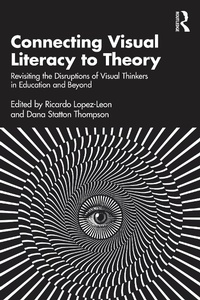
Connecting Visual Literacy to Theory
Revisiting the Disruptions of Visual Thinkers in Education and Beyond
1. Auflage
Erschienen am 12. Juli 2024
188 Seiten
978-1-040-04932-7 (ISBN)
Beschreibung
This volume seeks to close the gap between education systems across the world that remain systematically devoted to understanding our world through text rather than images.
Through an exploration of the contributions of well- and lesser-known visual thinkers from across disciplines and geographies, the contributors offer contemporary appraisals and modern re-conceptualizations of the subject. The book illuminates how experts from various disciplines ranging from art, communication, education, and philosophy laid the foundations for what we know today as visual literacy. These foundations and innovative ways of thinking and understanding images have been disruptive, but until now, have been relatively understudied. As such, the chapters examine the context of individual thinkers, expanding upon famous theories and providing new insight into why these visual and cognitive processes are imperative to learning and education and to disciplines spanning art history, museum studies, philosophy, photography, and more. The authors, all members of the International Visual Literacy Association (IVLA), are committed to advancing the study of visual literacy by raising new questions and proposing new routes of inquiry.
A unique and timely exploration of the way we derive meaning from what we see and how we interact with our visual environment, it will appeal to researchers, scholars, and educators from a range of interdisciplinary backgrounds across art, art education, art history, design, information science, photography and visual communication.
Through an exploration of the contributions of well- and lesser-known visual thinkers from across disciplines and geographies, the contributors offer contemporary appraisals and modern re-conceptualizations of the subject. The book illuminates how experts from various disciplines ranging from art, communication, education, and philosophy laid the foundations for what we know today as visual literacy. These foundations and innovative ways of thinking and understanding images have been disruptive, but until now, have been relatively understudied. As such, the chapters examine the context of individual thinkers, expanding upon famous theories and providing new insight into why these visual and cognitive processes are imperative to learning and education and to disciplines spanning art history, museum studies, philosophy, photography, and more. The authors, all members of the International Visual Literacy Association (IVLA), are committed to advancing the study of visual literacy by raising new questions and proposing new routes of inquiry.
A unique and timely exploration of the way we derive meaning from what we see and how we interact with our visual environment, it will appeal to researchers, scholars, and educators from a range of interdisciplinary backgrounds across art, art education, art history, design, information science, photography and visual communication.
Weitere Details
Auflage
1. Auflage
Sprache
Englisch
Verlagsort
London
Großbritannien
Verlagsgruppe
Taylor & Francis Ltd
Zielgruppe
Für höhere Schule und Studium
Für Beruf und Forschung
Illustrationen
1 Tables, black and white; 2 Line drawings, color; 6 Halftones, color; 6 Halftones, black and white; 8 Illustrations, color; 6 Illustrations, black and white
ISBN-13
978-1-040-04932-7 (9781040049327)
Copyright in bibliographic data and cover images is held by Nielsen Book Services Limited or by the publishers or by their respective licensors: all rights reserved.
Schweitzer Klassifikation
Weitere Ausgaben
Personen
Ricardo Lopez-Leon, PhD, is a lead researcher-lecturer at the University of Aguascalientes at the Design Sciences Center in Aguascalientes, Mexico.
Dana Statton Thompson, MLIS, MA, MFA, is the assistant dean of libraries and a research and instruction librarian at Murray State University in Murray, Kentucky, USA.
Dana Statton Thompson, MLIS, MA, MFA, is the assistant dean of libraries and a research and instruction librarian at Murray State University in Murray, Kentucky, USA.
Inhalt
Introduction 1. Rudolf Arnheim: The Power of the Image 2. Vilem Flusser: Play/Read/Write/See 3. The Conspiracy of the Spectacle: Guy Debord's Relevance for Visual Literacy Today 4. Fontcuberta and Postphotography: unveiling the border between fiction and reality 5. Literacy Foundations in June King McFee's Art Education Philosophy 6. Visual Literacy Development through Picturebooks: The Contributions of John Warren Stewig 7. Abigail Housen: Visual Thinking from Museums to the Classroom 8. Unleashing Perception: Exploring Michael Matyushin's Expanded Vision 9. Thinking in pictures: Temple Grandin's contribution to Visual Literacy 10. David Howes: Pioneer of Sensory Studies 11. Nada Shabout: The Challenge of Visual Literacy in Modern and Contemporary Arab Art
