

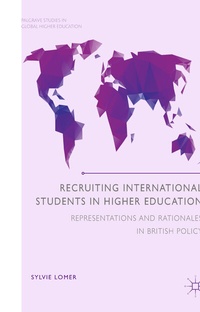
Recruiting International Students in Higher Education
Beschreibung

This book offers a comprehensive overview and critical analysis of the UK's policy on recruiting international students. In a global context of international education policy, it examines changes from New Labour policies under Tony Blair's Prime Minister's Initiative, to the more recent Coalition and Conservative Government policies in the International Education Strategy. The research uses a text-based approach to primary research, adopting a critical framework developed by Carol Bacchi ('what is the problem represented to be'?). The book argues that international student policy can be reduced to reasons for and against recruiting international students; in doing so, students are represented as ambassadors for the UK or tools in its public diplomacy, consumers and generators of reputation, means to get money, and as migrants of questionable legitimacy. These homogenizing representations have the potential to shape international education, implicating academics as agents of policy,and infringing on students' self-formation. The book will be compelling reading for students and researchers in the fields of education and sociology, as well as those interested in education policy-making.
Rezensionen / Stimmen
"Lomer's book is a substantial contribution to the field of studying international students in the UK and by extension, to the international higher education more generally. . The book is relevant for higher education scholars . higher education policy actors in the UK and around the world have much to gain from findings of the book. . it is also useful methodologically. It is clear and well written and is a good example of how to conduct a critical discourse analysis." (Janja Komljenovic, European Journal of Higher Education, December 7, 2018)Weitere Details
Weitere Ausgaben
Andere Ausgaben
Person
Sylvie Lomer is Lecturer in Policy and Practice at the University of Manchester, UK and was previously in Learning Development at the University of Northampton, UK. She is an HEA Fellow with eight years of experience teaching international students and her research interests currently include national branding of UK higher education and blended learning.
