

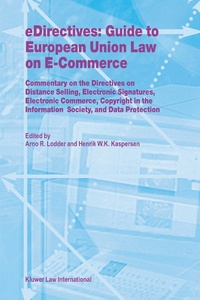
eDirectives: Guide to European Union Law on E-Commerce
Commentary on the Directives on Distance Selling, Electronic Signatures, Electronic Commerce, Copyright in the Information Society, and Data Protection
Erschienen am 1. Januar 2002
220 Seiten
978-90-411-7232-7 (ISBN)
Beschreibung

The enhancement of e-commerce nowadays is one of the important policy issues in the European Union. To this purpose the laws of the EU Member States should be further harmonised. The European Union has adopted a number of Directives relating to different aspects of e-commerce which should be implemented in the laws of the Member States.
eDirectives: Guide to European Union Law on E-Commerce provides article-by-article comments on four Directives central to the regulation of electronic commerce in the European Union (EU), viz. 97/7/EC on distance selling; 1999/93/EC on electronic signatures; 2000/31/EC on electronic commerce; and 2001/29/EC on copyright in the information society. In addition, a separate chapter deals with e-commerce and privacy protection, while the opening chapter discusses all other EU initiatives relevant to the regulation of e-commerce.
This book is meant as a comprehensive legal source of e-commerce legislation for both academics (LLM-students and academic staff) and practitioners (attorneys, company lawyers, consultants). It is not only of interest to readers in the EU-Member States (because their national law is or is about to be adapted to the EU Directives), but also to readers in aspirant Member States of the EU, as well as to readers in other countries where e-commerce has emerged, like the United States of America.
Dr. Arno R. Lodder & Professor Henrik W.K. Kaspersen are affiliated to the Computer/Law Institute of the Vrije Universiteit Amsterdam. Other authors include Professor Jos Dumortier (Belgium); Professor Michel Vivant (France); Julia Hörnle; Gavin Sutter; and Dr. Ian Walden (UK).
eDirectives: Guide to European Union Law on E-Commerce provides article-by-article comments on four Directives central to the regulation of electronic commerce in the European Union (EU), viz. 97/7/EC on distance selling; 1999/93/EC on electronic signatures; 2000/31/EC on electronic commerce; and 2001/29/EC on copyright in the information society. In addition, a separate chapter deals with e-commerce and privacy protection, while the opening chapter discusses all other EU initiatives relevant to the regulation of e-commerce.
This book is meant as a comprehensive legal source of e-commerce legislation for both academics (LLM-students and academic staff) and practitioners (attorneys, company lawyers, consultants). It is not only of interest to readers in the EU-Member States (because their national law is or is about to be adapted to the EU Directives), but also to readers in aspirant Member States of the EU, as well as to readers in other countries where e-commerce has emerged, like the United States of America.
Dr. Arno R. Lodder & Professor Henrik W.K. Kaspersen are affiliated to the Computer/Law Institute of the Vrije Universiteit Amsterdam. Other authors include Professor Jos Dumortier (Belgium); Professor Michel Vivant (France); Julia Hörnle; Gavin Sutter; and Dr. Ian Walden (UK).
Weitere Details
Weitere Ausgaben
Andere Ausgaben
Arno Lodder
E-Directives:Guide to European Union Law on E-Commerce - Commentary on the Directives on Distance Selling, Electronic Signatures, Electronic Commerce, Copyright in the Information Society, and Data Protection
Commentary on the Directives on Distance Selling, Electronic Signatures, Electronic Commerce, Copyright in the Information Society, and Data Protection
Buch
01/2002
1. Auflage
Kluwer Law International
74,90 €
Versand in 10-20 Tagen
Inhalt
- Cover
- Half Title Page
- Title Page
- Copyright Page
- Preface
- Summary of contents
- Table of Contents
- Chapter 1 Introduction
- 1.1 What is e-commerce?
- 1.2 Types of electronic commerce
- 1.3 The EU and e-commerce regulation
- 1.3.1 E-money and financial services
- 1.3.2 E-Tax
- 1.3.3 Jurisdiction
- 1.3.4 Miscellany
- 1.4 Structure of the book
- Chapter 2 Directive 97/7/EC on the protection of consumers in respect of distance contracts
- 2.1 Introduction
- 2.2 Article 2 - Definitions
- 2.3 Article 3 - Exemptions
- 2.4 Articles 4 and 5 - Transparency rights of the consumer
- 2.4.1 The reason for the transparency provisions
- 2.4.2 The point at which the information must be given
- 2.4.3 The manner in which the information must be given
- 2.4.4 Prior information-information to be given at the outset
- 2.4.5 Information which must be confirmed
- 2.5 Article 6 - Right of withdrawal
- 2.6 Article 7 - Performance
- 2.7 Article 8 - Payment by card
- 2.8 Articles 9 and 10 - Unsolicited supply and contact
- 2.9 Articles 11, 12 and 17 - Access to justice, enforcement and consumer redress
- 2.9.1 Enforcement
- 2.9.2 Standing for consumer organisations?
- 2.9.3 Access to justice, out of court settlement and EEJ-net
- 2.9.4 Burden of proof
- 2.9.5 Contracting-out
- 2.10 Articles 13 and 14 - Lex specialis and higher consumer protection standards
- 2.11 Articles 15 and 18 - Entry into force and implementation deadline
- 2.12 Concluding remarks
- Chapter 3 Directive 1999/93/EC on a Community framework for electronic signatures
- 3.1 Introduction
- 3.1.1 Terminology
- 3.1.2 Cryptography policy
- 3.1.3 First national legislative initiatives
- 3.1.4 The preparation of the Directive
- 3.1.5 Standardisation
- 3.2 Article 1 - Scope of the Directive
- 3.3 Article 2 - Definitions
- 3.3.1 (Advanced) electronic signature
- 3.3.2 Certificates and certification services
- 3.4 The certification services market - Articles 3(1-3, 7) and 4(1)
- 3.4.1 Free circulation of certification services
- 3.4.2 No prior authorisation
- 3.4.3 Voluntary accreditation
- 3.4.4 Supervision
- 3.5 Electronic signature products - Articles 3(4-6) and 4(2)
- 3.5.1 Free circulation of electronic signature products
- 3.5.2 Secure signature-creation devices
- 3.5.3 Secure signature-verification devices
- 3.6 Article 5 - Legal effects of electronic signatures
- 3.7 Article 6 - Liability
- 3.7.1 Qualified certificate
- 3.7.2 Issued to the public
- 3.7.3 'Guaranteed to the public'
- 3.7.4 Claimant ('relying party')
- 3.7.5 Liability causes
- 3.7.6 Reasonable reliance
- 3.7.7 Absence of negligence
- 3.7.8 Limitation of liability
- 3.8 Articles 7-15 - Other provisions
- Chapter 4 Directive 2000/31/EC on certain legal aspects of information society services, in particular electronic commerce, in the Internal Market
- 4.1 Introduction
- 4.2 General provisions
- 4.2.1 Article 1 - Objective and scope
- 4.2.2 Article 2 - Definitions
- 4.2.3 Article 3 - Internal market
- 4.3 Establishment and information requirements
- 4.3.1 Article 4 - Principle excluding prior authorisation
- 4.3.2 Article 5 - General information to be provided
- 4.4 Commercial communications
- 4.4.1 Article 6 - Information to be provided
- 4.4.2 Article 7 - Unsolicited commercial communications
- 4.4.3 Article 8 - Regulated professions
- 4.5 Online contracts
- 4.5.1 Article 9 - Treatment of contracts
- 4.5.2 Article 10 - Information to be provided
- 4.5.3 Article 11 - Placing of the order
- 4.6 Liability of intermediary service providers
- 4.6.1 Article 12 - 'Mere conduit'
- 4.6.2 Article 13 - 'Caching'
- 4.6.3 Article 14 - Hosting
- 4.6.4 Article 15 - No general obligation to monitor
- 4.7 Codes of conduct and dispute settlement
- 4.7.1 Article 16 - Codes of conduct
- 4.7.2 Article 17 - Out-of-court dispute settlements
- 4.7.3 Article 18 - Court actions
- 4.8 Cooperation and sanctions
- 4.8.1 Article 19 - Cooperation
- 4.8.2 Article 20 - Sanctions
- 4.9 Articles 21-24 - Final provisions
- 4.10 Concluding remarks
- Chapter 5 Directive 2001/29/EC on the harmonisation of certain aspects of copyright and related rights in the information society
- 5.1 Article 1 - Scope
- 5.1.1 Objective
- 5.1.2 Scope
- 5.2 Article 2 - Reproduction right
- 5.3 Article 3 - Communication to the public
- 5.4 Article 4 - Distribution right
- 5.5 Article 5 - Exceptions and limitations
- 5.5.1 General observations
- 5.5.2 Specific commentaries
- 5.5.2.1 Exceptions to reproduction right
- 5.5.2.2 Exceptions to different rights
- 5.5.2.3 Right of distribution
- 5.5.3 Valuation
- 5.6 Article 6 - Technological measures
- 5.7 Article 7 - Rights-management information
- 5.8 Articles 8-15 - Common provisions
- 5.9 Concluding observations
- Chapter 6 Data protection and e-commerce
- 6.1 Data protection and data protection instruments
- 6.2 Directive 95/46/EC
- 6.2.1 History and Implementation
- 6.2.2 Scope
- 6.2.3 Elaboration of the data protection principles
- 6.2.4 Other safeguards
- 6.3 The Telecommunications directive 97/66/EC
- 6.3.1 History and implementation
- 6.3.2 Scope
- 6.3.3 Relation to Directive 95/46/EC
- 6.3.4 The obligations under Directive 97/66/EC
- 6.4 Proposal for amendment of Directive 97/66/EC
- 6.4.1 History and background of the proposal
- 6.4.2 New definitions
- 6.4.3 New important elements in the Directive
- 6.4.4 Conclusion
- 6.5 Some specific aspects of data protection in e-commerce
- 6.5.1 Particular Privacy risks in e-commerce
- 6.5.2 Traffic data
- 6.5.3 Cookies
- 6.5.4 E-mail directories
- 6.5.5 Spam (unsolicited communications)
- 6.5.6 E-mail systems
- 6.5.7 Remedies: Anonymity/pseudonymity?
- 6.6 Concluding observations
- Appendix 1 Directive 97/7/EC of the European Parliament and of the Council of 20 May 1997 on the protection of consumers in respect of distance contracts
- Appendix 2 Directive 1999/93/EC of the European Parliament and of the Council of 13 December 1999 on a Community framework for electronic signatures
- Appendix 3 Directive 2000/31/EC of the European Parliament and of the Council of 8 June 2000 on certain legal aspects of information society services, in particular electronic commerce, in the Internal Market (Directive on electronic commerce)
- Appendix 4 Directive 2001/29/EC of the European Parliament and of the Council of 22 May 2001 on the harmonisation of certain aspects of copyright and related rights in the information society
- The Authors
- Index
- Back cover
