

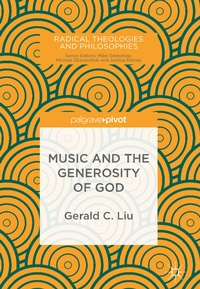
Music and the Generosity of God
Erschienen am 16. November 2017
XIII, 140 Seiten
978-3-319-69493-1 (ISBN)
Beschreibung

What if sounds everywhere lavish divine generosity? Merging insights from Jean-Luc Marion with musical ingenuity from Pierre Boulez and John Cage's 4'33 ", Gerald C. Liu blends the phenomenological, theological, and musical to formulate a hypothesis that in all places, soundscapes instantiate divine giving without boundary. He aims to widen apprehension of holiness in the world, and privileges the ubiquity of sound as a limitless and easily accessible portal for discovering the inexhaustible magnitude of divine giving.
Rezensionen / Stimmen
"Gerald Liu's book is an achievement of interdisciplinarity. Creatively synthesizing approaches drawn from a variety of far-flung fields, the work advances a radically open and pluralistic vision for the theological significance of all manner of sonic expression, from the esoteric to the everyday. At the heart of the book's analysis are provocative re-assessments of several monuments of postwar modernist composition. Alongside Liu's intricate defense of the value of 'the din of the sacred,' readers will find engaging excursions into twentieth-century cultural and intellectual history. This stimulating volume deserves a wide audience, one just as diverse and multidisciplinary as are the forms of insight that lend it such a distinctive voice." (Benjamin Looker, author of A Nation of Neighborhoods: Imagining Cities, Communities, and Democracy in Postwar America)"Heidegger would be proud. In Music and the Generosity of God, Gerald C. Liu leads us beyond theo-phenomenologicaldelimitations of musics (plural) in search of a non-conceptual, non-representational, non-discursive mode of sacramental perception. Liu stages an opening-beyond multiple metaphysical and metaphorical closures-in several unexpected works, viz., Robert Rauschenberg's White Paintings, Pierre Boulez's Structures Ia, and John Cage's 4'33". Inasmuch as these artists harbor sites of Divine generosity, Liu argues, their works free us to perceive a primordial charity wherein, perhaps, God might reveal Godself. This pithy yet expansive text demands careful attention from ethnomusicologists, philosophers, theologians-indeed, all who seek God amid the world's 'sonic ubiquity.'" (Jacob D. Myers, Assistant Professor of Homiletics, Columbia Theological Seminary, USA)"For any who have spent energy considering the relationship between music and theology, this succinct and unsettling contributionby Dr. Liu is a must read. An unabashed romp through late colonial theories, Cagian contributions, and theological interlocutors, this small book is nonetheless expansive in its vision. His work poses many questions. While not agreeing with every idea, I cannot dismiss his helpfulness in expanding the field. If you are interested in examining the role of music in a post-modern theological mode, then this is your guide." (Edward Foley, Catholic theological Union, USA)Weitere Details
Reihe
Auflage
1st ed. 2017
Sprache
Englisch
Verlagsort
Cham
Schweiz
Verlagsgruppe
Springer International Publishing
Zielgruppe
Für Beruf und Forschung
Produkt-Hinweis
Reflowable
Illustrationen
XIII, 140 p. 4 illus.
Dateigröße
1,93 MB
ISBN-13
978-3-319-69493-1 (9783319694931)
DOI
10.1007/978-3-319-69493-1
Schweitzer Klassifikation
Weitere Ausgaben
Andere Ausgaben
Gerald C. Liu
Music and the Generosity of God
Buch
11/2017
Palgrave Macmillan
69,54 €
Versand in 10-15 Tagen
Person
Gerald C. Liu is Assistant Professor of Worship and Preaching at Princeton Theological Seminary, USA.
Inhalt
1. Introduction.- 2. A Silent Prayer.- 3. Theological Stocktaking with Pierre Boulez.- 4. The Epistle of 4'33".- 5. The Ubiquity of Music and Sacramental Life.- 6. The Spook of Modern Technology and the Generosity of Music.- 7. Conclusion.
