

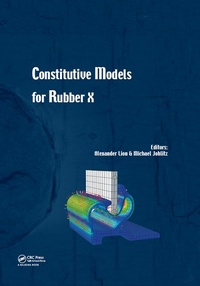
Constitutive Models for Rubber X
Proceedings of the European Conference on Constitutive Models for Rubbers X (Munich, Germany, 28-31 August 2017)
Erschienen am 15. August 2017
642 Seiten
978-1-351-84040-8 (ISBN)
Beschreibung

In order to develop innovative products, to reduce development costs and the number of prototypes and to accelerate development processes, numerical simulations become more and more attractive. As such, numerical simulations are instrumental in understanding complicated material properties like chemical ageing, crack propagation or the strain- and temperature-induced crystallisation of rubber. Therefore, experimentally validated and physically meaningful constitutive models are indispensable. Elastomers are used for products like tyres, engine and suspension mounts or seals, to name a few. The interest in modelling the quasi-static stress-strain behaviour was dominant in the past decades, but nowadays the interests also include influences of environmental conditions. The latest developments on the material behaviour of elastomers are collected in the present volume.
Constitutive Models for Rubber X is a comprehensive compilation of nearly all oral and poster contributions to the European Conference on Constitutive Models for Rubber (Munich, 28-31 August 2017). The 95 highly topical contributions reflect the state of-the-art in material modelling and testing of elastomers. They cover the fields of material testing and processing, filler reinforcement, electromagnetic sensitive elastomers, dynamic properties, constitutive modelling, micromechanics, finite element implementation, stress softening, chemical ageing, fatigue and durability. In the area of rubbery materials and structures, applied research will play an important role also in the coming decades.
Constitutive Models for Rubber X is of interest to developers and researchers involved in the rubber processing and CAE software industries, as well as for academics in nearly all disciplines of engineering and material sciences.
Constitutive Models for Rubber X is a comprehensive compilation of nearly all oral and poster contributions to the European Conference on Constitutive Models for Rubber (Munich, 28-31 August 2017). The 95 highly topical contributions reflect the state of-the-art in material modelling and testing of elastomers. They cover the fields of material testing and processing, filler reinforcement, electromagnetic sensitive elastomers, dynamic properties, constitutive modelling, micromechanics, finite element implementation, stress softening, chemical ageing, fatigue and durability. In the area of rubbery materials and structures, applied research will play an important role also in the coming decades.
Constitutive Models for Rubber X is of interest to developers and researchers involved in the rubber processing and CAE software industries, as well as for academics in nearly all disciplines of engineering and material sciences.
Weitere Details
Sprache
Englisch
Verlagsort
London
Großbritannien
Verlagsgruppe
Taylor & Francis Ltd
Zielgruppe
Für höhere Schule und Studium
Für Beruf und Forschung
Dateigröße
114,68 MB
ISBN-13
978-1-351-84040-8 (9781351840408)
Copyright in bibliographic data and cover images is held by Nielsen Book Services Limited or by the publishers or by their respective licensors: all rights reserved.
Schweitzer Klassifikation
Weitere Ausgaben
Andere Ausgaben
Alexander Lion | Michael Johlitz
Constitutive Models for Rubber X
Proceedings of the European Conference on Constitutive Models for Rubbers X (Munich, Germany, 28-31 August 2017)
Buch
08/2017
1. Auflage
CRC Press
358,30 €
Versand in 10-20 Tagen
Personen
Alexander Lion is Professor at the Institute of Mechanics at the University of the Bundeswehr Munich in Neubiberg, Germany.
Michael Johlitz is a postdoctorate at the Institute of Mechanics at the University of the Bundeswehr Munich, Neubiberg, Germany. He completed his PhD in 2008 at the University of the Saarland, Saarbruecken, Germany.
Michael Johlitz is a postdoctorate at the Institute of Mechanics at the University of the Bundeswehr Munich, Neubiberg, Germany. He completed his PhD in 2008 at the University of the Saarland, Saarbruecken, Germany.
Inhalt
Keynote lectures
Ageing
Constitutive models and their implementation in FEM
Experimental characterisation
Fracture, fatigue and lifetime prediction of rubber
Filler reinforcement
Stress softening
Special elastomers
Industrial applications
Design issues
Micro-structural theories of rubber
Tyres and friction
Ageing
Constitutive models and their implementation in FEM
Experimental characterisation
Fracture, fatigue and lifetime prediction of rubber
Filler reinforcement
Stress softening
Special elastomers
Industrial applications
Design issues
Micro-structural theories of rubber
Tyres and friction
