

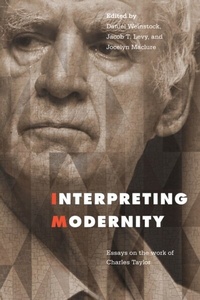
Interpreting Modernity
Essays on the Work of Charles Taylor
1. Auflage
Erschienen am 15. Oktober 2020
361 Seiten
978-0-2280-0282-6 (ISBN)
Beschreibung

There are few philosophical questions to which Charles Taylor has not devoted his attention. His work has made powerful contributions to our understanding of action, language, and mind. He has had a lasting impact on our understanding of the way in which the social sciences should be practised, taking an interpretive stance in opposition to dominant positivist methodologies.
Taylor's powerful critiques of atomistic versions of liberalism have redefined the agenda of political philosophers. He has produced prodigious intellectual histories aiming to excavate the origins of the way in which we have construed the modern self, and of the complex intellectual and spiritual trajectories that have culminated in modern secularism. Despite the apparent diversity of Taylor's work, it is driven by a unified vision. Throughout his writings, Taylor opposes reductive conceptions of the human and of human societies that empiricist and positivist thinkers from David Hume to B.F. Skinner believed would lend rigour to the human sciences. In their place, Taylor has articulated a vision of humans as interpretive beings who can be understood neither individually nor collectively without reference to the fundamental goods and values through which they make sense of their lives.
The contributors to this volume, all distinguished philosophers and social theorists in their own right, offer critical assessments of Taylor's writings. Taken together, they provide the reader with an unrivalled perspective on the full extent of Charles Taylor's contribution to modern philosophy.
Taylor's powerful critiques of atomistic versions of liberalism have redefined the agenda of political philosophers. He has produced prodigious intellectual histories aiming to excavate the origins of the way in which we have construed the modern self, and of the complex intellectual and spiritual trajectories that have culminated in modern secularism. Despite the apparent diversity of Taylor's work, it is driven by a unified vision. Throughout his writings, Taylor opposes reductive conceptions of the human and of human societies that empiricist and positivist thinkers from David Hume to B.F. Skinner believed would lend rigour to the human sciences. In their place, Taylor has articulated a vision of humans as interpretive beings who can be understood neither individually nor collectively without reference to the fundamental goods and values through which they make sense of their lives.
The contributors to this volume, all distinguished philosophers and social theorists in their own right, offer critical assessments of Taylor's writings. Taken together, they provide the reader with an unrivalled perspective on the full extent of Charles Taylor's contribution to modern philosophy.
Rezensionen / Stimmen
"In the contemporary philosophical landscape, Charles Taylor is a towering figure. Based on the classic idea that humans are self-interpreting animals, he has developed a systematic and historically situated body of work ranging from the philosophy of mind and language to central issues of political philosophy such as multiculturalism and secularism. The superb essays in this volume by a group of remarkable thinkers shed new light on Taylor's unique oeuvre. An essential conversation about the Geist of our age." Rainer Forst, Goethe University FrankfurtWeitere Details
Sprache
Englisch
Verlagsort
Montreal
Kanada
Zielgruppe
Für höhere Schule und Studium
Für Beruf und Forschung
Dateigröße
1,38 MB
ISBN-13
978-0-2280-0282-6 (9780228002826)
Copyright in bibliographic data and cover images is held by Nielsen Book Services Limited or by the publishers or by their respective licensors: all rights reserved.
Schweitzer Klassifikation
Weitere Ausgaben
Andere Ausgaben
Jacob Levy | Jocelyn Maclure | Daniel M. Weinstock
Interpreting Modernity
Essays on the Work of Charles Taylor
Buch
07/2020
McGill-Queen's University Press
185,62 €
Artikel z.Zt. nicht lieferbar
Personen
Daniel M. Weinstock is James McGill Professor in the Faculty of Law and director of the Institute for Health and Social Policy, McGill University. Jacob T. Levy is Tomlinson Professor of Political Theory and founding director, Yan P. Lin Centre for the Study of Freedom and Global Orders in the Ancient and Modern Worlds at McGill University. Jocelyn Maclure is professor of philosophy at Universite Laval.
Inhalt
- Cover
- INTERPRETING MODERNITY
- Title
- Copyright
- CONTENTS
- Acknowledgments
- Introduction Charles Taylor: A Biographical Sketch
- PART ONE Epistemology, Philosophy of Mind, and Philosophy of Language
- 1 To Follow a Rule: Lessons from Baby Logic
- 2 Charles Taylor's Conception of Language and the Current Debate about Theory of Meaning
- 3 Taylor's Engaged Pluralism
- PART TWO Religion and Modernity
- 4 State-Religion Connections and Multicultural Citizenship
- 5 Taylor, Rawls, and Secularism
- PART THREE Moral Agency and the Self I
- 6 What If Anything Is Wrong with Positive Liberty? The Struggles of Agency in a Non-Ideal World
- 7 What's Right with Positive Liberty: Agency, Autonomy, and the Other
- PART FOUR The Interpretation of Modernity
- 8 Whatever Happened to the Ontic Logos? German Idealism and the Legitimacy of Modernity
- 9 Taylor, Fullness, and Vitality
- PART FIVE Moral Agency and the Self II
- 10 Self-Creation or Self-Discovery?
- 11 An Explicitative Conception of Moral Theory
- 12 Charles Taylor and Ethical Naturalism
- PART SIX Political Philosophy, Recognition, and Multiculturalism
- 13 Protecting Freedom of Religion in the Secular Age
- 14 Two Conceptions of Indian Secularism
- 15 Memory, Multiculturalism, and the Sources of Democratic Solidarity
- PART SEVEN Canadian Politics
- 16 Recognition in Its Place
- Conclusion A Conversation between Charles Taylor, Jacob T. Levy, Daniel M. Weinstock, and Jocelyn Maclure
- Notes
- Bibliography
- Contributors
- Index
