

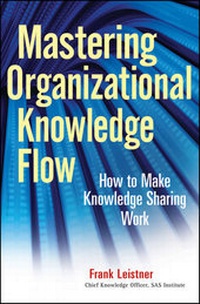
Mastering Organizational Knowledge Flow
How to Make Knowledge Sharing Work
Erschienen am 23. Februar 2010
208 Seiten
978-0-470-61746-5 (ISBN)
Beschreibung

Get your organization's expertise out of its silos and make itflow-with lessons from over a decade of experience
Looking at knowledge management in a holistic way, MasteringOrganizational Knowledge Flow: How to Make Knowledge SharingWork puts the proper emphasis on non-technical issues. Asknowledge is deeply connected to humans, the author moves away fromthe often overused and therefore burned-out term "knowledgemanagement" to the better-suited term "knowledge flowmanagement."
* Provides lessons learned and case studies from realexperience
* Discusses key knowledge flow components, success factors andtraps, and where to start
Covering topics such as the power of scaling, internalmarketing, measuring success, cultural aspects of sharing, and therole of Web2.0, Mastering Organizational Knowledge Flow: How toMake Knowledge Sharing Work allows you to stay up-to-date withtoday's knowledge flow management, and implement best practices toposition your organization to take advantage of all of itsassets.
Looking at knowledge management in a holistic way, MasteringOrganizational Knowledge Flow: How to Make Knowledge SharingWork puts the proper emphasis on non-technical issues. Asknowledge is deeply connected to humans, the author moves away fromthe often overused and therefore burned-out term "knowledgemanagement" to the better-suited term "knowledge flowmanagement."
* Provides lessons learned and case studies from realexperience
* Discusses key knowledge flow components, success factors andtraps, and where to start
Covering topics such as the power of scaling, internalmarketing, measuring success, cultural aspects of sharing, and therole of Web2.0, Mastering Organizational Knowledge Flow: How toMake Knowledge Sharing Work allows you to stay up-to-date withtoday's knowledge flow management, and implement best practices toposition your organization to take advantage of all of itsassets.
Weitere Details
Weitere Ausgaben
Andere Ausgaben
Buch
04/2010
Wiley
33,00 €
Artikel z.Zt. nicht lieferbar
Person
Frank Leistner, Chief Knowledge Officer at SAS Institute, is responsible for driving internal knowledge management within SAS via worldwide initiatives. Before coming to SAS, he worked for Siemens-Nixdorf in a United States-Germany liaison role. He has been driving worldwide knowledge management initiatives within SAS since 1997 and has been a participant of the Harvard Graduate School of Education Learning Innovations Laboratory roundtable since 2003.
Inhalt
Foreword: The Generations of Knowledge Management.
Preface.
Acknowledgments.
Chapter 1 The Human Touch.
Why This Book?
Terminology and Definitions.
Taking a Holistic View.
Getting into the Flow.
Case Study: ToolPool.
Chapter 2 Getting Started.
Project versus Initiative.
Team Structures.
Strategy and Assessment.
Big Bang or Small.
Chapter 3 Roles.
Who Should Introduce and Drive Knowledge Flow Management?
Who Should Worry about Knowledge Flow Management?
Knowledge Intermediaries.
Chapter 4 Basic Requirements for Successful Knowledge FlowManagement.
Passionate Initiative Support.
Culture.
Trust.
Executive Support.
Multiple Drivers.
Chapter 5 Driving for Success.
Internal Marketing: The Myth of Build It and They Will Come.
The Pulse.
Keep It Simple.
Go Global: The Power of Scaling.
Motivation.
What If Your Knowledge Takes a Walk?
Chapter 6 Barriers.
Barriers Hindering the Flow.
Knowledge Is Power: How Long?
Sharing Knowledge Takes Effort.
I Need Two More Weeks.
Less Can Be More.
Legal Limitations.
Chapter 7 The Technology Trap.
Asset or Pointer.
Tools: Not Only Technology.
CoPs.
Skills Management.
"Knowledge Bases".
Portals.
Open Space Technology.
Search.
Stories.
Knowledge Transfer Sessions.
Chapter 8 Measure and Analyze.
Measure to Get What You Want.
Measuring Quality.
Analyze Your Initiative.
Feed It Back.
Chapter 9 Knowledge Flow Management: The NextGeneration.
The Role of Web 2.0++.
Social Media Internally.
What about 2020?
Special Roles and Jobs.
Stone Age: Creativity Leap through Communities.
Technical Infrastructures.
Chapter 10 Final Thoughts.
Appendix A: Key Success Factors.
Appendix B: Additional Resources.
About the Author.
Index.
Preface.
Acknowledgments.
Chapter 1 The Human Touch.
Why This Book?
Terminology and Definitions.
Taking a Holistic View.
Getting into the Flow.
Case Study: ToolPool.
Chapter 2 Getting Started.
Project versus Initiative.
Team Structures.
Strategy and Assessment.
Big Bang or Small.
Chapter 3 Roles.
Who Should Introduce and Drive Knowledge Flow Management?
Who Should Worry about Knowledge Flow Management?
Knowledge Intermediaries.
Chapter 4 Basic Requirements for Successful Knowledge FlowManagement.
Passionate Initiative Support.
Culture.
Trust.
Executive Support.
Multiple Drivers.
Chapter 5 Driving for Success.
Internal Marketing: The Myth of Build It and They Will Come.
The Pulse.
Keep It Simple.
Go Global: The Power of Scaling.
Motivation.
What If Your Knowledge Takes a Walk?
Chapter 6 Barriers.
Barriers Hindering the Flow.
Knowledge Is Power: How Long?
Sharing Knowledge Takes Effort.
I Need Two More Weeks.
Less Can Be More.
Legal Limitations.
Chapter 7 The Technology Trap.
Asset or Pointer.
Tools: Not Only Technology.
CoPs.
Skills Management.
"Knowledge Bases".
Portals.
Open Space Technology.
Search.
Stories.
Knowledge Transfer Sessions.
Chapter 8 Measure and Analyze.
Measure to Get What You Want.
Measuring Quality.
Analyze Your Initiative.
Feed It Back.
Chapter 9 Knowledge Flow Management: The NextGeneration.
The Role of Web 2.0++.
Social Media Internally.
What about 2020?
Special Roles and Jobs.
Stone Age: Creativity Leap through Communities.
Technical Infrastructures.
Chapter 10 Final Thoughts.
Appendix A: Key Success Factors.
Appendix B: Additional Resources.
About the Author.
Index.
