

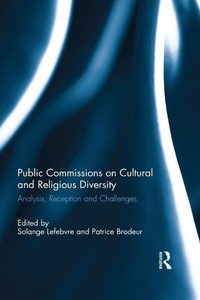
Public Commissions on Cultural and Religious Diversity
Analysis, Reception and Challenges
Erschienen am 8. Mai 2017
338 Seiten
978-1-317-07380-2 (ISBN)
Beschreibung

Due to growing negative perceptions about relations between historically entrenched, dominant populations and various minority groups, issues relating to the need to better manage cultural and religious diversity have been intensifying in many countries. These negative perceptions have recently led to a significant increase in popular support for right and extreme right nationalist discourses, and have created so much public tension that national governments have had no choice but to respond. In the last two decades, in several Western contexts in particular, the issues raised by such combined challenges have culminated in the creation of government-initiated or private national commissions.
This book presents the results of a multidisciplinary analysis, from a broader framework that includes the national public commissions which have addressed the challenges of managing cultural and religious diversity in Belgium, Britain, Canada (Quebec), France, Morocco and Norway (including also other cases of public management in Australia and Singapore). It includes in-depth studies of the issues and controversies examined by each of the commissions, such as the ways they perceived the issues, their results and impact, the key political players involved, the media debates and reception surrounding each commission, the communication strategies and difficulties their leaders encountered, as well as the legal aspects each commission has raised. The reports represent a rich body of work charting the fundamental questions nations face about their nature, history and future while the impact on peoples' lives tells us much about different approaches to the issues of cultural identity between countries.
This book presents the results of a multidisciplinary analysis, from a broader framework that includes the national public commissions which have addressed the challenges of managing cultural and religious diversity in Belgium, Britain, Canada (Quebec), France, Morocco and Norway (including also other cases of public management in Australia and Singapore). It includes in-depth studies of the issues and controversies examined by each of the commissions, such as the ways they perceived the issues, their results and impact, the key political players involved, the media debates and reception surrounding each commission, the communication strategies and difficulties their leaders encountered, as well as the legal aspects each commission has raised. The reports represent a rich body of work charting the fundamental questions nations face about their nature, history and future while the impact on peoples' lives tells us much about different approaches to the issues of cultural identity between countries.
Rezensionen / Stimmen
"This ground-breaking study of a number of important yet under-studied national commissions addresses the role of religion and management of religious diversification in modern societies. The theoretically informed volume offers detailed and comparative examinations of how a number of nation's efforts to understand what increasing, and controversial, religious diversification means for national identity and cohesion." - James T. Richardson, Emeritus Foundation Professor of Sociology and Judicial Studies, University of Nevada."This book is innovative and insightful in equal measure. It looks at the management of diversity - and in particular religious diversity - in an entirely new way. It does so by comparing the official and less official commissions that have addressed this question across a wide range of countries in recent years. The authors cover the origins of these ad hoc bodies, their membership, their purpose, their working practices, their conclusions, and their reception by the wider society. The cumulative knowledge that emerges is deeply impressive; in every sense of the term this book is more than the sum of its parts. It will become a must-read text." - Grace Davie, Professor of Sociology, University of Exeter.
Weitere Details
Sprache
Englisch
Verlagsort
London
Großbritannien
Verlagsgruppe
Taylor & Francis Ltd
Zielgruppe
Für höhere Schule und Studium
Produkt-Hinweis
Reflowable
Illustrationen
8 Tables, black and white; 10 Line drawings, black and white
Dateigröße
3,51 MB
ISBN-13
978-1-317-07380-2 (9781317073802)
Copyright in bibliographic data and cover images is held by Nielsen Book Services Limited or by the publishers or by their respective licensors: all rights reserved.
Schweitzer Klassifikation
Weitere Ausgaben
Andere Ausgaben
Solange Lefebvre | Patrice Brodeur
Public Commissions on Cultural and Religious Diversity
Analysis, Reception and Challenges
Buch
06/2021
1. Auflage
Routledge
66,30 €
Versand in 10-20 Tagen
Solange Lefebvre | Patrice Brodeur
Public Commissions on Cultural and Religious Diversity
Analysis, Reception and Challenges
Buch
05/2017
1. Auflage
Routledge
214,82 €
Versand in 10-20 Tagen
Personen
Solange Lefebvre holds the Research Chair in Management of Cultural and Religious Diversity at the Faculty of Theology and the Sciences of Religions, University of Montreal. She is the principal investigator of the international project on National Commissions on Diversity. She has conducted extensive research and published widely on issues of religion in the public arena, management of religious diversity, religion and education, and religious heritage. Lefebvre also served as a member of the Committee of Experts for the Consultation Commission on Accommodation Practices Related to Cultural Differences, chaired by Gerard Bouchard and Charles Taylor.
Patrice Brodeur is an associate professor at the Faculty of Theology and the Sciences of Religions at the University of Montreal (Canada), as well as senior adviser at the international Dialogue Centre (KAICID) in Vienna, Austria. He studied at McGill University and Harvard University. His career highlights include a Junior Canada Research Chair on Islam, Pluralism and Globalization at the University of Montreal (2005-2015), leading an interdisciplinary research team on contemporary Islamic thought as well as on various forms of dialogue, and developing a Peace Mapping Project.
Patrice Brodeur is an associate professor at the Faculty of Theology and the Sciences of Religions at the University of Montreal (Canada), as well as senior adviser at the international Dialogue Centre (KAICID) in Vienna, Austria. He studied at McGill University and Harvard University. His career highlights include a Junior Canada Research Chair on Islam, Pluralism and Globalization at the University of Montreal (2005-2015), leading an interdisciplinary research team on contemporary Islamic thought as well as on various forms of dialogue, and developing a Peace Mapping Project.
Inhalt
List of Figures and Tables
List of Contributors
Foreword
Preface: The Benefit of Analysing National Public Commissions on Diversity for Research and Policy-Making
Acknowledgements
Introduction: National Commissions on Diversity: When Reflective Processes Happen in Parallel within Several Nation-States
Part I: Britain, France, Quebec and Belgium
Chapter 1-National Commissions on Collective Identity and Diversity: Britain, France, Quebec and Belgium
Chapter 2-'Stories are the secret reservoirs of values': Personal Recollections of Two Commissions in the United Kingdom
Chapter 3-Assumptions of Power Subverted: Media and Emotions in the Wake of the Parekh Report
Chapter 4-From the Stasi (2003) to the Machelon Commission (2006): The Use of Commissions in Religious Regulation in France
Chapter 5-The Outcome of the Stasi Report in France: Much Ado About Nothing?
Chapter 6-The Bouchard-Taylor Commission in Quebec and Reasonable Accommodations: Collective Creation and Multilevel Reception
Chapter 7-Debating Intercultural Integration in Belgium: From the Commission for Intercultural Dialogue to the Round Tables on Interculturalism
Part II: Comparative and Theoretical Perspectives
Chapter 8-The Commissions: Caught between Media Simplifications and Political Interests
Chapter 9-Control, Instrumentalization and Co-operation: The Relationship between Law and Religion in Four National Contexts
Chapter 10-Glocalizations of a Common Discourse: The United Kingdom and Quebec Compared in the Context of Four National Commissions on Diversity
Chapter 11-The Altar of Victory and the Crucifix: A Tale of Two Controversial Symbols
Chapter 12-A Coherent Public Policy on Religion in Norway? An Analysis of the 2013 Report 'A Society Open to Religious and Worldview Diversity'
Chapter 13-A National Enquiry into Freedom of Religion and Belief in Australia
Chapter 14-Public-Policy Discourses on Selected Significant Issues of Cultural and Religious Diversity in Singapore
Chapter 15-The Religious Diversity Conundrum in Morocco: The Case of the National Commission for Dialogue on Civil Society and New Constitutional Prerogatives (2012)
Conclusion: On 'National Diversity Commissions'
List of Contributors
Foreword
Preface: The Benefit of Analysing National Public Commissions on Diversity for Research and Policy-Making
Acknowledgements
Introduction: National Commissions on Diversity: When Reflective Processes Happen in Parallel within Several Nation-States
Part I: Britain, France, Quebec and Belgium
Chapter 1-National Commissions on Collective Identity and Diversity: Britain, France, Quebec and Belgium
Chapter 2-'Stories are the secret reservoirs of values': Personal Recollections of Two Commissions in the United Kingdom
Chapter 3-Assumptions of Power Subverted: Media and Emotions in the Wake of the Parekh Report
Chapter 4-From the Stasi (2003) to the Machelon Commission (2006): The Use of Commissions in Religious Regulation in France
Chapter 5-The Outcome of the Stasi Report in France: Much Ado About Nothing?
Chapter 6-The Bouchard-Taylor Commission in Quebec and Reasonable Accommodations: Collective Creation and Multilevel Reception
Chapter 7-Debating Intercultural Integration in Belgium: From the Commission for Intercultural Dialogue to the Round Tables on Interculturalism
Part II: Comparative and Theoretical Perspectives
Chapter 8-The Commissions: Caught between Media Simplifications and Political Interests
Chapter 9-Control, Instrumentalization and Co-operation: The Relationship between Law and Religion in Four National Contexts
Chapter 10-Glocalizations of a Common Discourse: The United Kingdom and Quebec Compared in the Context of Four National Commissions on Diversity
Chapter 11-The Altar of Victory and the Crucifix: A Tale of Two Controversial Symbols
Chapter 12-A Coherent Public Policy on Religion in Norway? An Analysis of the 2013 Report 'A Society Open to Religious and Worldview Diversity'
Chapter 13-A National Enquiry into Freedom of Religion and Belief in Australia
Chapter 14-Public-Policy Discourses on Selected Significant Issues of Cultural and Religious Diversity in Singapore
Chapter 15-The Religious Diversity Conundrum in Morocco: The Case of the National Commission for Dialogue on Civil Society and New Constitutional Prerogatives (2012)
Conclusion: On 'National Diversity Commissions'
