

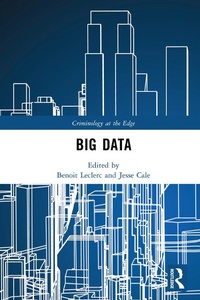
Big Data
1. Auflage
Erschienen am 14. Februar 2020
148 Seiten
978-1-351-02968-1 (ISBN)
Beschreibung

The internet has launched the world into an era into which enormous amounts of data are
generated every day through technologies with both positive and negative consequences.
This often refers to big data . This book explores big data in organisations operating in the
criminology and criminal justice fields.
Big data entails a major disruption in the ways we think about and do things, which
certainly applies to most organisations including those operating in the criminology and
criminal justice fields. Big data is currently disrupting processes in most organisations - how
different organisations collaborate with one another, how organisations develop products
or services, how organisations can identify, recruit, and evaluate talent, how organisations
can make better decisions based on empirical evidence rather than intuition, and how
organisations can quickly implement any transformation plan, to name a few.
All these processes are important to tap into, but two underlying processes are critical
to establish a foundation that will permit organisations to flourish and thrive in the era of
big data - creating a culture more receptive to big data and implementing a systematic data
analytics-driven process within the organisation.
Written in a clear and direct style, this book will appeal to students and scholars in
criminology, criminal justice, sociology, and cultural studies but also to government
agencies, corporate and non-corporate organisations, or virtually any other institution
impacted by big data.
generated every day through technologies with both positive and negative consequences.
This often refers to big data . This book explores big data in organisations operating in the
criminology and criminal justice fields.
Big data entails a major disruption in the ways we think about and do things, which
certainly applies to most organisations including those operating in the criminology and
criminal justice fields. Big data is currently disrupting processes in most organisations - how
different organisations collaborate with one another, how organisations develop products
or services, how organisations can identify, recruit, and evaluate talent, how organisations
can make better decisions based on empirical evidence rather than intuition, and how
organisations can quickly implement any transformation plan, to name a few.
All these processes are important to tap into, but two underlying processes are critical
to establish a foundation that will permit organisations to flourish and thrive in the era of
big data - creating a culture more receptive to big data and implementing a systematic data
analytics-driven process within the organisation.
Written in a clear and direct style, this book will appeal to students and scholars in
criminology, criminal justice, sociology, and cultural studies but also to government
agencies, corporate and non-corporate organisations, or virtually any other institution
impacted by big data.
Weitere Details
Reihe
Auflage
1. Auflage
Sprache
Englisch
Verlagsort
London
Großbritannien
Verlagsgruppe
Taylor & Francis Ltd
Zielgruppe
Für höhere Schule und Studium
Produkt-Hinweis
Reflowable
Illustrationen
1 Tables, black and white; 5 Line drawings, black and white; 36 Halftones, black and white; 41 Illustrations, black and white
ISBN-13
978-1-351-02968-1 (9781351029681)
Copyright in bibliographic data and cover images is held by Nielsen Book Services Limited or by the publishers or by their respective licensors: all rights reserved.
Schweitzer Klassifikation
Weitere Ausgaben
Personen
Benoit Leclerc is an Associate Professor of Criminology and Criminal Justice at Griffith University, Brisbane, Australia. His research interests include the development and application of procedural analysis (ie crime scripting) for purposes of crime investigation, detection and prevention. He is leading several research projects with Corrections and police organisations. With Clifford Shearing and Ross Homel, he is the cofounding editor of Criminology at the Edge, an annual edited volume series in criminology (Routledge). Recent publications appeared in Criminal Justice and Behavior, Crime & Delinquency, the Journal of Research in Crime, and Delinquency and Sexual Abuse.
Jesse Cale is an Associate Professor of Criminology in the School of Criminology and Criminal Justice at Griffith University and Adjunct Associate Professor in the School of Social Sciences at the University of New South Wales in Australia. His main areas of research involve the causes and consequences of sexual violence, developmental criminology and criminal justice policy and evaluation. He is a Chief Investigator on several large-scale research grants in Australia funded by the Australian Research Council and different state governments and agencies examining the development of delinquency and criminal offending and the effectiveness of criminal justice policy responses to crime.
Jesse Cale is an Associate Professor of Criminology in the School of Criminology and Criminal Justice at Griffith University and Adjunct Associate Professor in the School of Social Sciences at the University of New South Wales in Australia. His main areas of research involve the causes and consequences of sexual violence, developmental criminology and criminal justice policy and evaluation. He is a Chief Investigator on several large-scale research grants in Australia funded by the Australian Research Council and different state governments and agencies examining the development of delinquency and criminal offending and the effectiveness of criminal justice policy responses to crime.
Inhalt
1. What Big Data in Criminology and Criminal Justice Through the Lens of the Business Literature. By Jesse Cale, Benoit Leclerc & Francis Gil
2. The Data Are Everywhere: Integrating Criminology and Epidemiology and Improving Criminal Justice. By Matt DeLisi
3. Big Data and Criminology from an AI Perspective. By Charlotte Gerritsen
4. Future Applications of Big Data in Environmental Criminology. By Mohammad Tayebi, Uwe Glaesser & Martin A. Andresen
5. Leveraging Police Incident Data for Intelligence-Led Policing. By David B. Skillicorn, Christian Leuprecht & Alexandra Green
6. The Challenges and Concerns of Using Big Data to Understand Cybercrime. By Jin Ree Lee & Thomas J. Holt
7. Genetics, Bioethics and Big Data. By Melissa J. Green
8. Big Data: Generic Roadmaps as Global Solutions for Practice. By Benoit Leclerc & Jesse Cale
2. The Data Are Everywhere: Integrating Criminology and Epidemiology and Improving Criminal Justice. By Matt DeLisi
3. Big Data and Criminology from an AI Perspective. By Charlotte Gerritsen
4. Future Applications of Big Data in Environmental Criminology. By Mohammad Tayebi, Uwe Glaesser & Martin A. Andresen
5. Leveraging Police Incident Data for Intelligence-Led Policing. By David B. Skillicorn, Christian Leuprecht & Alexandra Green
6. The Challenges and Concerns of Using Big Data to Understand Cybercrime. By Jin Ree Lee & Thomas J. Holt
7. Genetics, Bioethics and Big Data. By Melissa J. Green
8. Big Data: Generic Roadmaps as Global Solutions for Practice. By Benoit Leclerc & Jesse Cale
