

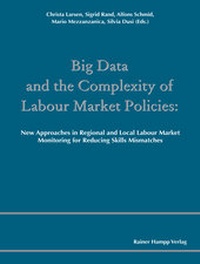
Big Data and the Complexity of Labour Market Policies
New Approaches in Regional and Local Labour Market Monitoring for Reducing Skills Mismatches
1. Auflage
Erschienen am 1. November 2015
307 Seiten
978-3-95710-145-7 (ISBN)
Beschreibung

The experience of regional and local labour market observatories shows that information on some aspects of the labour market - such as the demand for skilled labour in certain sectors or spatial units - is difficult to obtain. In the recent years, ICT-related innovations have created new forms and types of data that can be used for enhancing the efficiency in several areas of economic activity. So far, the vast amount of unstructured data contained in the World Wide Web - Big Data - has been largely unexploited. However, as the available technology provides increasingly cost-effective solutions, it has become possible to provide services that have formerly been too expensive. Therefore, applying Big Data in labour market monitoring can provide innovative insights into the functioning of labour markets. Also the process data of Public Employment Services or Statistical Offices constitute a promising source of large amounts of data. The results of the analyses based on the different sources of data can be used to improve the efficiency of the labour market at large and the provision of services by governments and private enterprises. However, the attempts to use Big Data in the context of labour market monitoring have been relatively rare so far, even though a growing interest can be observed among researchers and practitioners alike. Against this background, the issues of collecting, elaborating, analysing and disseminating the information available on the Web urgently needed to be addressed - as did the associated ethical and legal issues concerned with data ownership and protection. This year's Anthology of the EN RLMM covers these issues from the viewpoint of labour market researchers and practitioners in labour market observatories from different European regions and localities. The contributions provide first insights into new models and tools of labour market monitoring based on the usage of Big Data.
Weitere Details
Weitere Ausgaben
Andere Ausgaben
Christa Larsen | Sigrid Rand | Alfons Schmid
Big Data and the Complexity of Labour Market Policies
New Approaches in Regional and Local Labour Market Monitoring for Reducing Skills Mismatches
Buch
10/2015
1. Auflage
Edition Rainer Hampp
32,80 €
Artikel z.Zt. nicht lieferbar
Personen
Dr. Christa Larsen is a social scientist and Managing Director of the Institute for Economics, Labour and Culture (IWAK) at the Goethe-University in Frankfurt am Main. Her current work concentrates on regional labour market monitoring, regionalised analyses of labour markets for health workers, systems for information and diagnoses of labour markets and regional prognoses.
Prof. Dr. Alfons Schmid is Professor for Economics at the faculty of Social Sciences at the Goethe-University in Frankfurt am Main and scientific Director of the Institute for Economics, Labour and Culture (IWAK). His main areas of research are regional developments of employment and labour markets, regional competitiveness, regional forecasting, regional studies on poverty, wealth and attitudes towards the welfare state.
Prof. Dr. Alfons Schmid is Professor for Economics at the faculty of Social Sciences at the Goethe-University in Frankfurt am Main and scientific Director of the Institute for Economics, Labour and Culture (IWAK). His main areas of research are regional developments of employment and labour markets, regional competitiveness, regional forecasting, regional studies on poverty, wealth and attitudes towards the welfare state.
Inhalt
1 - Christa Larsen, Sigrid Rand, Alfons Schmid, Mario Mezzanzanica,Silvia Dusi (Eds.): Big Data and the Complexity of Labour Market Policies: New Approaches in Regional and Local Labour Market Monitoring for Reducing Skills Mismatches [Seite 1]
2 - FOREWORD [Seite 5]
3 - CONTENTS [Seite 7]
4 - INTRODUCTION [Seite 11]
5 - 1. BIG DATA AS A NEW DATA SOURCE FOR IMPROVED REGIONAL AND LOCAL LABOUR MARKET MONITORING [Seite 31]
5.1 - Silvia Dusi, Fabio Mercorio and Mario Mezzanzanica: Big Data Meets Web Job Vacancies: Trends, Challenges and Development Directions [Seite 31]
5.2 - Marta Salavová: Monitoring of Internet Job Vacancies in the Czech Republic [Seite 45]
5.3 - Svetlana Varlamova and Natalia Sedova: Big Data in Russian Sociology: First Steps Towards Understanding and Co-operation [Seite 57]
5.4 - Claudiu Brânda. and Ciprian Pânzaru: Analysing of the Labour Demand and Supply Using Web Mining and Data Mining [Seite 71]
5.5 - Katarzyna Antonczak-Swider and Maria Lenczuk: Examples of Applying Big Data in Labour Market Analysis:The Malopolska Region [Seite 87]
5.6 - Andrea Fasulo, Michele D'Alò and Stefano Falorsi: Predicting the Monthly Unemployment Rate with Google Trends Data: Does Google Search Data Improve the Nowcast of the Italian Labour Market?Andrea Fasulo, Michele D'Alò and Stefano Falorsi [Seite 99]
5.7 - Renato Fontana, Vera D'Antonio, Martina Ferrucci and Carmine Piscopo: The Value of Big Data in the Job Recruiting Process: New Opportunities for the Italian Labour Market? [Seite 115]
5.8 - Mattia Martini: The Use of Social Media in Human Resource Management: Evidences from a Sample of Italian Companies [Seite 139]
5.9 - Nina Oding: The Use of Big Data: Challenges and Perspectives in Russia [Seite 153]
6 - 2. BIG DATA APPROACH IN PRACTICE [Seite 165]
6.1 - Javier Ramos Salazar: Planning Vocational Training for Employment in the Basque Country Using a System of Indicators Combining Statistical Operations and Administrative Registers with Information on the Labour Market [Seite 165]
6.2 - Zeljko Rajic, Sinisa Veselinovic and Zvjezdana Jelic: Applying Big Data in Adult Education in Bosnia and Herzegovina [Seite 175]
6.3 - Marta Sosnowska: Developing Knowledge about the Labour Market in the Context of the Functioning of Big Data in Poland [Seite 193]
6.4 - Britta Lüdeke: Interactive Visualisation of Bottleneck Vacancies: Introducing a New Tool for Administrative Data Using Berlin as an Example [Seite 209]
6.5 - Andrew Dean and Sigrid Rand: Lessons for Local and Regional Skills Forecasting Arising from the Work of the European Network on Regional Labour Market Monitoring [Seite 223]
7 - 3. METHODOLOGICAL AND LEGAL CHALLENGES IN THE APPLICATION OF BIG DATA [Seite 235]
7.1 - Harry Piepers: Using Big Data from Multiple Sources in the Social Domain [Seite 235]
7.2 - Andreas Mångs: The PES Job Portal as a Labour Demand Indicator [Seite 247]
7.3 - Moreno Baruffini: Assessing Data Collection and Data Quality for Labour Market Monitoring [Seite 255]
8 - 4. INTERNATIONAL PERSPECTIVE ON THE APPLICATION OF BIG DATA IN REGIONAL AND LOCAL LABOUR MARKET MONITORING [Seite 275]
8.1 - Marco Ricceri: The United Nations and Big Data in the Strategy for Global Sustainable Development [Seite 275]
9 - INFORMATION ON AUTHORS [Seite 291]
2 - FOREWORD [Seite 5]
3 - CONTENTS [Seite 7]
4 - INTRODUCTION [Seite 11]
5 - 1. BIG DATA AS A NEW DATA SOURCE FOR IMPROVED REGIONAL AND LOCAL LABOUR MARKET MONITORING [Seite 31]
5.1 - Silvia Dusi, Fabio Mercorio and Mario Mezzanzanica: Big Data Meets Web Job Vacancies: Trends, Challenges and Development Directions [Seite 31]
5.2 - Marta Salavová: Monitoring of Internet Job Vacancies in the Czech Republic [Seite 45]
5.3 - Svetlana Varlamova and Natalia Sedova: Big Data in Russian Sociology: First Steps Towards Understanding and Co-operation [Seite 57]
5.4 - Claudiu Brânda. and Ciprian Pânzaru: Analysing of the Labour Demand and Supply Using Web Mining and Data Mining [Seite 71]
5.5 - Katarzyna Antonczak-Swider and Maria Lenczuk: Examples of Applying Big Data in Labour Market Analysis:The Malopolska Region [Seite 87]
5.6 - Andrea Fasulo, Michele D'Alò and Stefano Falorsi: Predicting the Monthly Unemployment Rate with Google Trends Data: Does Google Search Data Improve the Nowcast of the Italian Labour Market?Andrea Fasulo, Michele D'Alò and Stefano Falorsi [Seite 99]
5.7 - Renato Fontana, Vera D'Antonio, Martina Ferrucci and Carmine Piscopo: The Value of Big Data in the Job Recruiting Process: New Opportunities for the Italian Labour Market? [Seite 115]
5.8 - Mattia Martini: The Use of Social Media in Human Resource Management: Evidences from a Sample of Italian Companies [Seite 139]
5.9 - Nina Oding: The Use of Big Data: Challenges and Perspectives in Russia [Seite 153]
6 - 2. BIG DATA APPROACH IN PRACTICE [Seite 165]
6.1 - Javier Ramos Salazar: Planning Vocational Training for Employment in the Basque Country Using a System of Indicators Combining Statistical Operations and Administrative Registers with Information on the Labour Market [Seite 165]
6.2 - Zeljko Rajic, Sinisa Veselinovic and Zvjezdana Jelic: Applying Big Data in Adult Education in Bosnia and Herzegovina [Seite 175]
6.3 - Marta Sosnowska: Developing Knowledge about the Labour Market in the Context of the Functioning of Big Data in Poland [Seite 193]
6.4 - Britta Lüdeke: Interactive Visualisation of Bottleneck Vacancies: Introducing a New Tool for Administrative Data Using Berlin as an Example [Seite 209]
6.5 - Andrew Dean and Sigrid Rand: Lessons for Local and Regional Skills Forecasting Arising from the Work of the European Network on Regional Labour Market Monitoring [Seite 223]
7 - 3. METHODOLOGICAL AND LEGAL CHALLENGES IN THE APPLICATION OF BIG DATA [Seite 235]
7.1 - Harry Piepers: Using Big Data from Multiple Sources in the Social Domain [Seite 235]
7.2 - Andreas Mångs: The PES Job Portal as a Labour Demand Indicator [Seite 247]
7.3 - Moreno Baruffini: Assessing Data Collection and Data Quality for Labour Market Monitoring [Seite 255]
8 - 4. INTERNATIONAL PERSPECTIVE ON THE APPLICATION OF BIG DATA IN REGIONAL AND LOCAL LABOUR MARKET MONITORING [Seite 275]
8.1 - Marco Ricceri: The United Nations and Big Data in the Strategy for Global Sustainable Development [Seite 275]
9 - INFORMATION ON AUTHORS [Seite 291]
