

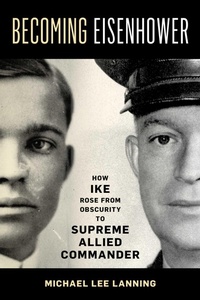
Becoming Eisenhower
How Ike Rose from Obscurity to Supreme Allied Commander
Erschienen am 15. Oktober 2024
288 Seiten
978-0-8117-7388-1 (ISBN)
Beschreibung
When Dwight Eisenhower graduated from West Point in 1915, few would have predicted he was destined for greatness. A middling student, he was denied his first choice of posting, missed overseas service in World War I, spent a dozen years as a major, and never commanded a unit larger than a battalion. Yet the young officer made the most of the opportunities he was given, made a lasting impression on superiors including George Marshall, and eventually gained a reputation as an excellent staff officer with a knack for administration, loyalty, and "getting along." Eisenhower was promoted to colonel in March 1941 and, sixteen months later, was a lieutenant general in command of the European Theater of Operations. His rise through the ranks was first painfully slow, then meteoric. It is one of the great, and most important, stories in military history, and Michael Lee Lanning tells it vividly, with an eye for the dramatic turning points in Eisenhower's rise.
The West Point class of 1915 was "the class the stars fell on." Fifty-nine graduates became generals during World War II, but none of that was clear at the time, especially not for the young Dwight Eisenhower, who graduated 61st in a class of 164. He failed to make the baseball team, but made the football team, only to see an injury end his playing career, and was known as a card player and prankster. Denied his request for service in the Philippines, Eisenhower was sent to Texas, where he spent a good bit of his time coaching football. Later denied his request to fight in France, he spent World War I training a tank unit near Gettysburg.
During the 1920s into the early 1930s-lean years for the army during which promotions came slowly and many officers quit the service-Eisenhower started to catch the eye of superiors and earned positions under the U.S. Army's leading lights, including Fox Conner, John Pershing, and Douglas MacArthur, whom he served under during pivotal years in the 1930s, from the Bonus March to the Philippines.
By the late 1930s, as war broke out in Europe, Eisenhower's star was on the rise. After serving in a series of staff positions-regimental executive officer, then corps and army chief of staff-Eisenhower joined the General Staff in Washington, DC, where he helped develop war plans and eventually became deputy chief of staff under George Marshall. When the time came to appoint a commander to execute the plans, Eisenhower recommended another officer, but Marshall knew Eisenhower was the man for the job.
Becoming Eisenhower is the story of a young man who first pursued the army for its free education but ultimately found his calling as an officer, the story of an officer who was initially overlooked but was motivated by this frustration to make himself the army's indispensable man, the story of how General Eisenhower carried these experiences not only into Supreme Command but also the presidency. This book will be essential reading for World War II buffs, people interested in American presidents, and readers looking for the leadership lessons of history.
The West Point class of 1915 was "the class the stars fell on." Fifty-nine graduates became generals during World War II, but none of that was clear at the time, especially not for the young Dwight Eisenhower, who graduated 61st in a class of 164. He failed to make the baseball team, but made the football team, only to see an injury end his playing career, and was known as a card player and prankster. Denied his request for service in the Philippines, Eisenhower was sent to Texas, where he spent a good bit of his time coaching football. Later denied his request to fight in France, he spent World War I training a tank unit near Gettysburg.
During the 1920s into the early 1930s-lean years for the army during which promotions came slowly and many officers quit the service-Eisenhower started to catch the eye of superiors and earned positions under the U.S. Army's leading lights, including Fox Conner, John Pershing, and Douglas MacArthur, whom he served under during pivotal years in the 1930s, from the Bonus March to the Philippines.
By the late 1930s, as war broke out in Europe, Eisenhower's star was on the rise. After serving in a series of staff positions-regimental executive officer, then corps and army chief of staff-Eisenhower joined the General Staff in Washington, DC, where he helped develop war plans and eventually became deputy chief of staff under George Marshall. When the time came to appoint a commander to execute the plans, Eisenhower recommended another officer, but Marshall knew Eisenhower was the man for the job.
Becoming Eisenhower is the story of a young man who first pursued the army for its free education but ultimately found his calling as an officer, the story of an officer who was initially overlooked but was motivated by this frustration to make himself the army's indispensable man, the story of how General Eisenhower carried these experiences not only into Supreme Command but also the presidency. This book will be essential reading for World War II buffs, people interested in American presidents, and readers looking for the leadership lessons of history.
Weitere Details
Sprache
Englisch
Verlagsort
PA
USA
Illustrationen
20 BW Photos
Dateigröße
5,60 MB
ISBN-13
978-0-8117-7388-1 (9780811773881)
Copyright in bibliographic data and cover images is held by Nielsen Book Services Limited or by the publishers or by their respective licensors: all rights reserved.
Schweitzer Klassifikation
Weitere Ausgaben
Person
Michael Lee Lanning served more than twenty years in the U.S. Army, where he commanded an infantry platoon, a recon platoon, and a rifle company in Vietnam and went on to serve as public-affairs officer for Norman Schwarzkopf. He has appeared on NPR, CBS, and the History Channel and has written more than twenty-five books. His previous books include the classic Vietnam, 1969-1970: A Company Commander's Journal, which the New York Times called "one of the most honest and horrifying accounts of a combat soldier's life to come out of the Vietnam War." His other books include Tours of Duty: Vietnam War Stories, Inside Force Recon: Recon Marines in Vietnam, The Court-Martial of Jackie Robinson, The Blister Club, and Patton in Mexico. Lanning lives in Lampasas, Texas.
Inhalt
- Cover
- Contents
- Introduction
- Detours to Greatness
- "Iron Cutters" to Abilene
- West Point
- Fort Sam Houston, Texas
- The Great War
- Camp Dix, Fort Benning, and across the Country
- Fort Meade and George Patton
- Panama and Fox Conner
- Command and General Staff School
- Fort Benning, Washington, and the American Battle Monuments Commission
- Paris and General Pershing
- War Department and General MacArthur
- Philippines and General MacArthur
- San Francisco, Fort Lewis, and San Antonio
- War Department and General Marshall
- War and Postwar Eisenhower
- Epilogue
- Appendix A
- Appendix B
- Appendix C
- Sources
- Index
- About the Author
